First Permanent Capital and City of Vitality

Without a doubt, the cities I am referring to are Nara (奈良市) and Osaka (大阪) respectively. Nara, formerly known as Heijo (平城), was Japan’s first permanent capital, established in 710. Due to its historic status, Nara is replete with historic treasures and cultural significance. It is also home to some of Japan’s oldest and largest temples. Unfortunately, given its close proximity to two more popular tourist cities (approximately one hour by train from Kyoto and Osaka), little attention has been paid to Nara as a result. More often than not, it is just a by-the-way side trip people make before/after Kyoto or Osaka. Nara does have a lot offer, especially shrines and temples. Just need to give it the due attention it deserves, I reckon.
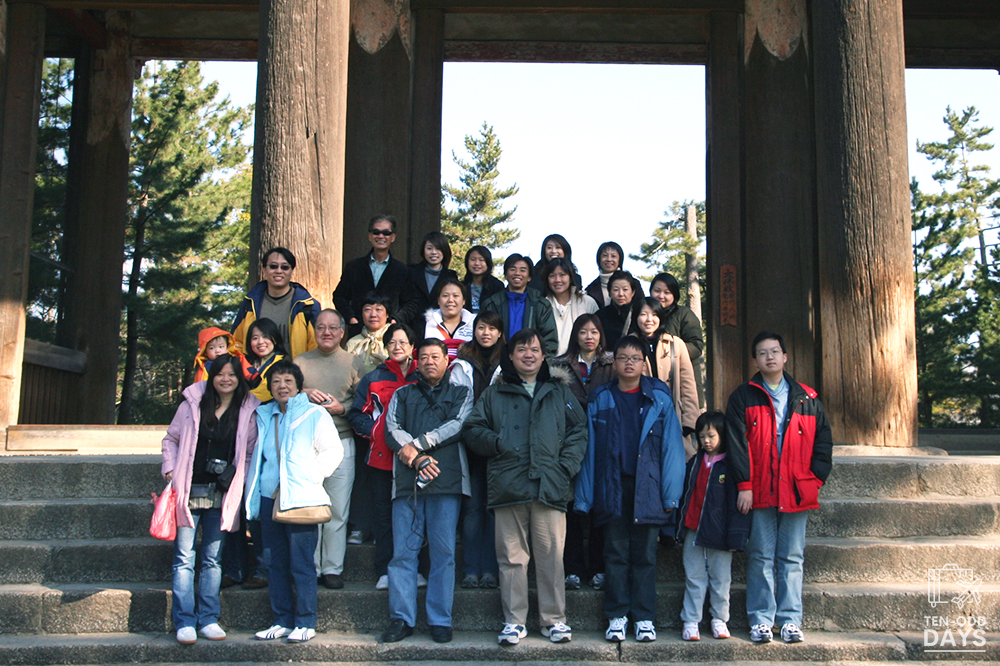
Nara Park Group Pic

Here’s the whole lot of us taking a group photograph in front of the Nandaimon Gate (南大門) leading to Todaiji Temple (東大寺), one of the most historically significant temples in Japan. The gate, reconstructed in 1199 after a burndown in 1180, is in itself a rather impressive monument, not to mention humongous. There are apparently two statues by the side of the gate, guarding the temple (and since the gate is the gateway to the temple, it kind of makes sense) but since nobody explained that to us and we didn’t do any prior read-up, we didn’t really notice the statues. Oh well… part of the problem with guided tours is this reliance leading to false impressions that one will learn everything from the tour leader/guide.
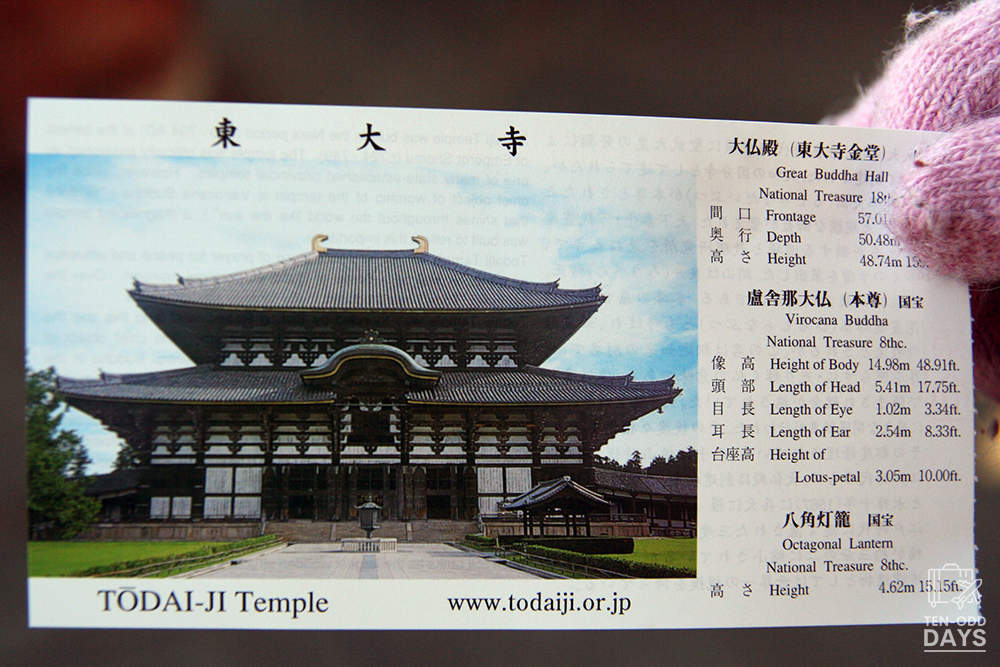
Todaiji Tic
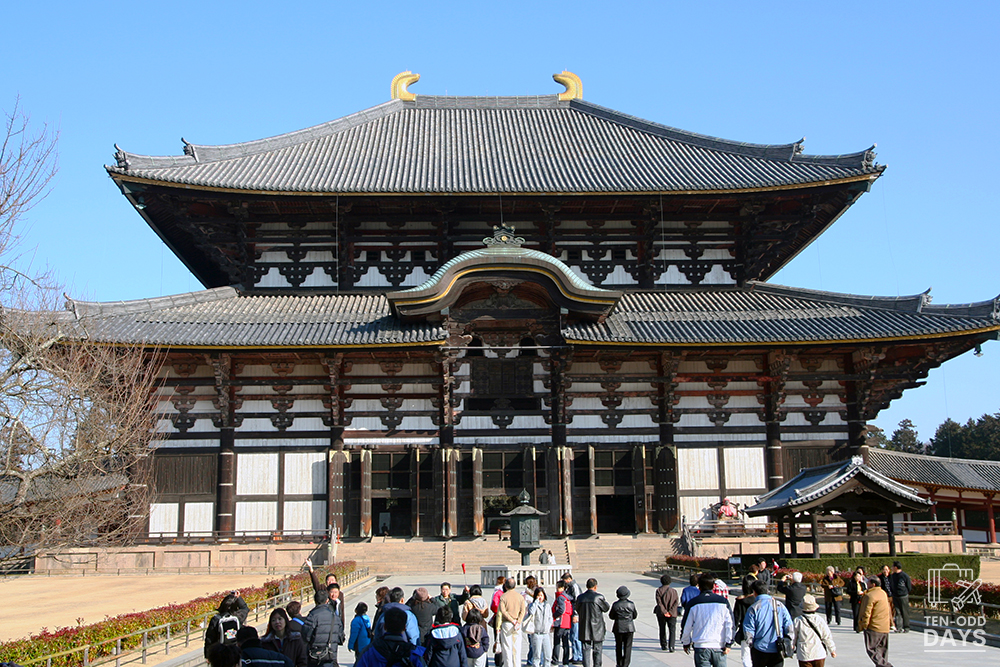
Todaiji

And then the Eastern Great Temple (Todaiji Temple) came into sight as we crossed the Nandaimon Gate. On a rather non-related note… may I just comment on how much I just love all the entrance tickets we’d received on the trip? Interesting, and very pretty. Shows that the Japanese take pride even in the smallest details.

One of the reasons why Todaiji Temple is as famous as it is lies in the the word’s largest bronze statue of the Virocana Buddha (大仏) in the main hall, measuring almost 15 metres in height. It was rumoured that this project nearly crippled Japan’s economy at that time due to the massive demand of so much bronze for the statue. While I do have some pictures of the statue, I find them non-impressive in general (and thus does no justice to the real thing) so there is no intention to post any of it up here.
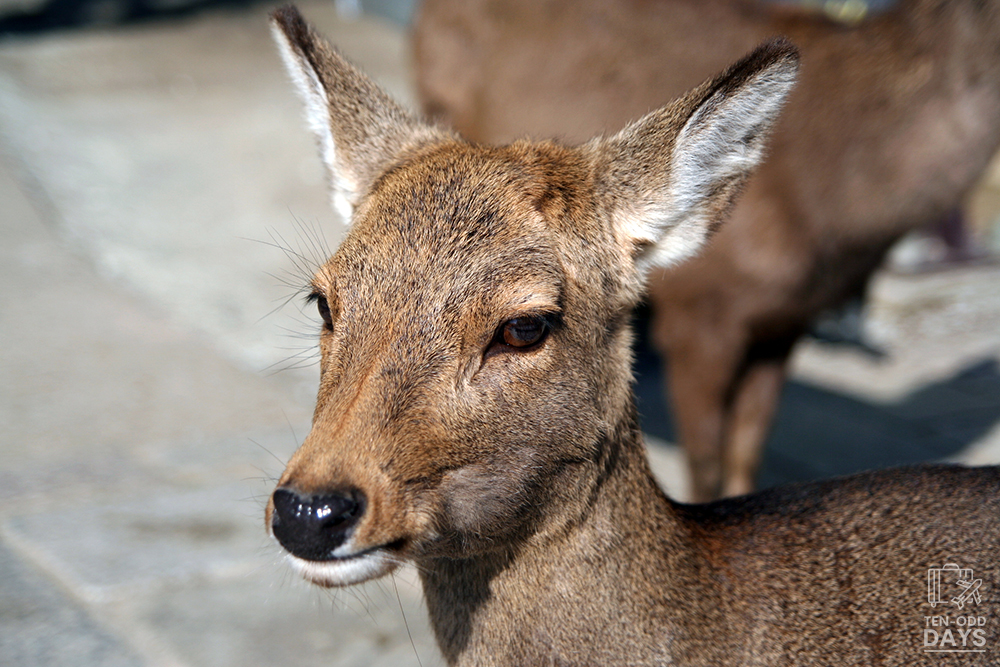
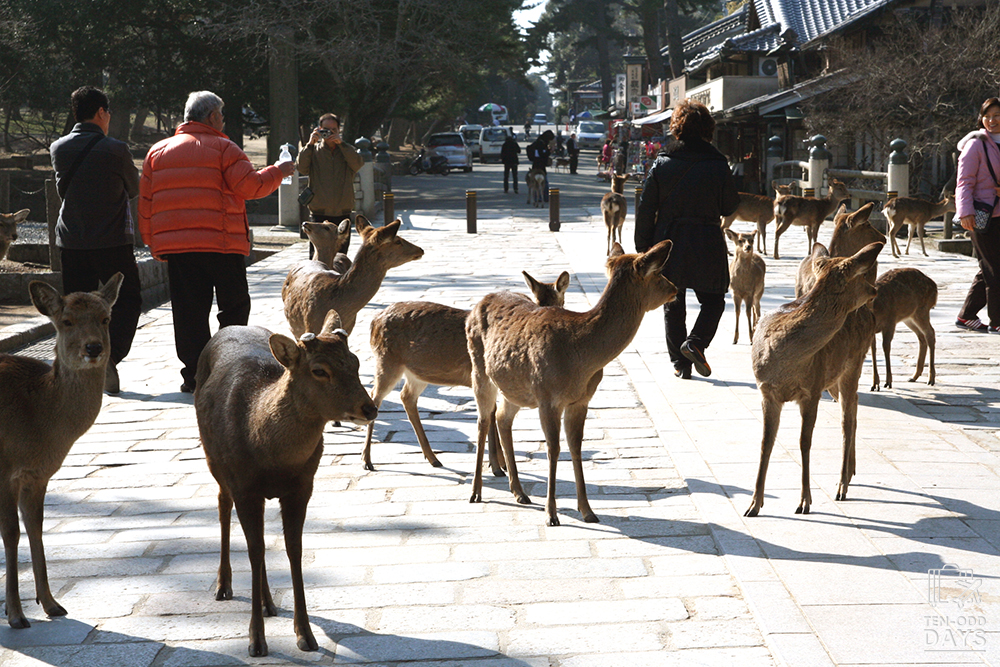
Nara Deers I
Nara Deers II

Sika deer from the nearby Nara Park wandered freely around the park compound. They are mostly tame but love congregating around new visitors to the park in hope of getting fed shika senbei (鹿煎餅). We didn’t purchase the deer crackers because although I found the deer adorable, they also frightened me senseless. I cannot explain why, because some of them are so small they are comparable in size to the golden retrievers we have at home. Perhaps that’s the reason why – my furkids go absolutely bonkers when I feed them, and they are domesticated. The behaviour of the deer would understandably be even more unpredictable. This was why, adorable as they are, I refused to feed them those special crackers.

Not that they were going hungry from my lack of participation in the random feeding. Most other visitors to the park were brave enough to partake in this touristy activity, and the deer population couldn’t be happier. I wanted to stay as far away as possible, just putting enough distance for me to take some pretty shots of them.

Next on, to Osaka the well-known City of Vitality. And we had a lot of ground to cover in the little time we had there it was crazy.
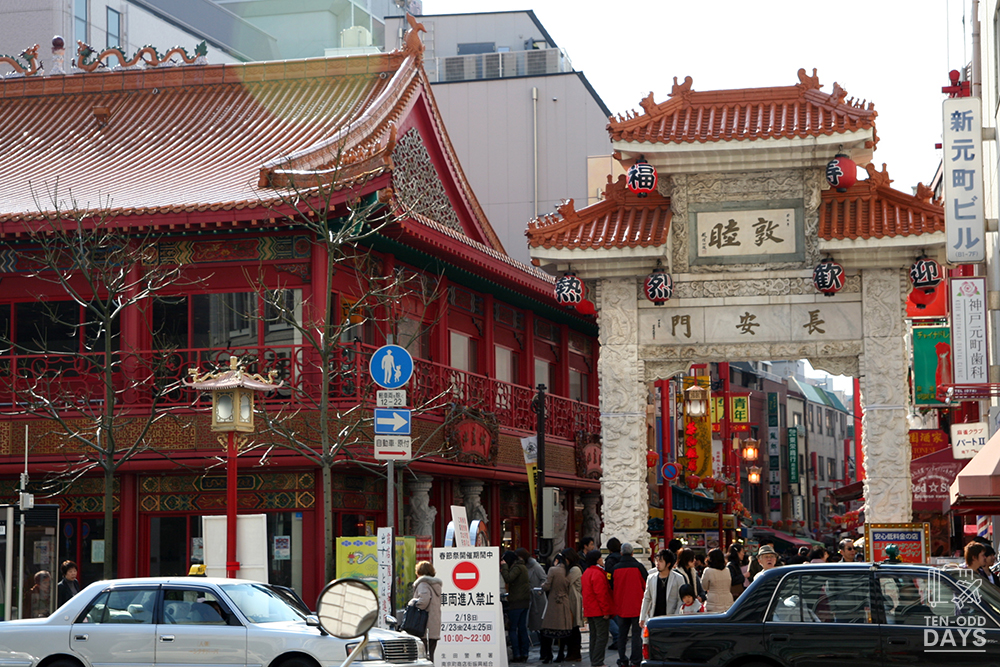
Chinatown Osaka

There’s just this thing about guided tours and chinatowns. I have no idea why they always assume that Chinese tourists like to see the Chinatown. Same question as to why they like to serve us Chinese cuisine whenever they could. To please the older generation of travellers I guess, because the mum wanted Chinese cuisine almost every other meal. I know I mentioned that I do like visiting overseas chinatowns in general, however they are hardly the first or only thing I want to see of a new city I go to. Especially not when Osaka has so many places to see and do, quite unlike Yokohama. But oh well, we needed to settle our own lunch and the tour agency must have figured that we would love to have some Chinese food in the Chinatown. Thing is, never expect food in overseas chinatowns to ever taste authentic, or the way you expect it to taste like. Why? This is not because they are incapable of replicating the food but rather that they would have had to tweak little changes to the taste to appeal to the palate of the locals i.e. the Japanese in this case. Same reason why I found the Chinese food in Everett, Washington so incredibly sweet. But I digressed.
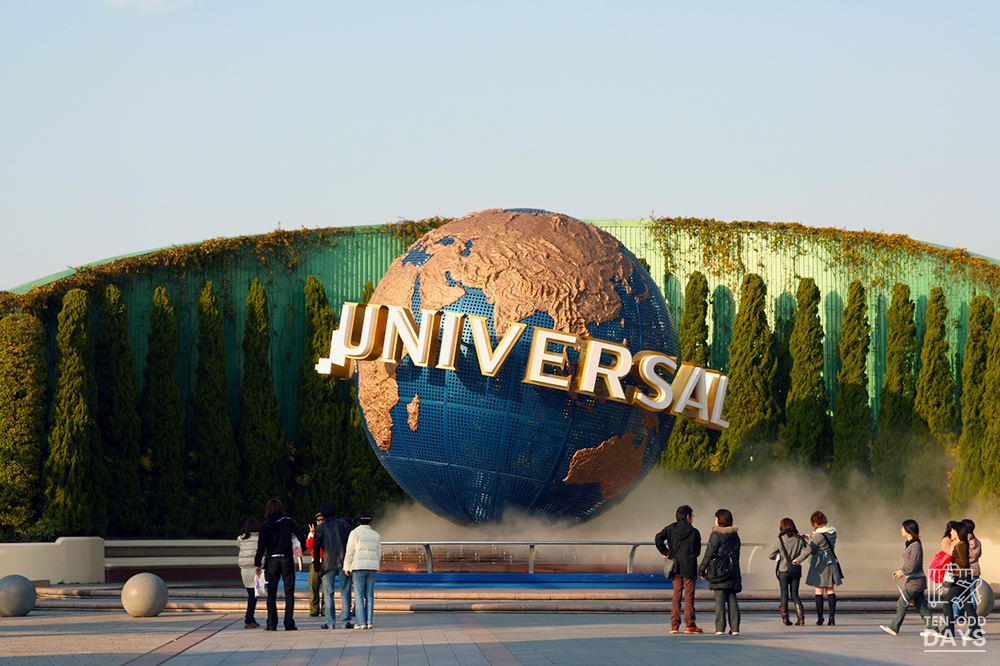
USJ Globe

And then we dropped by Universal Studios Japan. Entrance tickets weren’t covered in the costs of the tour so some people opted to pay out of their own pockets to spend like, 1-2 hours in the park. The mum, little sis and I discussed over this and decided we didn’t want spend our time in yet another amusement park. Instead we opted to go shopping at a large shopping mall nearby. Can’t tell if we made the right choice or not but we were jolly happy doing some shopping whilst our tour mates complained of long queues in the park and how they ended up just browsing the merchandise stores. Don’t think we missed much eh? I would much prefer having a full day to explore the park properly instead.
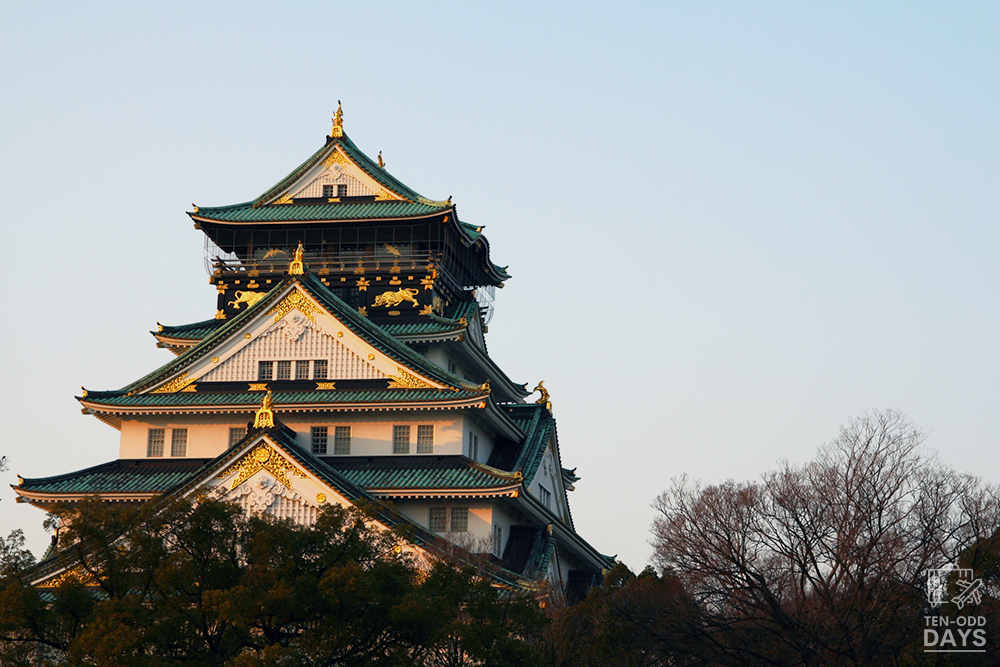
Osakajo

And our visit to Osaka would not be complete without a cursory visit to Osaka Castle (大阪城). Because the group made a consensual decision to spend more time at Universal Studios, we had less time at Osaka Castle as a consequence. It was near closing hour when we arrived, resulting in a mad rush to introduce us to this gorgeous castle. Quite a bit of drama behind this symbol of Osaka today but this is no place to discuss it. Interesting history nevertheless. And may I repeat again… gorgeous castle. Wished we had time to explore the interior including a visit to the museum.
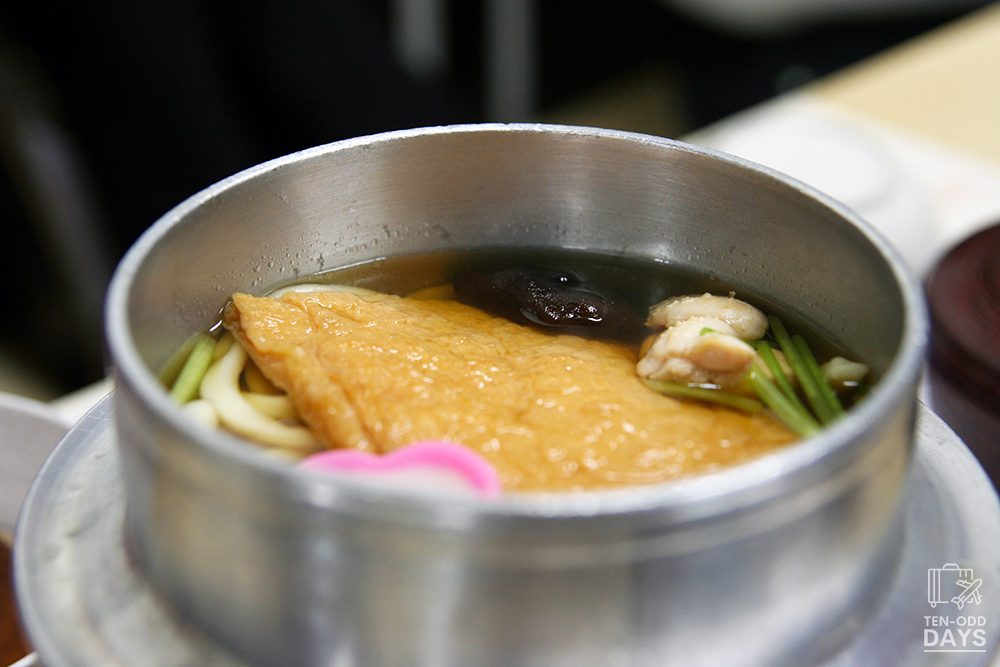
Dinner at Osakajo

Good thing the castle park doesn’t close, or if it does, not so early anyway. So we had a chance to walk around, enjoy the scenery and take more pictures of the castle. And then we had a simple dinner at an eatery in the park itself. Simple, yet delectable udon.
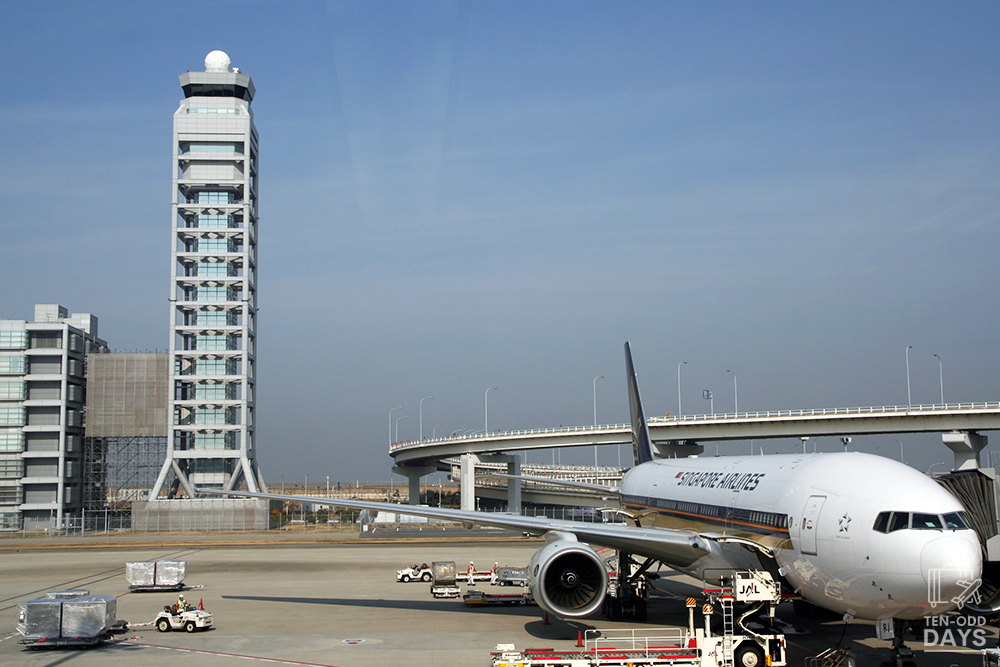
Osaka Kansai Airport

Finally it was time to head home. Kansai International Airport has an interesting control tower. Which I must take picture of, considering how a Singapore Airlines aircraft was also parked nearby. Picture perfect opportunity. And a great way to sum up a great trip. We didn’t learn very much of all the places we visited, but we sure saw a lot. It was also a good 7-day of bonding with the mum and the little sis. Truth is, I haven’t had much time for them ever since moving out after marriage so I cherish what little time I get to spend with them.
Kyoto and Its Rich Cultural Heritage

And Kyoto, the old Imperial Capital of Japan, was up next. Resources (from books to reviews from friends) reveal that Kyoto is one of the most, if not the most beautiful city in Japan because of its rich cultural heritage. They were not in any way speaking in jest. Kyoto, or what little I saw of it, is indeed an exceedingly beautiful city!

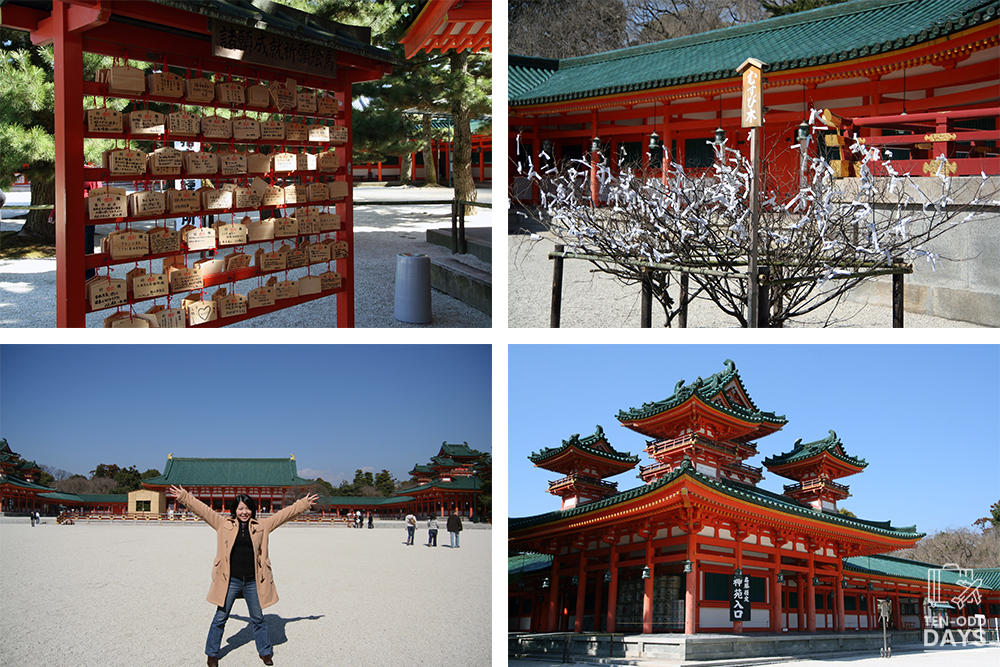
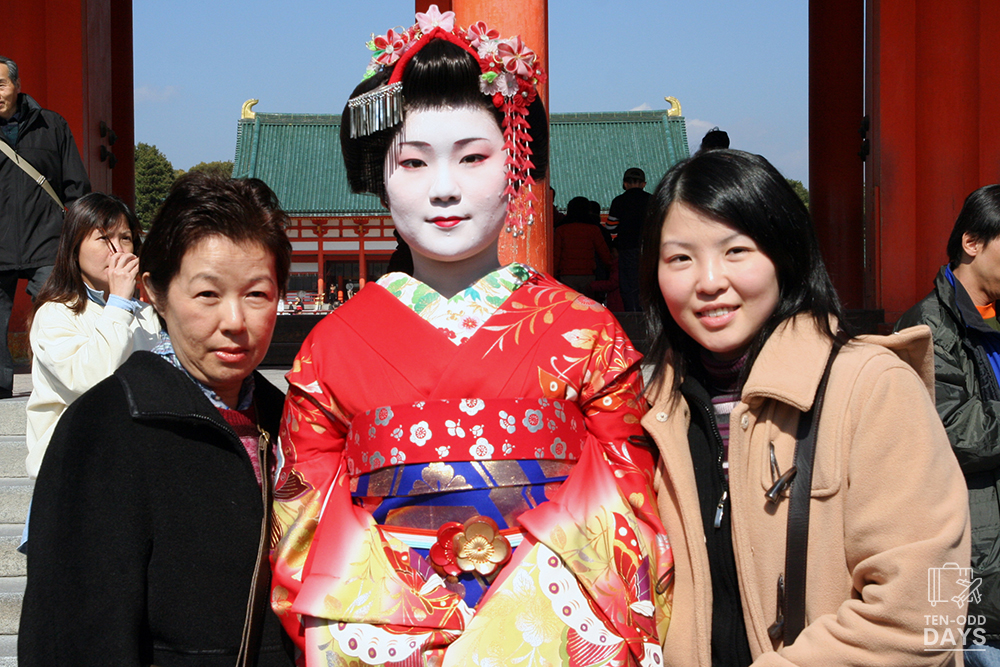
Starting the day off, the services of a maiko (geisha trainee) was sought in that she accompanied us to Heian Shrine (平安神宮), an Imperial Shinto Shrine for some unique photo-taking moments. I will readily admit that, like most other people, I know very little about the sui generis geisha culture beyond their glaringly obvious white makeup. Apparently this ‘escort service’ is a booming business for the geisha in Kyoto. Ensuring that the culture doesn’t die out completely, I guess. And it’s working. It’s just that I don’t envy them one single bit. There is no other way to put it across gently but they reminded me of… animals on exhibit in the zoo. Everyone jostled to take pictures with her, otherwise looked on curiously by the sidelines. I felt bad for her.

With Maiko
Heian Jingu I

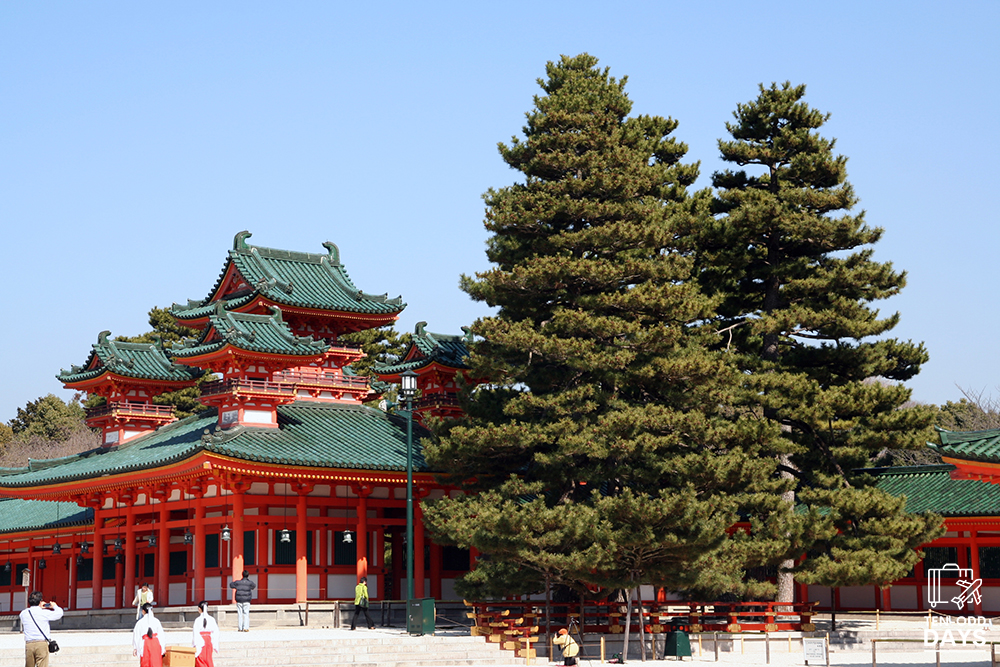
Looked beyond that and I started enjoying the beauty of Heian Shrine. Architecturally, it was an intricately alluring shrine with an expansive courtyard space. Couple that scene with a beautiful day and my favourite clear blue sky resulted in some of the most picturesque photographs taken on the trip.

Heian Jingu II

Heian Shrine deifies both the founder and the last Emperor of the Heian Capital. Though not nearly half as famous or popular as Kiyomizu-dera (音羽山 清水寺), this shrine too serves as a major tourist attraction for domestic and foreign visitors alike. And as typical of Shinto shrines, devotees could write their wishes or prayers on Ema (絵馬) and hang them at designated racks. They could also receive random fortune lots (御御籤) by contributing a small token amount. All is well if the prediction turned out good. What if it were bad? According to Wikipedia, ‘when the prediction is bad, it is a custom to fold up the strip of paper and attach it to a pine tree or a wall of metal wires alongside other bad fortunes in the temple or shrine grounds. A purported reason for this custom is a pun on the word for pine tree (松 matsu) and the verb ‘to wait’ (待つ matsu), the idea being that the bad luck will wait by the tree rather than attach itself to the bearer.‘ The poor tree…

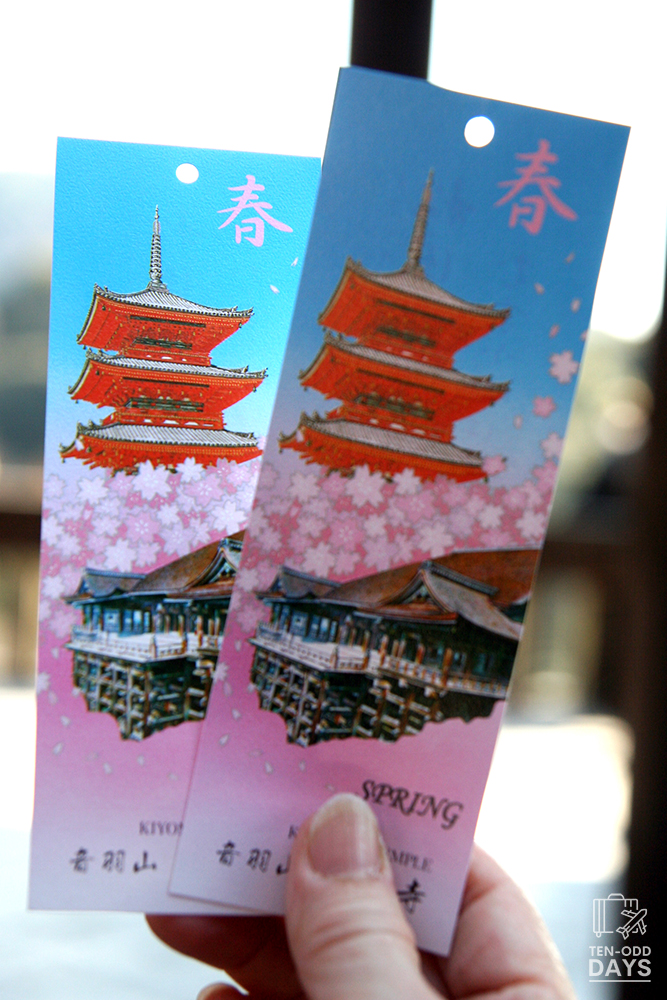
Kiyomizudera Tics
Kiyomizudera I

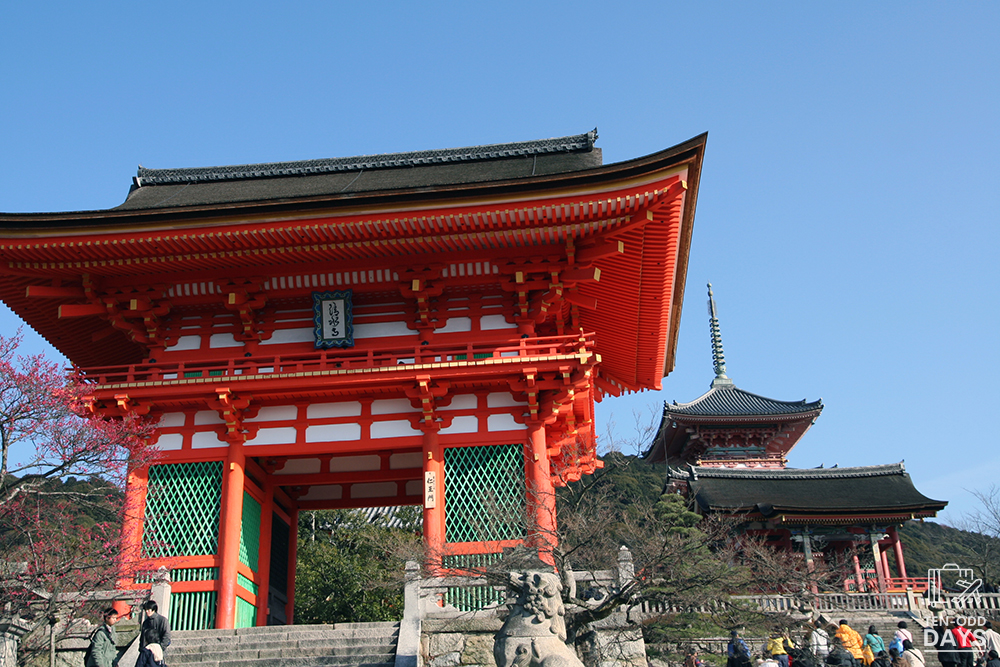
A visit to Koyto is not complete unless one makes a trip to Kiyomizu-dera, arguably one of the most famous symbols of Kyoto. This historic Buddhist temple located halfway up the Otawa Mountain was established way back in 778. The temple was burned down several times in history, according to the temple’s website. Exactly which part and which building, I’m not sure. Even if we take into consideration the newest part of the temple (which was rebuilt latest in 1633), that still makes it over 300 years old. Based on the what I saw of the temple, I say they are doing an extremely good job out of maintaining this UNESCO World Cultural Heritage Site.

Kiyomizudera II

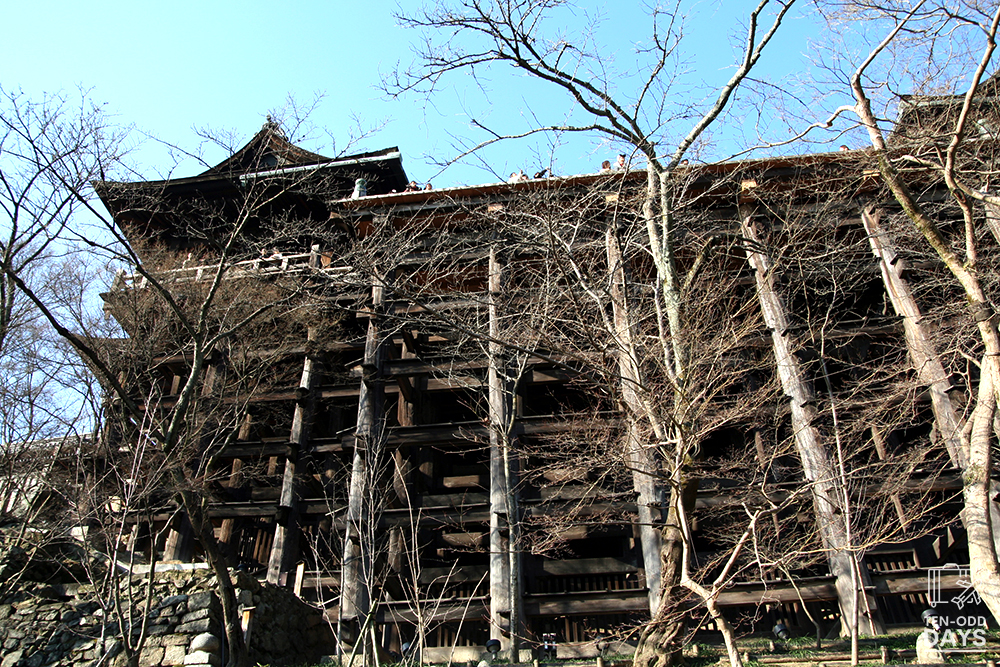
There are two famous places within the temple – the Main Hall and the Kiyomizu Stage. Personally I try not to take pictures of the interior at places of worship because I find it disrespectful on so many counts. I do break this rule once in a while when I find the interior so overwhelmingly beautiful I have to take a picture to remember it by but in general, yup… that’s a principle I live by. And so, I do not have pictures of the famous Eleven Headed and Thousand Armed Kannon Bodhisattva. Furthermore the picture I have of the Kiyomizu Stage is of an uncommon angle, I would say. Most photographers shoot it from above (you will have more than enough examples to peruse if you google) but for some strange reason, I shot it from below. Blame it on my fascination with buildings and structures – I have to say that the Kiyomizu Stage, which is the verandah of the main hall built over a precipice, was intriguing. I stared at it for a very long time trying to figure out the construction method. No nails at all, that bit I deduced. Fascinating. The mum had to drag me away after some time because we had other places to go to. 😆

Higashiyama Street

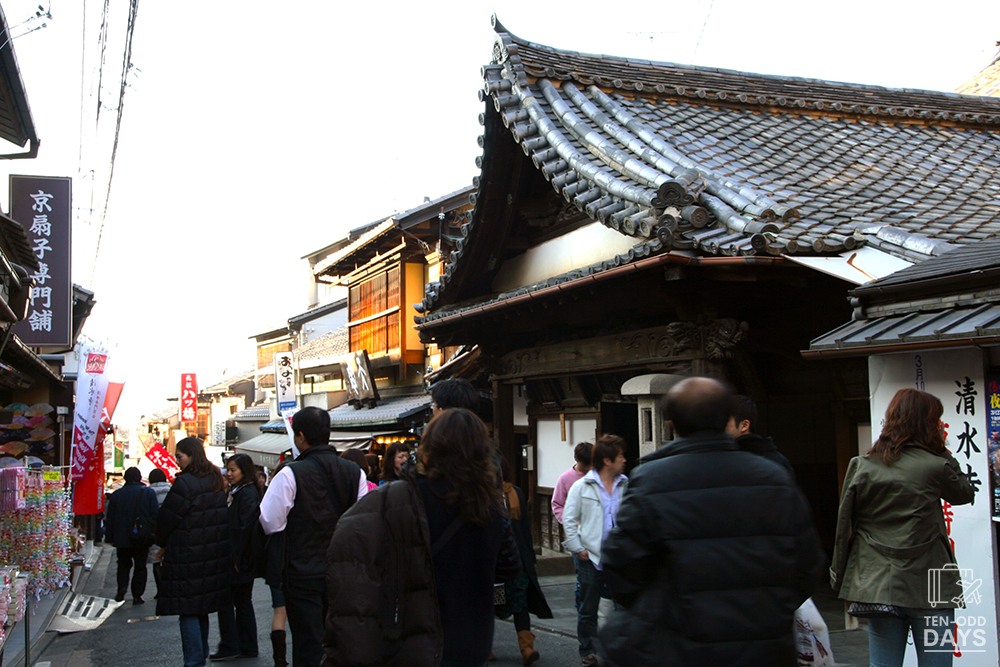
And then it was time for shopping! Not quite the usual type of shopping that other women love. The women in my family like tidbits and knickknacks, and Higashiyama District has everything to offer in this respect. The district is in total just about two kilometres long but we sure took a long time to clear this short distance.

Higashiyama Collage

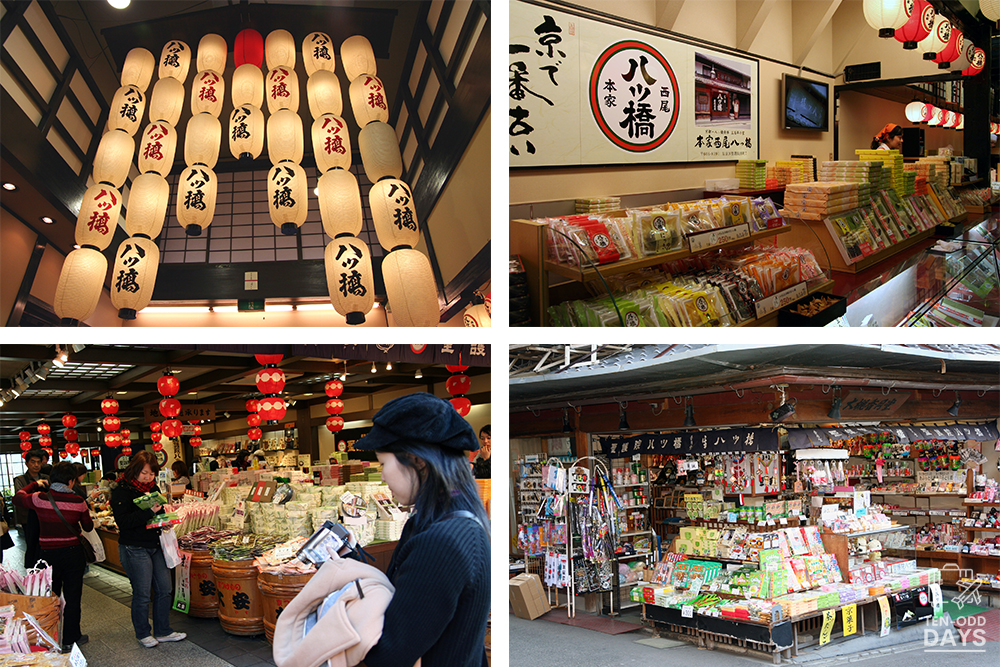
We shopped for Omiyage (お土産), stopped every few steps to look at the food offerings, and ended up eating a lot including waffles and ice-cream. A perfect wrap to our overview of beautiful Kyoto.

(In actuality, this post was written in Apr 2013, 6 years after the trip. In this duration, I have revisited Japan several times, on an average of once every year, but I never did once revisit Kyoto. It is in the pipeline but just not yet. Reliving the memories from this particular trip makes me want move the plan ahead to revist and explore Kyoto in further detail. This is a city that has so much to offer.)

In Search of The Elusive Fuji-San

After a quiet and peaceful night sleeping at an Onsen Ryokan in Hakone (箱根), we left early the next morning in search of the elusive Fuji-san (富士山), otherwise more commonly known as Mount Fuji. The plan was to have the coach bring us up to the Kawaguchiko (河口湖) 5th Station for a closer view of the active stratovolcano, also the highest mountain in Japan. And if luck would have it, we might even get to walk a bit of the Yoshida Trail. Our tour leader did however pre-empt us that the trail might be closed considering that winter just passed and it might still be unsafe for trekking up the mountain.

Swan Boat

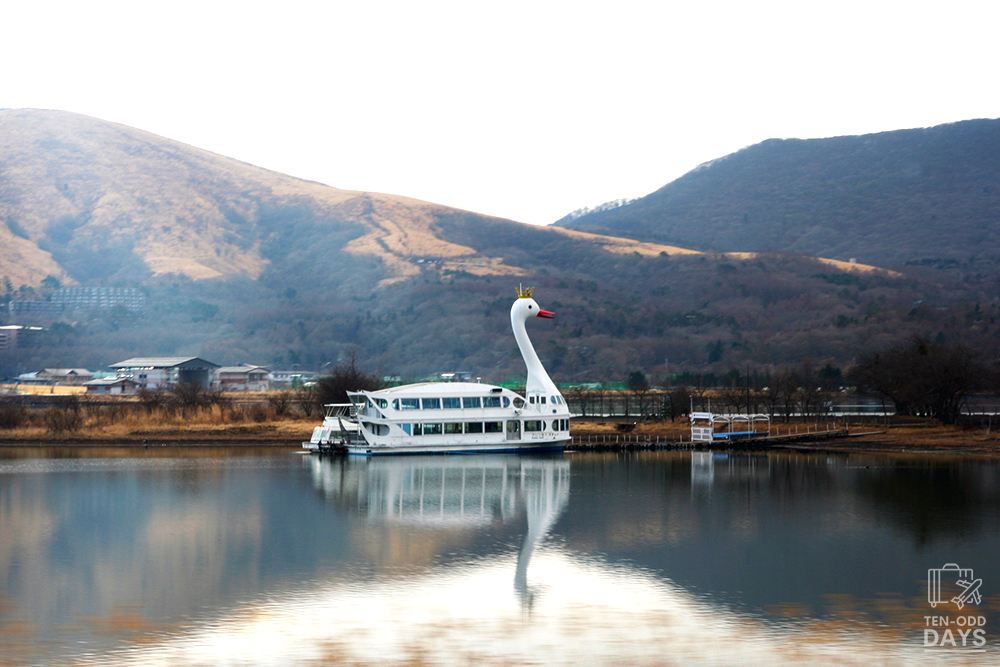
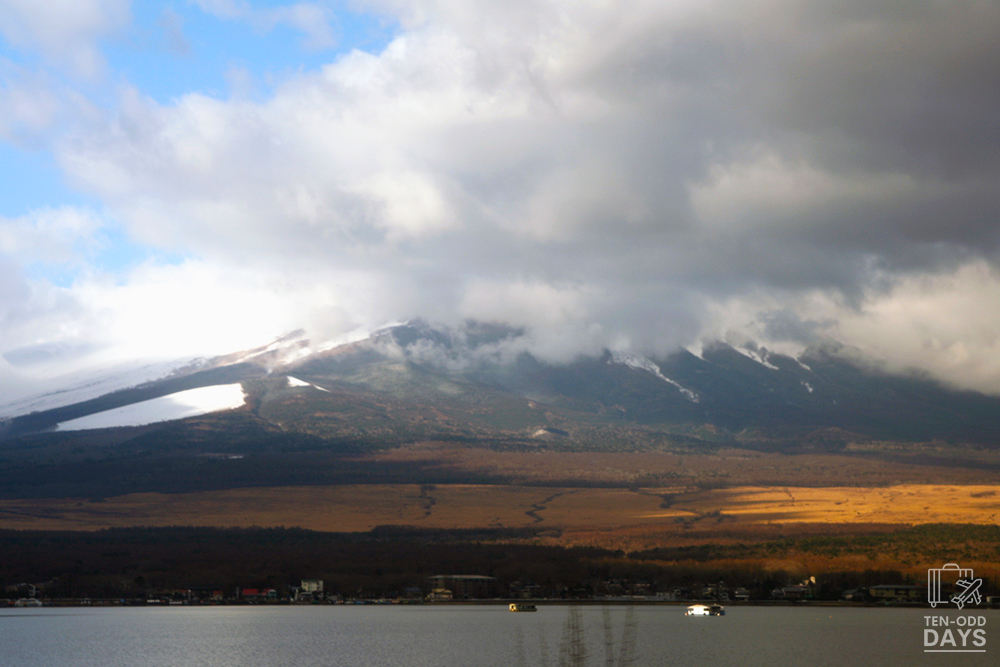
To get to the Kawaguchiko 5th Station, we passed by Lake Yamanaka (山中湖) and came across one of the legendary Swan-shaped pleasure boats. It was an overcast, otherwise good day with great weather. In other words, nightmarish conditions for me, the amateurish DSLR photographer.

Of the Fuji Five Lakes (富士五湖), Lake Yamanaka is the largest. And on a clear, cloudless day it offers a splendid view of magnificent Fuji-san. Except that it was a cloudful day when we visited. Not one to be daunted by a tiny, little failure I tried shooting Fuji-san again and again that day whenever I chanced upon her. Which was very often, of course, since we were after all in Hakone.

Fujisan I

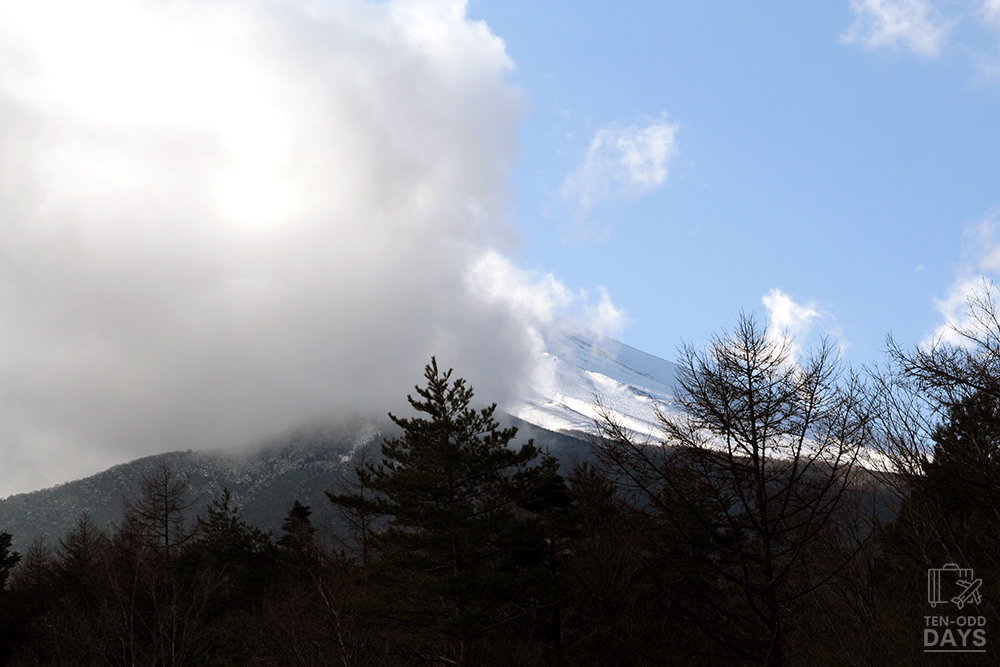
Take #1 was taken on the moving coach while we were in the vicinity of Lake Yamanaka. No chance of gazing upon the full beauty of Fuji-san because the summit was completely enveloped by clouds. Never mind though: the day was still young and I should have plentiful opportunities to shoot her again, hopefully in better weather conditions.

Fujisan II

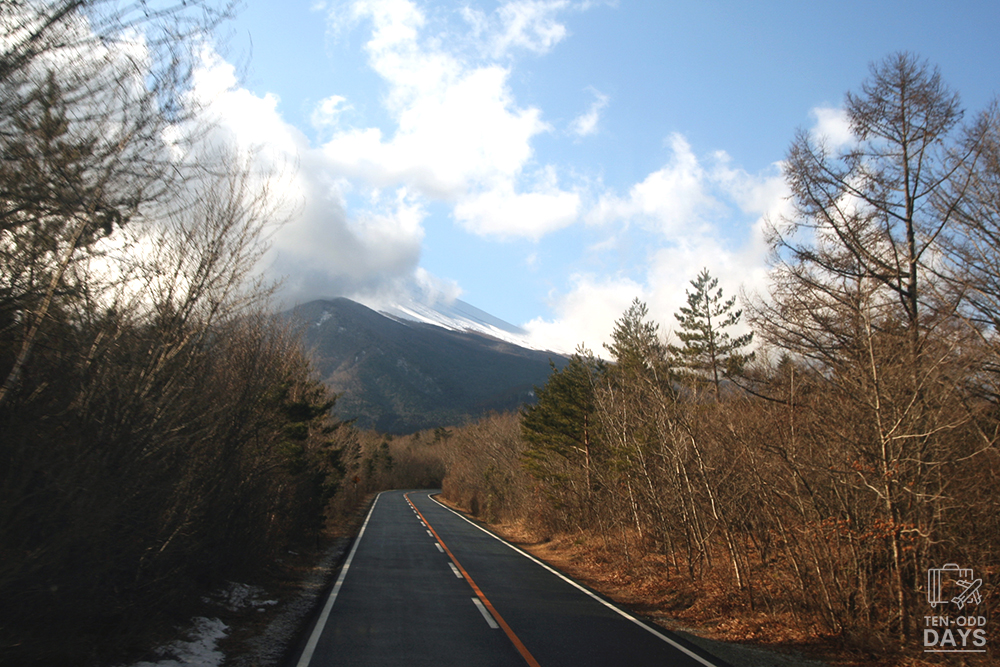
Take #2 was taken on the moving coach again, when we were nearing Kawaguchiko 5th Station. Risked getting lectured by walking to the front of the coach for this shot. But I think it was worth it. Probably the  best shot I had of Fuji-san. The summit was still partially hidden. However there was just a tinge of it peeking through the clouds.

Fujisan III

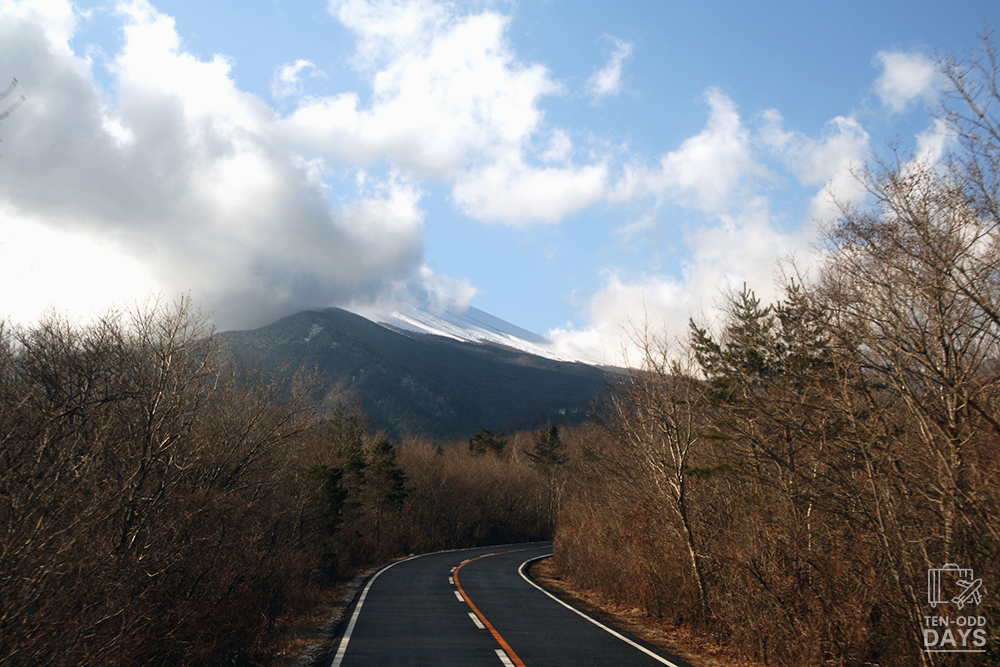
Take #3 was taken a few metres down from the previous shot. A closer shot but basically the conditions didn’t change. I was hopeful that we might see the summit as we ascended slowly to Kawaguchiko 5th Station.

Fujisan IV

But alas, Take #4 taken at Kawaguchiko 5th Station featured the same patch of clouds in the way of us and the summit. She was so near, yet so far. Well at least she lives up to her reputation of being elusive and out of reach. She is consistent in this way. 😆

There was no one else about, and absolutely nothing to do at Kawaguchiko 5th Station. We stopped and alighted the coach for some photo-taking but 1) it was cold being at higher altitude (2,300 m, to be precise) that had many of our tour mates went running to the coach in less than 10 minutes and 2) there were only so many photographs we could take. I reckon we were on our way again in less than 15 minutes. Which posed a real challenge to our tour leader since we were not supposed to leave till much later. Why, you may ask. Because our next destination was where we were supposed to have our lunch, and we were obviously way too early for that.

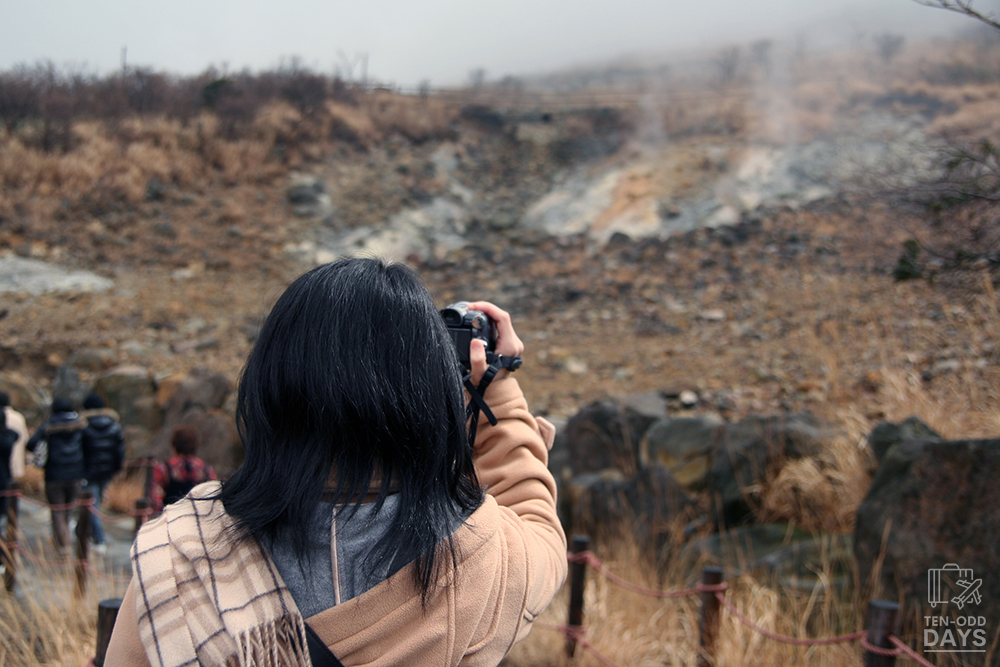
It helped that we were travelling with a group of very considerate and understanding tour mates. With her explanation, we were all agreeable to spending a little more time at Owakudani (大涌谷). It sure beat hanging around Kawaguchiko 5th Station doing nothing in particular. Apart from having a manageable trail to explore, Owakudani (which is essentially a volcanic valley with sulphur vents and hot springs) is also famous for its black eggs (黒卵) and scenic view of Fuji-san on clear days. As already established earlier, it was not a clear day so we had no luck of seeing the whole of Fuji-san.

Sis at Owakudani

We walked on the Owakudani Trail a little but I was hasty to leave the area because the pungent smell of sulphur did not sit well with me. Instead the mum and I went to hang around the visitor’s centre because the restaurant where we were supposed to have our lunch was just adjacent to the centre, leaving the little sis to explore more of the trail by herself.

Owakudani Food
Mum with Sis

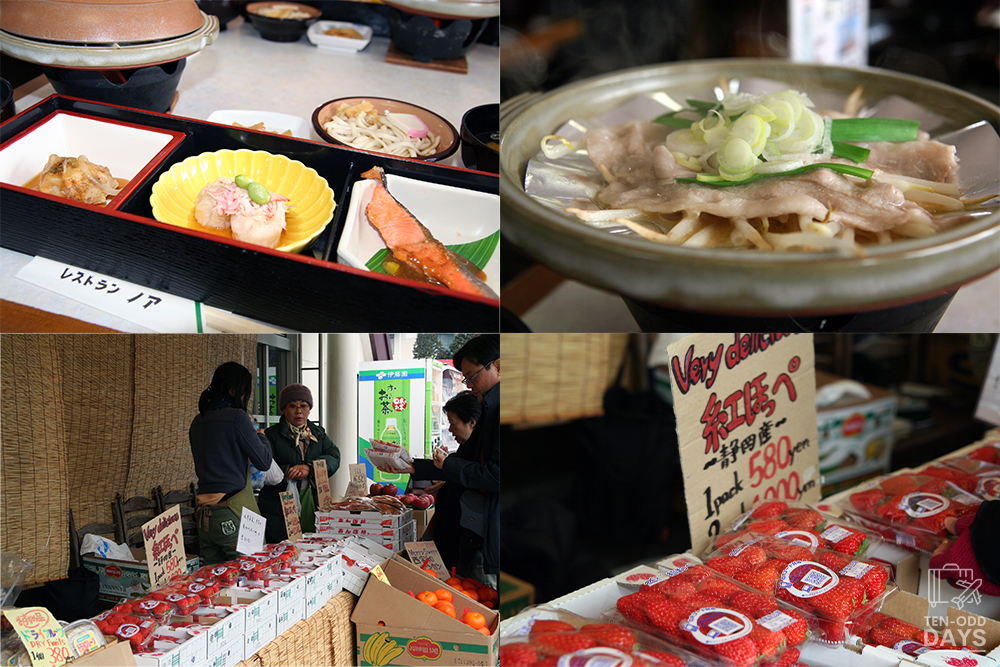
It was a hearty lunch we had. Some Nabe (鍋) it was but I can’t tell exactly what it was, now. It was in fact one of the most delectable meals of the whole trip. But what we were really impressed with was not the lunch itself, but the packs of strawberries on sale just outside the restaurant. The strawberries we get to purchase at reasonable prices in Singapore (hence eliminating the Japanese strawberries sold at Japanese supermarkets) are hardly tasty, and rarely sweet. The strawberries we ate at Owakudani were anything but. Big, juicy and also unbelievably sweet. I thought I tasted some really great strawberries at the Keukenhof near Amsterdam in 2005, but these just beat them hands down. I was never quite a fan of strawberries but after that experience, I absolutely love strawberries. They were that life-changing.

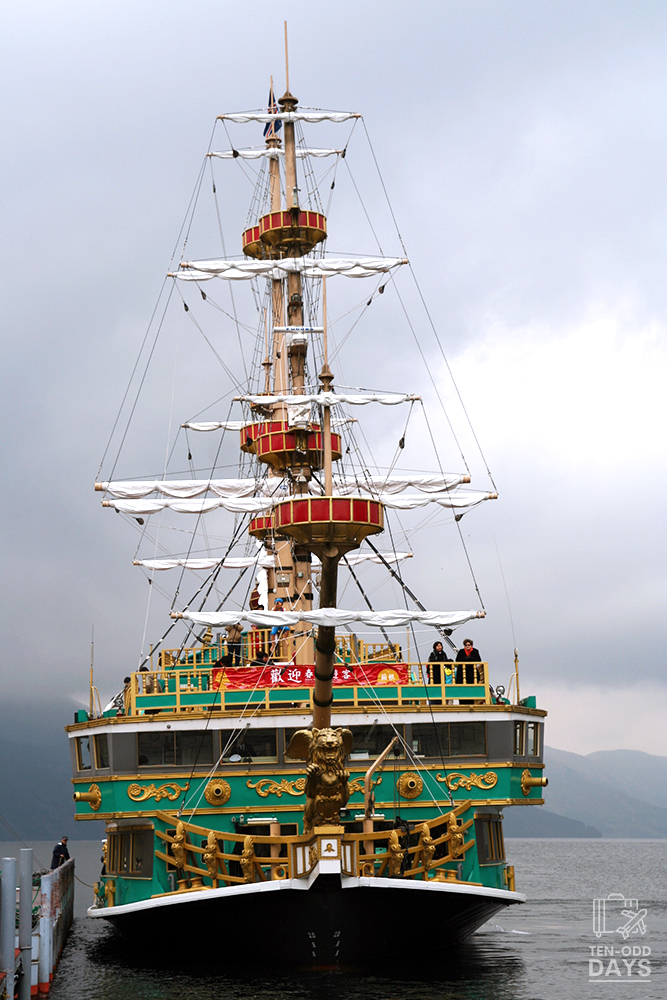
The Pirate Ship
On Lake Ashi

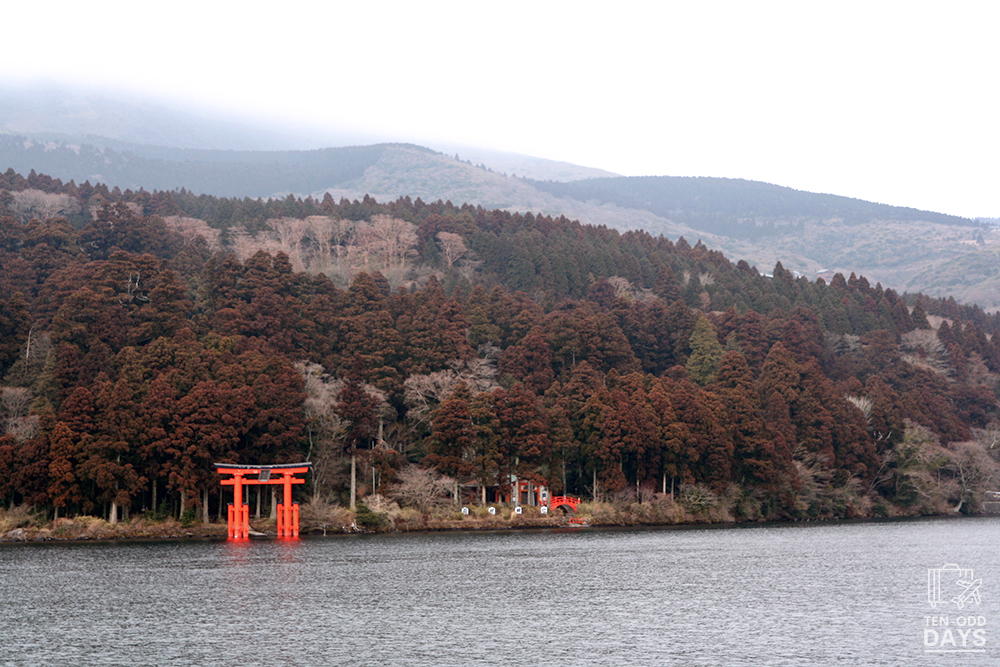
While we were at Owakudani, we of course must embark on the Lake Ashi Sightseeing Boat a.k.a. the Pirate Boat. Having no hopes of getting a better view of Fuji-san, we concentrated on enjoying other beautiful scenery. And spotted this beautiful red Torii (鳥居) of Hakone Shrine (箱根神社) at the foot of Mount Hakone. While possibly not quite as spectacular as the ‘floating’ Torii of Itsukushima Shrine (厳島神社), this Torii is magnificent and mysterious in its own way.

Speeding Shinkansen

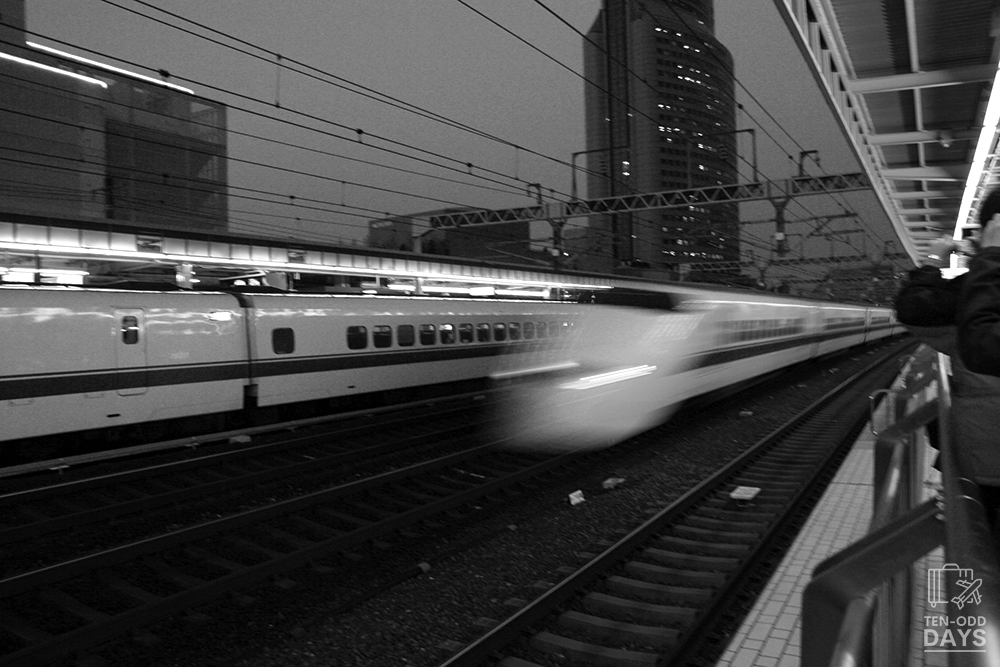
It was a long day, but was most certainly not over for us. Yet. Because it was time for us to experience for ourselves the real speed of Japan’s legendary Shinkansen (新幹線), or Bullet Trains that could operate at a maximum speed of 320 km/h. It was not completely necessary for us to board the Shinkansen to get to Osaka because our coach could traverse the same distance by road to meet up with us on the other side although it took much longer. It was a novel experience and really just for thrill of the speed. Except that we didn’t really feel the speed at all. The train was that stable on the move. I was duly impressed!

Of Ramen and Hello Kitty

It’s a wonder what one night of good rest could do to a person. From the grouch I was the day before I transformed into someone in considerably better spirits the next morning. That was until I saw the rain. What a mood dampener…

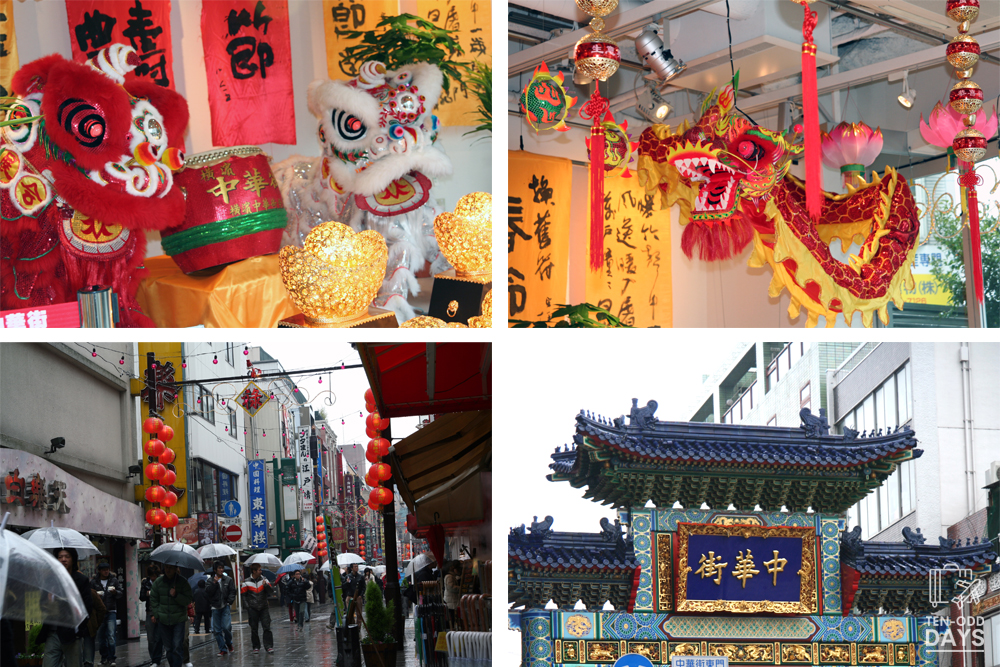
Still, the show must go on. The coach transported us to Yokohama (横浜) where we spent time for the better half of the day. First and foremost, the Yokohama Chinatown (横浜中華街) cannot be missed. Purported to be the largest Chinatown not only in Japan but in Asia, it started and grew exponentially in 1859 following opening of the sea port in Yokohama. Today not many Chinese are still living within Yokohama Chinatown itself but it remains a major sightseeing spot and a must visit for many overseas Chinese tourists. Us included.

Personally, I have always found chinatowns fascinating. For a start, I’m always amazed by the fact that Chinese have somehow found their way to all parts of the world: from Yokohama to San Francisco, London to Barcelona. This is also the very reason why I am a Singaporean – because my ancestors travelled all the way down from Canton to Singapore!

Yokohama Chinatown

Because of the unrelenting rain, we didn’t stay very long shopping around Chinatown. Furthermore, most things that could be found in and around Yokohama Chinatown are easily available in Singapore so nothing much intrigued us. After visiting this iconic location in Yokohama, we headed for yet another iconic location – Shin-Yokohama Raumen Museum (新横浜ラーメン博物館). And no, no spelling error there.

Raumen Museum Interior

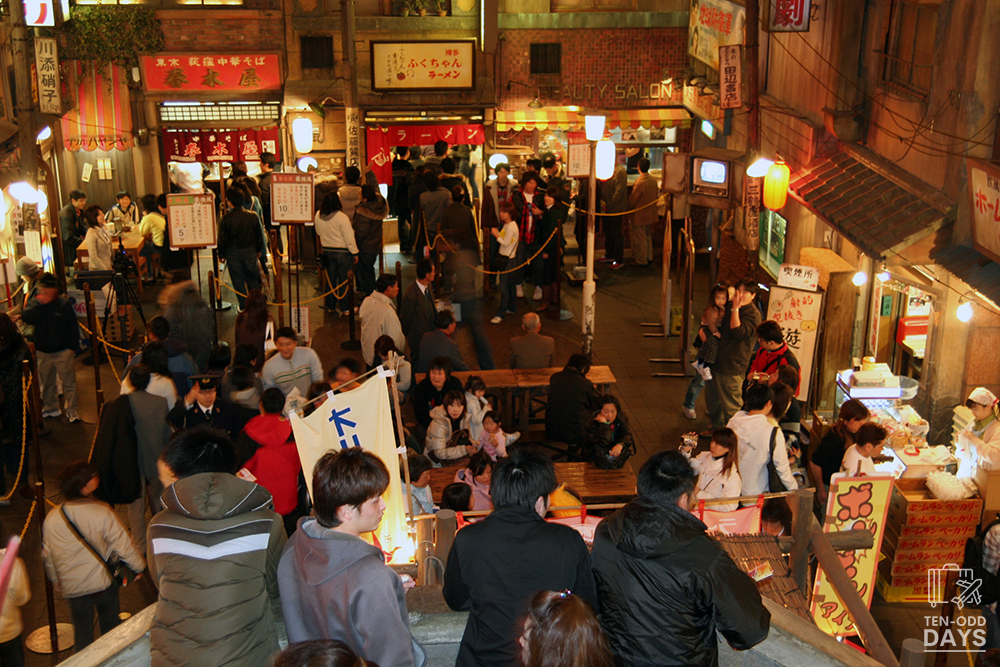
To be precise, Shin-Yokohama Raumen Museum isn’t exactly a museum but more like a three-storey food amusement park where some of the biggest names in the Ramen circuit in Japan are gathered together to provide visitors (mostly overseas tourists) a convenient one-stop regional Ramen experience. At last count, 9 carefully selected Ramen branches occupy the stores at the basement level of the ‘museum’, which is very tastefully donned up like the yesteryear of Tokyo complete with billboards overhead and music blaring from the loudspeakers as if they were played on a gramophone.

It was a very tight space accommodating the many people who were either queueing at their favourite Ramen store, browsing around trying to decide on which Ramen to eat, or basically standing around to soak in the whole atmosphere. And in order to allow patrons to be able to taste more of the Ramen offered, half portions are available. Which is a very good strategy if one intends to eat to one’s fill, provided time is not a factor. The queues were outrageously long when we visited!

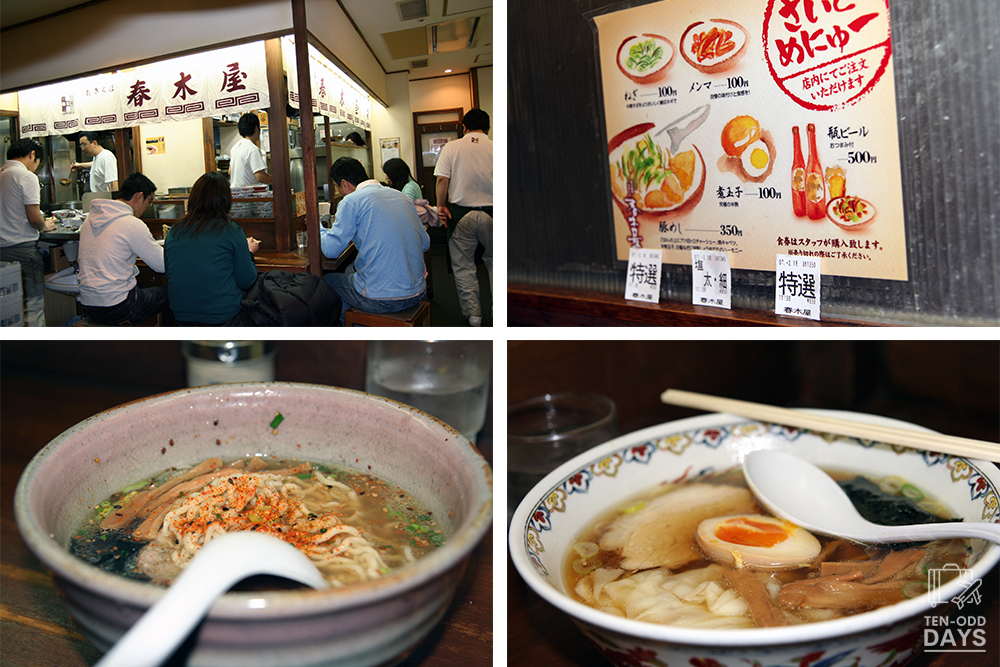
Our tour leader’s personal recommendation was the Sapporo-style Ramen. Clearly it was one of the most popular stalls because the queue was, in much correspondence with its status, equally impressive. After walking round and round aimlessly, the mum, the little sis and I decided on patronising the stall with one of the shortest queue – Harukiya Ramen (春木屋). We reckoned any of the stalls would serve delicious Ramen, so it didn’t really matter which choice we made. Our deduction was quite right.

Harukiya Ramen Booth

We didn’t have to wait too long for our 3 bowls of Tokyo-style Ramen. On a cold and wet winter day as such, there couldn’t be a more inviting and welcoming sight than a bowl of noodles complete with piping hot soup. As with any other Ramen stall, the patrons quietly waited for their order to arrive, concentrated on their Ramen when it arrived, and then quickly vacated the seats after being done with their food. We did the same. In no time, we were done with our lunch and all ready to explore the rest of the ‘museum’ which includes an area showing Ramen exhibits and history (the true ‘museum’ part of this building) and a shopping area for the Ramen enthusiasts to bring vacuum-packed Ramen home with them, on top of other knickknacks. However I think nothing beats Ramen in fresh, thick broth prepared by chefs who obviously know what they are doing compared to us novices so as much as I love my Ramen, I will never be tempted to buy those vacuum packs.

The Shin-Yokohama Raumen Museum, repleted with symbols and memorabilia reminiscent of urban Tokyo in the 1960’s, was a truly fun place to visit as we relived how life was back then during the ‘Ramen boom’, so to speak. But it is also one of those places where you visit once, and once is enough to last you a lifetime. I revisited the food amusement park 18 months later, with the mister in tow. It was kind of a trip we specially made down to Yokohama from downtown Tokyo (where we bunked in with a good friend), and let’s just say my companions (the mister and good friend) were not amused with my making them travel all the way to Yokohama just so to visit this ‘museum’. So I guess it’s only worth a visit if you truly love your Ramen, or stay within striking distance. Otherwise, good Ramen alternatives are easily available everywhere in Tokyo.

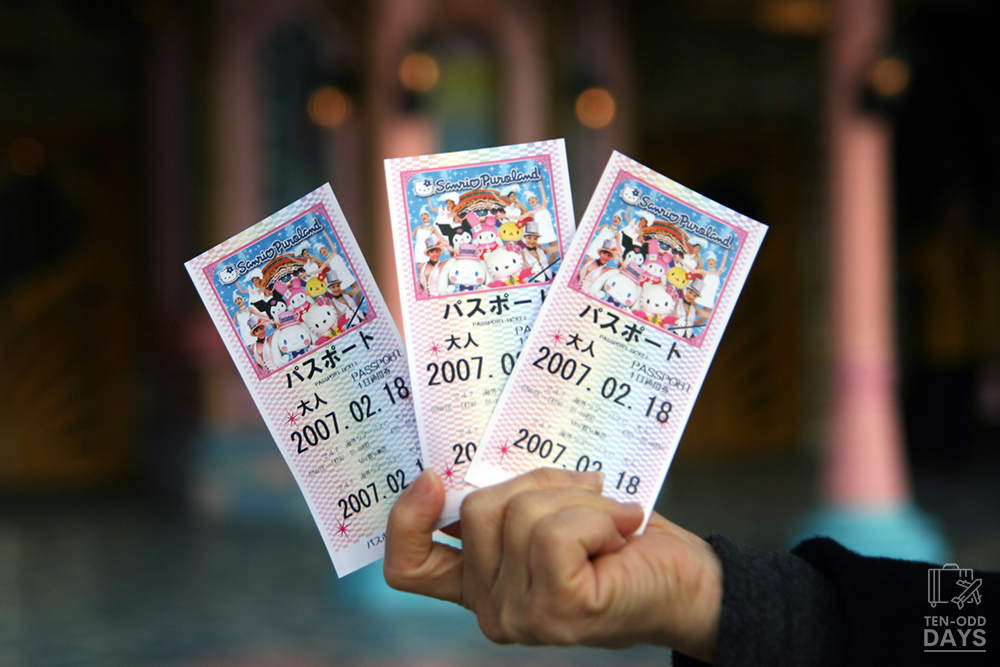
Puroland Tics
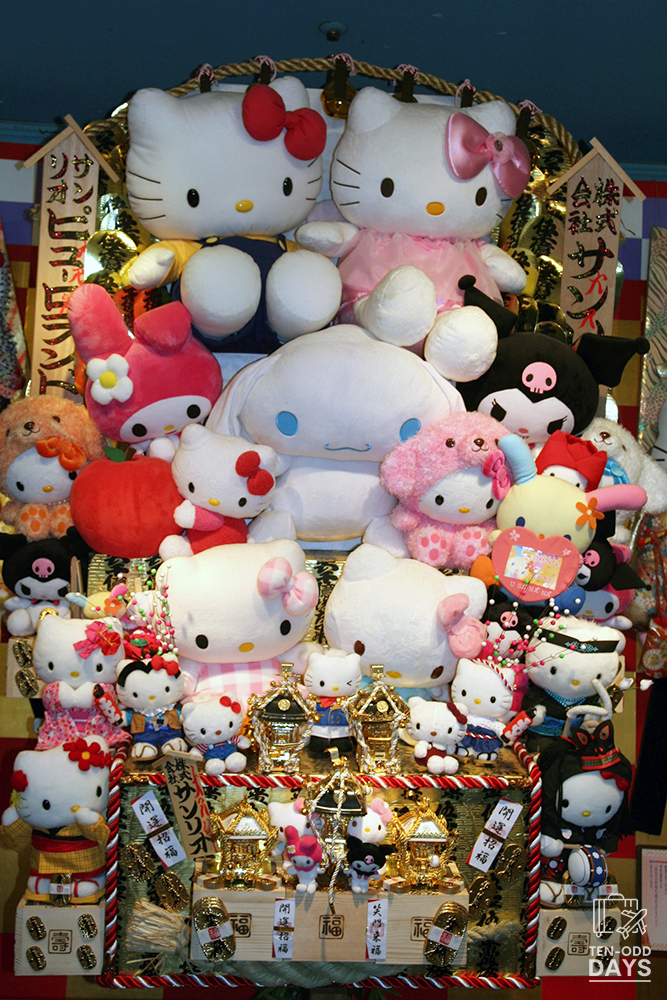
The entrance tickets are so pretty!
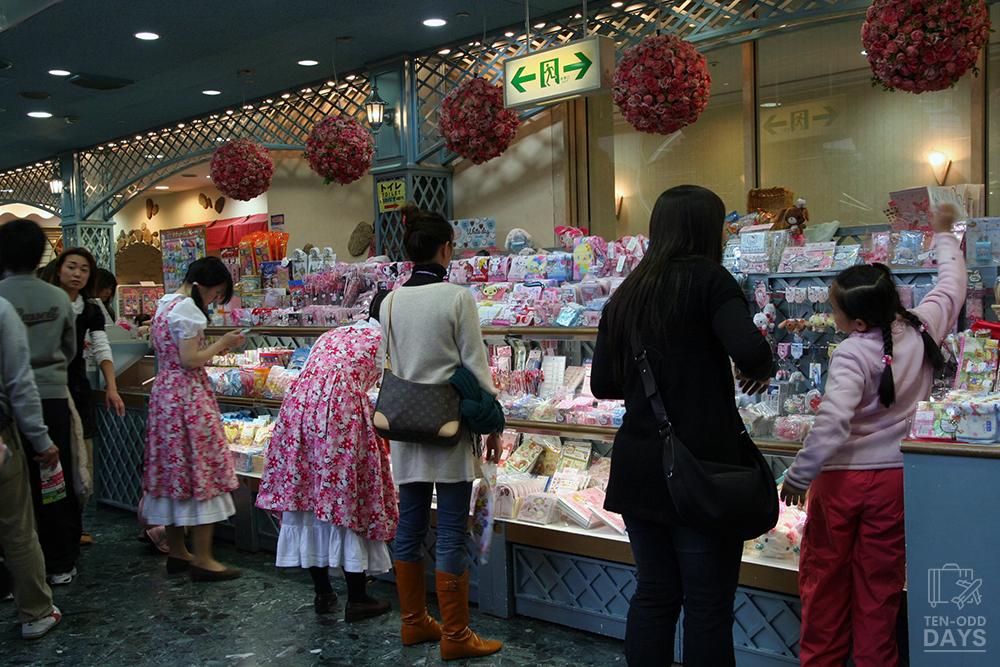
The Puroland Store

Our next stop for the day – Sanrio Puroland, a rather small-scaled indoor theme park about 30 minutes away by train from Shinjuku Station. Unlike Tokyo Disneyland, Sanrio Puroland appeals much more to younger children. But the stationery shop selling all sorts of Sanrio character merchandise saw an endless stream of wide-eyed customers, adults included. While there also exist Sanrio stores in Singapore, none is at this scale with such a complete collection of merchandise. I’m not a huge fan of Sanrio (although the little sis loves My Melody) but even then, I was equally taken by the cute array of pinky merchandise. The little sis, needless to say, was elated to have found numerous authentic My Melody stationery.

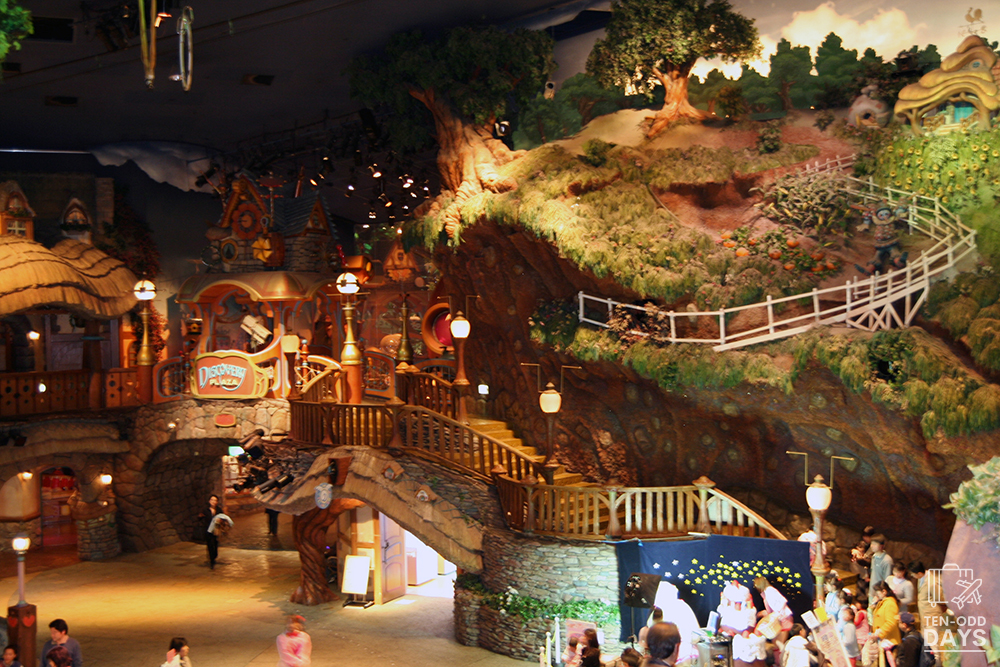
Puroland Interior I
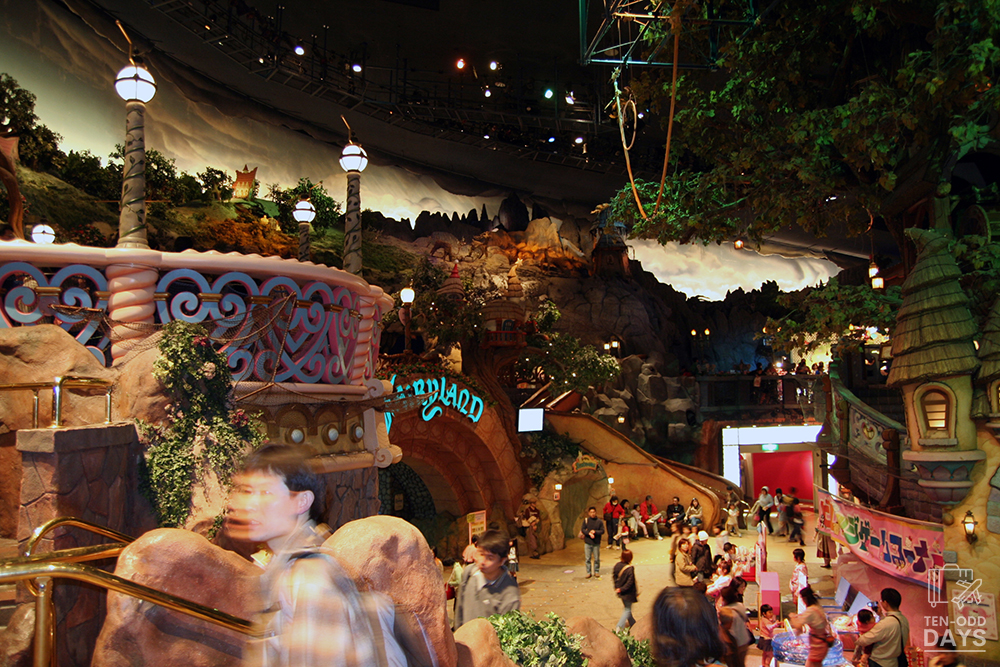
Puroland Interior II
Puroland Soft Toys

Sanrio Puroland was truly an eye-opener. I’d never seen indoor amusement parks that elaborately adorned. I had initially thought that Lotte World Amusement Park in Seoul is one of its kind in the world and I was completely dazzled. But that was before I saw Sanrio Puroland. It might not be entirely  fair to compare the two because they are obviously different in terms of scale, and appeal. Lotte World after all, still has to maintain outdoor thrill rides while Sanrio Puroland probably easily generates more than enough income to sustain the park from the sale of Sanrio merchandise alone.

Subsequent visits back to Tokyo always sees me wanting to return to Sanrio Puroland but the trip out never quite materialised over the numerous trips we made. One big reason is that this indoor amusement park really doesn’t appeal much to me. It is definitely worth visiting if you have young children, especially girls, in tow. Otherwise, you wouldn’t be missing anything much.

Tokyo Disneyland, Adults’ Paradise Too

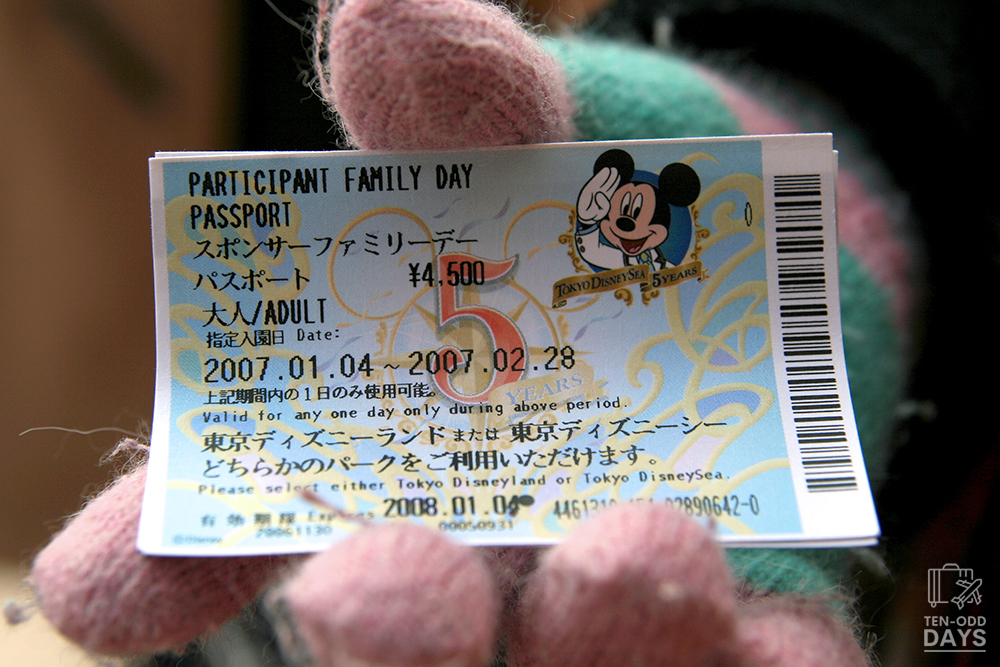
TDL Tickets

After a rather long flight including a layover at Bangkok Suvarnabhumi Airport, the mum, the little sis and I stepped foot on Japan soil. And immediately, as typical of most guided tours, we were whisked off from Tokyo Narita International Airport to Tokyo Disneyland. It was not our first Disneyland visit (the honour goes to Disneyland in California, albeit 20 years ago) and we were most certainly not expecting to be wowed like children. We were after all over a century old, ages combined.

But anticipation and excitement lingering in the atmosphere does strange things to people, even sane and mature adults. While standing in line and waiting to enter the resort the minute it opened, we felt a magical aura about to descend upon us. In spite of ourselves, we were getting all excited about entering the magic land! 😆

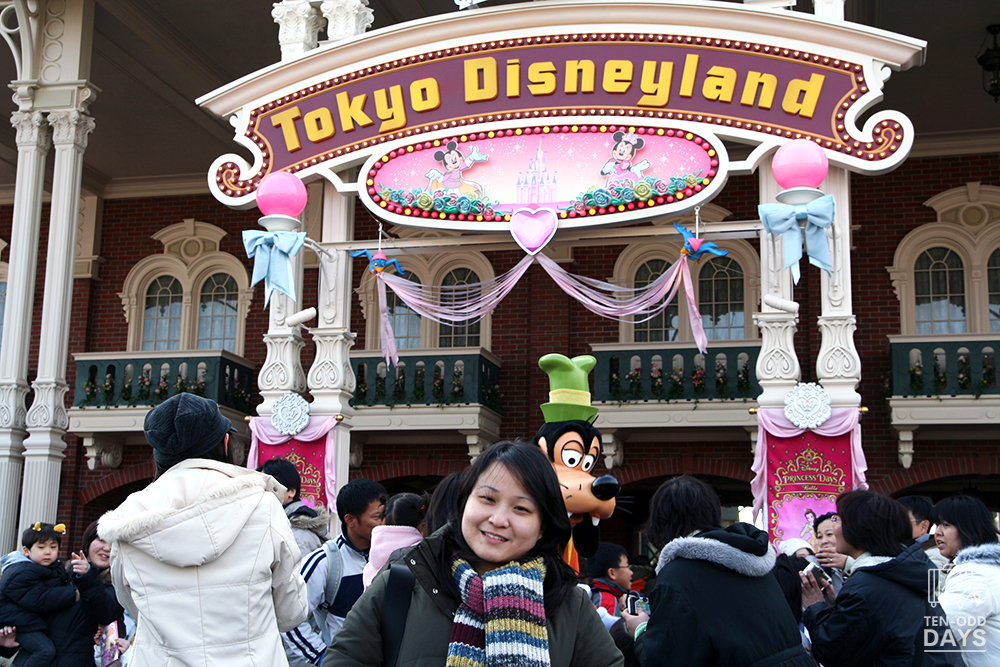
At TDL Entrance
TDL Montage I

It wasn’t fun at all just waiting around doing nothing, so we started taking pictures. Lots of them. Trust me when I say you will not find a lack of subject matter for photography at Tokyo Disneyland, or for that matter, any of the Disneyland resorts in the world. Everything was insanely brightly-coloured and incredibly cute, all rightly done so in an attempt to attract the attention of children and ‘eternal children’ alike. Like the young children, we too were squealing in excitement when the Disney characters strolled out to mingle with the crowd before the resort officially opened its doors for the day.
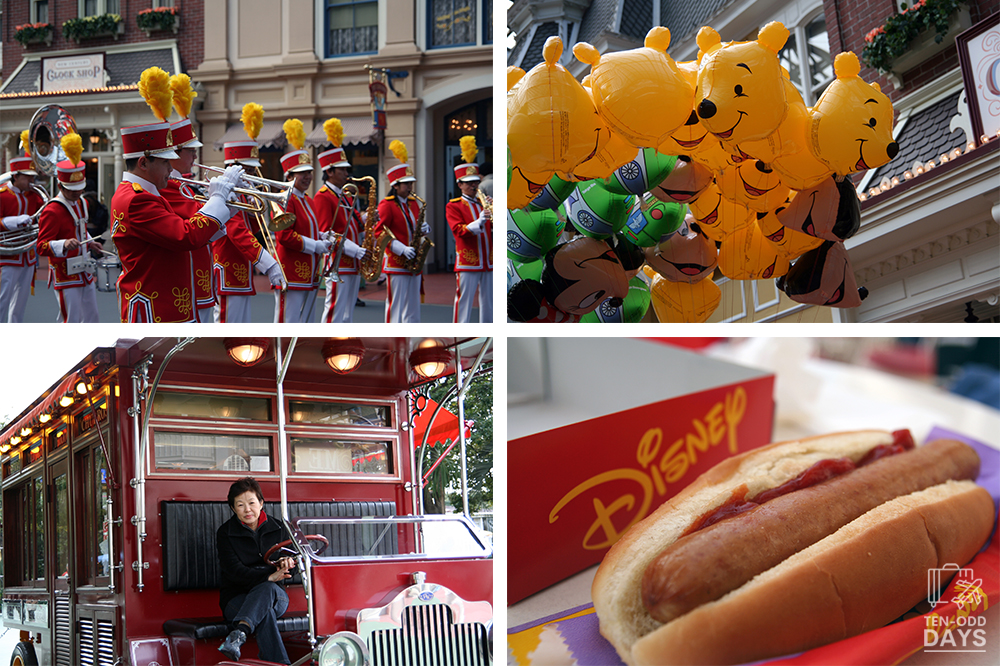
Tokyo Disneyland opened its doors to the first visitors on 15 Apr, 1983 and comprises 7 themed areas namely: Adventureland, Fantasyland, Tomorrowland, Westernland (the 4 classic Disney lands), Critter Country, Mickey’s Toontown and the Grand Bazaar. We were not looking to doing any of the rides and actually spent the most of our time at the Grand Bazaar window-shopping or taking pictures at all corners of the resort. Even the mum, who is unusually camera-shy because of her tendency to blink whenever her pictures are taken, felt uplifted enough to have her portrait taken by me, and several times at that!

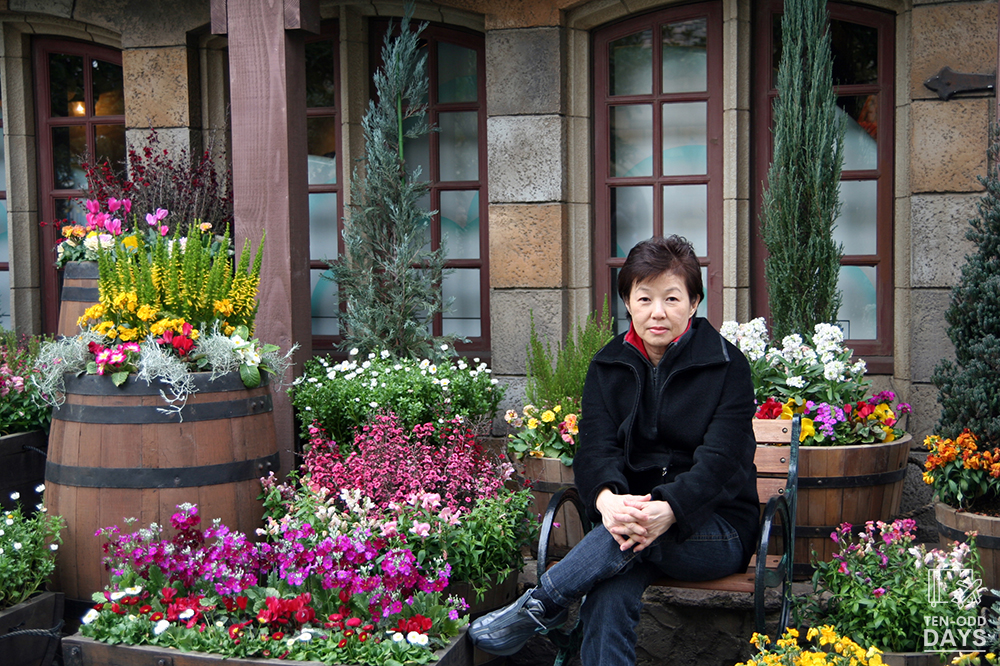
Mum with Flowers
Mum amongst her favourite flowers. 🙂
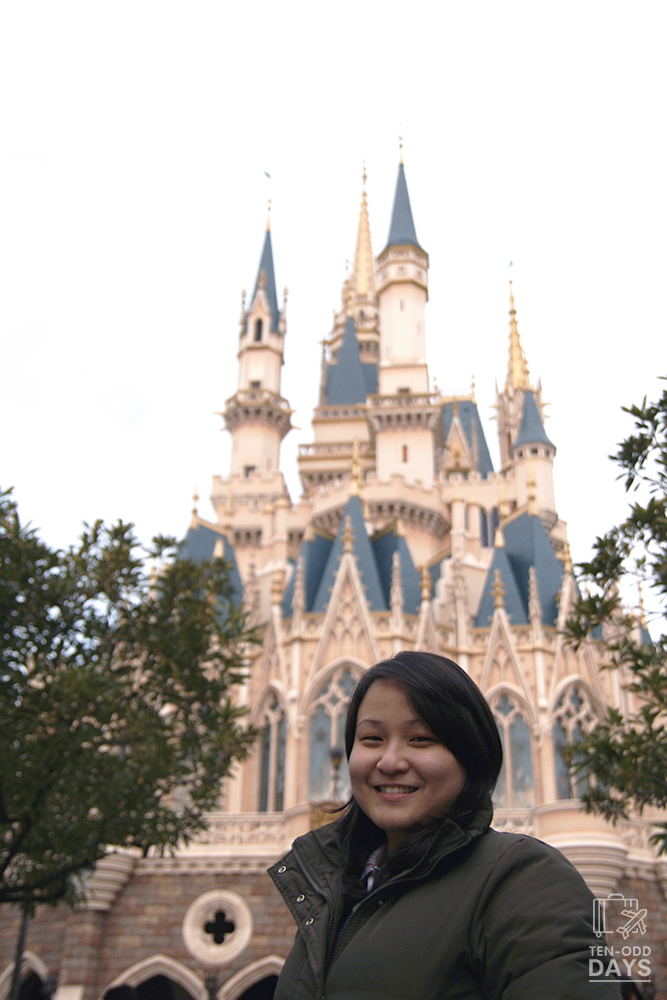
With TDL Castle

The weather was generally fine on the day we visited the Tokyo Disneyland, however the sky was unfortunately grey and overcast most of the time. Any photographer would have much preferred a clear blue sky instead, but this is the way with winter – the sky could go either way. Given that the turrets of the Cinderella Castle at Tokyo Disneyland are largely painted in tan colour, a snapshot of it taken on an overcast day is going to result in a castle that looks more muted than impressive. This was a major regret from our first visit to Tokyo Disneyland. And it didn’t help that I was dressed in a boringly understated, army green-coloured overcoat. My pictures with the castle just turned out looking colourless and dull.

TDL Montage II

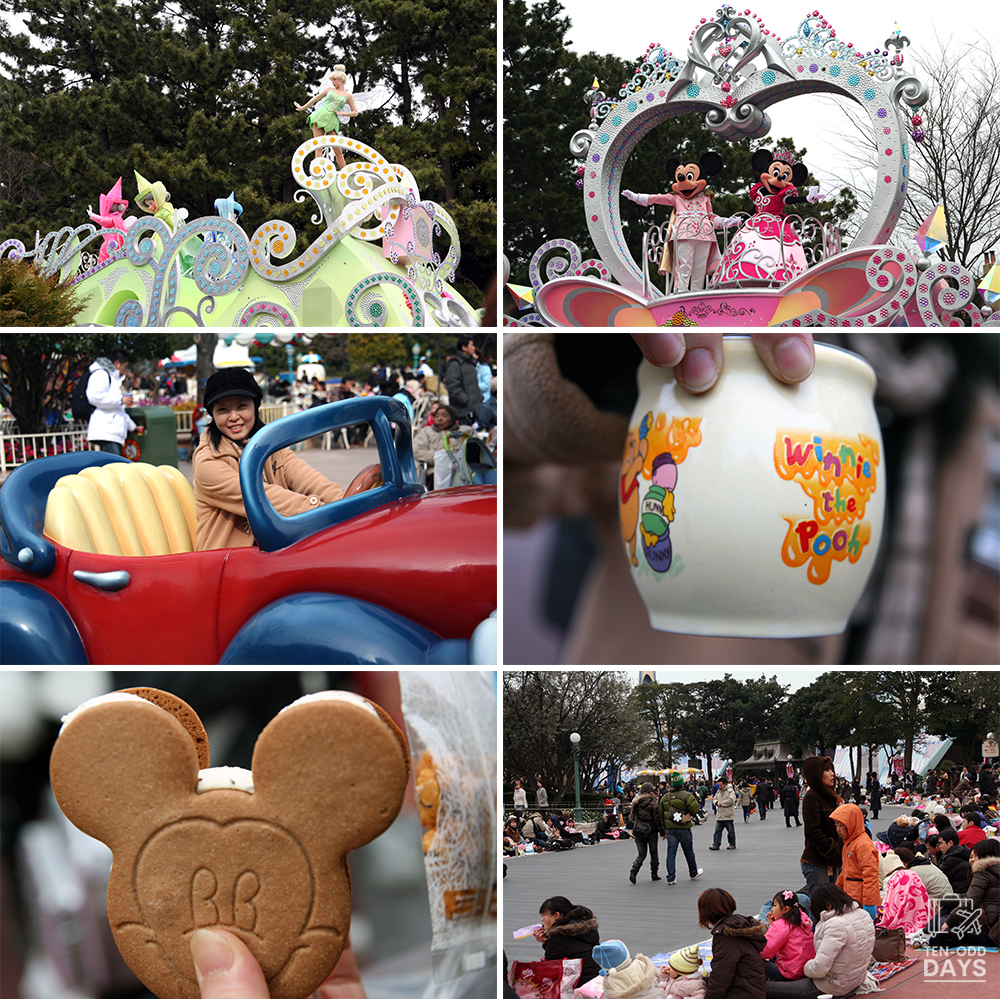
While we didn’t queue for any of the rides (didn’t want to deprive the real children of their chances at getting on the rides – plus the queues were insanely long!), we made sure we didn’t miss the daytime parade. It was not necessary to take special note of the parade timings (we definitely didn’t!). Just take cue from the Japanese visitors at the resort if you didn’t come across any of the notice boards bearing the timings. As per the resort’s unique regulation, visitors could spread out their plastic sheets or ground coverings and sit by the road side one hour before the scheduled time of the parade. You would think one hour is hell of a long time to sit around doing nothing ay? Not to the majority of the Japanese at the resort. They came fully prepared with plastic mats, and took opportunity of the one-hour wait to have a picnic-lunch with their children. No hustling and no pushing: everything was executed orderly and quietly. To be quite honest, I was expecting nothing less from the civic-minded Japanese.

I have not been to the other Disney resorts around the world. Not since I was 11 anyway. So, is this orderly scene common at all? From what I remember of my visit to California’s Disneyland, hardly anyone was sitting down during the parade; most people were just standing around behind the first two rows of sitters. Have things change over the years?

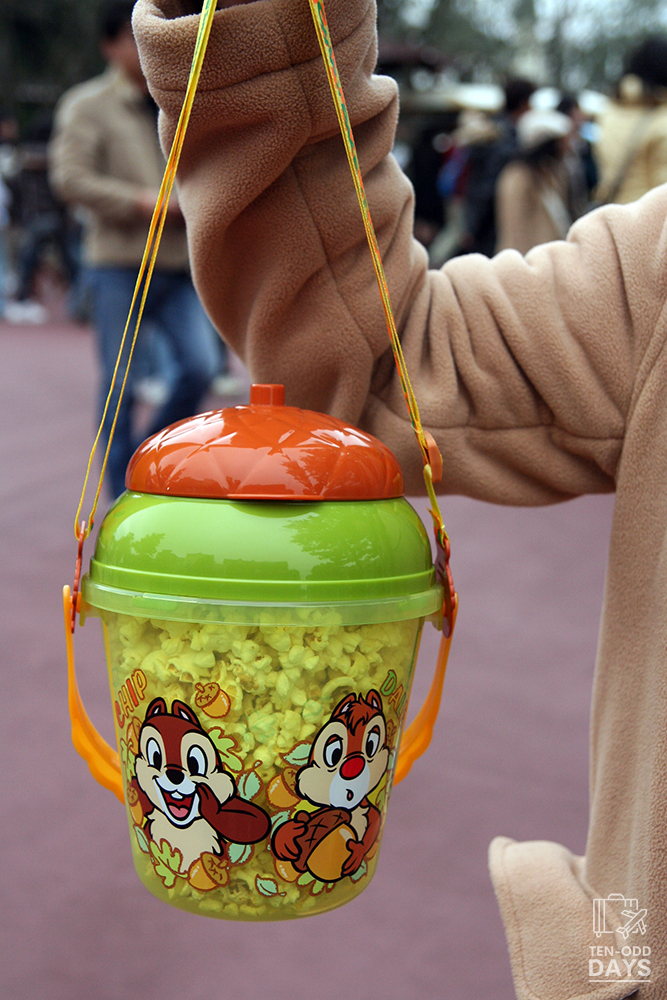
C&D Popcorn Bucket

On this trip we discovered something very intriguing about Tokyo Disneyland – popcorn buckets. While strolling about the park’s nooks and crannies we came across a stall selling the Chip ‘n’ Dale version and without even a second of hesitation, I started queueing for the popcorn. And bucket of course. Well yes, I am a huge long-time fan of Chip ‘n’ Dale. And then I saw a child carrying one with Winnie-the-Pooh. Make a guess what I wanted to do next? I went on a frantic search for the stall selling that particular version of popcorn bucket, with the mum and little sis in tow. Alas, we didn’t manage to locate the stall. Could have, if we had more time, or discovered it earlier. Reluctantly, we left the resort to meet up with our tour leader and tour-mates. Can’t say though, that I wasn’t looking forward to checking into our hotel. Badly wanted to shower. And dress warmer.

So was the day fun for us, given that we had no young children in tow when we visited? A resounding yes! And would I revisit? Absolutely!