It was a long drive westward to Granada and that necessitated an early morning departure from Valencia, with an intermediate stop at the cathedral town of Guadix along the way.
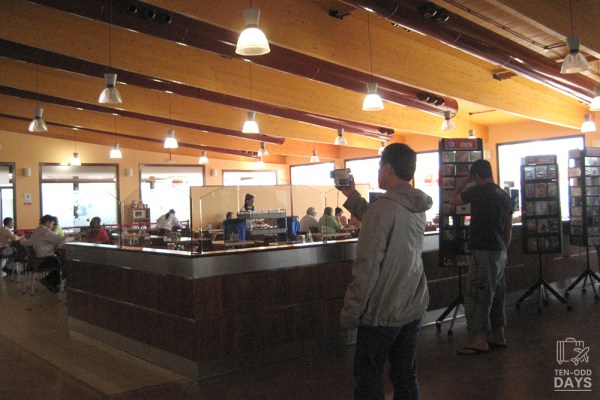
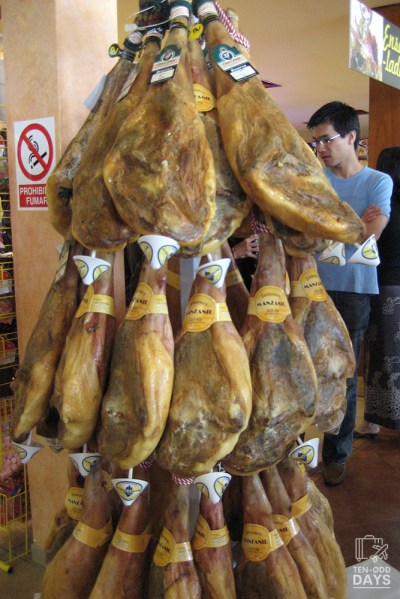
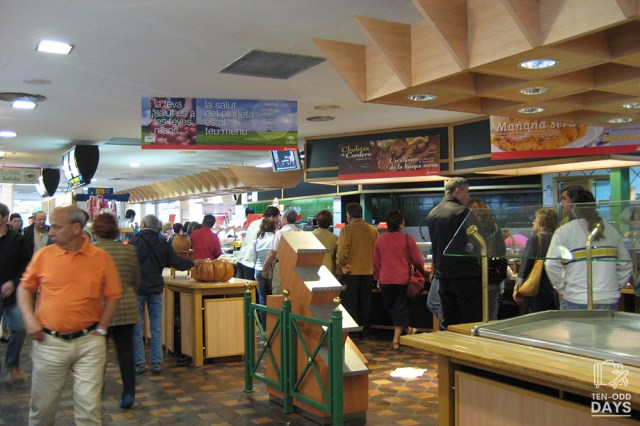
Another pit-stop for toilet break.Legs of Spanish Iberian ham. Apparently very expensive but from memory, these weren’t.
Such run-of-the-mill pit stops are now a common occurrence each time we journey on to our next destination along the southern coast. What makes this one particularly interesting were these legs of ham we spotted hanging from a pole, the first of its kind we came across. I would go as far to admit that I did not particularly appreciate the smell (not really a fan of cured meat and pork) but hey it was a rather strange sight to us, and we all gravitated closer to have a look. Someone in our group actually contemplated bringing a leg home!
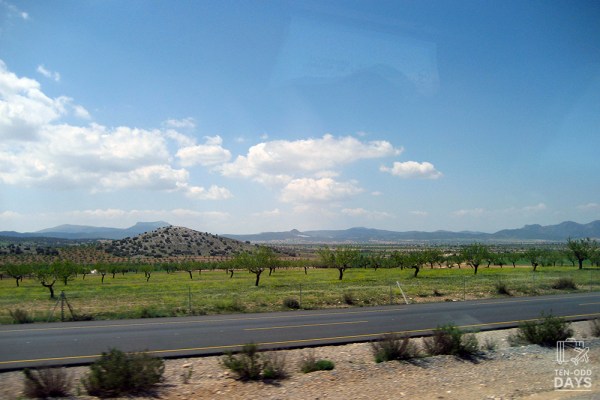
Beautiful landscape of Andalusia.
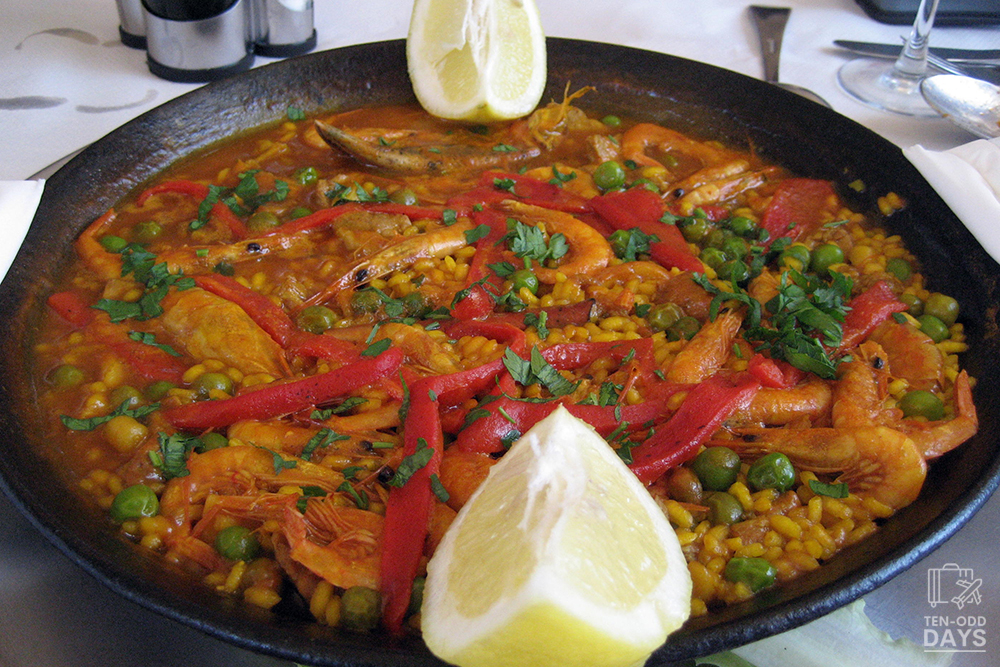
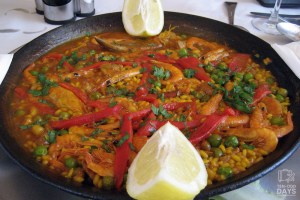
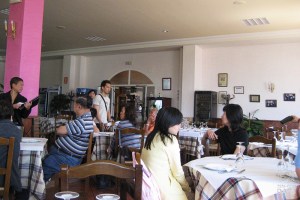
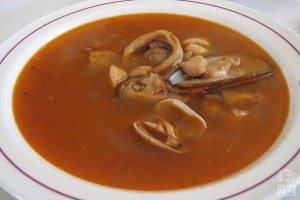
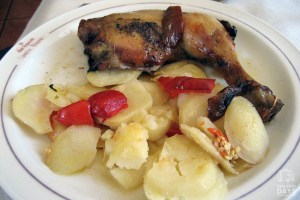
Before we arrived at Guadix, we made a lunch stop and had the most awesome and satisfying meal of the trip. I was totally blown away by the seafood paella. Indeed, no one else does seafood paella as well as the Spanish do. Not even Spanish restaurants in Singapore, unfortunately.
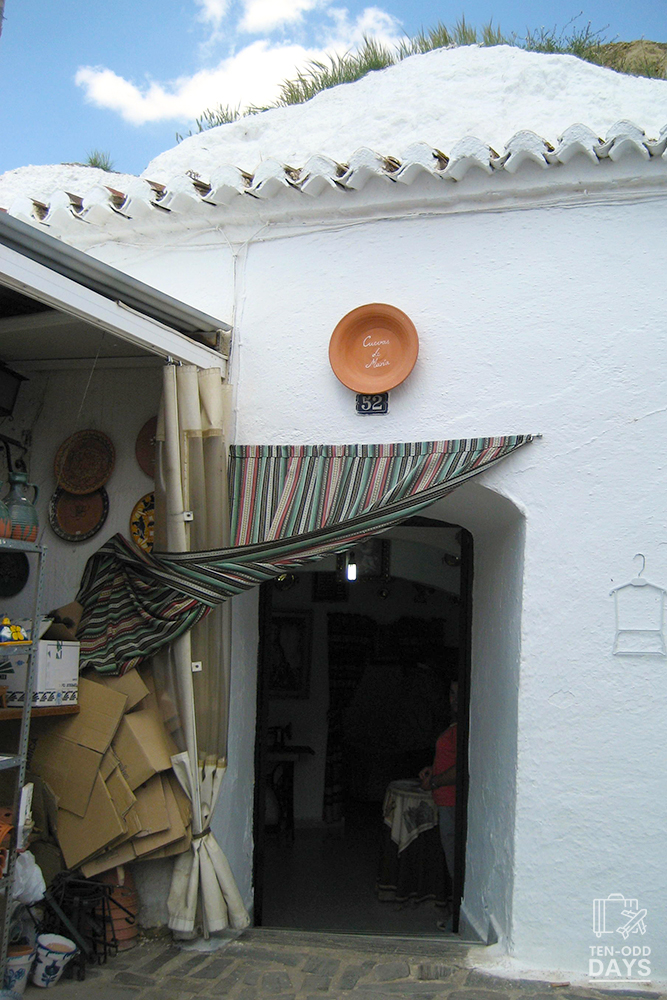
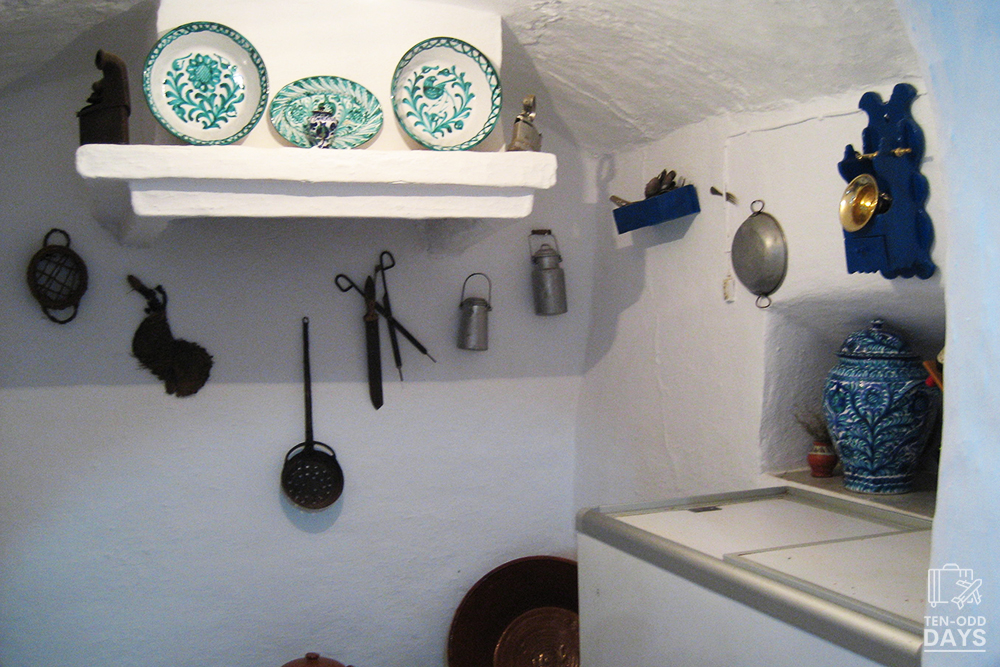
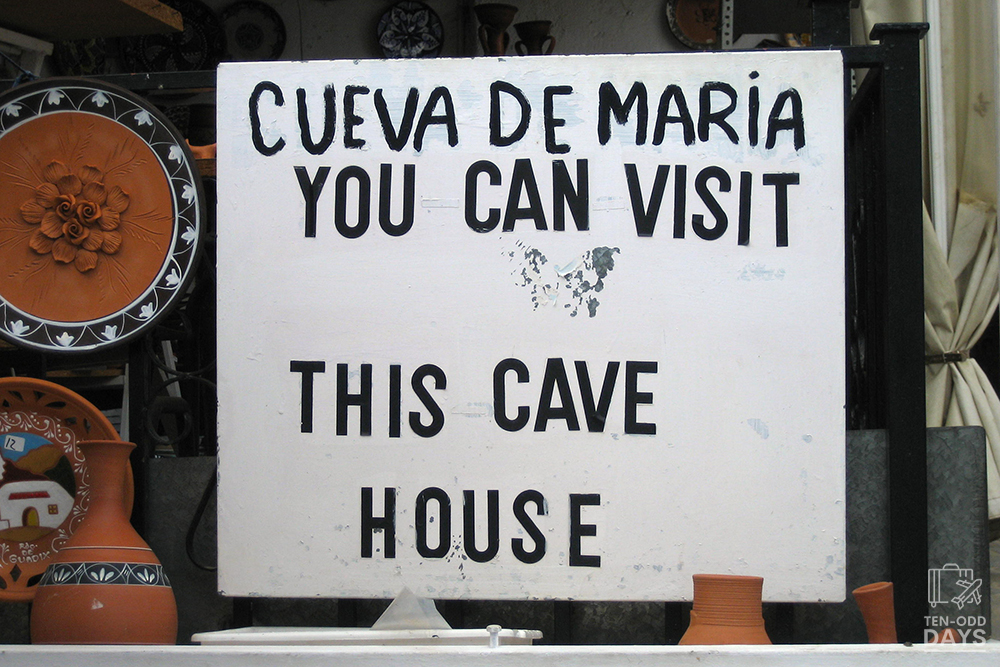
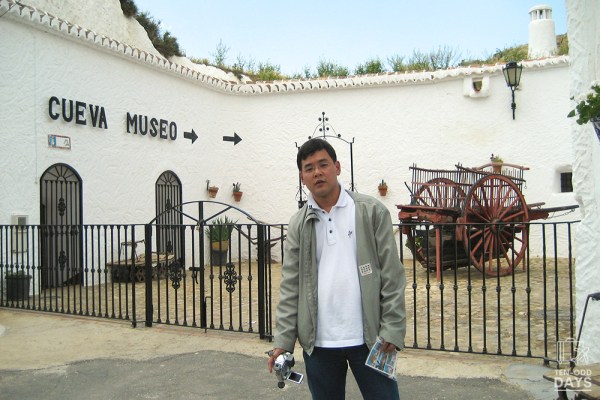
Now, Guadix is one curious town, being one of the oldest human settlements in Spain dating all the way back to the Stone Age. While it lies at an elevation of over 900 metres, most of its inhabitants live underground in cave houses. This is because in general, Andalusians are rather fond of living underground as a means to escape the summer heat, given the semi-arid climate of the region. They are also very proud of their unique dwellings, as we found out while walking round the town: we came across several signs inviting us to view their cave houses if we so wished to. We eventually did take up an offer, curious to experience how cooling these cave houses actually are.
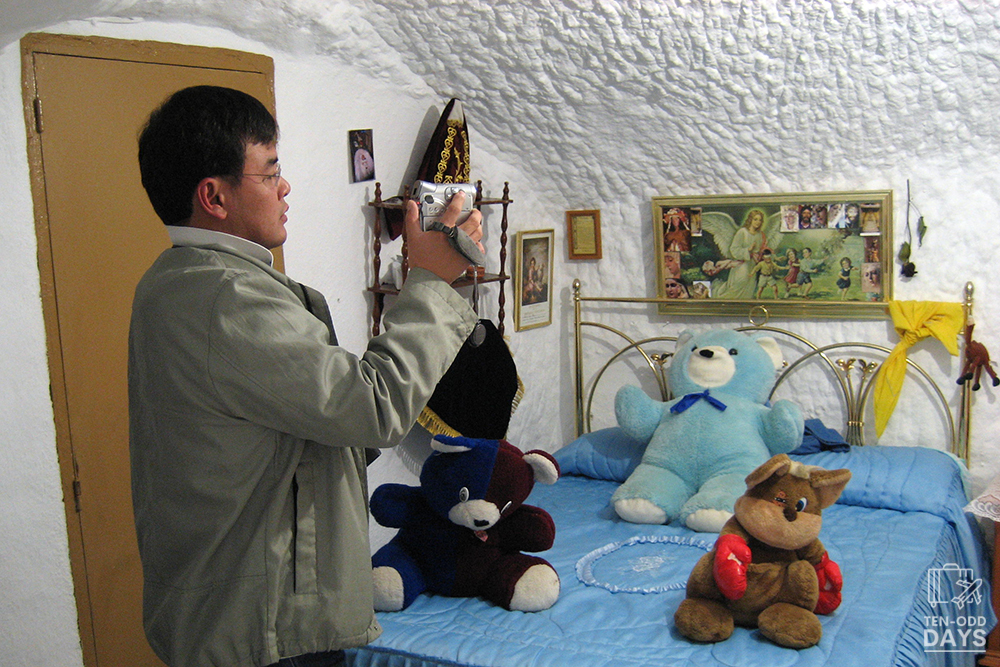
In spite of the scorching heat outside, I was taken by surprise at how the ambient temperature dropped so significantly the moment we stepped into the cave house. There was no air-conditioning or fan whatsoever but wow, it felt like the temperature dropped by 10 degree Celsius instantly. The wisdom of our ancestors simply never fails to amaze me.
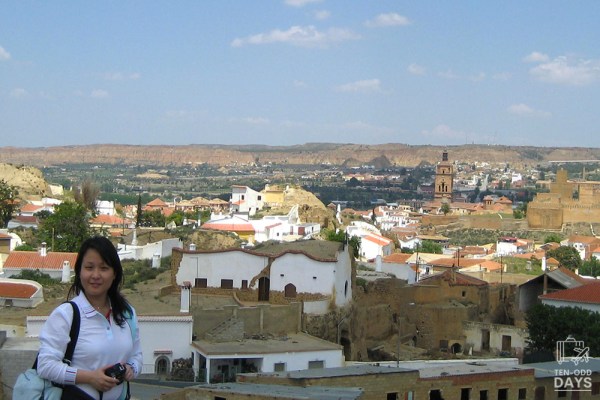
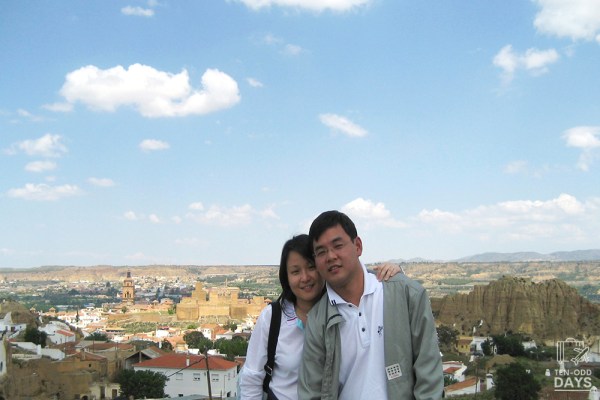
Cathedral of the Incarnation in the background.
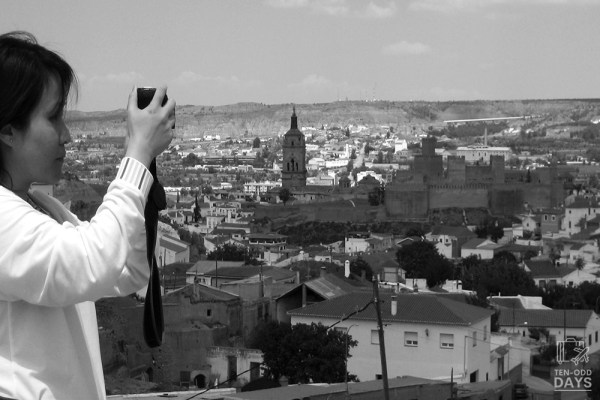
We climbed to the top of the hill for a panoramic of the town ancient town and its surroundings. Beautiful day it was, and we were somehow shaded by some clouds overhead, making the short respite atop the hill more bearable as we enjoyed the view that went as far as the mountain ranges of Andalusia. And from where we stood, the Guadix Cathedral (also know as Cathedral of the Incarnation) was a striking presence and I would have loved for the opportunity to visit. Suffice it to say that we didn’t manage to on this particular trip.
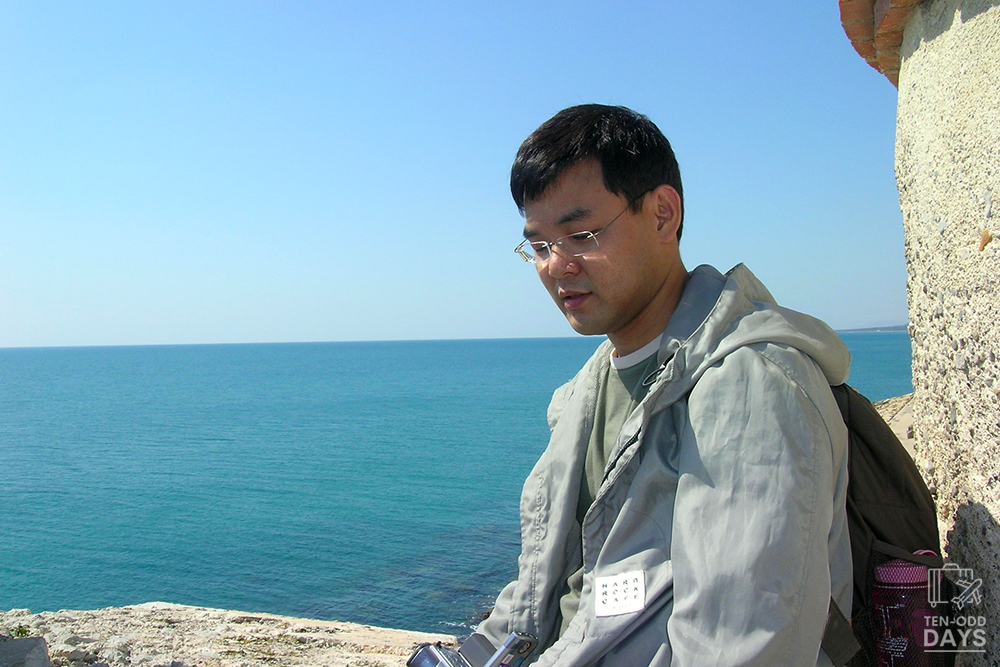
Rare pic of me in full concentration trying to take a panoramic shot. Didn’t quite work out…
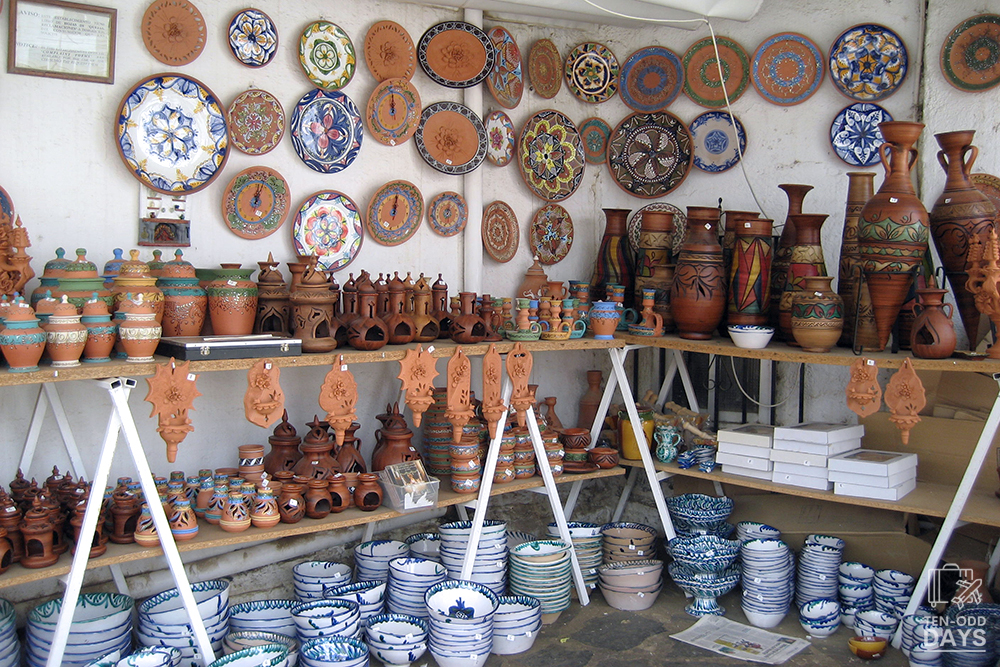
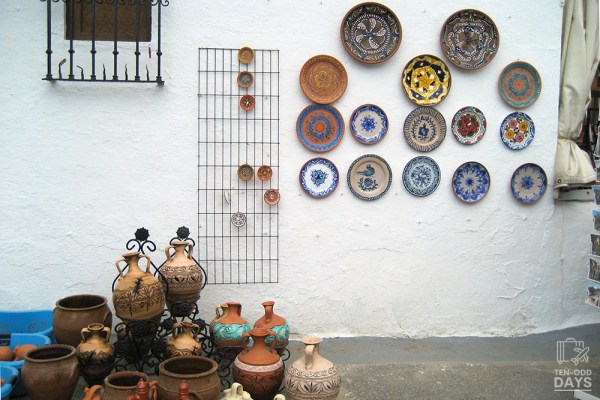
Guadix started out with producing quality cutlery but over the years the focus had shifted to mostly handcrafted earthenware, which was evident everywhere at every corner we turned.
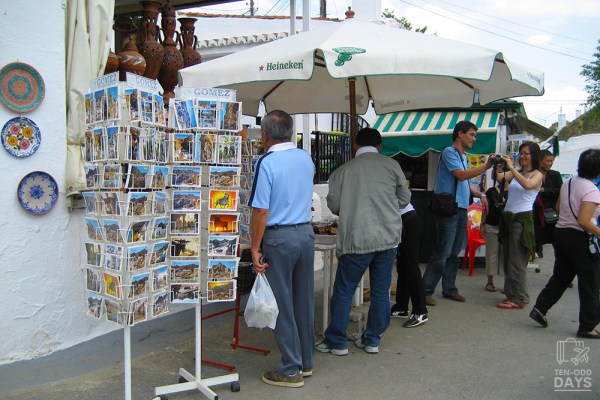
It’s quite clear earthenware wasn’t actually our cup of tea; we were really more of the fridge-magnet-and-postcards kind of tourists and were happy to stop by the store at the corner of the street where our coach was parked nearby. Seemed like we were definitely travelling with like-minded group mates, judging from the picture above. 🙂
And finally, we were on our way to Granada, which was definitely one of the highlights of our itinerary. After all, Granada isn’t known as the Moorish jewel of Spain for nothing, primarily for its strong Moorish influence in its buildings and streets culminating in the impressive Alhambra Palace. Our first place though, wasn’t the palace but the viewpoint Mirador de San Nicolas, located next to the Church of San Nicolas. Even since Bill Clinton the ex-US president visited this viewpoint in 1997, it has become the must-visit viewpoint for every visitor to Granada although that is not to say that the other viewpoints offer less superior views. For the record, Mirador de San Miguel also offers a splendid view of this beautiful city.
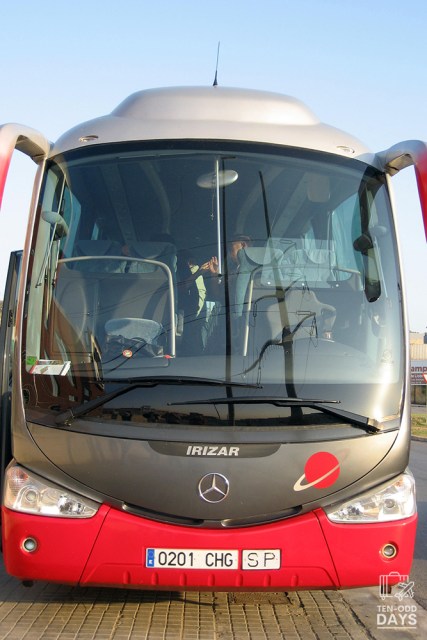
We bade farewell to Barcelona early in the day and boarded the coach that was to be our main mode of transport for the whole duration of the trip. And since our group size wasn’t very large, everyone had ample space to take two seats each. Very helpful for stretching out when needed since we were spending a lot of time on the roads tracing the lower coast of Spain.
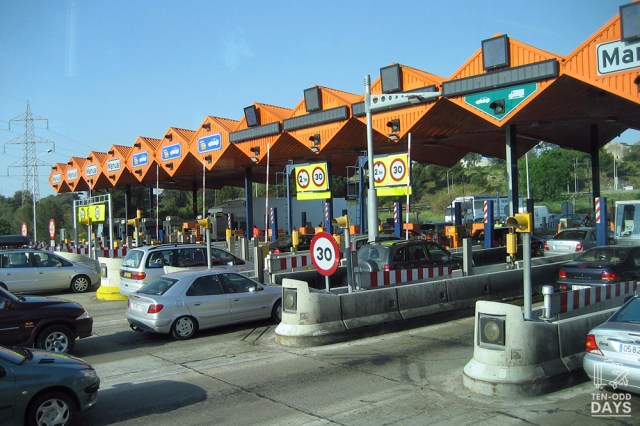
Toll booths as we were leaving region of Barcelona.
One of the many typical pit stops we made along the way.
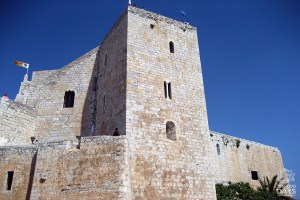
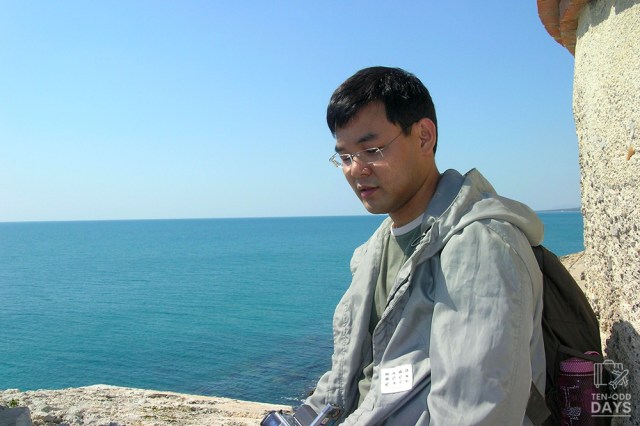
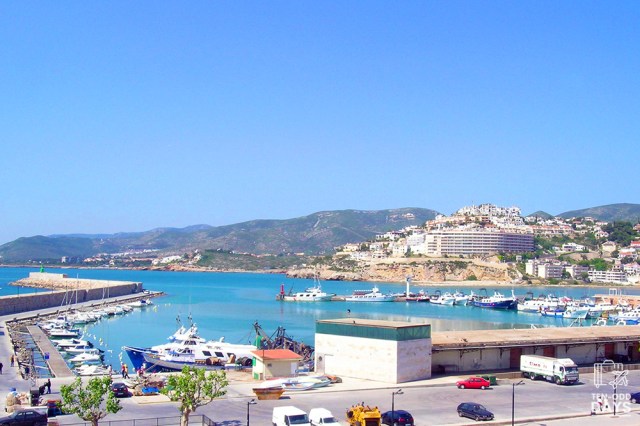
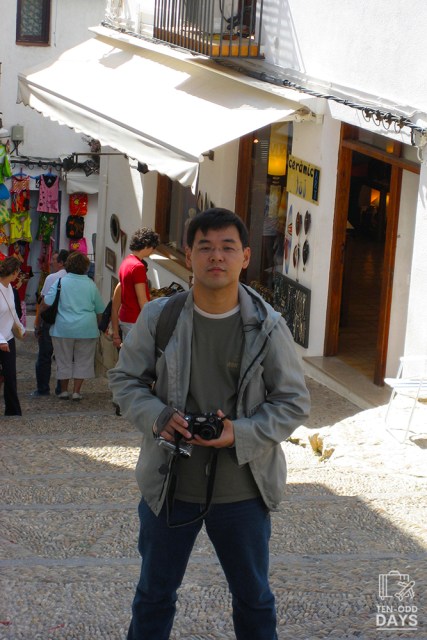
After a pit stop to relieve our bladders, we headed for Peníscola, an ancient fortified seaport that is now part of the Valencian Community. Often called ‘Gibraltar of Valencia’, it is located along the Mediterranean Coast and a very popular tourist destination. If Peníscola sounds familiar to you as it did to me, it is likely because you’ve heard of the annual comedy film festival that the town hosts. Either that, or you might have mixed it up with yet another place with beautiful beaches – Pensacola in Florida, United States of America. I know this because well… I did. 😆
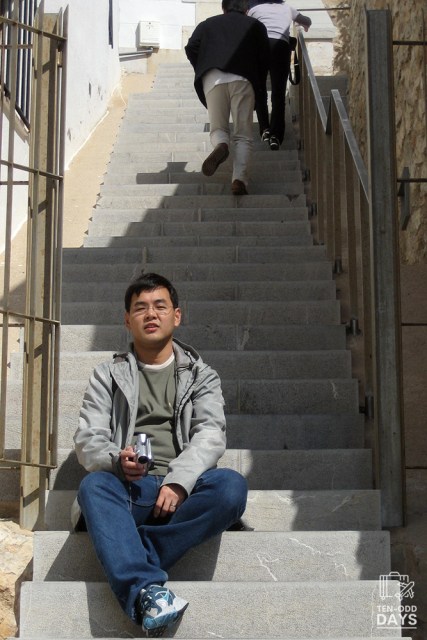
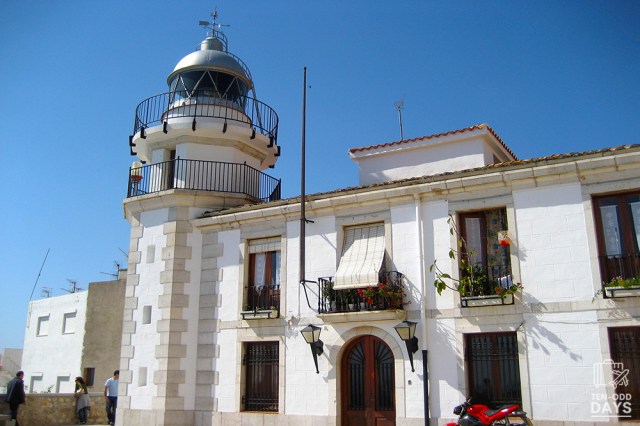
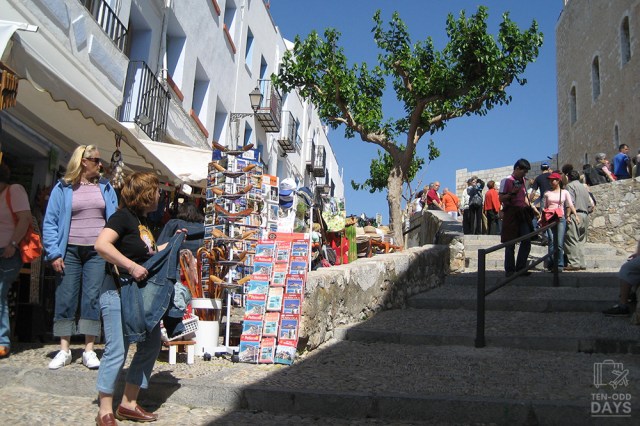
The old town of Peníscola comprises a confusing maze of narrow winding cobbled stone streets with the castle located at the highest point of the town, at 64 square metres above mean sea level. It was built by the Knights of the Templar in the late 13th century, and since then it had undergone several minor alterations.
Beyond this gate and we would have officially entered the medieval town of Peníscola.
It was a gorgeous, beautiful day with cloudless blue skies as we came into close contact with the Mediterranean Sea and finally understood its enigmatic draw. Long romaticised as the destination for lovers, the many islands and coastal cities with dramatic coastlines surrounding the Mediterranean Sea are often overrun by tourists during the popular summer months. It really doesn’t help that many of these coastal cities and bigger islands are also ports of call for cruise ships (I’ll admit I am not a fan of cruise ships – they destroy the environment at least three times more severely than aircraft). In this respect, we have chosen well, to visit Peníscola during the shoulder month of April. I felt immense relief at not having to jostle with crowds of cruise ship tourists while we explored the walled fortress.
The Mediterranean Sea is indeed blue in colour. Its lacking in certain nutrients promoting growth of sea algae resulted in the signature blue and clear waters. The lack of sea algae meant that the water remains close to pure water, hence reflecting the true colour of the sky. That doesn’t really explain all of the factors why seas and oceans appear blue, but for the most part, this does explain why the Mediterranean Sea appears bluer than the rest of them.
Sadly, it won’t stay this way for long given the pollution from increased sea activity supporting tourism. Sustainable tourism is a term coined only in recent years, but one that resonates with me as we travel more widely over the years. It’s a huge topic to cover on its own so for now, I shall just leave it here as food for thought.
The castle is now a popular tourist attraction and the beaches and surrounding area a popular family holiday resort. The surrounding shops, I have to say, are mostly tourist traps selling run-of-the-mill souvenirs. This is unfortunately the way it has become for most, if not all popular tourist spots. Nevertheless, that did not take away the charm of the ancient town one bit. And I’m all for it if these retail activities help support the livelihood of the locals.
Around noon when the sun was getting a little too hot for comfort, we returned to our coach to seek refuge and headed for Valencia, the third largest city of Spain after Madrid and Barcelona.
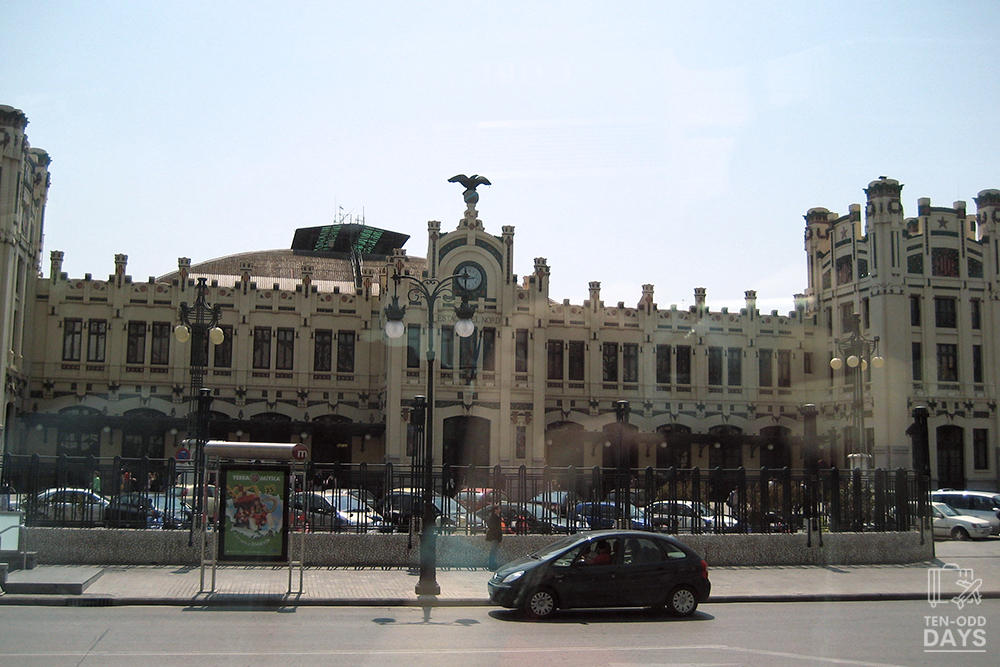
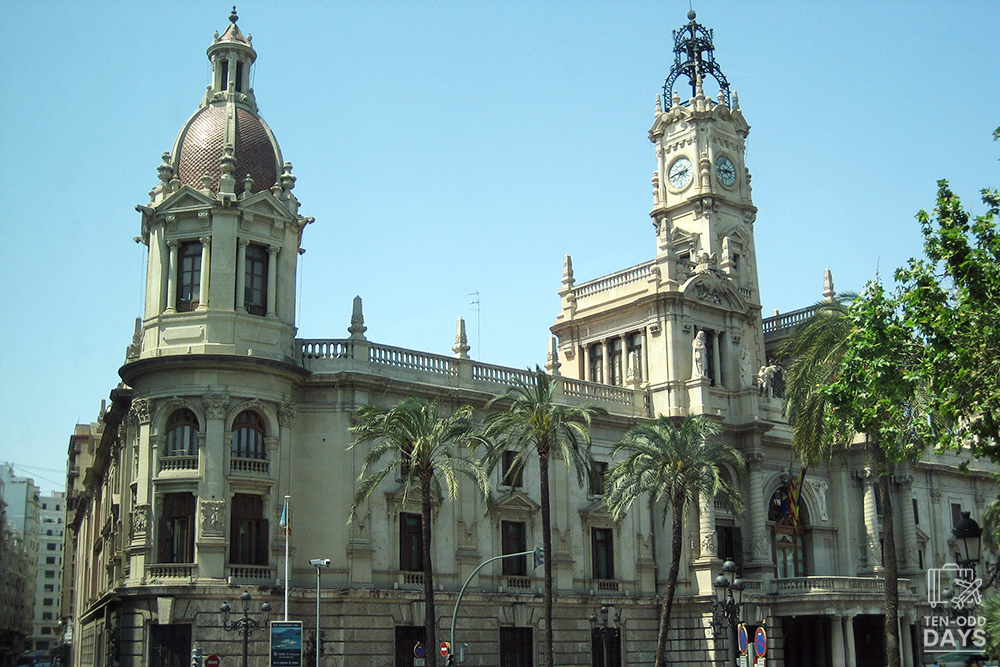
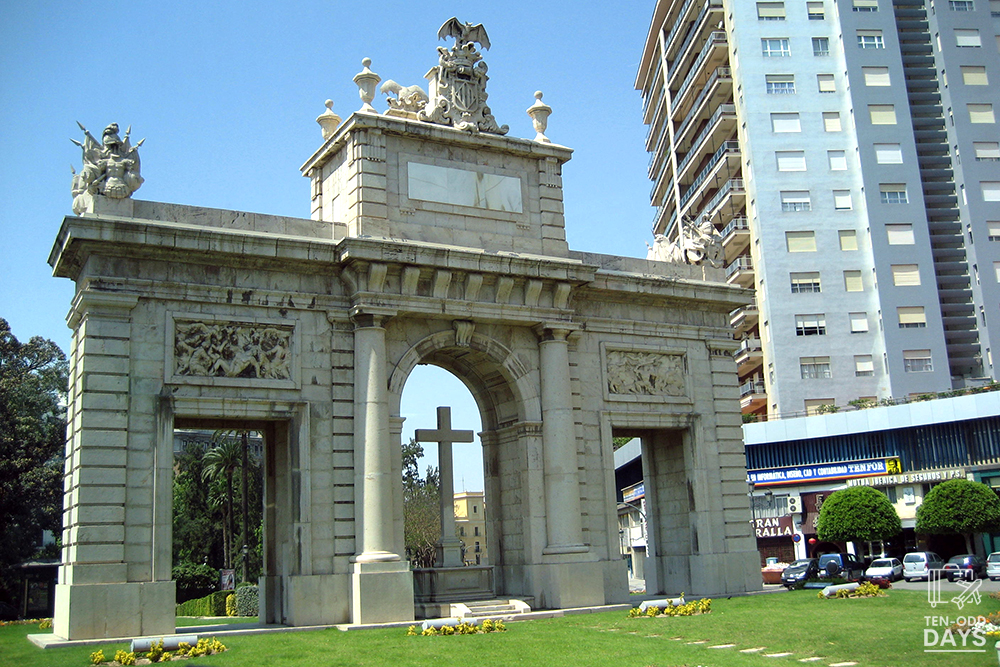
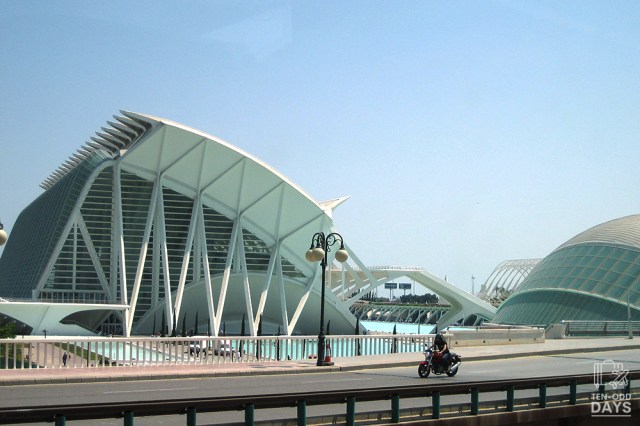
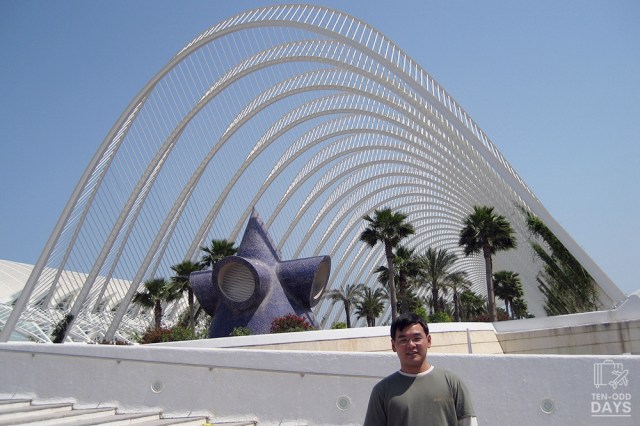
And one of the first things we did was to sight-see Valencia while in the coach. I was thoroughly impressed with the various architecture found all around the city, especially in the centre where Romanesque architecture dominated. We were driven across town to make a stop at the world famous City of Arts and Sciences.
L’Umbracle at City of Arts and Sciences.
Being the most important modern tourist attraction of Valencia, the cultural and architectural jewel that is City of Arts and Sciences feature several futuristic-looking structures including one that resembles the skeleton of a whale and an open-air structure made of numerous arches encompassing plant species indigenous to the region serving as the entrance to the ‘city’. In the ‘city’ there are several museums and other interesting spaces which we unfortunately did not have enough time to explore in further detail..
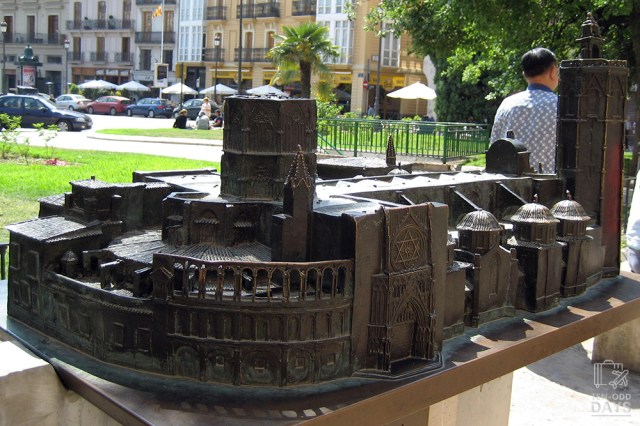
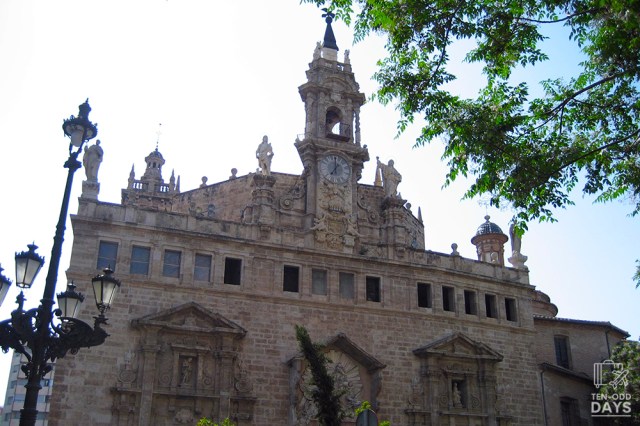
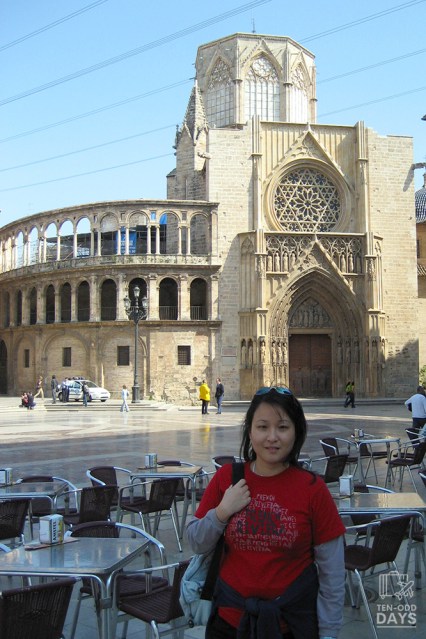
Valencia Cathedral, also known as Saint Mary’s Cathedral, was our next destination. As with most European cities, this church sits in the heart of the old town. It was consecrated in the 13th century as a Catholic Church that was built over the site of a Visigothic church, which was turned into a mosque when the Moors occupied Valencia. This church has a vastly interesting history this way, but hardly unique since we later learnt that the church in Córdoba has a similar history.
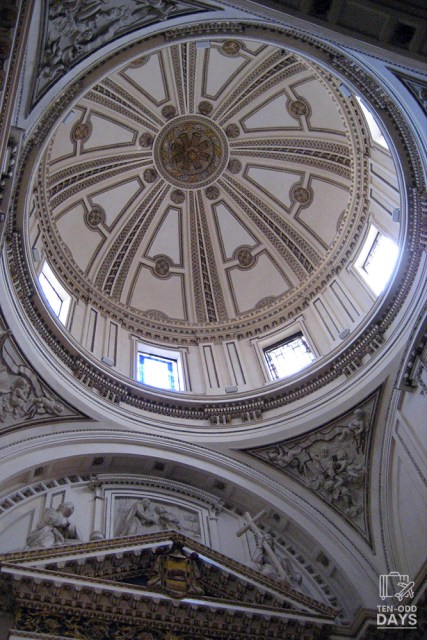
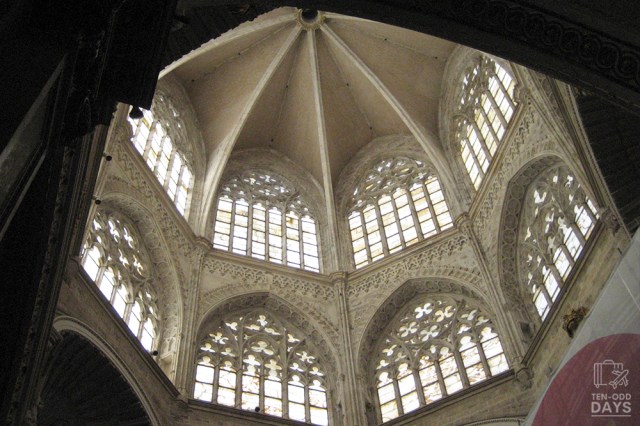
Because the construction of the church was built over two centuries from the 13th to the 15th century, the structure consisted of several different artistic styles, but predominantly Gothic. While the interior does look a little like a mishmash of several architectural styles, the vast majority of visitors to the church miss this as they pay the most attention to the chapel located at the back of the church, for a very important artefact housed within.
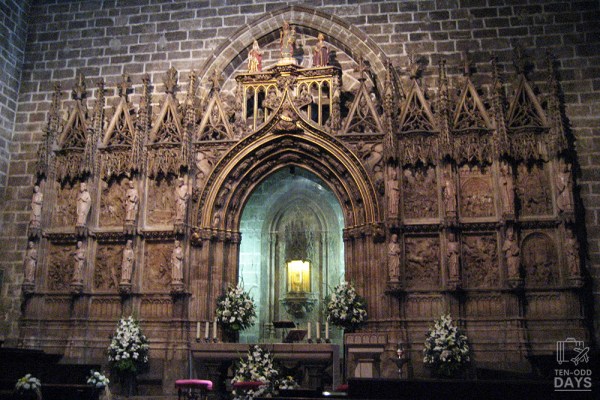
Chapel of the Holy Chalice.
From the standpoint of Roman Catholicism, the Valencia Cathedral is exceptionally important because of the rather nondescript Chapel of the Holy Chalice within the church. Or rather, what the chapel keeps behind the protective glass – the Holy Chalice, also known as the Holy Grail, believed to the cup that Jesus drank from at the Last Supper with his apostles. Religious historians cannot agree on how it travelled all the way to Valencia, and while no one can really prove that this is the authentic Holy Grail, it is probably the most famous of the several Holy Grails there are.
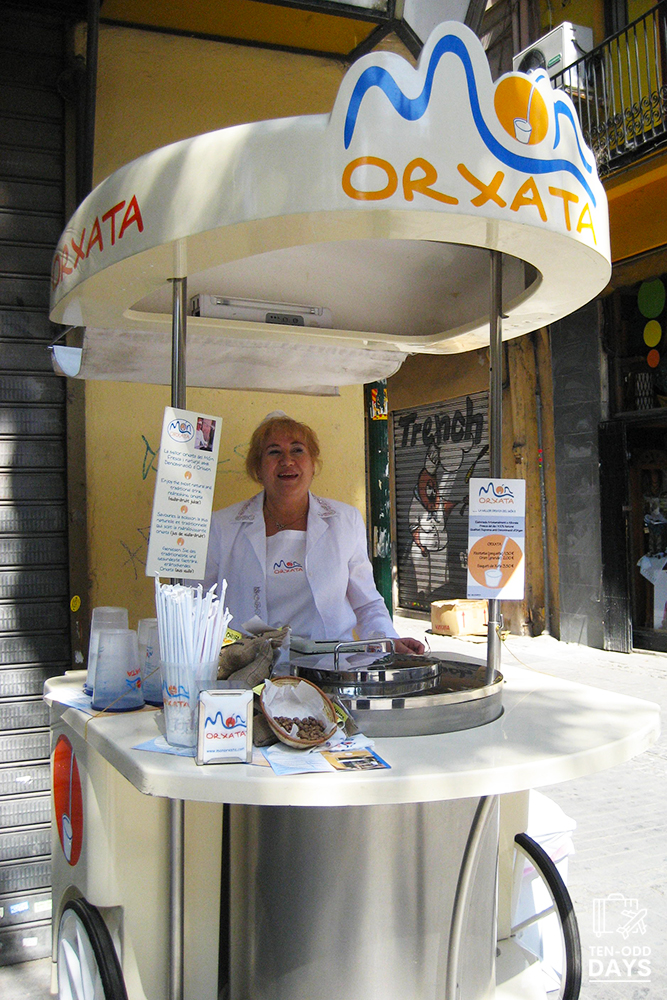
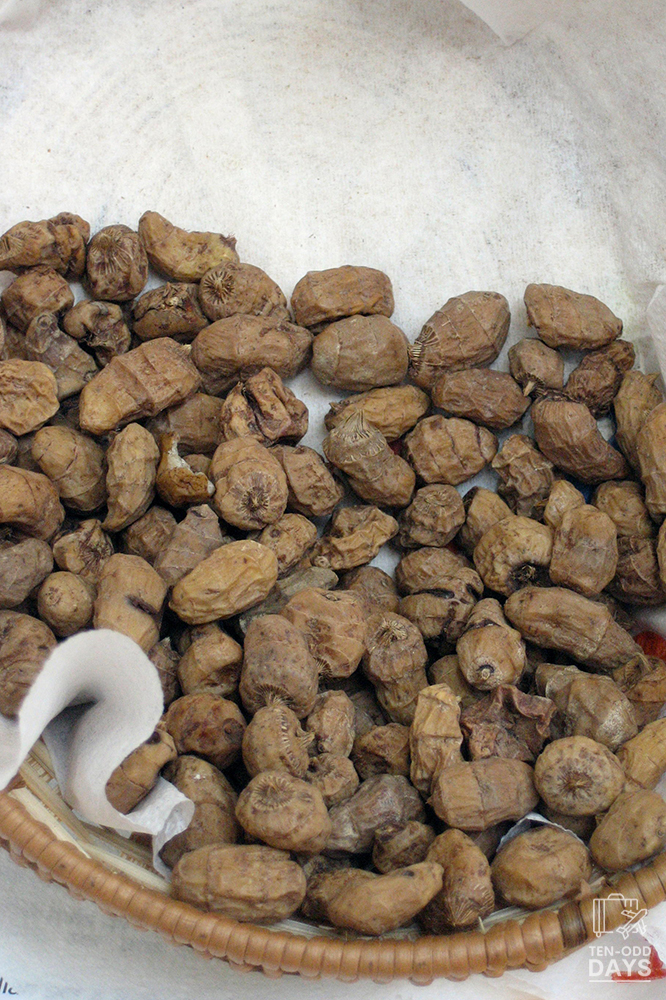
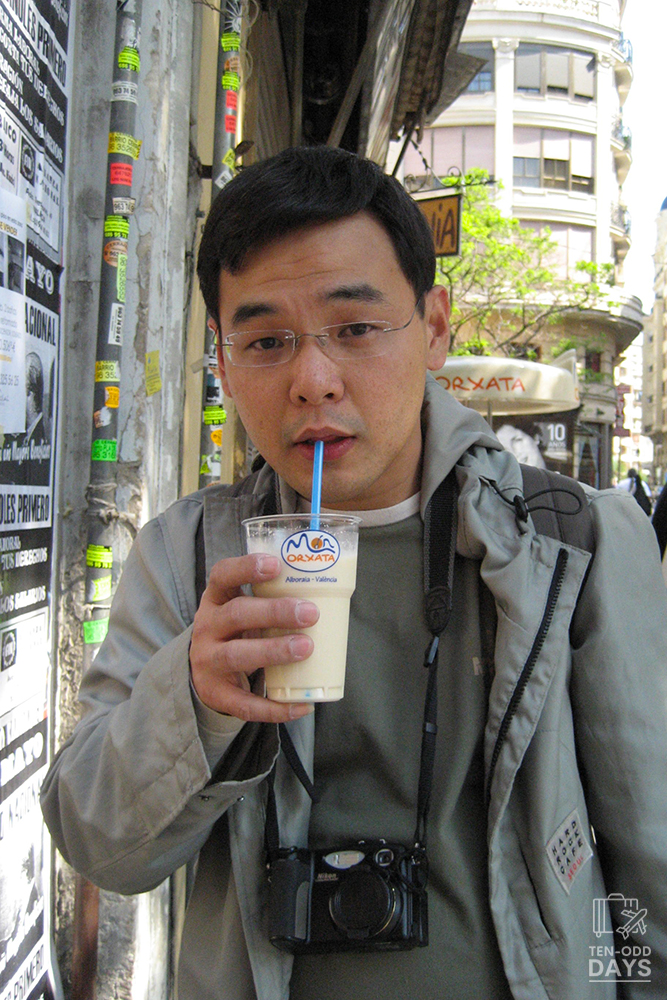
After the immensely interesting guided tour of the Valencia Cathedral, we explored the streets of the city and came across a mobile kiosk selling Orxata. Orxata, a drink made from nuts and apparently unique only to Valencia, originating as far back at the 13th century. Our group crowded around the mobile kiosk and inundated the poor Spanish lady with our orders, curious about the taste. The drink was very refreshing and to be honest, tasted just a tad like the soybean milk that I liked. A welcomed beverage given how scorching hot it was getting.
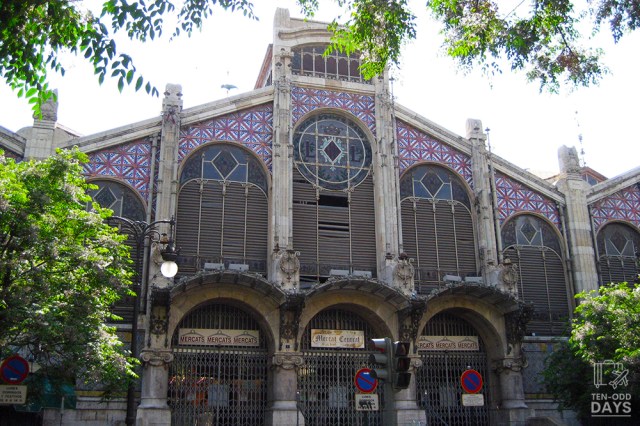
As we continued with our walking tour, we came by an impressive large building that was closed. We were told that this was the market. The Mercat Central of Valencia (Spanish: Mercat Central de València) is claimed to be one of the biggest and oldest markets in Europe. It started out as an open-air marketplace in the 19th century and did not have a roof until 1928 when construction was completed.
Standing across from Valencia Cathedral.
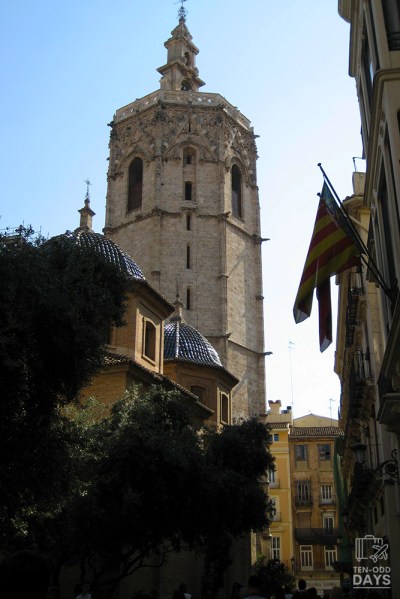
The famous El Miguelete Bell Tower.
We finally rounded up our walking tour with a view of El Miguelete Bell tower attached to the Valencia Cathedral. Like the church itself, the bell tower looked like it was designed by an architect who couldn’t decide on the style he wanted the tower to be built in. This functioning bell tower is a curious sight, for it seems to be incomplete, exposing the large bells. Indeed, the bell tower never finished construction after it was halted for some reason in the 18th century. The final phase of construction never resumed since the locals decided that they liked how the bell tower looked. And this is how this unique-looking tower comes to existence.
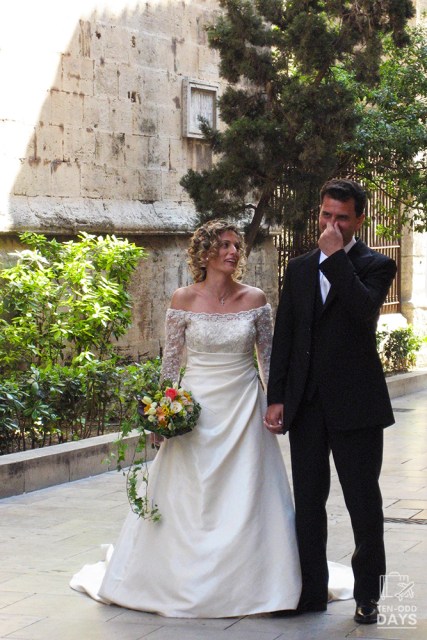
A newly-wed couple we met during our city tour around Valencia.
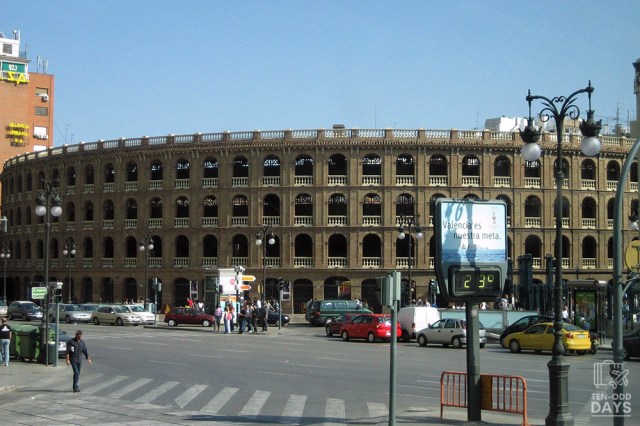
If Plaza de Toros de Valencia (officially Plaça de bous de València) somewhat reminds you of the Colosseum in Rome, that’s because this bullring arena built in neoclassical style in the 1850’s did take inspiration from Rome architecture including the Colosseum and the likes. Situated almost right smack in the city centre, this arena sits over 10,000, making it one of the largest arena in Spain, making it really hard to miss.
Anyhow we passed by (several times) but a pity we didn’t get the opportunity to enter for a visit since we were on a tight schedule. In fact, that was the last landmark we saw of Valencia in daylight. We had to travel onwards to our accommodation for the night before travelling some 500km to our next destination – Granada.
Having had a total of two days in Barcelona, we decided to break away from the group to explore Camp Nou and the city by our own on the second day. Though not avid fans of Futbol Club Barcelona, the soccer-loving mister felt a compelling need to pay a visit to legendary Camp Nou since we were in the very city. It meant that we had to forgo some of the sightseeing included in the package tour but between those places and the largest stadium in Europe, our choice was quite clear.
As the hotel we put up at (Hotel NH Sant Boi) is located in the outskirts, we had to brave the public bus to get ourselves to the city centre (Plaça d’Espanya) where we switched to the metro. It turned out to be less of a nightmare than we thought it would be. Moreover, we had a taste of how it was like to live like a typical Spaniard, even if it were just for one short day.
Plaça d’Espanya is one of the biggest and most important squares in Barcelona as the junction of several major thoroughfares. It also leads to the National Art Museum of Catalonia (in Spanish, ‘Museu Nacional d’Art de Catalunya‘), the national museum of Catalan visual art.
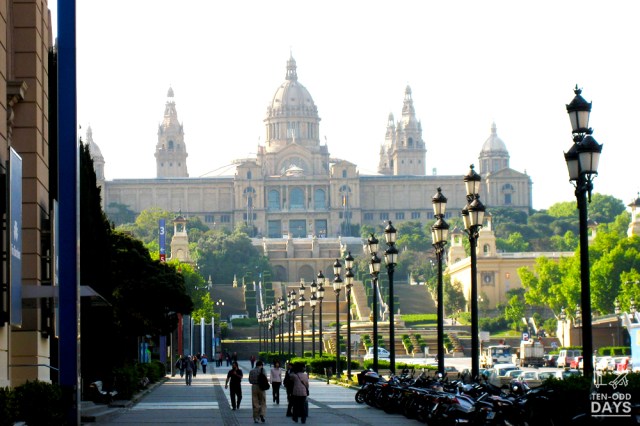
The imposting Museu Nacional d’Art de Catalunya
From afar, the museum building looked an imposing work inspired in the Spanish Renaissance. The lovely classicist facade especially the main dome crowned in roman style called out to us earnestly, especially to the photographer wannabe in me. Alas, with limited time to spare we simply couldn’t visit. Instead we made our way to the metro station, unable to contain our excitement at the prospect of visiting Camp Nou.
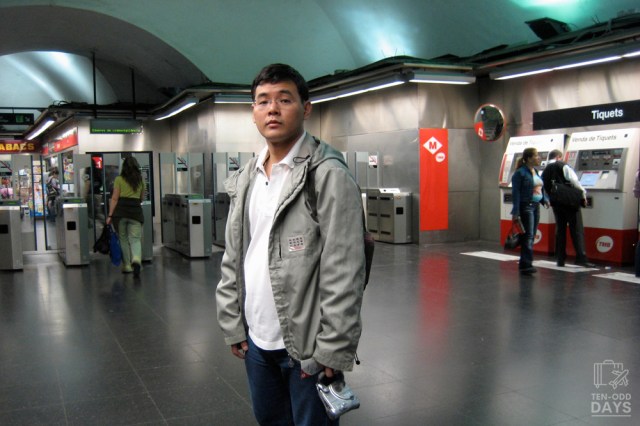
After arriving at the metro station closest to Camp Nou.
We don’t speak a word of Spanish but had little difficulty navigating our way at the metro station – from purchasing the tickets to boarding the correct train. The real challenge we faced came from asking for directions to Camp Nou after alighting at the correct metro station. As with most other major stadiums in Europe, Camp Nou was quite a walk from the metro station. When we initially asked the hotel staff for directions, they gave us precise instructions right up till the point of alighting at the correct metro station. Beyond that, they told us to ask for directions from passersby, who would be able to point us in the direction of Camp Nou.
They couldn’t be more wrong. To our (immense) surprise, the Spaniards we came by spoke little if no English at all. Many got frustrated at not understanding our repeated attempts asking for directions, and we ourselves got disheartened at not being understood. Eventually we approached a young lady manning a booth outside a mall, hoping that the younger generation spoke more of English than the officer workers. She did, but we were made to feel extremely patronised when she replied accompanied with a surly face.
As the saying goes, beggars can’t be choosers. In spite of the treatment we received, we listened attentively and managed to understand her instructions and gesturing. After politely thanking her, we were more than glad to be on our way.
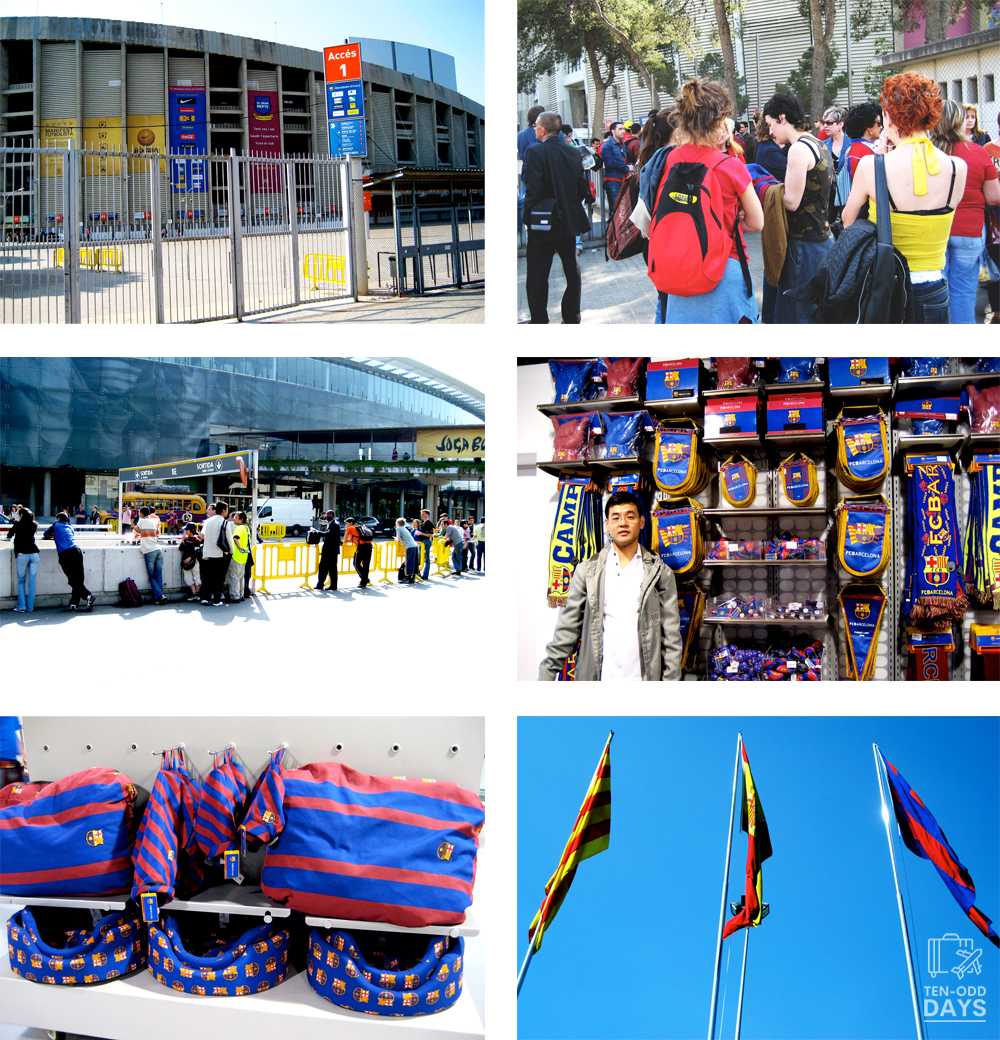
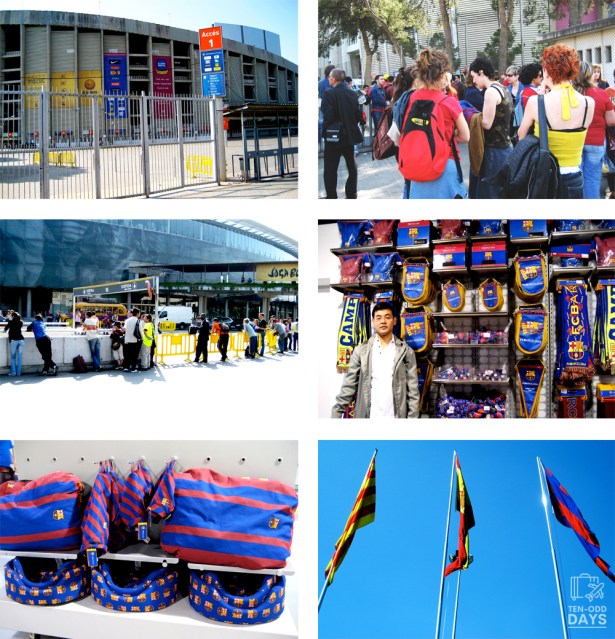
It was not a short walk. Though not physically unfit (the walk was manageable), I was getting irritable by the scorching heat. We first came upon Camp Nou from its side, and I had to agree that it looked humongous just from the side profile (has to be, since it seats almost 100,000). We explored the stadium and were most impressed with the merchandise store. Perhaps it being our first visit to a world-class soccer stadium had something to do with our awe; our eyeballs almost popped out looking at the deluge of merchandise they sold. You name it, they probably sell it.
We had to wait several hours for the tour of the stadium because the home team was having their practice. Unfortunately we couldn’t identify any of them as they drove their flashy cars into the basement car park. Not the other visitors to the stadium though, because some of them were leaning half their bodies out of the ledge trying to catch the attention of the soccer players (I worried for their safety) and screaming at the same time. Fans they must be.
After traipsing parts of the stadium grounds opened to the public, we decided to make a move. The tour was available at too late a timing; we didn’t want to sit around and do nothing in the few hours prior to it. Naturally we headed towards Central Barcelona where the shopping district and La Rambla are situated.
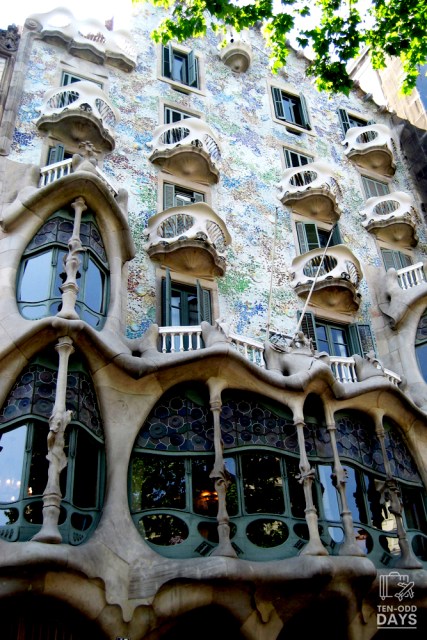
Casa Batlló is a stunning building!
As we were pottering around, we came upon another of Gaudí’s masterpiece – Casa Batlló. Locally it is known as House of Bones due to its visceral, skeletal organic quality. Once again we see the undulating facade that Gaudí seemed to favour very much. Remarkable design, and a total nightmare for the builders I presume.
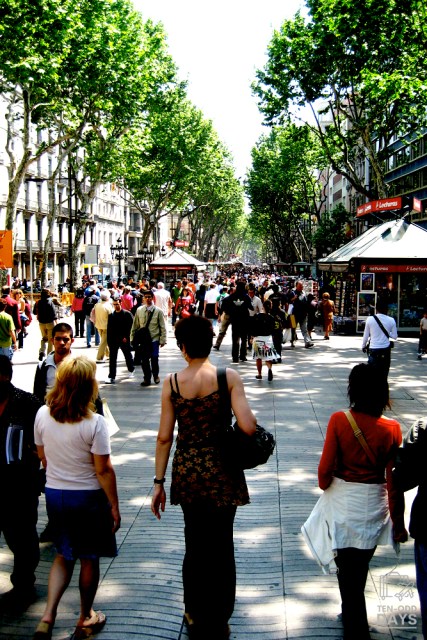
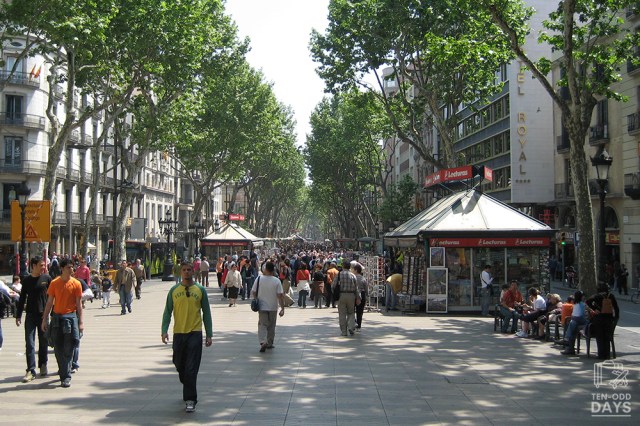
La Rambla was crowded, as expected.
By and by, we found ourselves strolling along La Rambla once again. This time, we spent lesser time on the street itself because our aim was to walk to the end of the street towards Port Vell. It was a weekday afternoon, but one most definitely couldn’t tell from the crowd along La Rambla.
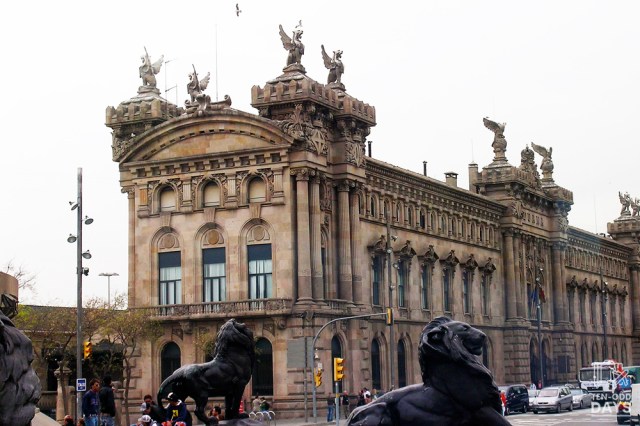
We passed by the Maritime Museum (‘Museu Marítim‘ in Spanish), which I heard is one of the most interesting museums about. We gave it a miss, as with most museums we came by because I would probably take half a day just browsing one museum. I’ve said it more than once that time is not a luxury while on a package tour. it didn’t help that the decision to break away from the group for a day was quite an impromptu one, hence we didn’t do any of the requisite homework we should have. If we had, we might have better managed that one day in Barcelona.
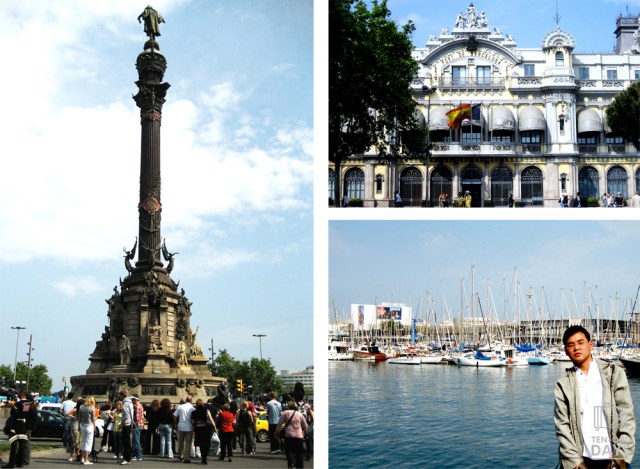
The Columbus Monument (‘Monumento a Colón‘ in Spanish), a 60 m tall monument stands at the site where Christopher Columbus landed in Spain after his first voyage to the Americas. It doesn’t look very apparent from the photograph, but the statue of Columbus had his right hand outstretched pointing towards The New World (as believed). Many, many tourists were crowing around the monument so it was quite an arduous task trying to get near the monument at all. We gave up eventually and simply took a picture of it across the street.
Port Vell, a waterfront harbour and part of Port of Barcelona, was a short walk away. Once a run-down area of empty warehouses, railroad yards, and factories, it underwent an urban renewal program prior to the 1992 Summer Olympics. And this is the result. We totally loved the vibrancy of the harbour. The way the warm sea breeze gently caressed our faces and the sailboats easily cascaded to the waves… reminded us a lot of home. Could be the reason why we took to the harbour immediately. Fancy us being homesick on the 2nd day of our tour. 😆
Mention this city located on the North-Eastern coast of the Iberian Peninsula facing the Mediterranean Sea, and several images come to mind: the Port of Barcelona, La Rambla and Camp Nou. After a short and uneventful transit at Amsterdam Airport Schiphol, we landed at Barcelona El Prat Airport on a cloudy, balmy day. Almost immediately, we were whisked off to commence our tour of the City of Counts once we cleared the customs.
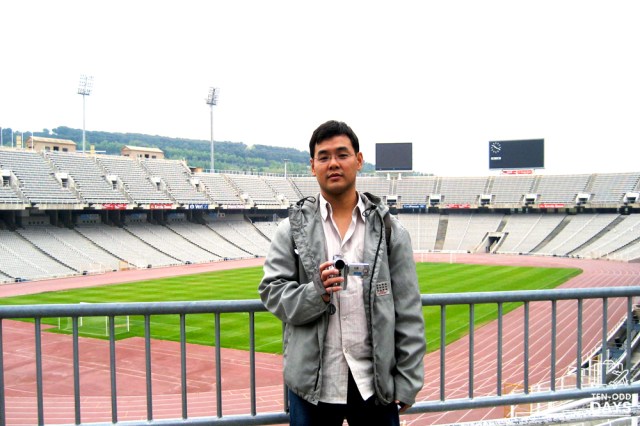
The mister still looking fresh after a long red-eye flight from home.
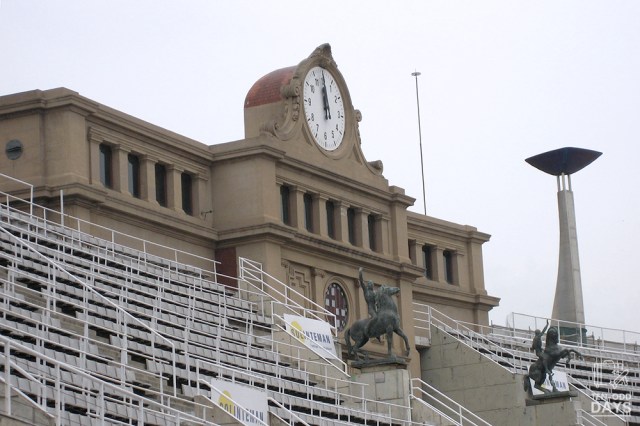
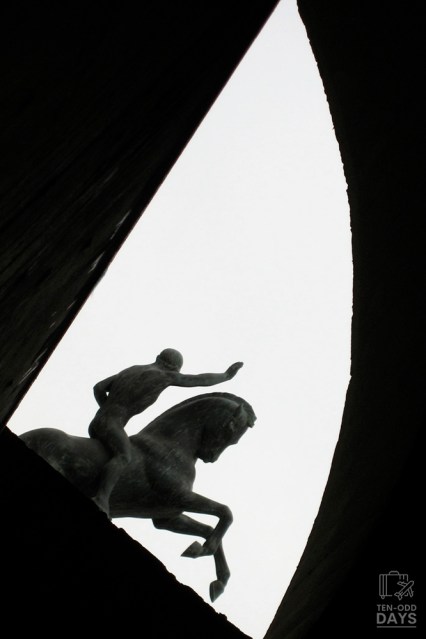
Our first stop – Barcelona Olympic Stadium (or Estadi Olímpic Lluís Companys, as renamed in 2001). The stadium was originally built in 1927, and renovated in 1989 in preparation to be the main stadium for the 1992 Summer Olympics. Today, the stadium continues to play host to some of the most important sporting events Barcelona sees. It also hosted numerous concerts held by several famous artists including Bon Jovi, Madonna, Rolling Stones and Shakira, just to name a few.
By a stroke of luck, we found the stadium to be relatively deserted. Perhaps it being mid-day had something to do with this seemingly odd phenomenon at otherwise a rather important landmark of the city. Shortly after, we were ferried to another place for more sightseeing.
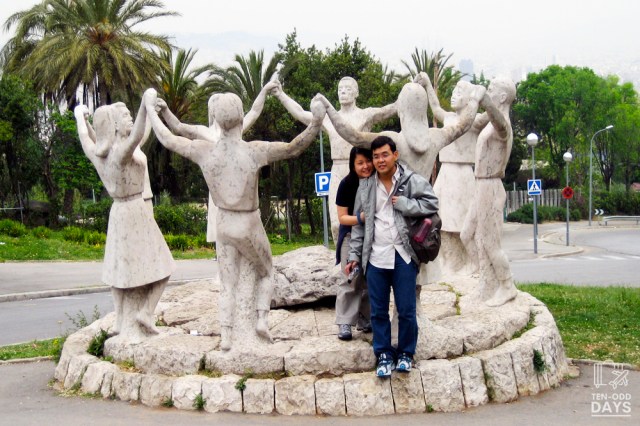
One important cultural aspect of Catalonian Barcelona is the Sardana Dance symbolising unity and pride. Circles of people join their raised hands and slowly dance round and round with small, precise steps. The circles become bigger as more people join in the dance, and eventually when the circle becomes too big, it may break into several smaller circles. Usually, all are welcomed to join but it is good to observe how to do the dance properly prior to jumping in because a wrong move could really upset the rhythm of the whole circle.
Given the significance of the Sardana Dance, little wonder that we came across a delightful monument depicting the unity dance on Montjuïc, a broad shallow hill with a relatively flat top overlooking the harbour, to the southwest of the city centre. The monument, known as La Sardana de Montjuïc, was completed by Josep Cañas and officially commissioned at Montjuïc Park in 1966.
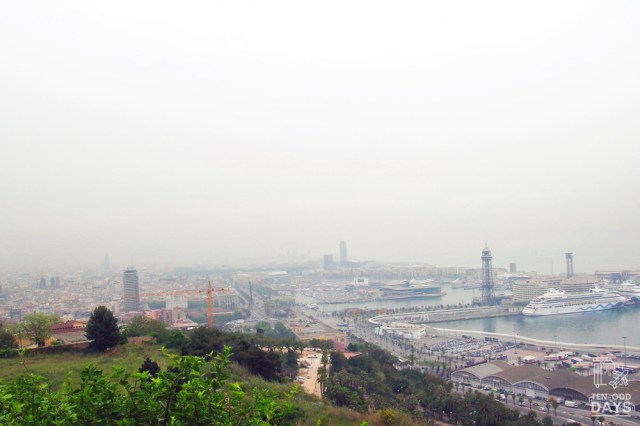
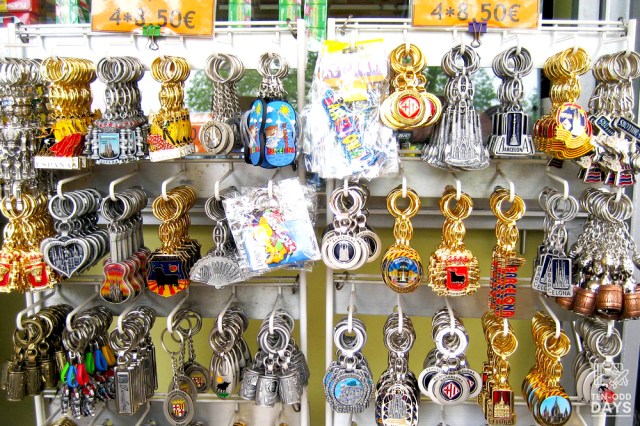
Panoramic view of the port of Barcelona.Inexpensive souvenirs for family and friends.
The monument was not the only reason why we found ourselves on Montjuïc. There, we were also greeted with a scenic panoramic view of Barcelona. Montjuïc Park seems like a must-visit for all tourists to the city because while we were there, tour buses were constantly offloading more and more tourists at the park. Apart from the view (which must look better on a clear day), the park came complete with a small cafe and mobile vendors selling keychain souvenirs. It only took us mere minutes to fulfill our responsibilities (with the requisite souvenirs) to our family and friends.
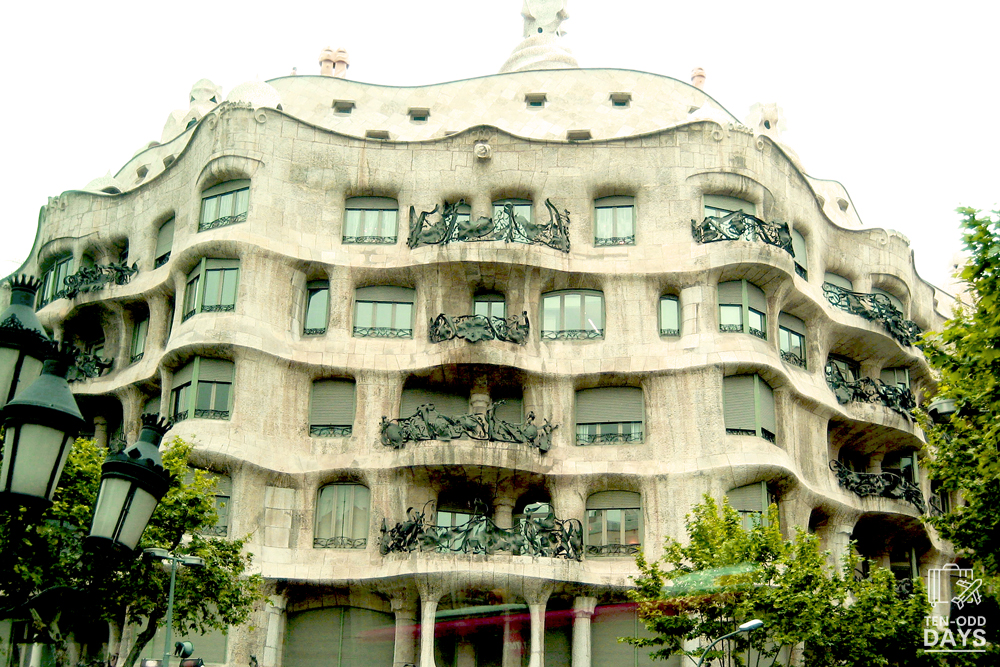
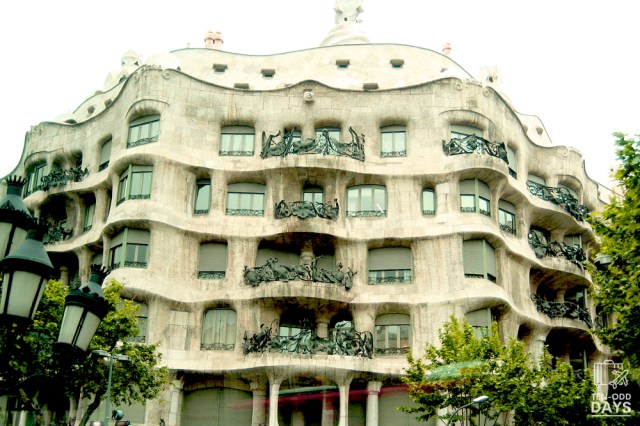
After a late lunch, we were brought around on a city tour where we saw numerous notable landmarks, in particular houses designed by Antoni Gaudí. Right from the start, Gaudí the architect thought very differently from his contemporaries. He loved nature and his designs were greatly influenced by different forms of nature. La Pedrera (or Casa Milà)with its bold forms of the undulating stone facade is a fine example.
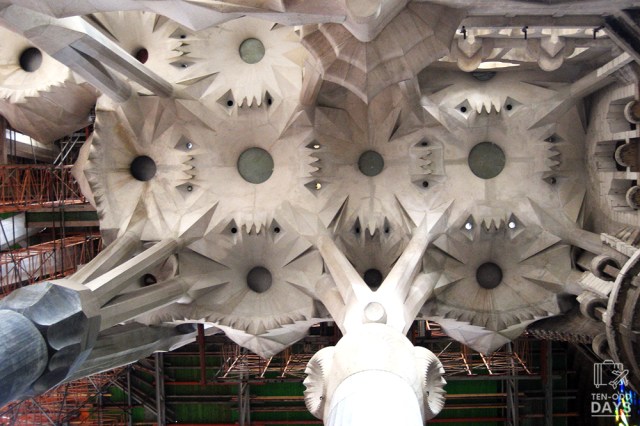
Interior ceiling depicting sunflowers.
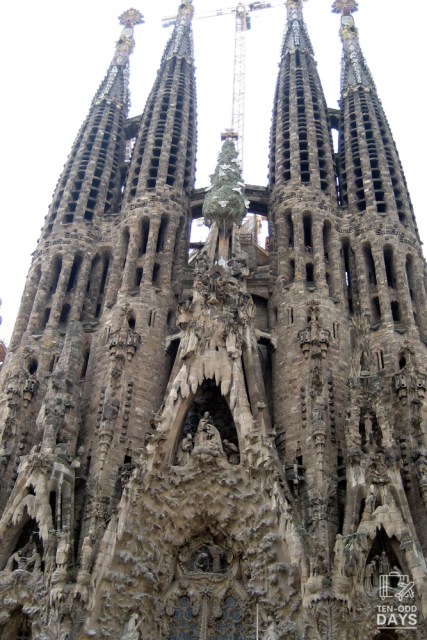
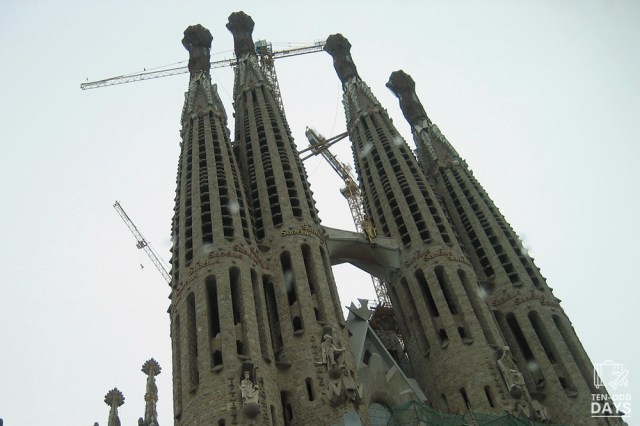
La Sagrada Familia is probably the singular most famous landmark ever to be associated with Gaudí and maybe even Barcelona. This large Roman Catholic Church commenced construction in 1882, and till today, is still incomplete. The construction progressed so slowly largely due to the fact that funds were coming in solely via private donations, not to mention the interruption of the Spanish Civil War. It is largely anticipated that the church will finally be completed by 2026, on the centennial of Gaudí’s death. Whether it can be completed on time remains much to be seen. If it does, we really should revisit Barcelona that same year, some 20 years after our first visit.
Construction of the Passion facade was still very much underway.
There are 3 grand facades to the church building – the Nativity facade to the east, the Passion facade to the west, and the Glory facade to the south. The Nativity facade was the first to be completed and directly bore most of Gaudí’s influence. At the time of our visit, only the Nativity facade was truly complete; both the Passion and Glory facades were still undergoing construction, especially the latter. Without a wide-angle lens, there was just no way one could take in the whole facade of the cathedral, which stood at an astounding height including the spires.
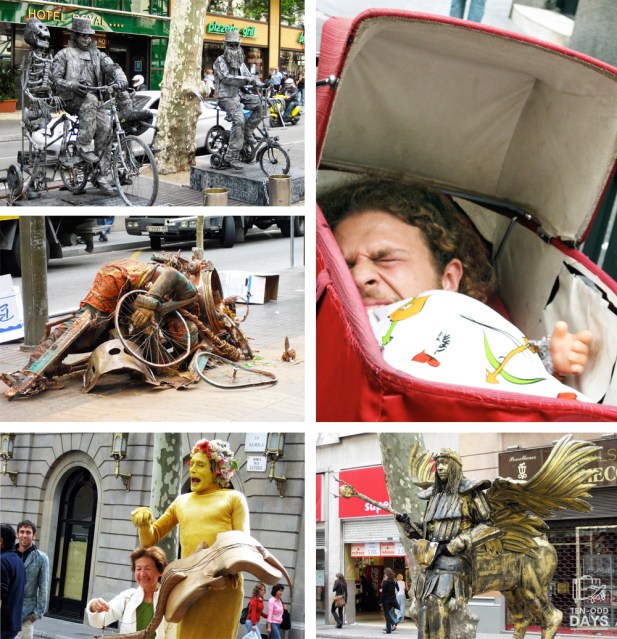
Our last stop for the day prior to dinner was a visit to La Rambla (‘Las Ramblas‘ in Spanish), a street in Central Barcelona lined with kiosks, stalls selling flowers and animals, buskers, street performers, cafes and restaurants. The promenade is therefore, a place to see and to be seen, for locals and tourists alike. However in recent years, more tourists than locals like to linger along the streets, and that has somewhat changed the character of the streets and the nature of businesses plying along the promenade considerably. Tourist crowd during the high season has also attracted many pickpockets to easy prey in the form of inattentive tourists.
Walking down La Rambla was quite an experience in itself. The street performers lining along two sides of the street were most impressive, and totally devoted to their trade. We’ve seen street performers prior to this visit, but never with such amount of vivacity and dedication. From the sheer ingenious to the downright absurd, we’ve seen it all. In fact we think we’ve seen the best here in La Rambla, Barcelona.
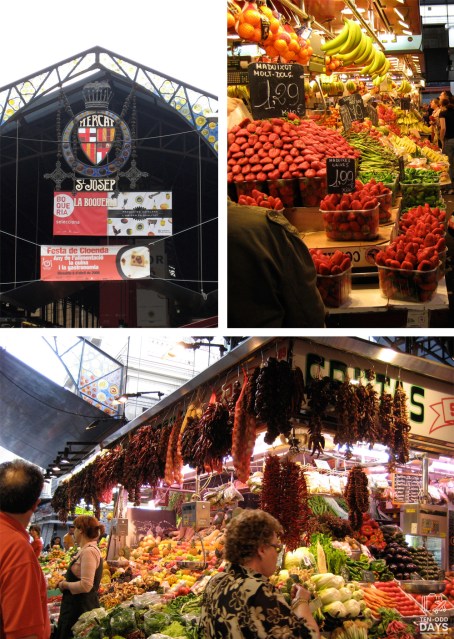
As we walked on, we came by this enthralling bazaar of sorts and decided to explore further. It turned out to be a wet market selling groceries and sweets. The surfeit of colours were so vibrant we felt like purchasing some of them, especially the fruits! Unfortunately time was not on our side. We left the bazaar after briskly walking through it and made our way back to the coach.
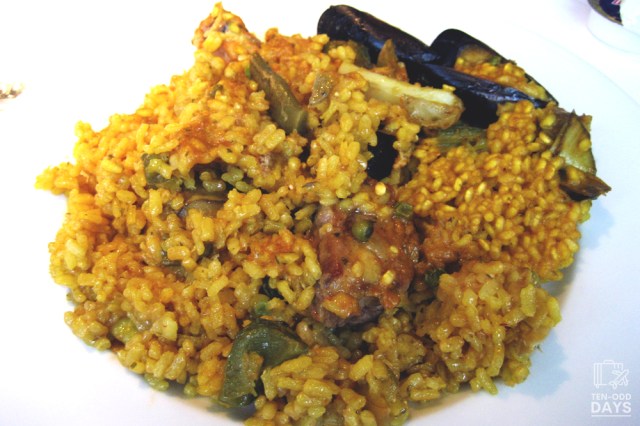
That evening, we were brought to a restaurant called Marina Moncho’s by the marina to have probably the most delicious seafood paella we’d ever eaten in our whole lives. It was our first time with paella and what a fine example it was. Never got to taste seafood paella that comes anywhere close since.
TRIVIA: Barcelona, nicknamed the City of Counts (‘Ciutat Comtal‘ in Spanish), is the capital of Catalonia (an autonomous community of Spain) and the second largest city in Spain, after Madrid the capital. This moniker came about as sort of a commemoration to the Counts of Barcelona who took control of the city at the beginning of the 9th century. The counts became increasingly independent and expanded their territory eventually to control the whole of Catalonia. Barcelona is often erroneously abbreviated as Barça, which is used exclusively to refer to FC Barcelona. The locals commonly used the abbreviation ‘Barna’ instead.
Switzerland’s official name is Swiss Confederation (Confoederatio Helvetica in Latin) hence explaining its official abbreviation CH.
Switzerland is a land-locked country in Western Europe bordered by Germany to the north, France to the west, Italy to the south, and Austria & Liechtenstein to the east.
The capital of Switzerland is Bern, not Zurich. Bern is the seat of the federal government, which makes it the de facto capital. The largest city is Zurich.
The President of Switzerland is elected once every year.
Switzerland is not part of the EU, and they use their own currency and legal tender – the Swiss Franc.
There are four official languages in Switzerland, namely German, French, Italian and Romansh.
Switzerland has no official state religion. Most of the Swiss are either Roman Catholics or Protestants.
Brietling, Cartier, Chopard, Franck Muller, Jaeger-LeCoultre, Omega, Patek Philippe, Rolex and TAG Heuer are some of the renowned Swiss watches.
Headquarters of the International Red Cross is situated in Geneva while the Headquarters of International Olympic Committee in Lausanne.
The Swiss has the 2nd highest life expectancy, after Sweden.
Expectations were feverishly high because it was after all (pricey!) Europe and well… our honeymoon. The honeymoon. One may travel to many places in his entire lifetime and promptly forget about some of these places several moons later, but nobody forgets the honeymoon.
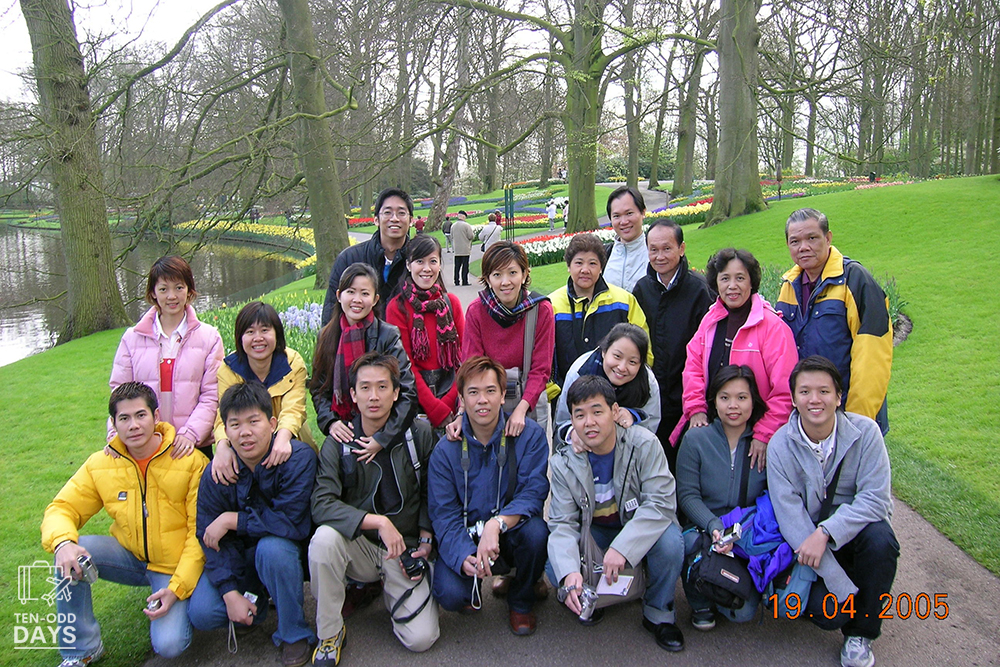
As luck would have it, our honeymoon turned out to be nothing short of perfect. The itinerary was unsurpassed, the tour leader unrivalled, and the company unparalleled. Our group was manageably small with only 19 adults including 3 other pairs of honeymoon-ers like us, and everyone was pleasant, jovial and considerate.
If anything, I only have two minor grouses – we didn’t get to see much of Rome and totally missed out on Vatican City because of late Pope John Paul II’s funeral. I also didn’t particularly enjoy the incessant rain, in which we were told was not in congruence with Europe’s usual climate in April. I didn’t remember this, but the mister recalled that the rain started shortly after we landed in Rome, and only stopped after our day trip to Volendam in The Netherlands. He knew it for a fact that it wasn’t raining prior to 8 Apr 2005 because of a colleague who left Rome the day we arrived – apparently it was the only day which rained in the week she was there.
We were in Volendam on 19 Apr 2005 having our dinner of fish & chips when our Italian coach driver (who is a Roman Catholic) announced that the new Pope had been elected. It was raining bucketfuls of cats and dogs prior to dinner, but reduced to a drizzle when we were done with our scrumptious dinner. By the time we arrived at our hotel, the rain had completely stopped.
Was it a coincidence, or was there divine ‘intervention’? The oddity of the rainy season occurring within the period of sede vacante (Latin for ‘the seat being vacant’) of the Holy See, which promptly ended with the cessation of sede vacante – seemed to suggest that it was more than mere coincidence. We are not deeply pious people, but… it was some food for thought.
Our honeymoon coincided with the funerals of late Pope John Paul II and Prince Rainier III of Monaco, and the wedding of Prince Charles & Camilla Bowles. As you could see, we visited Europe during a very, for lack of a better word, interesting time. The trip was quite the eye-opener – we learnt how and why a papal conclave is convened, the difference between white smoke versus black smoke, Grace Kelly (not the bag!) and the House of Grimaldi from the Principality of Monaco. Speculations on the identity of the next Pope and expostulations on the sovereignty of Monaco considering Prince Albert II’s lack of a lawful heir totally preponderated the European, if not the world’s, prime time news. The media were having a series of field days.
We thought that Jeffrey Hoh, our tour leader, is the very epitome of an exceptional tour leader. He totally blew our minds with his experience, general knowledge, even temper and high level of service orientation. Following Jeffrey’s tradition of bestowing every tour group with a specific name (to distinguish all the groups he’d ever led), our group was aptly titled ’2 Funerals & a Wedding’. He professed that it would be difficult to forget our group given the unusual events facing Europe during our travel. He held true to his words, because several years later, he found and added the both of us as his friends on Facebook.
Regrettably, we’d lost contact with almost everyone in the group, with the exception of Kenneth and Sharon. If you are, or know any of our group-mates from the picture above, please email us at tenodddays[at]gmail[dot]com. We’d love to re-connect!
‘Of all the countries you visited, which is your favourite?’
We got asked this question umpteen times, by friends and family alike, following our return to reality. Not trying to play favourites here… but we have to concede that we enjoyed Italy the most. Something about the Italians’ honest charm, warmth and gregariousness tugged at my heartstrings – possibly because being reticent and bashful by nature, I couldn’t be more different than they are. The mister readily agreed with me, for an entirely different reason, I suspect – he had been raving incessantly about the unlimited potently flavoursome shots of espresso he got to enjoy at breakfasts in Italy.
Check out CTC Travel if you would like to trace our footsteps. While we do not sanction a package tour for seasoned travellers, we highly recommend it for virgin travellers (to Europe) who have no inkling of their travel likes and peeves, as a starting point.
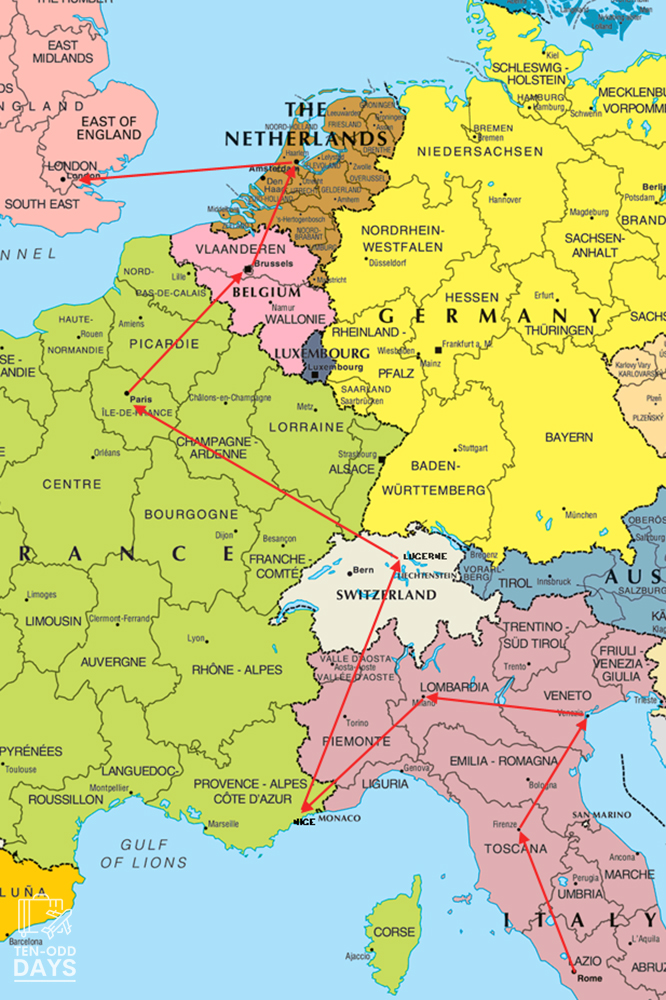
Not that Lake Maggiore in Italy, Brussels in Belgium and London in England are any less important, but they have been lumped together simply for convenience’s sake since we spent very little time in these cities and it seemed appropriate to put them together in a post (rather than completely omitting them).
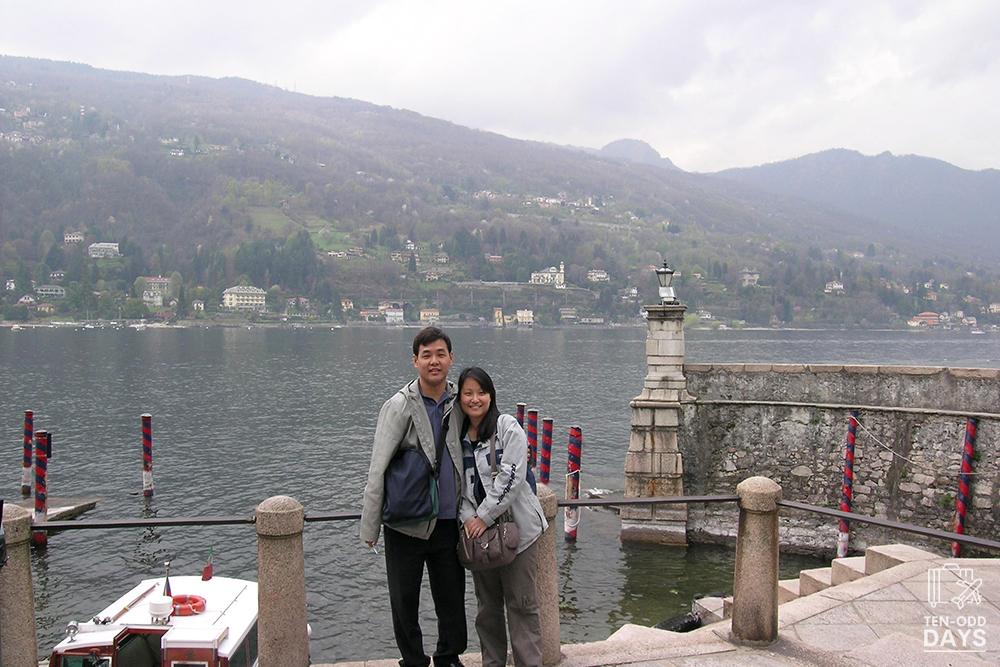
Took a couple pic at the dock of Isola Bella.
While on the way from the French Riviera to Lucerne, our coach made a stop at Lake Maggiore (Italian: Lago Maggiore). For this detour, we have our experienced tour leader to thank. I’d been to England’s Lake District years back, and I loved it there. Italy’s Lago Maggiore and its vicinity was equally charming.
A boat hire was necessary to bring us across the lake to Isola Bella, one of the Borromean islands of Lago Maggiore. We both liked Isola Bella a lot. For starters, this quiet little island was not swarmed with tourists. It was also a good break for us all, to be amidst Mother Nature instead of built-up cities. We didn’t have a lot of time to fully explore the island, but I do remember that a small trattoria on the island served about the best fare we had on the whole trip. We had nothing fancy for lunch, just simple pasta (the mister had aglio e olio). It was mind-blowingly delicious!
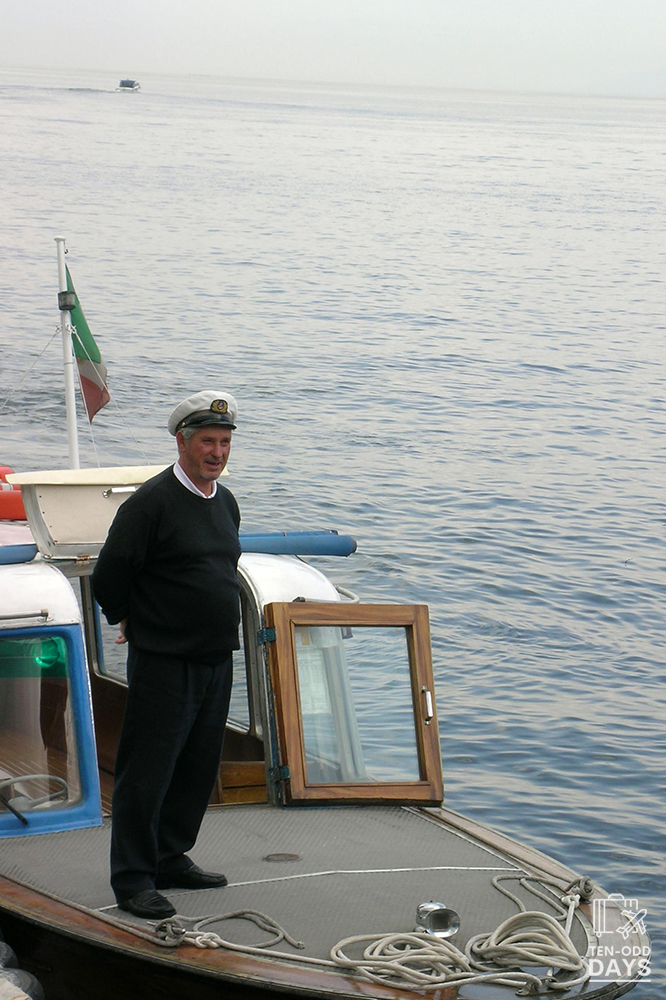
Our boat captain.
Before we knew it, it was time to leave the island. We did after all have quite a distance more to travel. Here is a parting shot of the friendly boat captain who traversed us across the lake to and from Isola Bella.
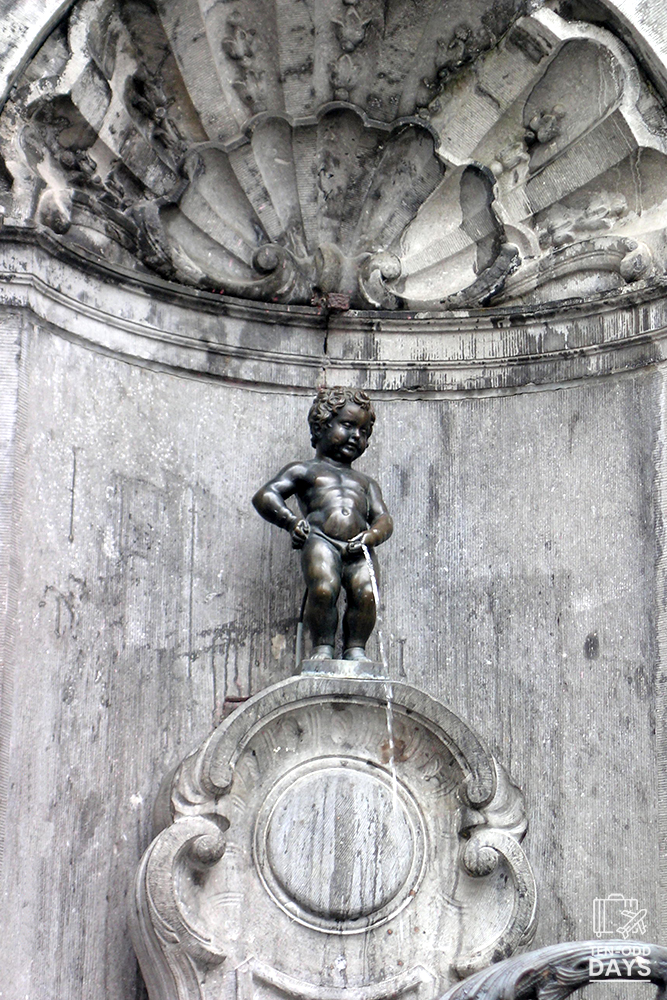
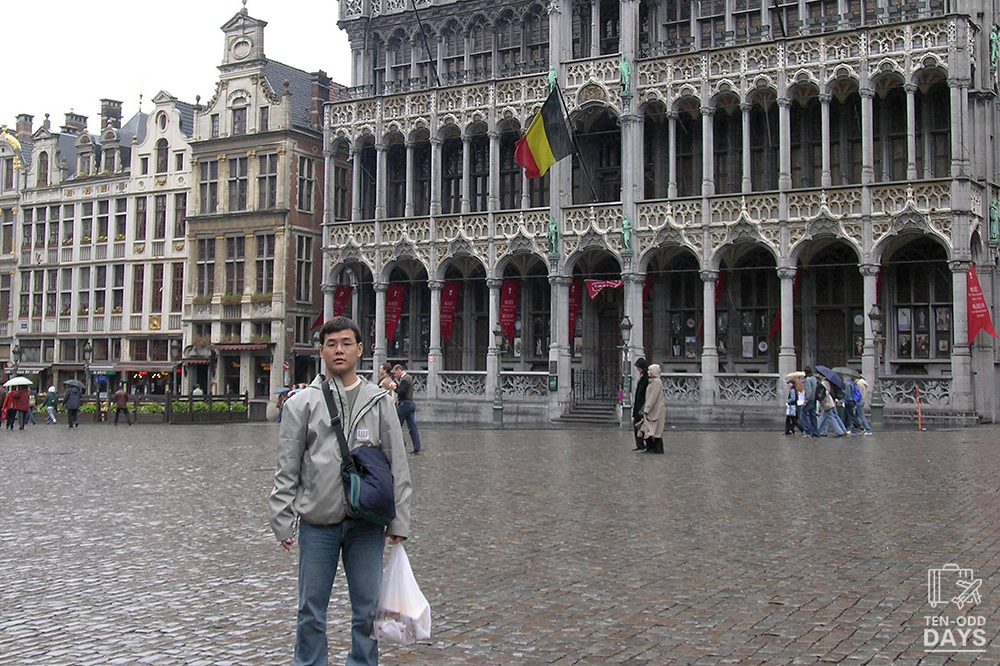
Brussels in Belgium was another day tour we made while travelling via coach from Paris to Amsterdam. We were supposed to come by many sites including the Atomium, the Chinese and Japanese pavilions etc. but it was raining incessantly. Rain… a definite mood dampener for me. Because of it, we never got off the coach till we arrived at Grote Markt (the central square of Brussels). We saw Manneken Pis who, unfortunately was buck-naked, and not dressed up in any costume. The 61cm tall bronze statue that we saw was of course a mere copy from 1965 and not the original. We were told that the original statue was kept locked up in at Maison du Roi on Grote Markt itself, presumably to foil any future plans of stealing it.
Was rather disappointed to see buck-naked Manneken Pis, not dressed in any costume.
And we came across numerous shops selling Belgium chocolates. It was where we went quite crazy shopping for chocolates to bring home to family and friends since we were only left with Amsterdam and London before headed for home. Here, on the historical square of Brussels, I first heard about the folklore of Lady Godiva and the origins of the term “Peeping Tom”. It was also here that I finally decided that I do not fancy Belgium chocolates. Too bitter for my tastebuds.
We had a good couple of hours to ourselves, and thoroughly explored the historical centre of Brussels. With it being a rainy and gloomy day, we hardly took out the DSLR to take pictures. There is really nothing I hate more than rain when travelling.
London needs no introduction. Please don’t be offended if you are a Londoner or is a fan of London, but if there is any city I’ve come across that I felt is grossly over-rated, it is London. Considering that I made up my mind about this metropolitan city at the age of 17 (and felt strongly about it) it had to count for something, because at that impressionable age, I was greatly undecided about most things.
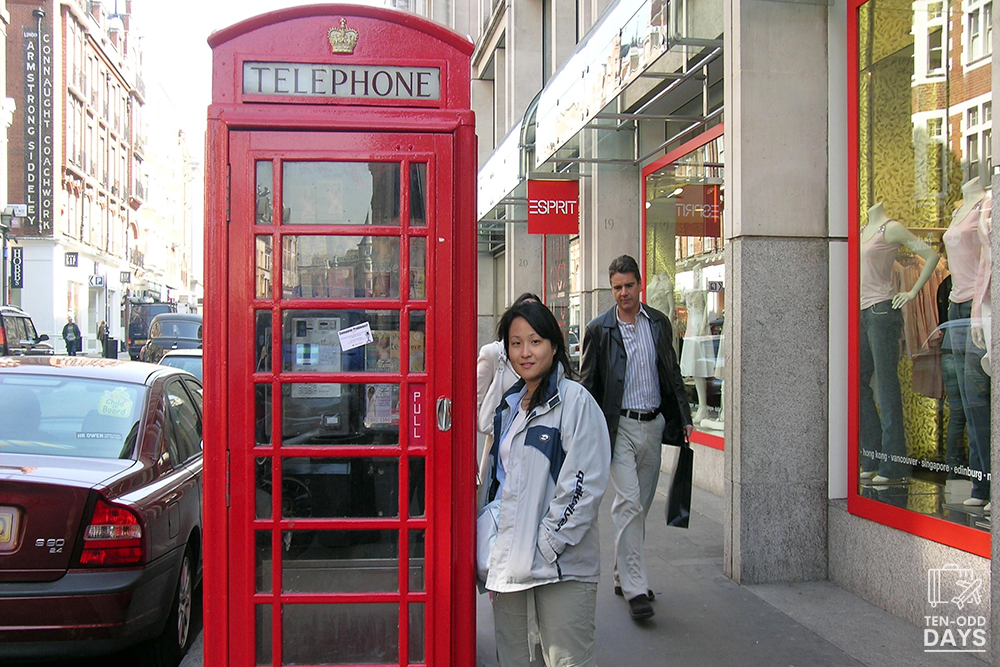
Since we had very little time in London after flying in from Schiphol Airport Amsterdam, we broke from the group after checking into our hotel in Knightsbridge. While the group went visiting the usual touristy places like Trafalgar Square, London Bridge, Big Ben, Buckingham Palace, Westminster Abbey and the likes, we headed straight for Old Bond Street and Oxford Street. If these two streets reek of a shopping haven to you, you are quite right. I was however, not there to shop for the usual stuff women shop for: I was there for the old-style bookstores and bookbinders. 12 years ago, they were all over Oxford Street. Alas, 12 years later, I had serious trouble locating even one of them. Must have given way to the more commercialised and profitable shopping trade in the name of ‘progress’. 😦
We took the least amount of pictures in London since we were busy soaking in the commercialised aspect of the city. On hindsight, it was a rather self-serving decision on my part not to revisit the usual sights in London. After all it was the mister’s first visit to London. Although he was very agreeable to break from the group, he wouldn’t know what he was missing since he’d never been. My conscience has been weighing heavily on me these years because of what he missed as a result of my wilfulness. I promised to make it up to him; one day we would do an extensive fly-drive tour of England, including a visit to the mecca of every Manchester United fan – Old Trafford. It is my dream to watch a live match between the red devils and the reds but the mister fears my safety because well… football hooliganism is very real. We have not sorted this out yet, but will. Soon.
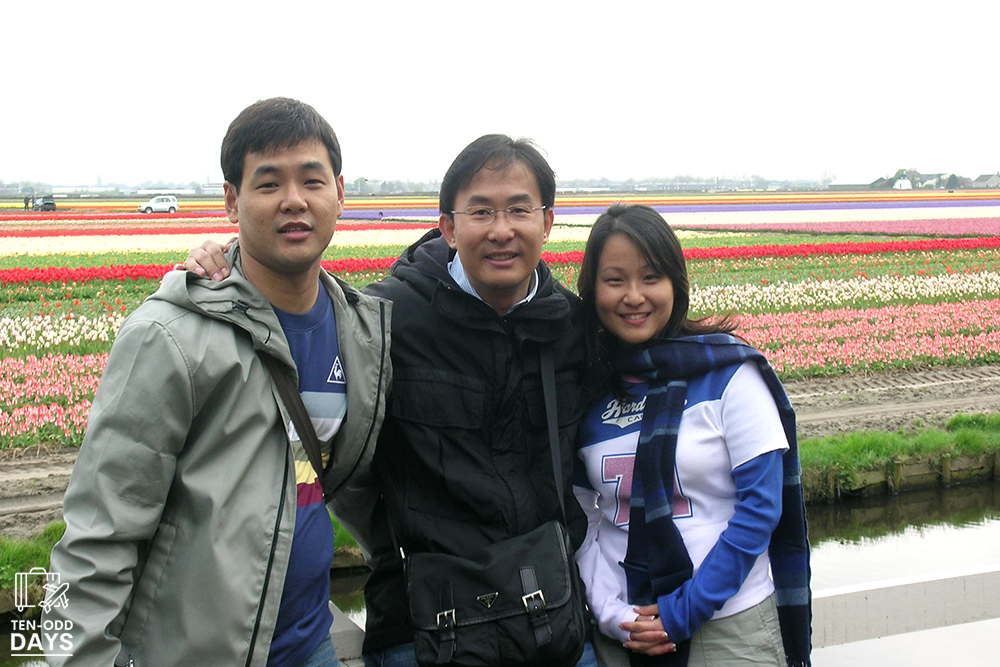
Contrary to popular belief, not all women are partial to flowers. I am one such exception. Apart from two white flowers – tiger lilies and white cymbidiums – no other flower, however resplendently packaged in a bouquet, catches my eyes. We were therefore expectedly not looking forward to visit The Keukenhof despite much hype amongst our group mates. Little did we expect ourselves to be in for a pleasant surprise.
The Keukenhof, the world’s largest flower garden located near Lisse in Netherlands, opens annually between the last week of March and mid-May. During its opening, stunning displays of blooming tulips and horticultural mastery greets hundreds of thousands of visitors from all over the world. It is sometimes also aptly called the Garden of Europe.
We started the day insanely early – at least it was so for me – hoping to be one of the earliest groups to reach The Keukenhof. Granted, we were one of the earliest, but there were already another 10 or so tour groups ahead of us, judging from the number of coaches at the parking bays. I wondered how early they woke up and set off to reach this early? Encouraged instead of being disheartened, we joined the rather long queue with much gutso.
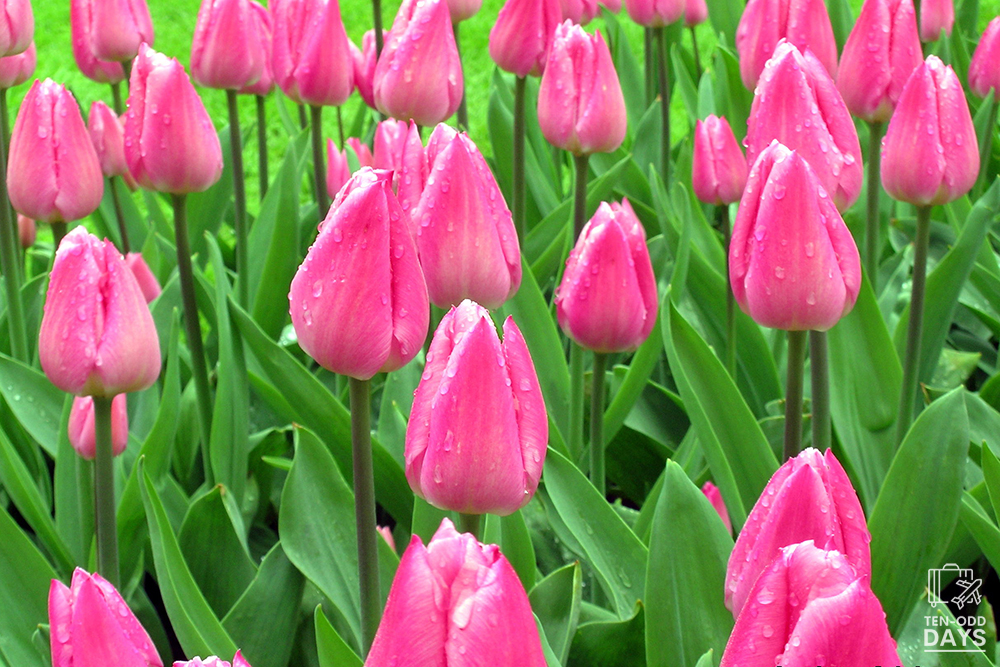
Some lovely tulips in hues of bright pink.
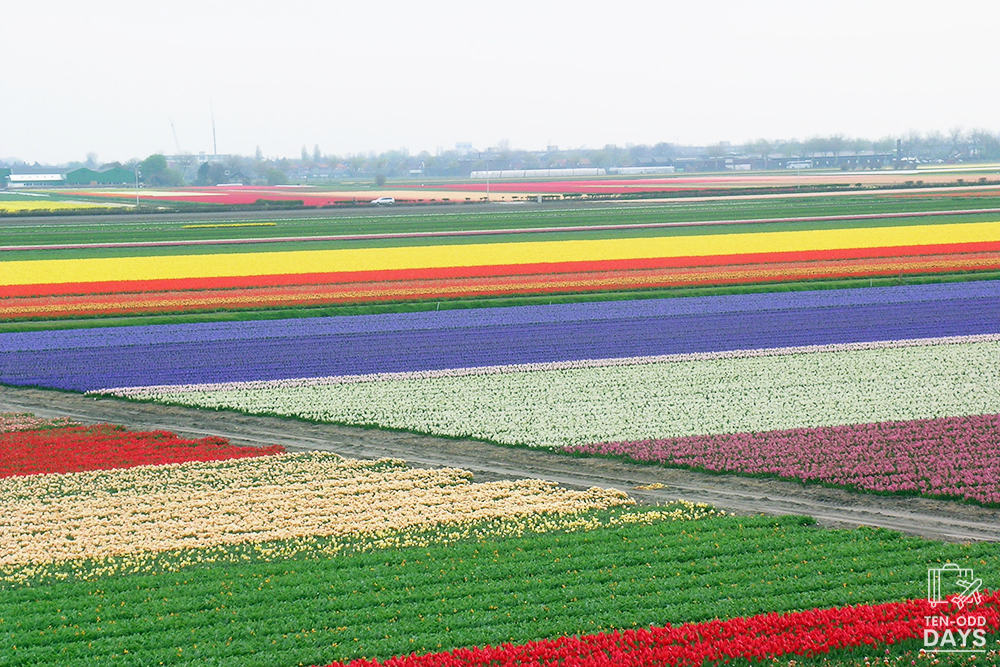
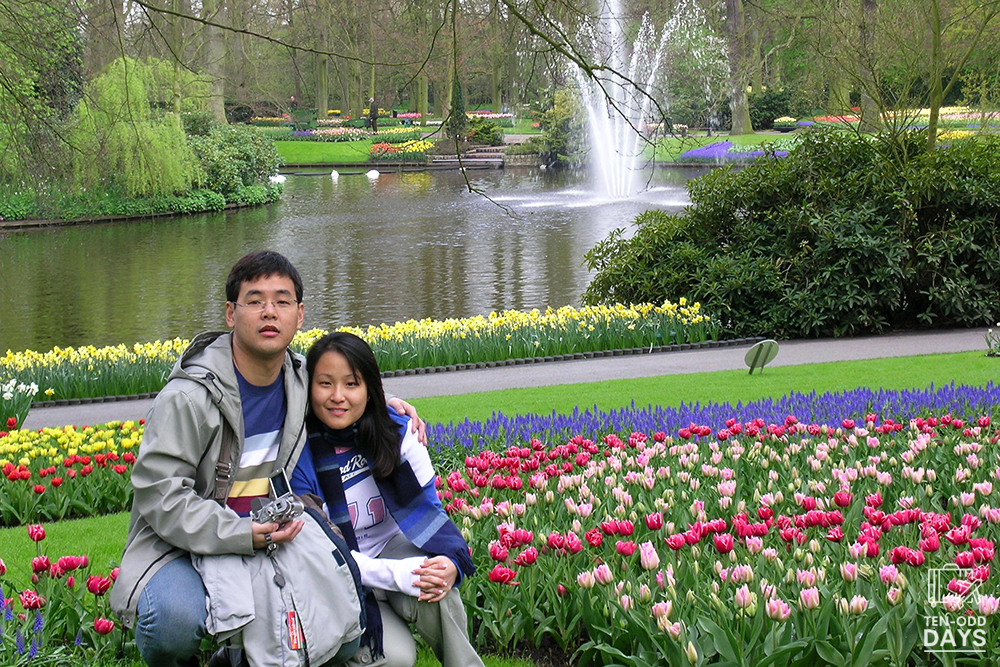
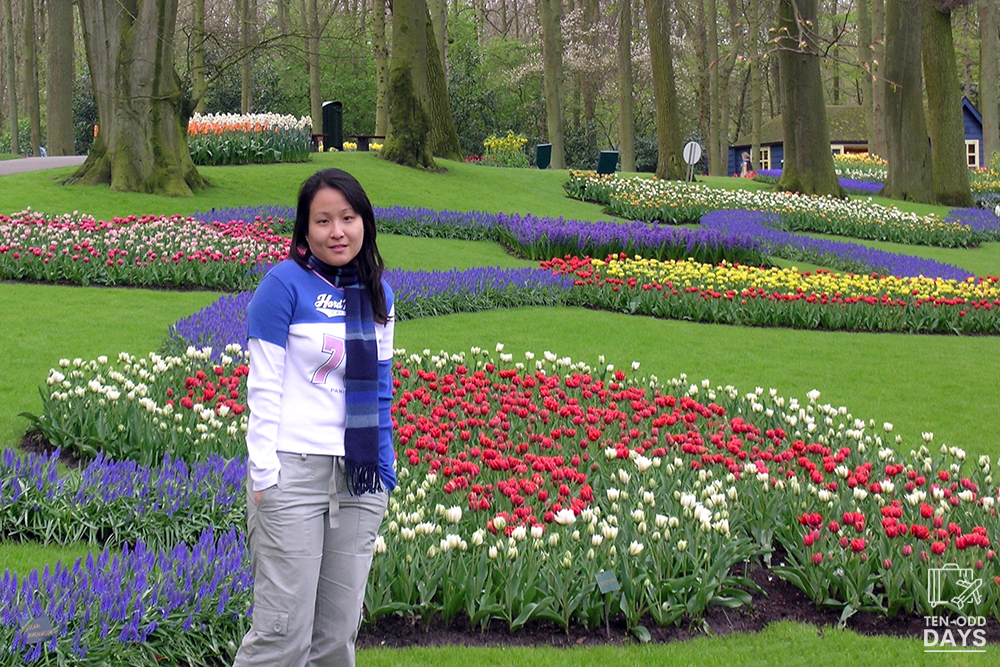
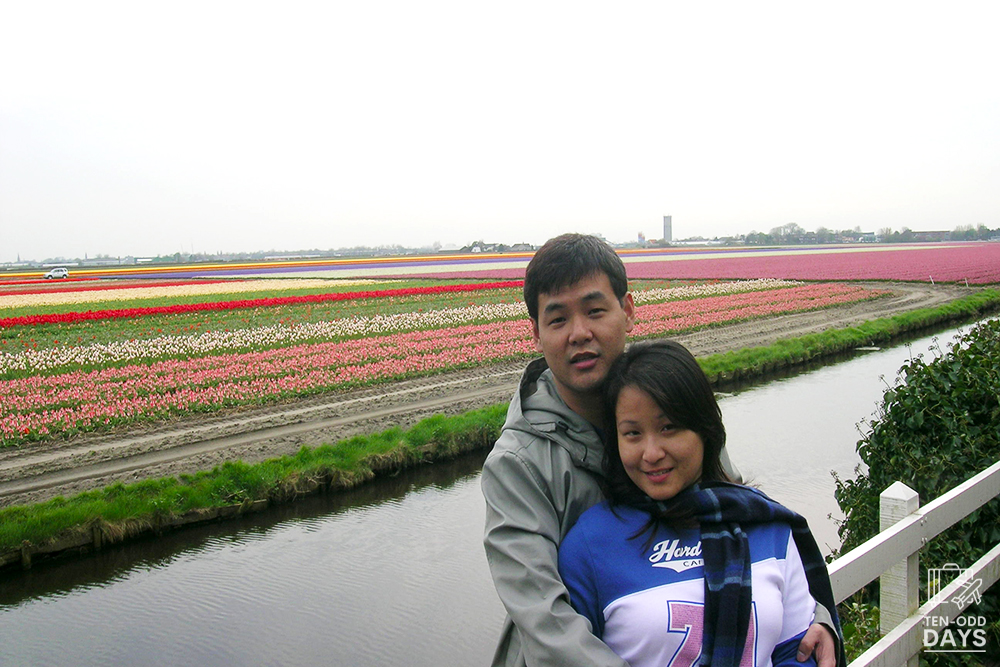
I was barely awake when we finally got through the barricades and stepped foot onto the legendary garden park. Borrowing lyrics from one of Bryan Adam’s songs – I thought I’d died and gone to Heaven, for Keukenhof is what I would envisage Heaven to be, blasphemous as it may sound. We were blessed in many ways: the weather was rather good, with only slight manageable drizzles, if anything; the park was still not overwhelmed with crowds early in the morning; we were enchanted by the carefully preened florae; and oh, how could I forget the captivating tulip bulbs in every imaginable hue in the vast fields adjacent to the park.
Such a beautiful sight to behold!
I’m a convert, but only for tulip bulb fields.
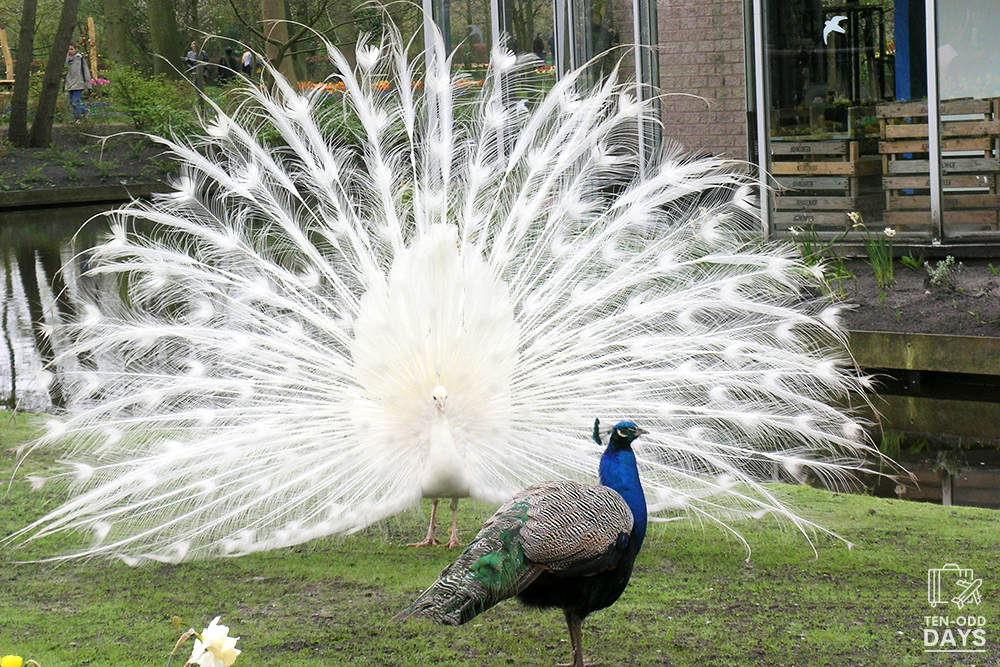
The park is huge by any standard, and as we were slowly making our way back to the entrance cum exit of the park, our attention was captured by an enthralling act of a peacock courting a peahen. And a rather rare species of a white peacock, to boot!
Peacock snubbed by peahen.
Alas, the peacock’s advances was snubbed by the arrogant peahen, which chose to ignore him throughout the courtship ritual that dated back to ancient times. Alright, I have to admit we don’t know much about peacocks and the likes. Perhaps the pair adjourned somewhere else to continue their rendezvous, away from prying eyes. We left not knowing what happened next.
If you intend to make a trip to The Keukenhof, time it earlier rather than later during the season. We were there in mid-April and it was perfetto: the flowers, while not in their full glory, were showing the first signs of blooming. Do take into account the general climate in Europe when deciding. For example, if it was a warm winter, then spring would likely be warmer too, resulting in the blooming occurring earlier than usual.
Following lunch in Amsterdam, we proceeded for our canal cruise. Barring my need to visit the restroom (but refusing to use the one on the boat!) and feeling rather motion-sick after a full lunch, it was an enjoyable and leisurely tour of Amsterdam. We sighted some really delightful self-contained houseboats along the way, and wondered what it would be like to live in one.
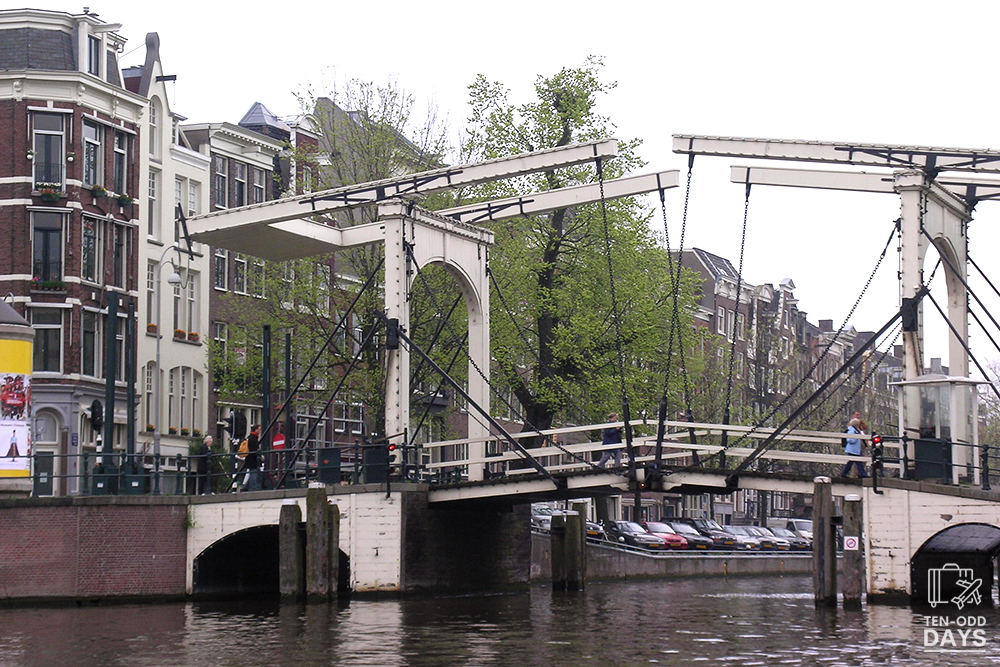
A typical drawbridge found in Amsterdam.
Several drawbridges were also sighted during our canal tour. A pity there weren’t many tall vessels requiring the bridges to be drawn, for designing bridges was decidedly one of my favourite modules in college.
The Netherlands, also mistakenly referred to but widely accepted as Holland, is the world’s first producer and exporter of tulips although they were first imported from the Ottoman Empire (now known as Republic of Turkey). Amsterdam is the capital of the country, and the large number of canals found in the capital has led it to be called ‘Venice of the North’. With almost 25% of their land lying below sea level, it’s little wonder that the Dutch are famous for their bridge-building and technical know-how in water management. They have honed these skills to perfection for survival, more than anything else.
Soft drugs like cannabis are legal in The Netherlands, and only licensed “coffee shops” are allowed to sell these drugs. If you are a Singaporean and is thinking of trying out these drugs while visiting The Netherlands (or anywhere in the world, for that matter), I beg you to think twice. Singapore takes an unwavering firm stance where drugs are concerned – be it for trafficking or for personal consumption. But of course, the penalty for the former is much more severe than the latter. Even cannabis tested in a random urine test could get you imprisoned, and it is common knowledge that it takes a while for drugs to be totally cleared from your system.
The infamous Amsterdam Red Light District has also somewhat become a major tourist attraction. One contributing factor, I conclude, is its close proximity to Amsterdam’s Centraal Station (10 minutes walk, and no spelling error there). The later it is, the busier the area gets. If you so wish to see the prostitutes plying their trade in the famous little windows, otherwise known as ‘window-shopping’, you know to be later rather than earlier. However, we were warned that we should not attempt to reach for our cameras for it is forbidden to take photos in the district. Apparently anyone spotted to be doing so by any of the girls’ bouncers would be escorted out of the area, with the expensive toy thrown into the canal. Ouch!
After a unanimous vote of confidence from the whole group, we proceeded to Volendam for our dinner of Fish & Chips. I have little recollection of the quaint little town as it was raining so heavily we thought a flood was impending. I was also nursing an extremely bad cold. Bad weather with a cold combined: a sure-proof formula to bring on my surliness. I was the most disagreeable person to walk the surface of earth, if you had asked the mister that evening.
Needless to say, I was dreadfully grateful to have finally reached our hotel for the night. We were flying off to London the next day, but I left all the outstanding packing in the trusty hands of the mister since I was in no state to be of any help.
The last time I saw Paris Her heart was warm and gay, I heard the laughter of her heart in every street café.
– Oscar Hammerstein II
Paris, the City of Lights. Certainly every die-hard romantic’s dream honeymoon destination. And since we were on our honeymoon, we envisaged Paris to be the highlight of our tour. Of course, it ended up that almost all destinations during our honeymoon turned out to be highlights in their own right.
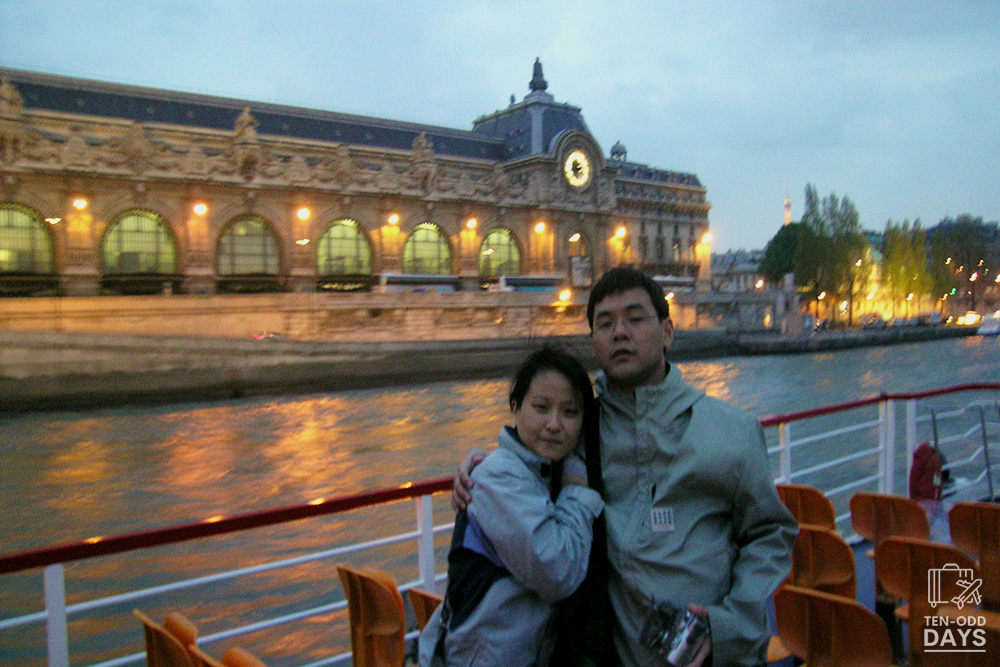
It was a long way to travel from Lucerne to Paris; we ended up spending better half of the day in the coach. The moment we arrived, we engaged in the most touristy activity possible – a boat tour along River Seine, the river which divides Paris into the Left Bank and Right Bank. The Left Bank (French: La Rive Gauche) is situated on the southern side of the Seine and is by far the smaller section of Paris. It is also known for its artistic and intellectual life. The Right Bank (French: La Rive Droit) to the north of the river, on the other hand, represents the aristocratic privileged class and their expensive districts. While the distinction between the two banks is less applicable nowadays, most of Paris’ big businesses, banks and tourist attractions are located on this larger section. But I digressed.
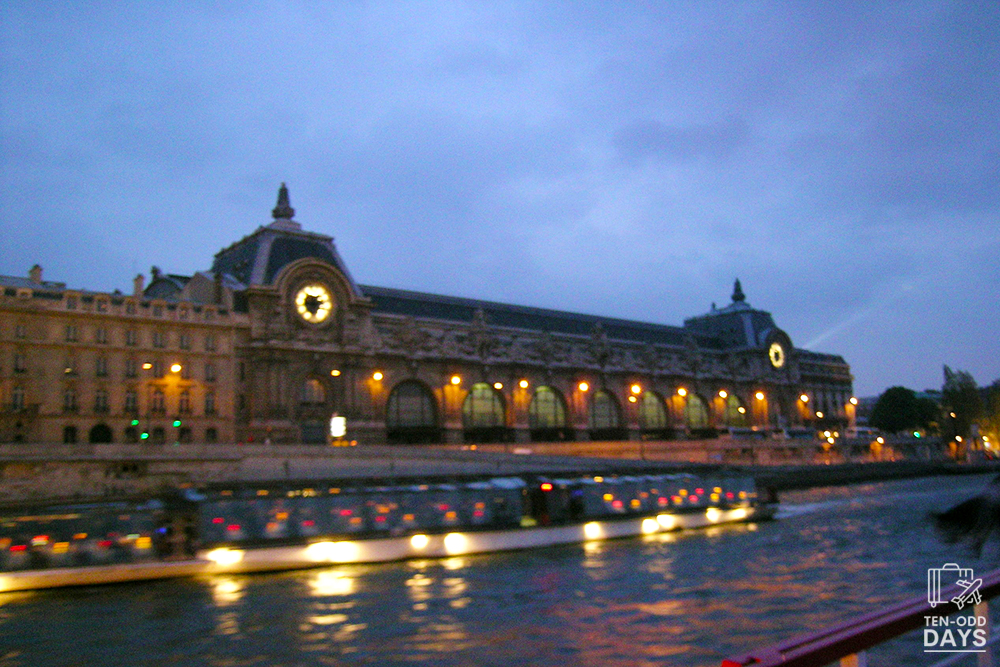
The Musée d’Orsay from our cruise on River Seine.
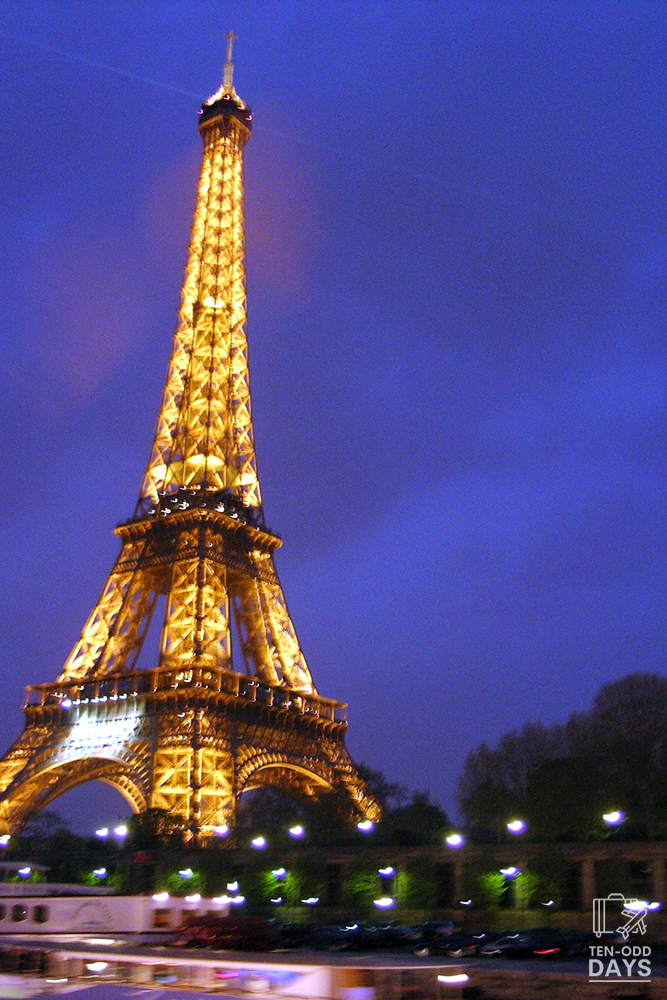
As night fell, we froze out in the open (it was early spring after all) on the upper deck of the river boat, all for the hope of having a glimpse of the global icon of France – the Eiffel Tower. We were told we would only have a short few seconds of capturing both the Eiffel Tower and the Statue of Liberty near Pont de Grenelle together, and so I tried to warm my stiff hands and prepare for the big moment. Only to have the DSLR fail me. Or rather, to have my photo-taking skills fail me: a Point-and-Shoot, an entry-level DSLR, or a professional camera, will take photographs only as good as the photographer’s skills, to a large extent.
So we couldn’t get any decent shots of the Eiffel Tower together with the Statue of Liberty. Or any shots of the tower during the light show on the hour. Night photography and a moving river boat? Worst combination ever for most amateur photographers, myself included. My advice is, be on solid ground when you attempt to take pictures of the tower, and if shooting from afar, use a tripod or at least prop on some sort of support. It would save you a lot of heartache. In short, just relax and enjoy the river cruise without the burden of trying to take pictures because it is indeed to best way to see Paris. One of these Seine river cruises takes about an hour to complete, and costs about 13,00€ for an adult ticket.
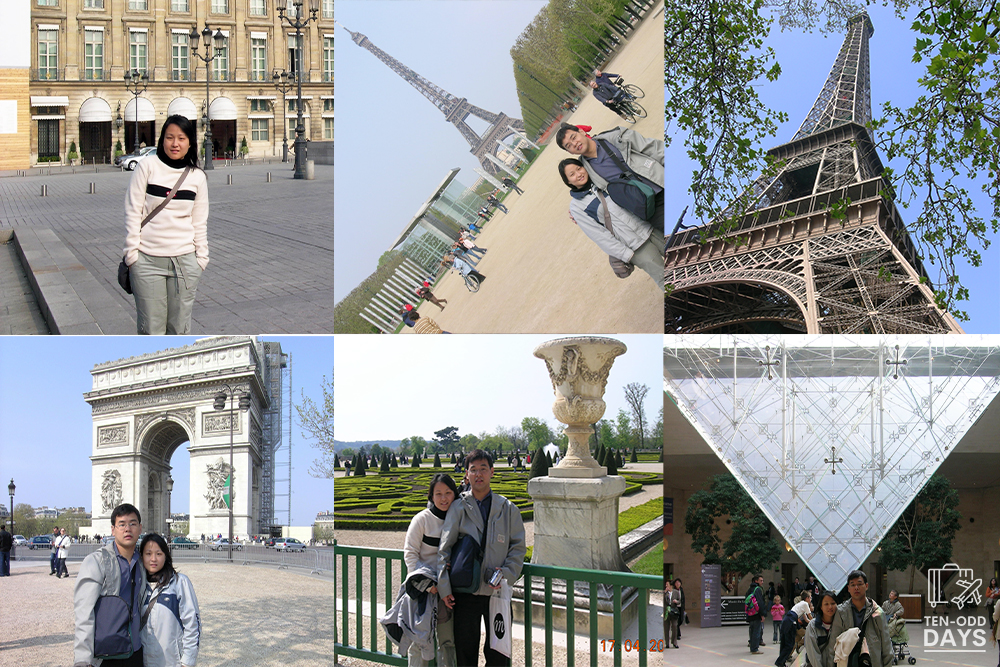
We had a crazy schedule the following day. Somehow within the waking hours, we covered most of the famous sights in Paris and then some: we saw the Luxor Obelisk at Place de la Concorde, took pictures in front of Ritz Paris, came up close and personal with Arc de Triomphe, strolled along Avenue des Champs-Élysées and scaled The Eiffel Tower. On top of that, we somehow till found time to visit Château de Versailles, Musée du Louvre and sit through a 10-course French dinner. How we managed to achieve all that is now quite beyond my comprehension.
As a result of this whirlwind sightseeing schedule, we didn’t have the luxury of time to scale Arc de Triomphe for the awesome overview of Avenue des Champs-Élysées. More importantly, I didn’t get to explore Musée du Louvre, or visit Notre Dame Cathedral. To say that I left Paris laden with a heart heavy of regrets would be a gross understatement.
Mid-April is a wonderful time to visit Paris. Although still a magnet for multitude of tourists, it is considerably less crowded than the more popular summer months.
Throughout our tour, we were warned of gypsy ladies who would, on the surface be begging for money as a ruse while on the sly, have a partner pickpocket the valuables when the unsuspecting victim was distracted. I must say we were quite fortunate not to have met many of them along the way. That was till our stay in Paris. Along Avenue des Champs-Élysées near Arc de Triomphe, we were suddenly swarmed by unkempt, dark-skinned women dressing like gypsies while we were taking pictures. We could barely understand their speech, and tried our best to ignore them while concentrating on photographing the famous monument. Our tour leader was on an exceptionally alert mode as a result. Because there were so many of us in the group, he decided to play safe by chasing the gypsy ladies away instead of trying to watch all of them like a hawk. Strangely enough, his single Italian word ‘Via!’ was sufficient to convey his message. Seeing how they were not going to make any headway with our group, they moved on to another group of tourists. I hope none of them had fallen prey.
TRIVIA: The Eiffel Tower, nicknamed the Iron Lady, is named after engineer Gustave Eiffel, whose company designed and built the tower. Standing at 320m, the tower’s design was met with widespread disdain and it was even criticised to be an eyesore that ruined the beautiful skyline of the city. Today, many recognise the romantic icon of Paris, but lesser know that it was never meant to be a permanent fixture. The emerging field of radio telegraphy saved it from dismantlement in 1909 and as the cliché goes, the rest is history.
Though sharing the Alps mountain range with France, Italy, Austria and Liechtenstein, land-locked Switzerland is undoubtedly regarded as heart of the Alps. The Alps occupy about 65% of Switzerland’s surface area, making it one of most alpine countries in the world. Notably, Switzerland is not a member of the European Union. Therefore, Euros are not widely accepted in the alpine country as they still use their own currency and legal tender – the Swiss Franc or CHF. So does Liechtenstein.
A few entities are synonymous with the Swiss – traditional Swiss cottages, cheese fondue, milk chocolates, banks, the Swiss army and watches. In a nutshell, anything associated with Switzerland is almost guaranteed to be of high quality.
After a half-day trip to Lake Maggiore in Italy, our coach entered Switzerland from the south. By the time we arrived in Lucerne, it was already early evening. We wasted no time in setting down our luggage in our room, for we wanted to be out and about roaming the streets of Lucerne before night fell.
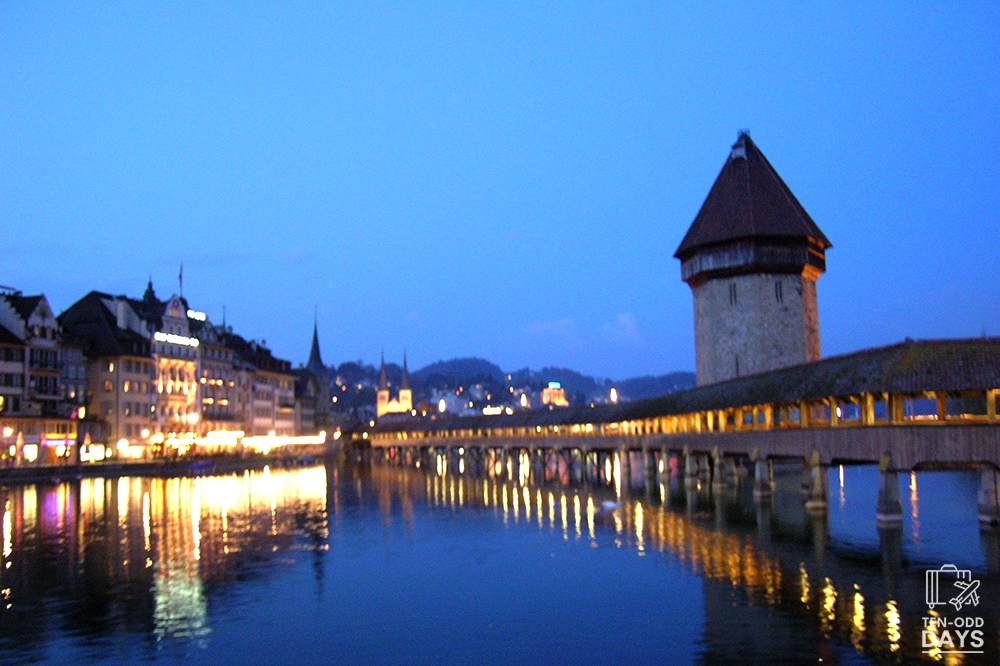
The landmark Chapel Bridge during Blue Hour.
The Chapel Bridge crossing the Reuss River, a short jaunt from our hotel, is the oldest wooden-covered bridge in Europe. The current bridge standing in Lucerne is however, not the original constructed in 1333 as much of the bridge was destroyed in a fire in 1993. The Swiss wasted no time in rebuilding the bridge since it is a major tourist attraction and is easily the most photographed monument in the country.
Tomorrow we would be scaling Mount Titlis, well… not in the traditional sense. Exhilarated to finally get to meet the Alps at close range.
Mount Titlis is reputed as having the world’s first revolving cable car that delivers a 360-degree panoramic view of the glaciers, valleys, rivers etc. One has to take a total of 3 cable cars to reach the summit, and the reward for the chore of changing cable cars several times – a breathtaking view of the Alps above the clouds. No photograph in the world would do justice to the spectacular sight which greeted us – you would really quite have to see it for yourself.
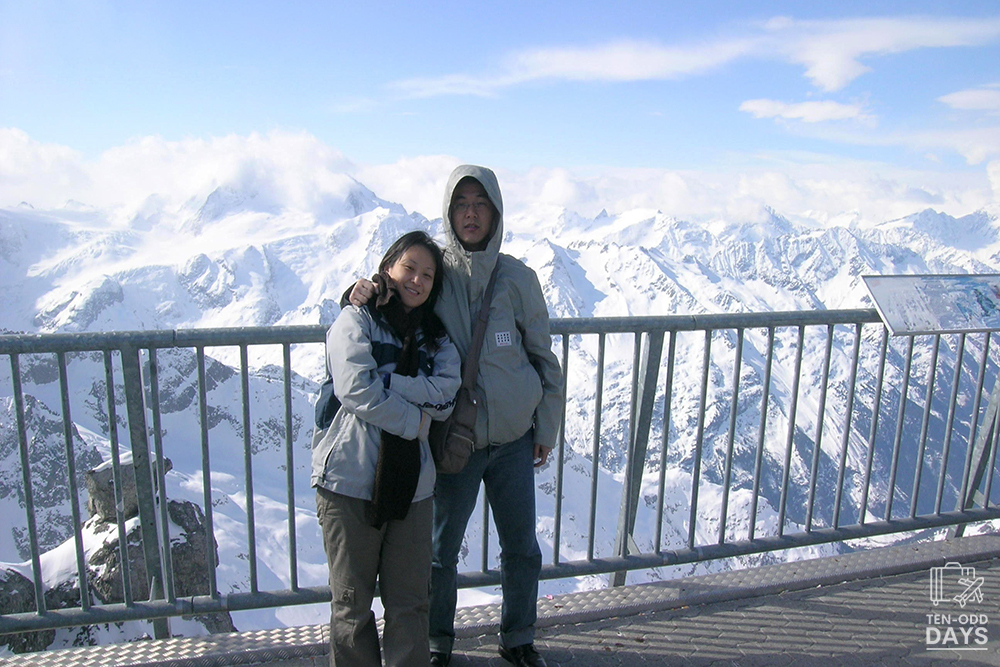
At the summit of Mount Titlis. I think we managed to make it look much less colder than it actually was.
We were blessed with clear blue skies and good weather when we ‘mounted’ the summit with the assistance of the cable cars. However, we suffered the repercussions of our wilfulness. In a bid to lighten our luggage, we omitted our winter overcoats and the full works as we saw no point in packing them just for half a day’s worth of visit. Our group mates were much more prepared, and we finally understood why they needed luggage space double of ours – they were warm and snug in their bulky winter wear while we were seriously freezing our asses off. Silly us…
At a height 3,028m above mean sea level, the ambient temperature out in the open was easily in the range of minus 10°C. We couldn’t bear to stay out longer than necessary and were frequently dashing into the comforting warmth of the indoors. Even our trusty DSLR died on us intermittently, as if protesting against the biting cold.
Seeing that the tourist crowd was reaching the summit in throngs, we decided it was time to quickly settle our lunch at the cafeteria ahead of lunch hour to avoid the crowd. If you ever have the opportunity to visit Mount Titlis, you must try the delicious grape drink Grapillon. We’re quite certain this drink must also be widely available throughout Switzerland though. Look out for it if you are a grape drink lover like us.
Squinting from the glare… the struggle is real.
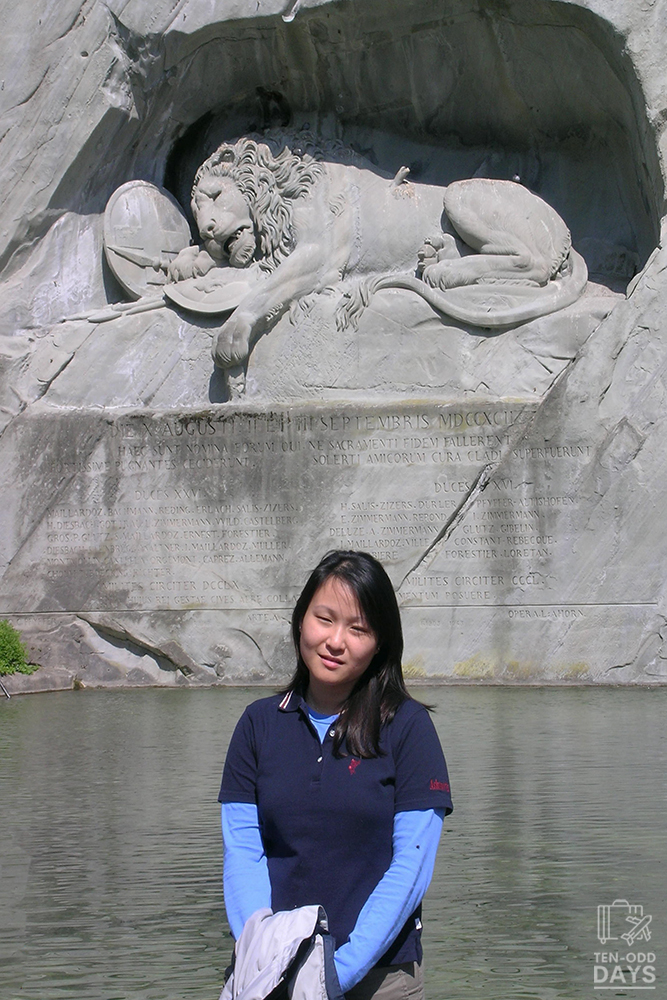
The Lion lies in his lair in the perpendicular face of a low cliff — for he is carved from the living rock of the cliff. His size is colossal, his attitude is noble. His head is bowed, the broken spear is sticking in his shoulder, his protecting paw rests upon the lilies of France. Vines hang down the cliff and wave in the wind, and a clear stream trickles from above and empties into a pond at the base, and in the smooth surface of the pond the lion is mirrored, among the water-lilies.
Around about are green trees and grass. The place is a sheltered, reposeful woodland nook, remote from noise and stir and confusion — and all this is fitting, for lions do die in such places, and not on granite pedestals in public squares fenced with fancy iron railings. The Lion of Lucerne would be impressive anywhere, but nowhere so impressive as where he is.
– Mark Twain, A Tramp Abroad, 1880
A befitting tribute to the Lion Monument in Lucerne, which commemorates the Swiss Guards who served the French King Louis XVI and were massacred during the French Revolution in 1792. That sentimental Swiss monument was our next stop after Mount Titlis.
After visiting the Lion Monument, we were sent back to the vicinity of our hotel and left to our own devices. We went shopping at Bucherer and the neighbouring shops. In particular, we were looking to buy some Swiss chocolate home but were advised against it as the climate was getting warmer and there was no telling if the chocolates would hold for another 5-6 more days before we arrived back in Singapore.