First Encounter with The ‘Boot’

Italy (Italian: Italia) also often goes by the moniker of ‘The Boot’, ascribed by the physical shape of the country. This endearing nickname is honestly rather befitting for a soccer-crazed nation like Italy, me thinks.

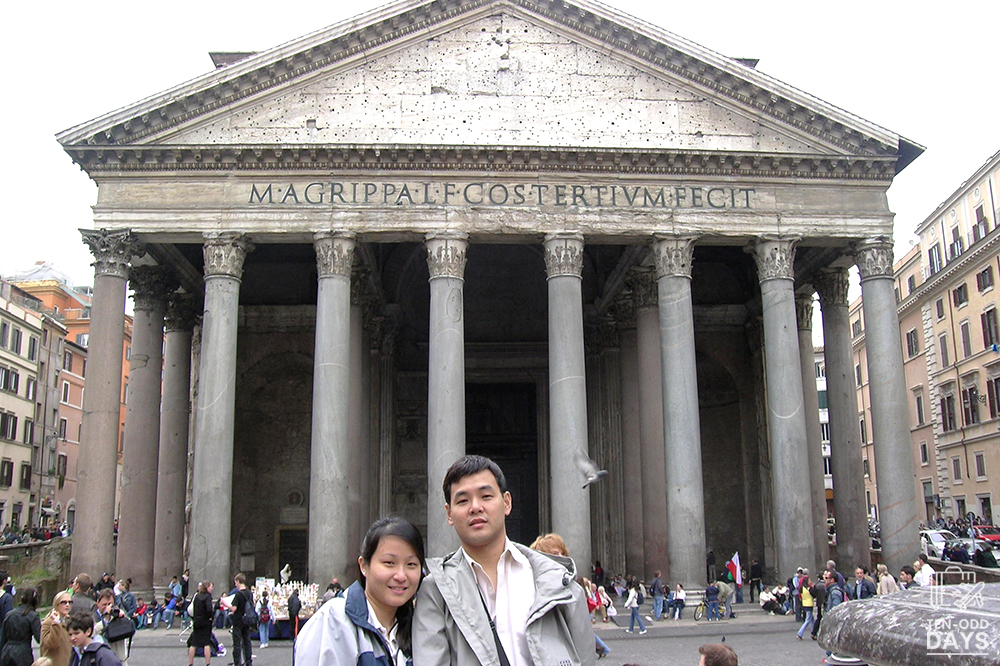
We landed at Rome Fiumicino Airport on a special day – 8 Apr 2005, incidentally late Pope John Paul II’s day of funeral. Rome (Italian: Roma) was swarmed with multitudes of pilgrims whom, together with numerous heads of state and dignitaries, were making their way to Vatican City to pay their last respects to a much-loved and well-respected leader of the worldwide Catholic Church. While I am not entirely certain if that day was declared a public holiday in Rome, it was a futile effort trying to proceed with our tour itinerary (for Rome itself) since several iconic landmarks including The Colosseum and The Pantheon were closed as out of respect. Vatican City, where the funeral was taking place, was also out of bounds to commoners like us.
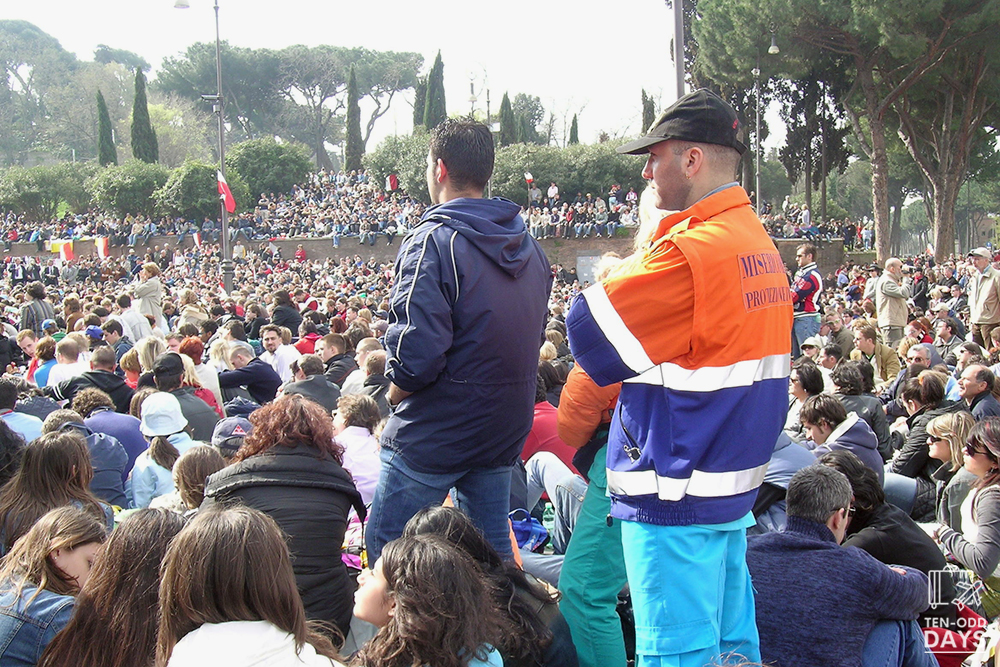
Remote TV Screens
It almost seemed like everyone in Rome that morning decided to go outdoors
to follow the funeral mass proceedings together.

Pilgrims and locals alike were watching the funeral mass on many of the mobile TV screens we saw set up all over Rome. As a result, it became exceedingly inconvenient for the coach to move around in the city due to the crowdedness. That was when our tour leader opted for us to travel on foot instead. I weren’t upset with the sudden turn of events (not that anything would change if I were), for how many people could actually boast that they were in Rome on such a day of significance? To witness the populace being moved and touched by the passing of a great spiritual leader was… a very sobering reminder that we all could, and should endeavour to continue doing good in our lives.
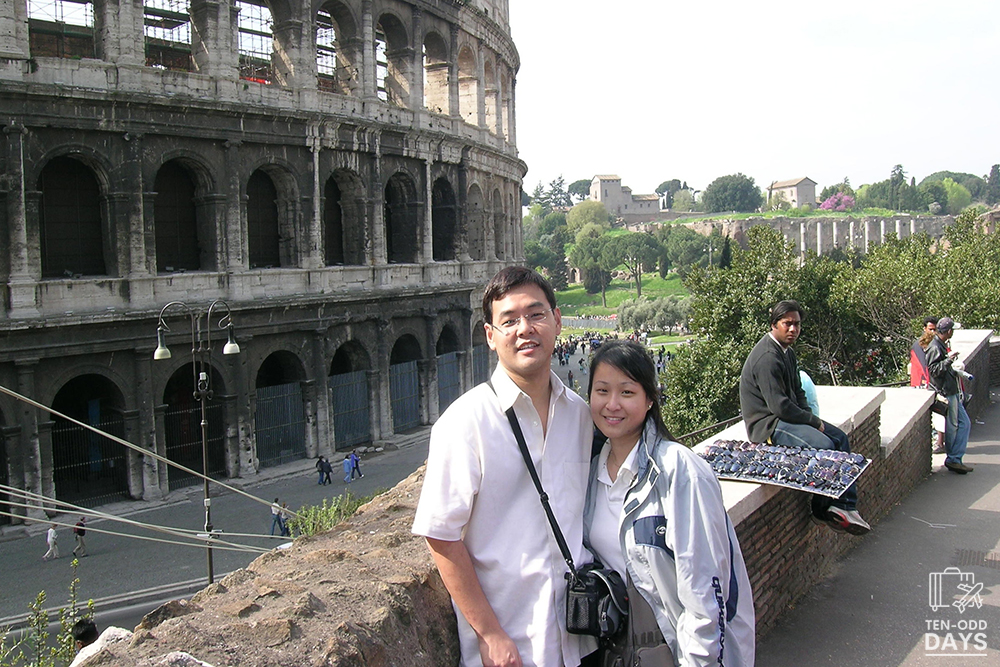
At Colosseum
The Colosseum was closed, so we took a shot of it across the street.
At Pantheon
The Pantheon was also closed for the day.

After the obligatory photo stops at the few famous landmarks including The Colosseum, Trevi Fountain and The Pantheon, we were very much left to our own devices in the vicinity of Spanish Steps. It started raining intermittently, which dampened our moods considerably. The mister and I explored the area a little, and after throwing perfunctory glances at the upmarket designer stores and restaurants, we decided to seek refuge (from the rain and the maddening crowd who were out and about in throngs after the funeral mass ended) at the McDonald’s outlet near the steps till it was time for the group to reassemble.

The rest of the day spent in Rome was rather nondescript and uneventful. We were still rather jet-lagged and sleepy (no thanks to the great selection of movies available on Singapore Airlines, I hardly slept on the red-eye flight) hence the decision to have an early night.


The second day started early (and this is to be expected for most package tours) as we were leaving Rome for Florence (Italian: Firenze). After a forgettable breakfast at the hotel, we were all raring to go.

On the way to Florence, we made a short 3-hour stop at Pisa. Ah, Pisa… who isn’t fascinated with the leaning tower located at Square of Miracles (Italian: Piazza dei Miracoli)? The evil Superman in the 3rd installation of the same-titled series of movies introduced me to the Leaning Tower of Pisa when I was but a young lass barely of schooling age. I remember being extremely puzzled by the existence of a tilting building in the world, following my parents around and questioning them incessantly in an attempt to satisfy my inquisitive young mind. ‘Does it really exist? Why didn’t it topple over? Why didn’t they tear it down and rebuild it? Is anyone living in the building?’ I swear I went on and on about it, but back then the parents were not equipped with the requisite knowledge to explain things adequately to appease me. I too, moved on to obsess over other stuff.

Later on in life, I went to college, majored in civil & structural engineering, and learnt all about foundation and soil consolidation. Admittedly, foundation engineering was not one of my favourite topics, but it sure did answer my questions, albeit almost 2 decades late.
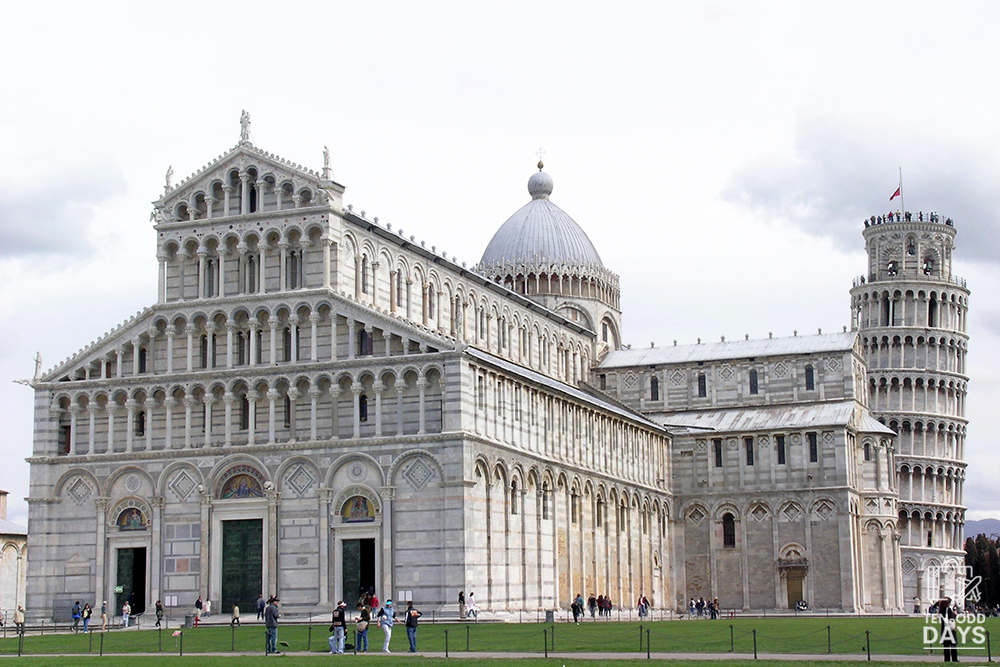
Miracle Square
The truly beautiful Piazza dei Miracoli.

Unlike the other tourists who were attempting to take shots with the tower in all poses conceivable, I was busy reading about the ongoing restoration works, which demanded my assiduous concentration. My professors at college would have been proud of me, for I was about the only person in the vicinity who was interested! The mister was understandably more than pleased to accompany me in my pursuit to satisfy my insatiable thirst for knowledge; he is as camera-shy as I am otherwise shutter-happy.
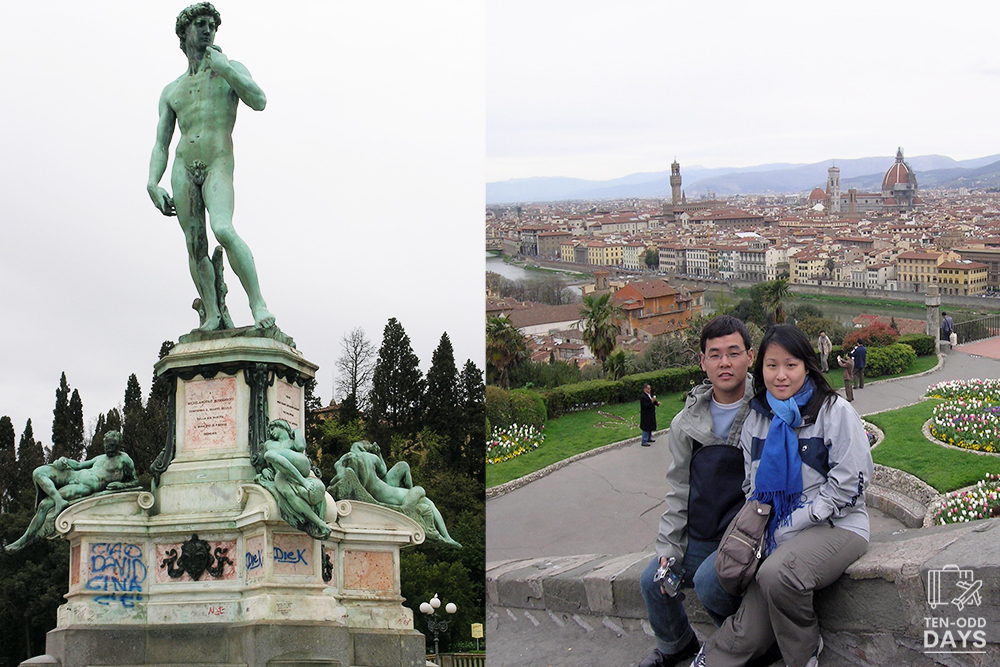
Michelangelo Park
The sun was setting and the park was becoming quite chilly.
The panoramic view of Florence totally made up for the cold.

It was slightly past mid-afternoon by the time we finally arrived in Florence. Florence, arguably the grand old dame of the Renaissance movement, is one classy lady. We were whisked off the coach at Michelangelo Park located up on a hill where we saw a replica of ‘David’ and a magnificent panoramic view of Florence. The view which greeted us was breathtaking, both literally and figuratively – the ambient temperature of the square had noticeably dropped with the drizzle and setting sun, which resulted in my nose turning numb from the cold. Each breath I took was becoming a rather laborious effort and though I enjoyed the view, I couldn’t wait to hide out in the coach.

Piazza del Duomo, where Duomo of Florence (Italian: Basilica di Santa Maria del Fiore) is sited, is a must-visit and was where we found ourselves next. The square, located in the heart of the historical centre of Florence, is one of most visited places in Europe. With exterior facade of the basilica lined with marble panels in various shades of green and pink bordered by white, it resulted in a very, for lack of a better word, attractive neo-gothic exterior. Not everyone thought the same though – to some, the facade appeared to have been excessively decorated.
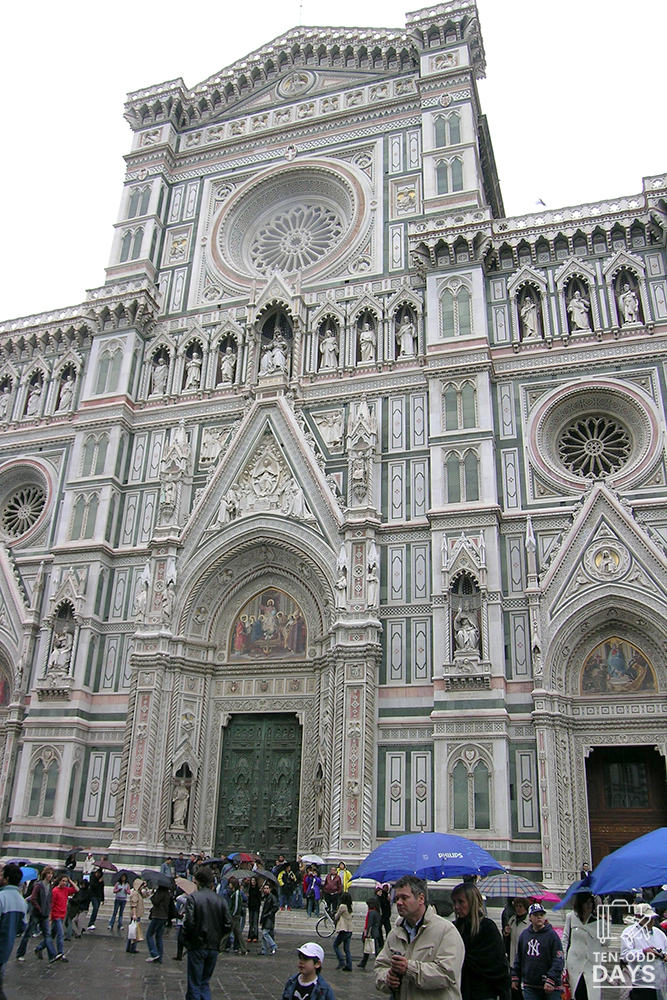
Florence Cathedral
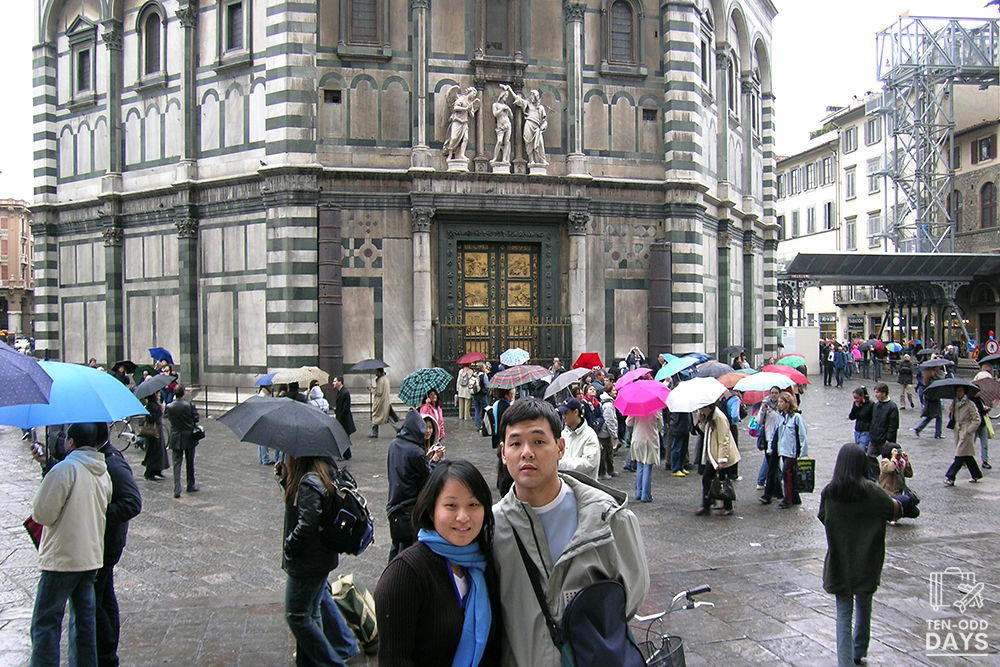
Gates of Paradise
Gates of Paradise in the background.

Opposite, we saw the great east gates of the Florence Baptistery, more commonly referred to as the Gates of Paradise, a term coined by Michelangelo the maestro himself, comprising 10 panels depicting scenes from the Old Testament. Lorenzo Ghiberti, the sculptor of the 10 panels himself admitted that they were “the most singular work that I have ever made”. Although the panels that are mounted on the east doors now are mere copies (the originals are carefully restored and kept in a dry environment), the remarkable beauty and grandeur of the original works shone even through their replicas.

After a long day on the roads, we again turned in early after yet another nondescript dinner.
Of First Trips and Many More

It was our inaugural trip together as man and wife. Fondly coined the ‘Mini Honeymoon’, we chose a country close by to vacation for a week, postponing the honeymoon proper to Europe till spring the following year. Hallyu (한류) was still in its infantry stage but was interesting enough to arouse our curiosity, hence the decision on a package tour to South Korea (the mister’s first visit and my second within a year). Incidentally, it was the first package tour we signed up for: prior to that, we were always travelling independently to nearby countries like Malaysia, Hong Kong and Thailand.

Alas, we forgot to factor in the fact that we would be travelling during the school holidays. Whilst I’m not certain how this works in other countries, it is almost always a bad idea to travel during the school holidays here in Singapore: the packages are decidedly more expensive, the tour groups larger and the tour buses noisier. Unless one works in the education profession or has school-going children, it is perhaps more sensible that everyone else avoids travelling during that period. Never mind that you love children (we both like our nieces and nephews enough) because being stuck on an aircraft or a tour bus with fretting children can become an unpleasant experience.

That said, the children in our tour group were very adorable when they were not behaving like gremlins. In fact several of them liked playing with us because we entertained them, unlike their harassed parents (who were very grateful to us for the short respites). We also met some interesting characters on the trip, for example one of our fellow group mates was the President of F4 Fan Club in Singapore. She was there on a vacation with her father, sister and brother-in-law (left her husband and children behind in Singapore). Once on a long bus journey, she confided that she was tempted to slip away to some place on her own because F4 would be there! In the end her plan didn’t materialise because her elderly father felt it wasn’t safe since she didn’t speak any Korean.

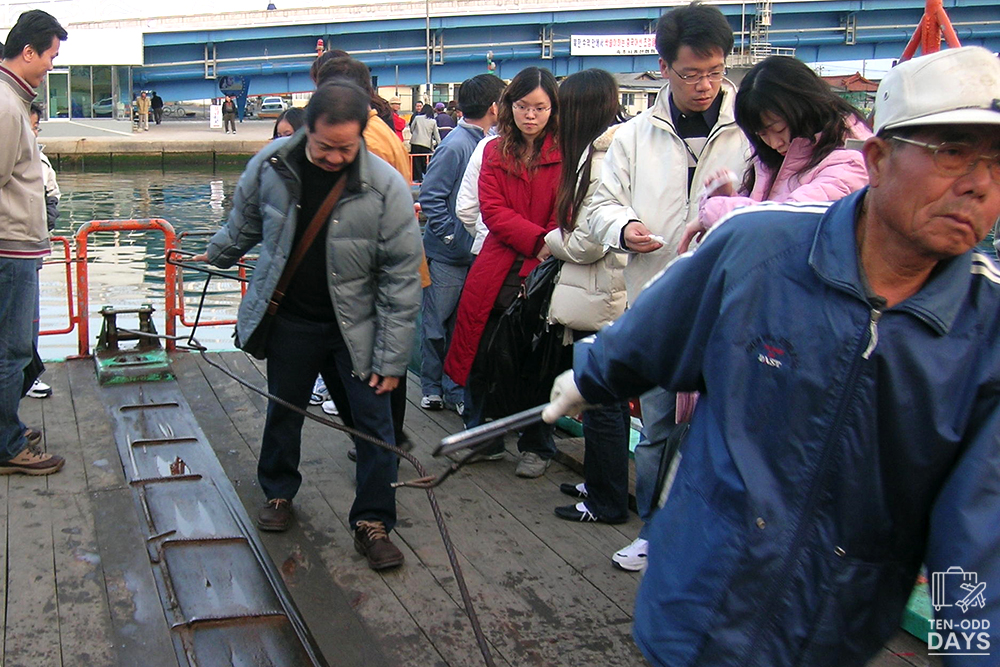
Manual Raft
Onboard the manual raft to Abai Village.

One of the more interesting sights during the tour, in my opinion, was this manual raft-like ferry boat (갯배) we took in Sokcho (속초). Unlike most other fuel-powered ferries, this particular one requires passengers to help out by means of pulling a special hook along a cable laid across the channel in order for the ferry to move. Being one of the abled-body young men on the ferry, the mister volunteered one obligatory run and then promptly came running to tell me that it wasn’t as easy as it looked. 😆

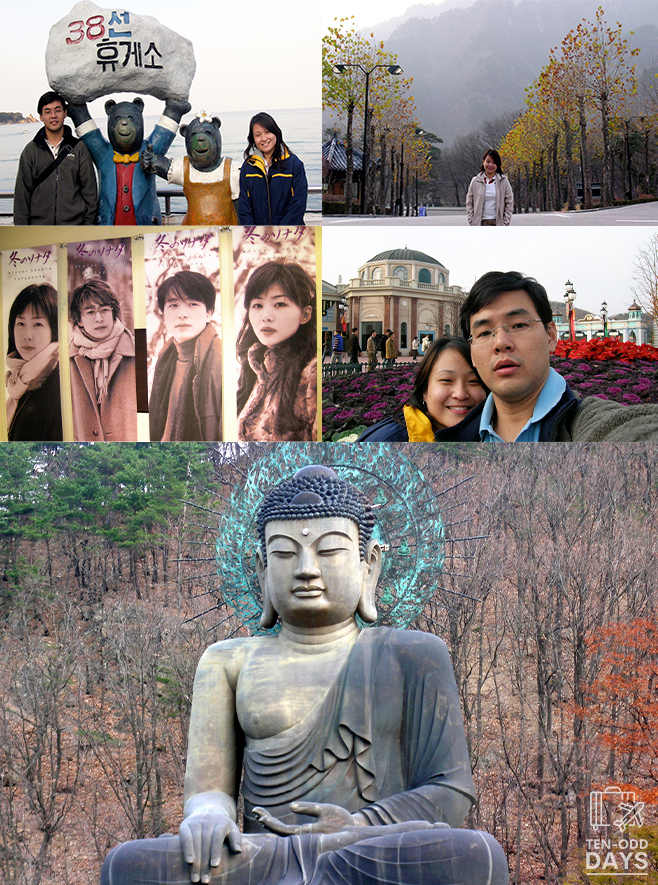
Winter Sonata Scene
Re-enacting a scene from Winter Sonata.
Korea Honeymoon

We were brought to several notable locations in Korea within the week including the 38th Parallel monument, Everland Resort, Lotte World, Yongpyong Ski resort, Mount Sorak and so on. Too much to take in, too little time, but that’s the way it is with package tours. It took us quite a while to figure what we wanted out of our travels (after 3 more package tours), but once we crossed that slight impediment that is sheer laziness, we never looked back (to package tours).

One major reason why people tend to stick to package tours is the fear that they don’t speak the language and therefore cannot communicate with locals or find their way around. A valid concern, except that our recent travels have proven otherwise: it is possible to survive with plain English coupled with plentiful gesturing. After this trip, we visited Seoul twice more on our own without knowing or reading a word of Korean, and survived. Of course, things improved vastly the 3rd time when we returned armed with my basic Hangul reading and speaking skills: we got lost less often, and we could give cab drivers very specific instructions so we didn’t have to walk too much. It is possible to explore a country without speaking their language. Just be ready to put up with inconveniences like more walking and getting lost more often. Me thinks that can be part of the fun anyway.

Of First Snow

The first fall of snow is not only an event,

it is a magical event.

You go to bed in one kind of a world

and wake up in another quite different,

and if this is not enchantment

then where is it to be found?

–  J. B. Priestley

Without a doubt, winter is irrevocably and undeniably my favourite season, for a myriad of reasons: Christmas would be around the corner (for the Northern Hemisphere, that is), I almost always prefer cold to warm weather and, who doesn’t have romantic notions of a White Christmas, cuddling with your loved one by the fire with the aroma of roasting chestnuts permeating the whole house? Why, even Winter is my best-loved concerto from Vivaldi’s Four Seasons. ‘Nuff said.

Oh wait, there is but this one little problem – that we hail from a region that doesn’t get to experience winters (we should be very worried if we do). The closest we have are the northeast monsoon rains from December to March that help bring down the ambient temperature by some: from an average of 32°C to 27°C. Snow, the all-essential element for a white Christmas, is however conspicuously absent.

There is a famous saying: ”If the mountain won’t come to Muhammad, Muhammad must go to the mountain”. Since we can’t have things our way, we must then bow down to the inevitable. Well yes, we have since long resigned to our fate; while we don’t get winters here, our beloved country has provided us with much in return. For the winter experience, we always have the option of travelling.

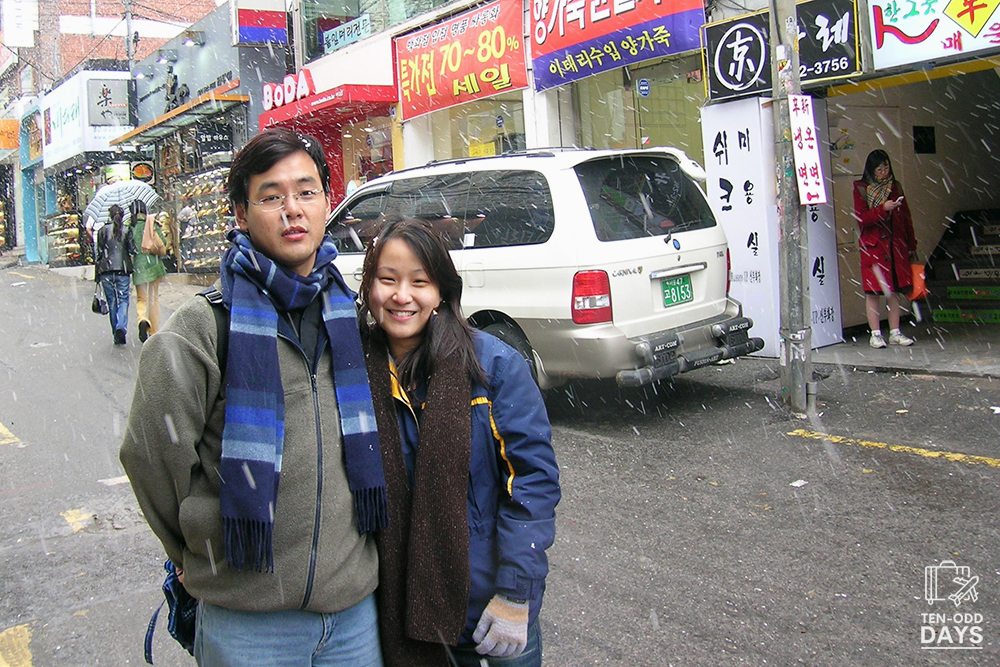
Honeymoon First Snow
Encounter of ‘first snow’ when we were at Sincheon Walking Street.

There is snow, and then there is first snow. Apparently, the Koreans decided that first snow (첫눈) should be set apart from other snows, and the logic of this completely eludes me. If you’d ever watched Winter Sonata (겨울 연가), you would have noticed that the motif of first snow was repeatedly emphasised in the said Korean drama series, especially whenever the two lovers met. It must be a certain significance known only to the Koreans.

Determined to uncover the basis of the Koreans’ obsession over first snow, I delved deeper with the aid of the internet. Nothing useful showed up, possibly because I typed and searched in English – I have a strong hunch the concept must be best explained in Hangul (한글), which unfortunately, is a language I was not familiar with at the time of writing this post. From what little information unearthed, I deduced that first snow could refer to first love, meeting of lovers or that witnessing first snow with your beloved means that this will be an everlasting relationship.

Whichever the case, fact is everyone gets excited over the first snowfall of the winter. Years back during our mini honeymoon to Korea, we witnessed Seoul’s first fall of snow while shopping along Sincheon Walking Street (신촌동). Understandably, we tourists hailing from the Tropics were squealing away in delight, but I was surprised to find the locals equally excited: some started dialling and speaking on their mobile phones informing their loved ones about it while others got busy taking snapshots.

Considering the romantic connotation of first snow, I take witnessing it on our mini honeymoon as a good augury for our marriage.

TRIVIA:
South Korea (officially known as Republic of Korea) has a temperate climate with 4 distinct seasons. Their winters are notoriously long, cold and dry while their summers are short, hot and humid. They are however, less vulnerable to typhoons than Japan, Taiwan or the eastern coast of China. The country is warmest in July and coolest in January. On balance, South Korea sees 116 days annually with measurable frost, and on average, one can see frost throughout the whole of every January.