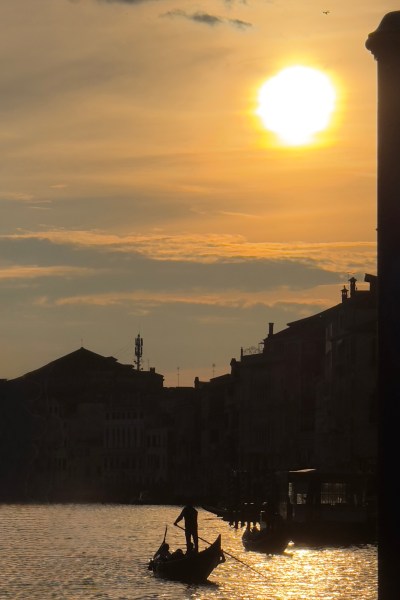
Some places are instantly recognisable. And Venice doesn’t need an introduction.
Few cities carry an identity so effortlessly.
I’ve been here more than once, and perhaps that is why Venice feels less like a place I visit and more like a place I return to. There is something about its quiet beauty, its strange sense of time… the way it seems to exist entirely on its own terms.
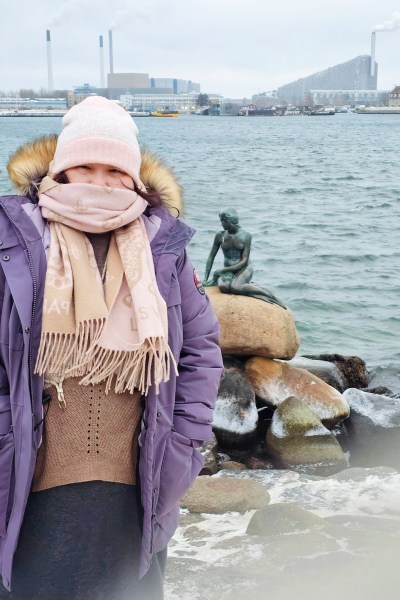
It was a mere 1.7km on paper, a perfectly manageable distance by any measure. But by the time we reached the Little Mermaid, I wasn’t thinking about Hans Christian Andersen anymore; I was wondering whether a nose could actually freeze off.
I knew Wellington, New Zealand, was famous for its winds. What I didn’t know was that Copenhagen could be just as relentless. And I certainly wasn’t expecting it to feel colder than Tromsø. It was, and my carefully packed winter wardrobe proved no match for the biting wind.
At some point, the hubs suggested we cut inland, or take an Uber. But I insisted we keep going. Apparently, I had become very committed to the Little Mermaid.
Suffice it to say, it was the longest and most painful 1.7km I’ve ever walked.
By the time we arrived, I simply couldn’t muster the same enthusiasm as everyone else gathered around the monument. I was cold, miserable, nursing a headache—and, as it turned out, my nose hadn’t frozen off. I just couldn’t feel it anymore.
The face of someone questioning every life choice that led to this 1.7km walk.
Maybe it was the biting wind talking, but I found the Little Mermaid surprisingly underwhelming. She was much smaller than I’d expected, and the skyline was more smokestacks than storybook. It wasn’t exactly the fairy-tale setting I’d imagined.
In retrospect, I probably should have listened to the man and saved myself the misery.
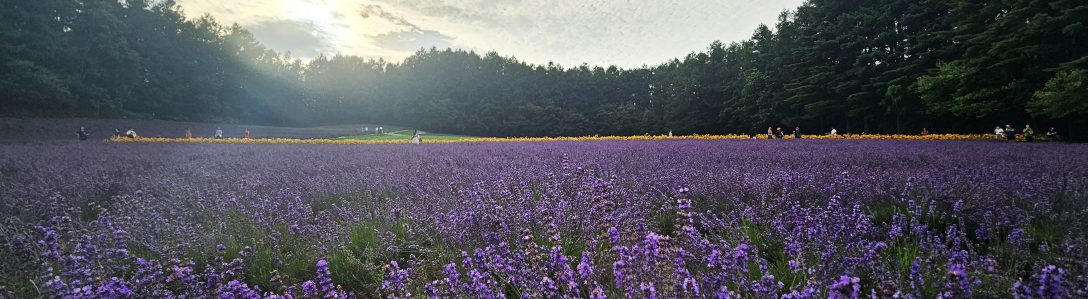
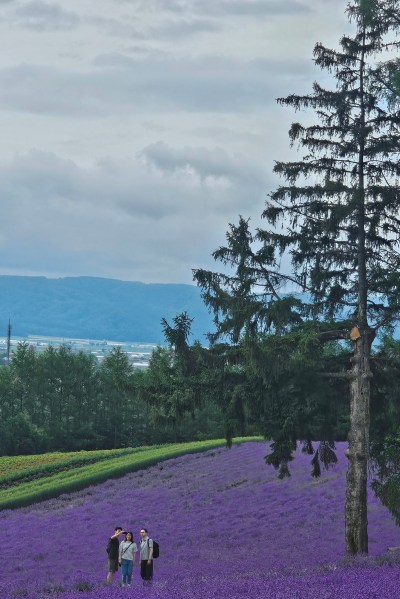
It wasn’t the lavender fields that lingered with me long after we left, but the sight of a family of three standing beneath a lone tree, dwarfed by the vastness around them.
There was no time to compose the shot. I caught it almost by instinct, just before the scene disappeared.
Only later, when I looked at the photograph, did I understand what had drawn my eye. The family wasn’t really the subject at all. It was the sheer scale of the place that stayed with me. Their smallness made the space feel even larger, but it also give the photograph a sense of life within all that grandeur.
Somewhere along the way, I started attempting not to dish out unsolicited travel advice.
It wasn’t because I ran out of recommendations. If anything, we’ve accumulated more over the years: small family-run restaurants, quiet neighbourhood cafes, overlooked alleys… places we’d happily return to. It was because I realised something: every traveller has a first time.
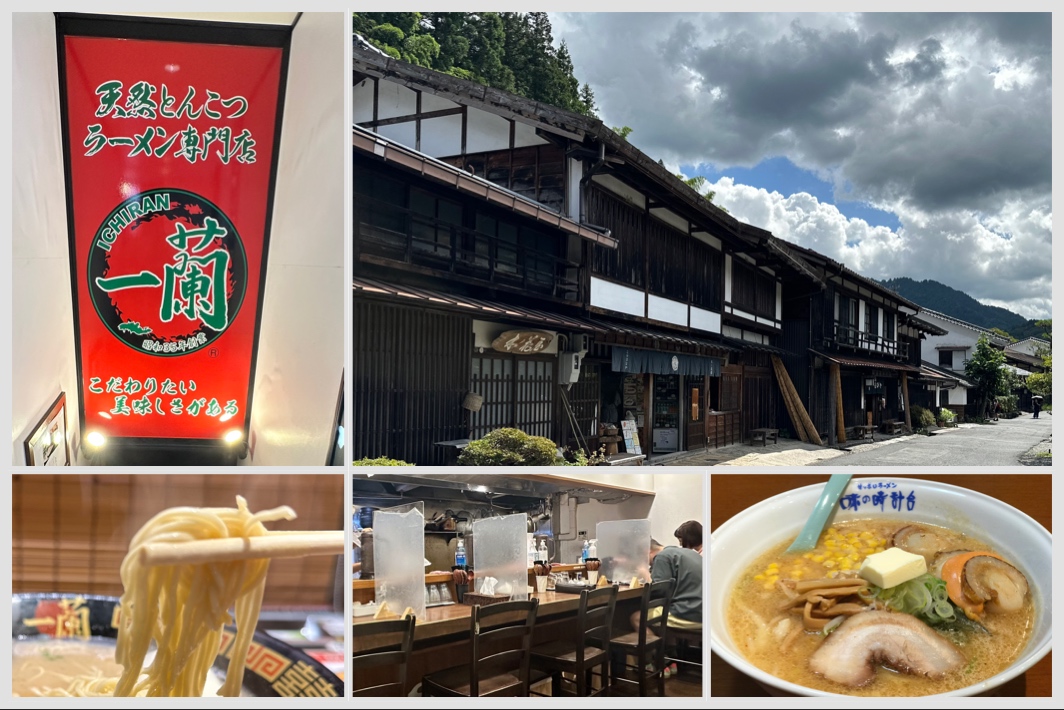
If it’s your first visit to Japan, perhaps you’ve dreamt about eating at Ichiran long before you booked your flight. Maybe you’ve watched countless reels of diners seated in individual booths, waiting for that first steaming bowl of tonkotsu ramen. Then someone tells you to skip it.
“It’s overrated.”
“It isn’t worth the wait.”
“Go where the locals go.”
“There are so many better places.”
Perhaps they’re right.
We’ve had wonderful bowls of ramen in tiny neighbourhood shops with handwritten menus, no queues and not a word of English. Sometimes there’s only one item on the menu. And some of those meals remain among our favourites. Yet somehow, every time we’re back in Japan, we find ourselves back at Ichiran again. Not because we think it’s the best ramen in Japan or because it’s a hidden gem, but simply because we enjoy it. We like being able to customise our bowl, we know exactly what to expect, and after so many visits, it’s become one of those familiar stops we genuinely look forward to.
Over time, we also started measuring our travels by how obscure our discoveries were. We hoped to stumble upon the hidden café, the restaurant with no tourists, the alley no guidebook mentions. There’s nothing wrong with that. Some of our favourite travel memories have come from wandering into places we hadn’t planned to visit. But there’s something equally satisfying about finally experiencing a place you’ve imagined for years, whether that’s the crossing at Shibuya, the torii gates at Fushimi Inari, or a bowl of ramen at Ichiran.
I’ve come to believe that neither experience is more valid than the other. Travel isn’t a test to pass or a summit to conquer. It’s deeply personal. What becomes unforgettable for one person may be entirely ordinary to another.
So if it’s your first trip to Japan, order that ramen you’ve always wanted to try. If it’s your tenth, wander into the little ramen joint tucked away down an alley. If you eventually end up doing both, even better.
As for us, we’ll probably still queue for Ichiran every time we’re in Japan. Not because it’s the best, but because we like it.
Before we become insiders, we all deserve to be first-time travellers.
“The world doesn’t need another travel influencer.”
This was my reply to a close friend when we met over lunch one day and were discussing viable ways to generate a second income on YouTube.
The words came out before I’d really thought about them. Looking back, I realised they explained something I’d never been quite able to put into words. They also explained why I’d stopped writing for a while.
We never stopped travelling. If anything, we travelled more than before, and I came home with more stories than I knew what to do with. I stopped because I wasn’t interested in writing another travelogue, and I didn’t yet know how I wanted this site to evolve.
When I think about the journeys that have stayed with me, they’re rarely defined by the itineraries I painstakingly planned. Instead, I remember the moments that seemed insignificant at the time: waiting on a station platform before sunrise, wandering down a quiet street with nowhere to be, returning to a place years later and finding it both familiar and changed.
This is my way of celebrating those moments.
Some entries are travel journals. Some are photographs. Some begin with a passing thought that lingered long after I came home.
A visit to a park possibly furthest away from home in the entire of Singapore has been in the pipeline for the past month, but our plan had been thwarted several times due to inclement weather and last-minute recall to work. Finally on this day, we managed to make a short trip (albeit long drive, by local standards) to the new national gardens. At 90 hectares upon completion, Jurong Lake Gardens will be even larger than Singapore Botanic Gardens. Imagine that!
The mister proclaimed that it has been raining in the mid-mornings the past few days, so he planned that we wake up early and target to arrive at the gardens before 7am in order to avoid any weather. We drove almost 40 minutes before daybreak to reach Jurong expecting the park to be close to empty, only to be sorely wrong. It was eye-opening to learn that so many health enthusiasts like to exercise very early in the morning.
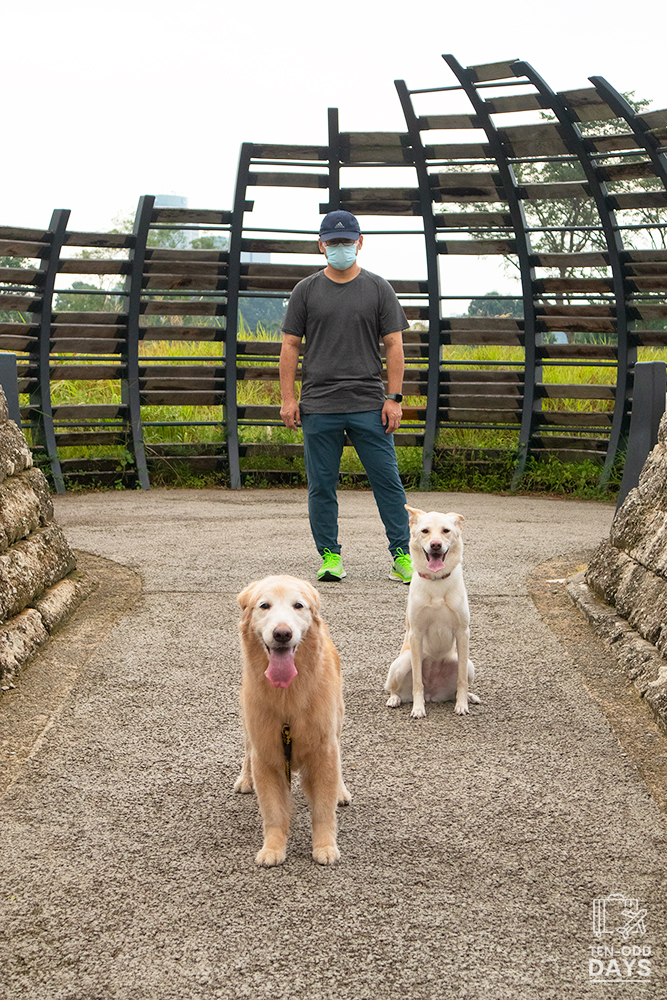
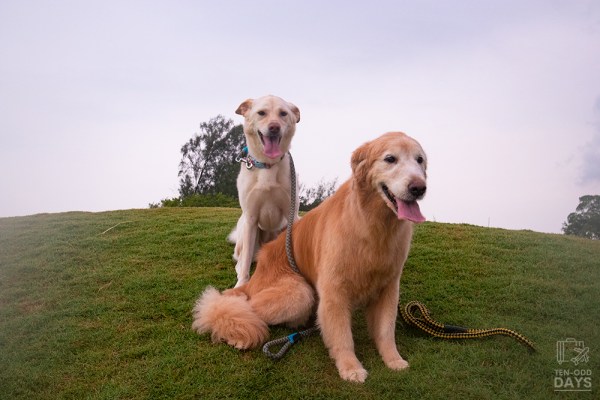
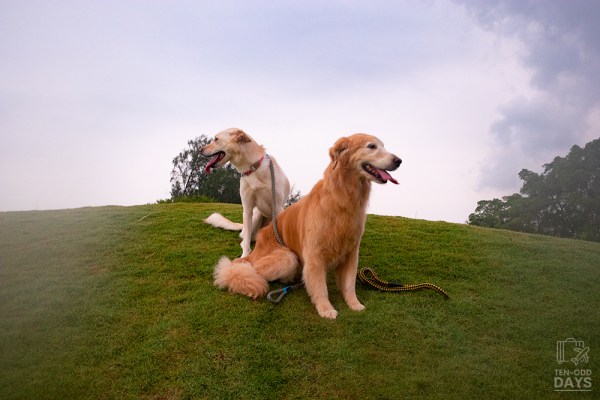
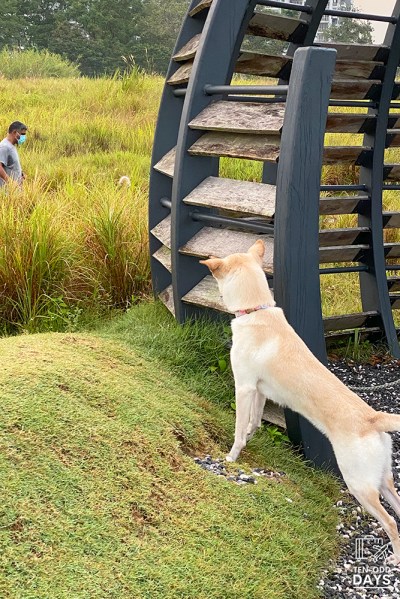
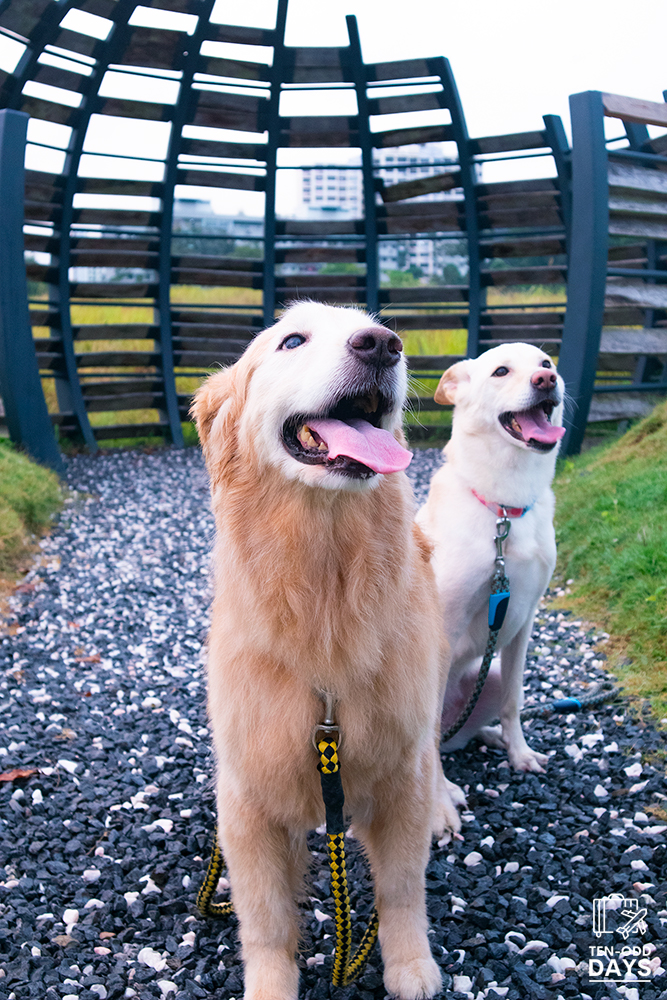
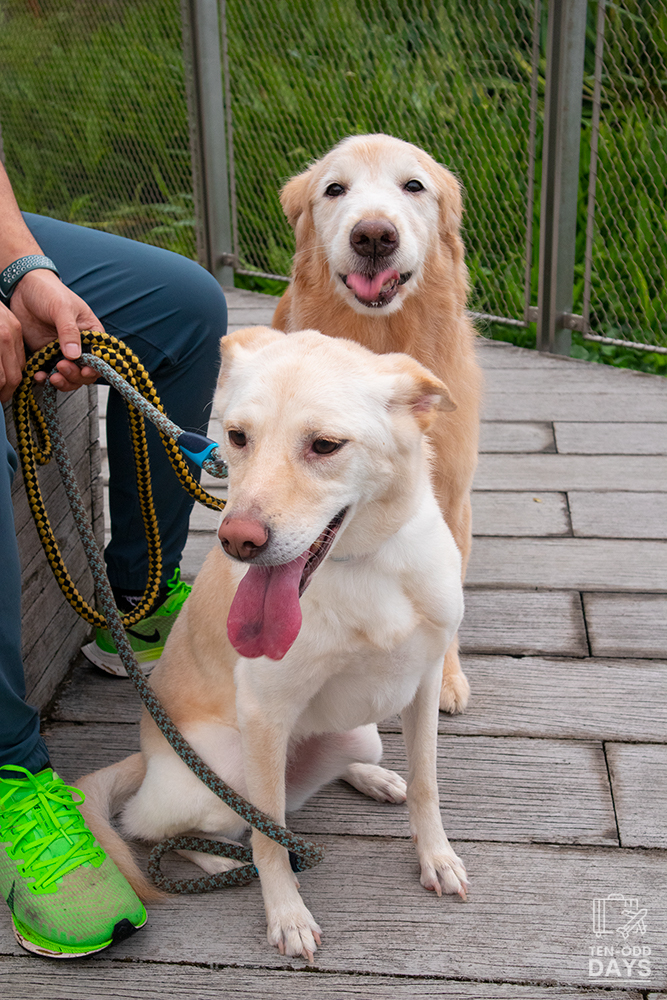
We headed to The Grasslands first, and came across several mounds. Got the girls to mount one, which they happily did and stayed for the vantage view that satiated their curiosity. Belle and Cassie were so busy looking at the joggers, strollers and cyclists they barely heard us when we called out to them.
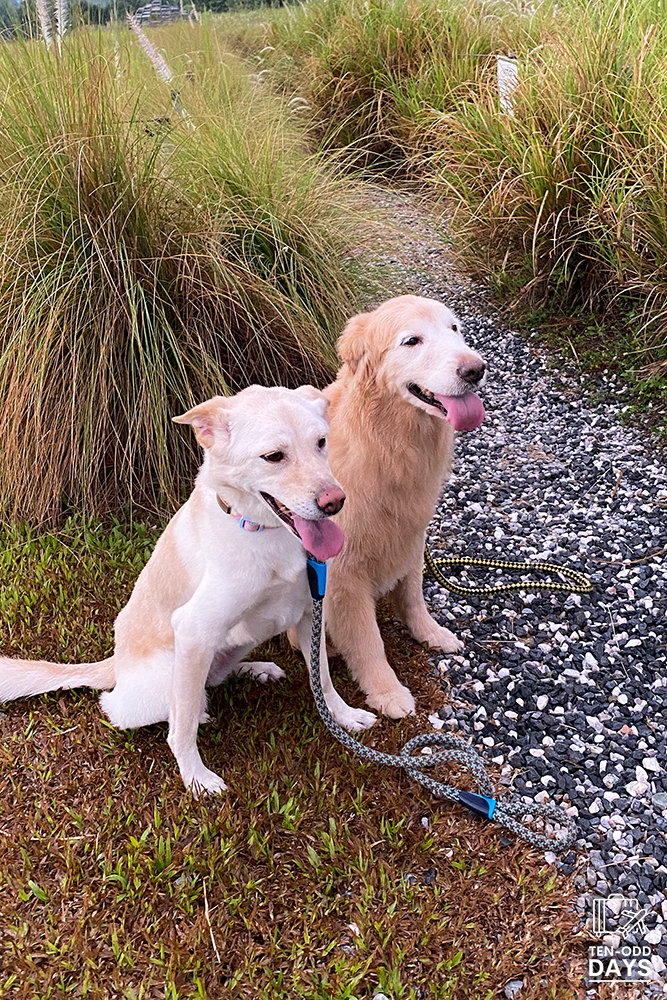
‘Tis was a very strange morning – Cassie was much more receptive to being photographed than Belle, which… never happened in the past. Must be my lucky day that she was in an obliging mood.
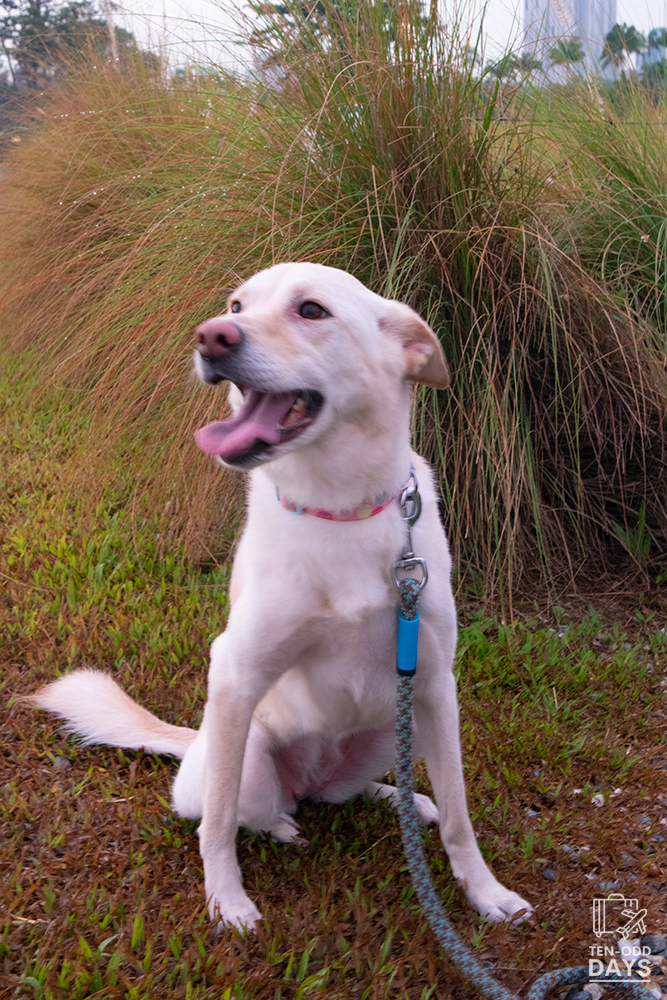
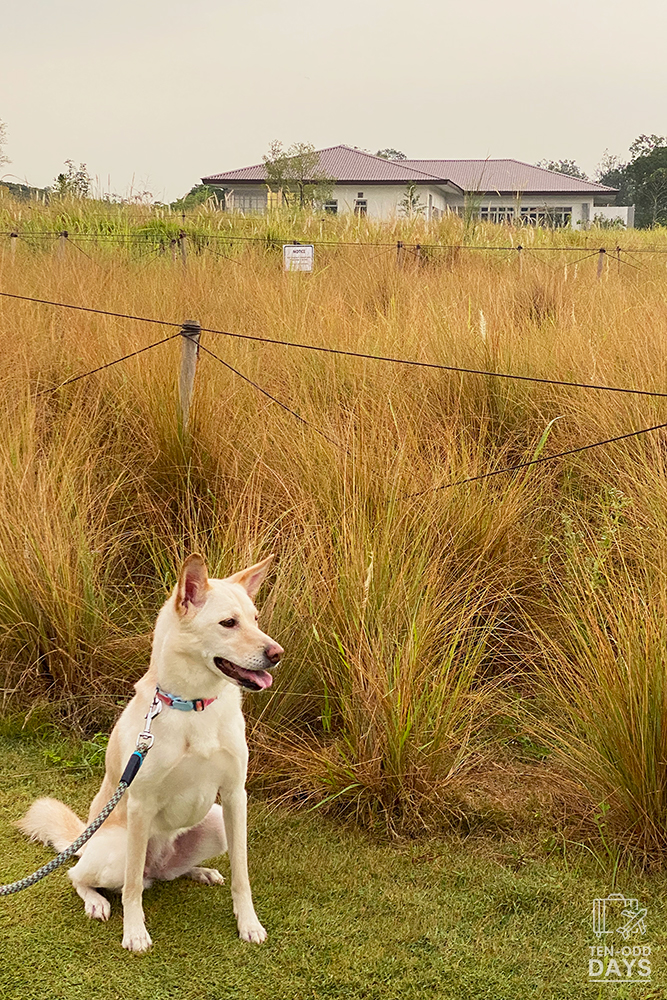
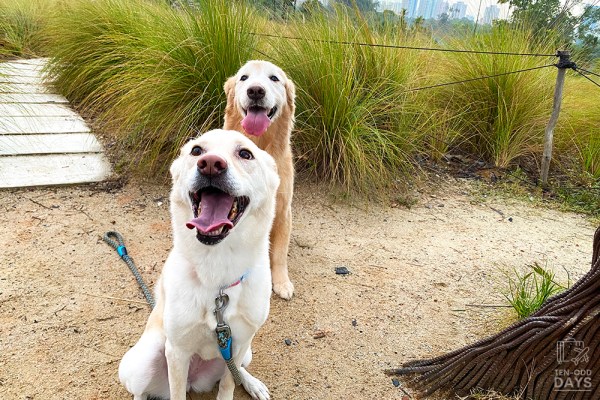
Cassie was a full-fledged busybody on the walk. A golden retriever walked by with its owner and she was curiously following its path with her eyes. How adorable! I bet if we had let her off-leash, she would have run off to make friends with that golden retriever. Reminds me of how her trainer told us this girl would easily be the life of a party given how she wanted to be friends with everyone in her obedience class. And back then she was only a 4-month old puppy! 😛
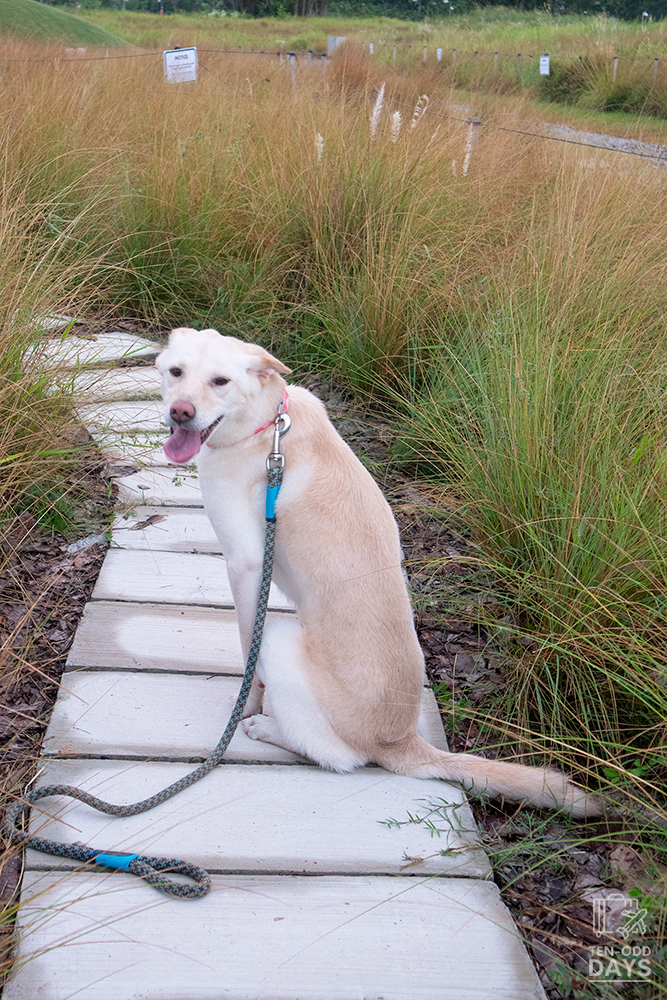
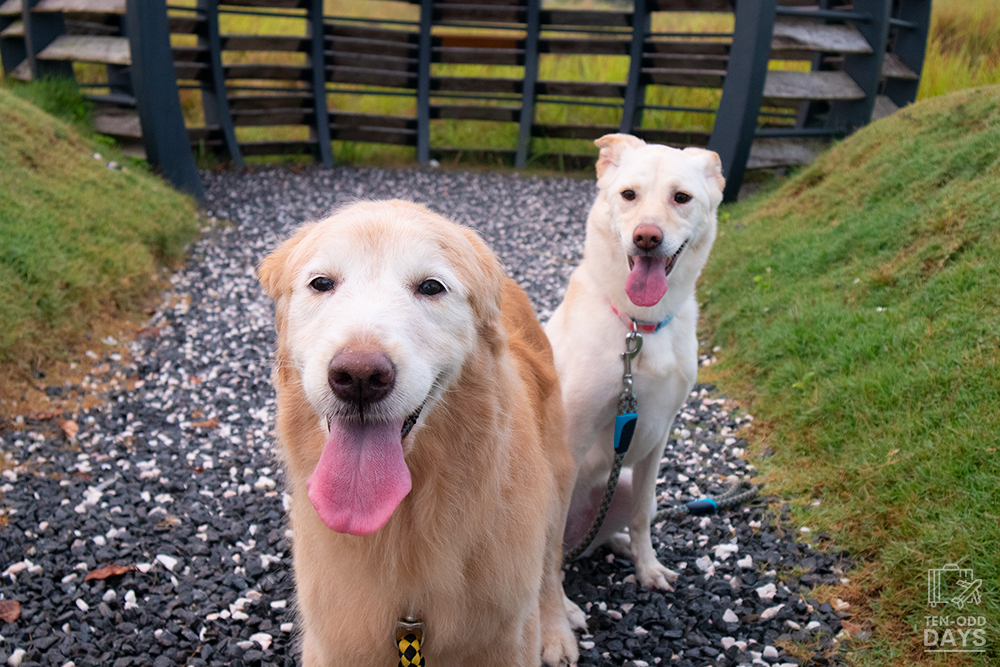
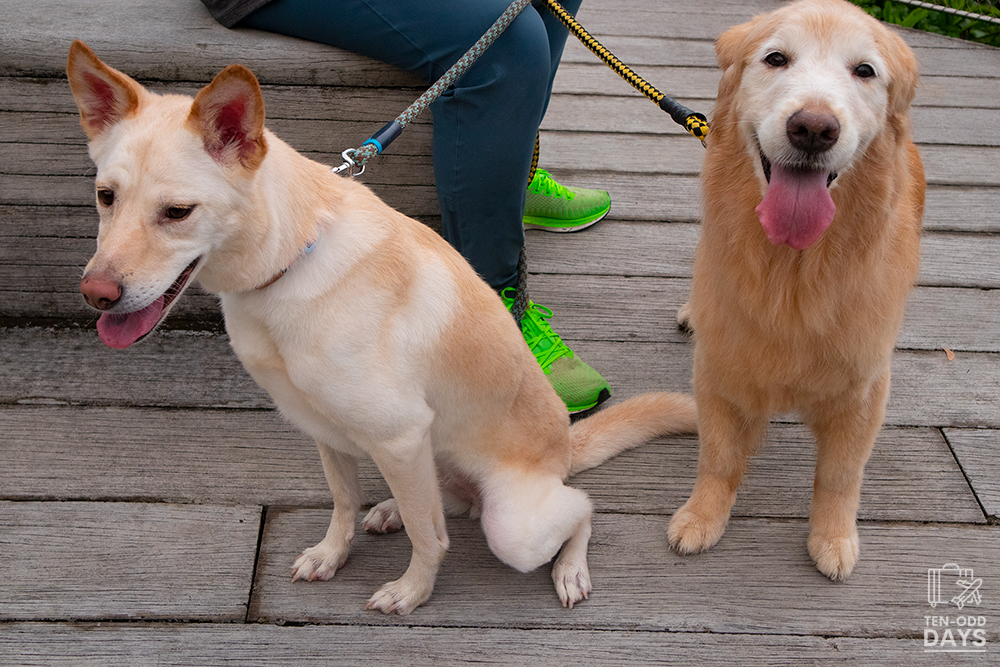
That morning, the girls have experienced walking on all sorts of terrain: concrete, grass, gravel, mud and sand. Belle and Cassie are generally very fastidious about cleanliness and they are not so used to walking on gravel. Both girls challenged the terrain with much gutso, to my surprise.
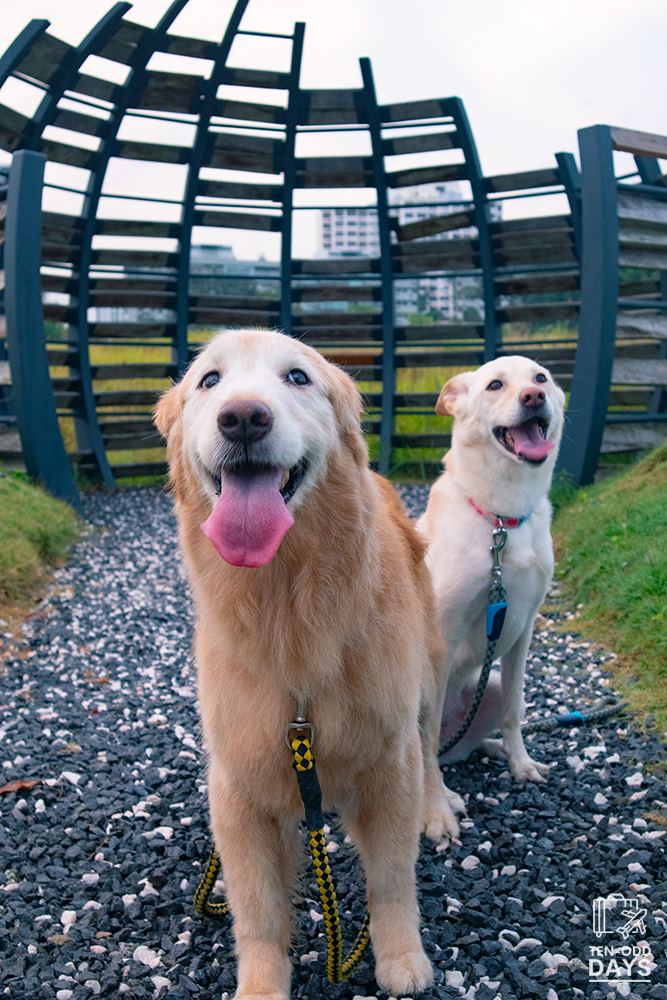
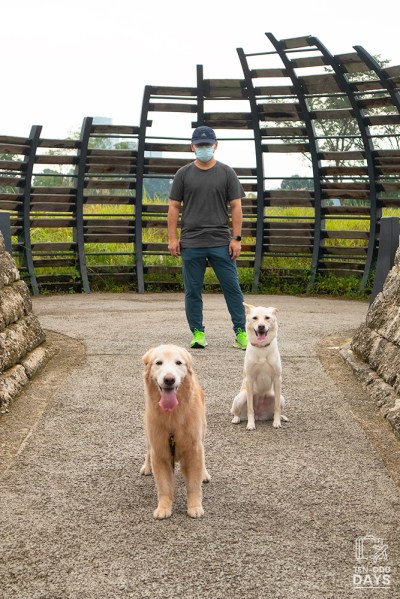
My newest favourite picture of my three beloved.
We’ve only managed to explore The Grasslands in the short hour we had before it started pouring. It was enough to let us have a taste of what the completed gardens would be like simply by seeing how well designed Lakeside Garden is. The rest of the gardens including Chinese Garden, Japanese Garden and Garden Promenade are currently still under construction, estimated to be completed by end 2021, but I guess with the current COVID-19 situation, completion date would be postponed.
In spite of the long drive, we can’t wait to revisit and explore the other areas of the park!
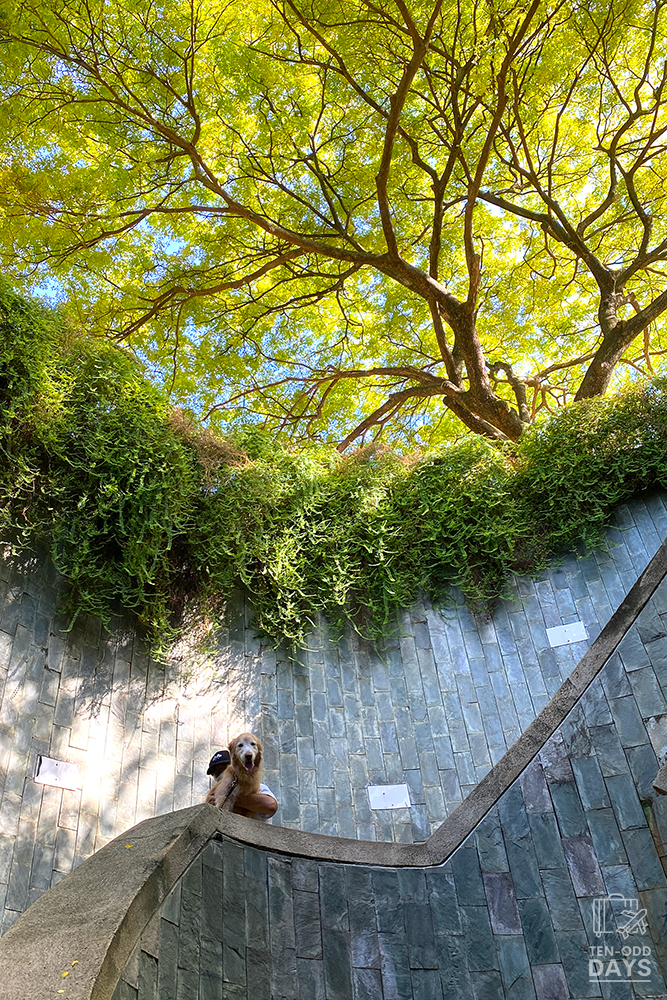
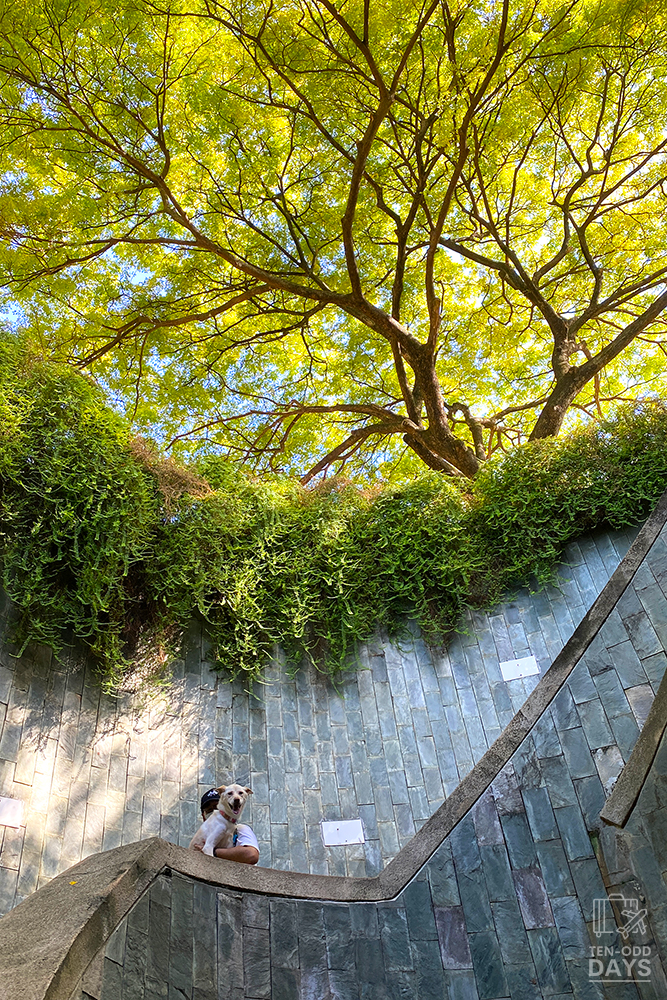
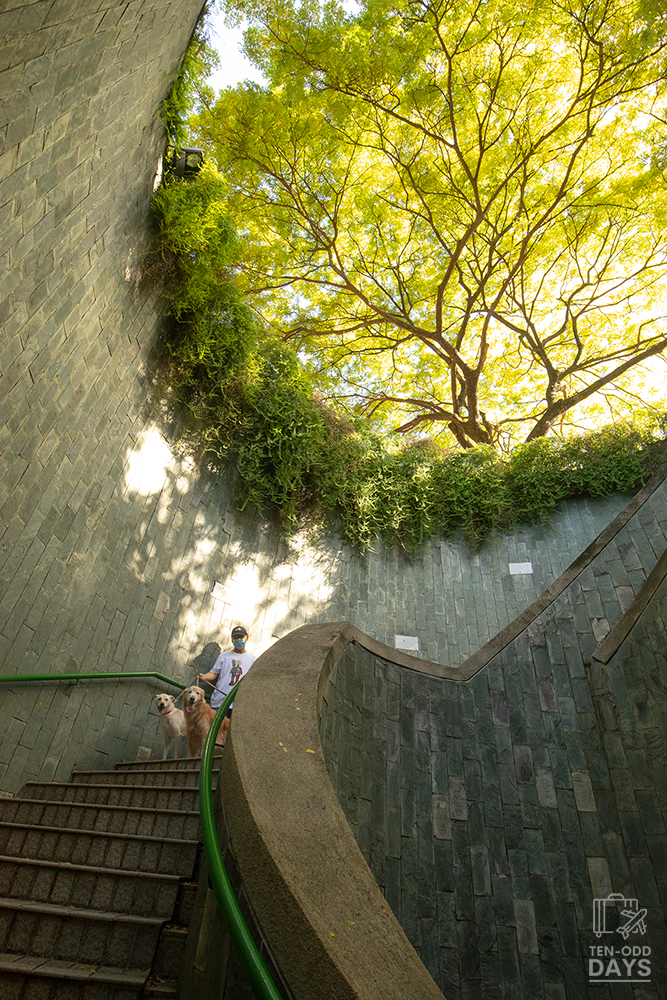
A particular open-air spiral staircase location encased by lush green leafy top has been making its round as an Instagram hotspot. This photogenic site was never meant to be a point of attraction of the park, until local Instagrammers discovered it. Now, more than half of visitors to Fort Canning Park will probably invariably end up looking for the spiral staircase. Talk about the impact of influencers.
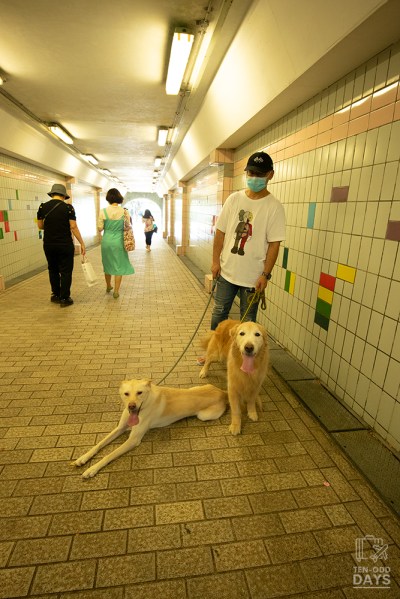
Resting in the tunnel waiting for our turn.
Fort Canning Park isn’t a park that we frequent, hence we had no idea where the spiral staircase is located despite researching online. Eventually we ended up walking the whole length of Fort Canning Park before realising that we had passed and completely missed it because Google Maps was slow in updating our position (and because I was navigating haha). We had to retrace our steps slowly in part to allow the app to update, and in part to allow the girls more time to take in the scents along the trail.
How to Get to Fort Canning Park Spiral Staircase if You Drive:
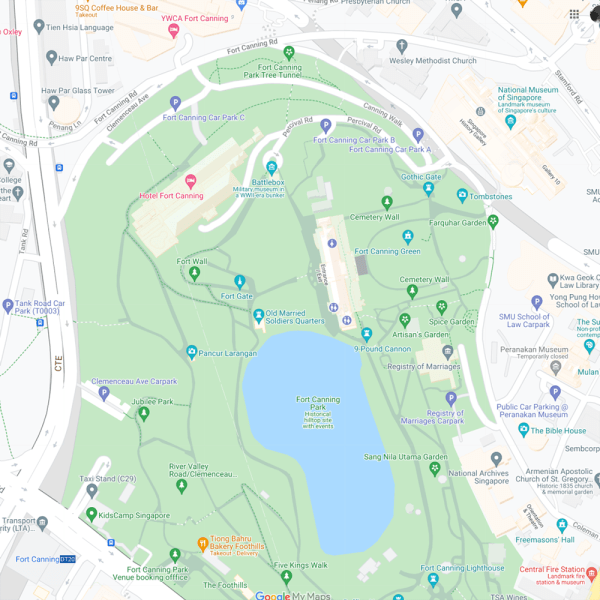
The spiral staircase is denoted by Fort Canning Park Tree Tunnel in the Google Map attached above. If you drive, it is very near to the parking gantry (on your left).
Fort Canning Car Park C in front of Hotel Fort Canning is the nearest car park to the spiral staircase. If you intention is also to explore the park, Car Parks A & B are good alternatives.
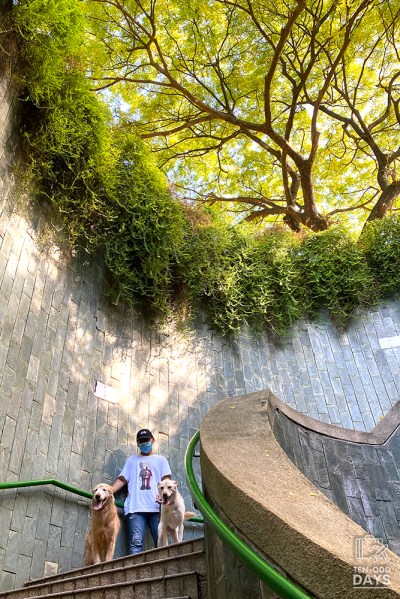
When we finally found the spiral staircase, there was a queue! On a Monday afternoon! As Instagram Influencers wannabe, I think we have completely failed. How on earth did they take such nice pictures? Then again, we have not really seen good pictures taken with large furkids.
We waited till everyone in the queue has cleared before we attempted to take some pictures. There was no way the mister could carry both the furkids at the same time and take care of their safety, so he carried them one by one while I stayed at the foot to take pictures. It was hilarious! 😆
We daren’t take too long as a queue was again forming behind me. As it turned out, this picture above ended up being our best attempt. Without showing any of the tree canopy. We laughed at what a failure we were. 😳
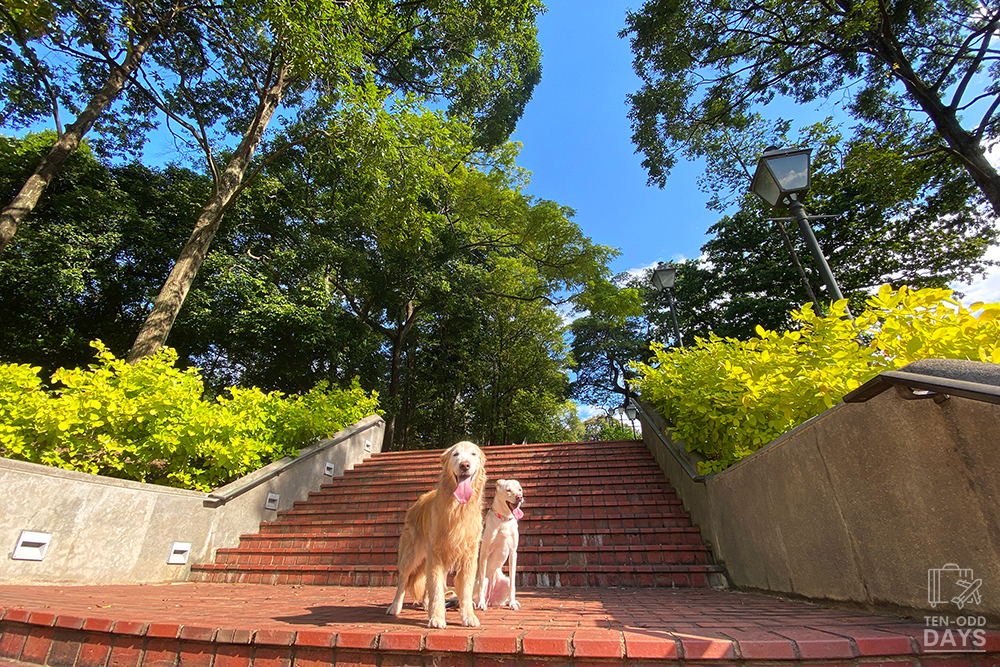
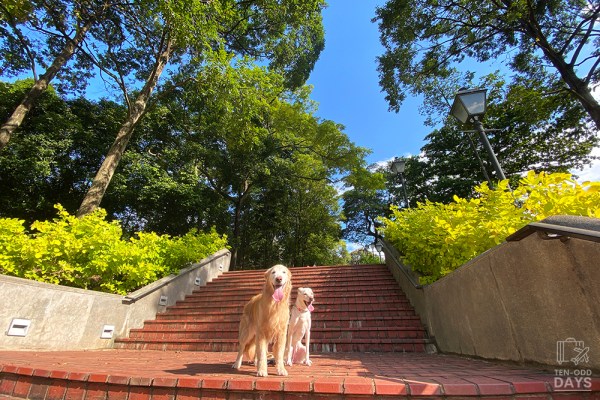
After a lacklustre attempt at becoming Instagram stars, we headed back to the car at a leisure pace. Which involved a long flight of steps in the sun…
And at sighting a bench, the girls immediately jumped up without much coaxing, just to rest a bit in the shade. We let them be, to let them cool down a bit. Heatstroke in dogs is a very real problem that is not taken too seriously here in Singapore, but recently a dog here passed away from heatstroke, simply by walking in a park. It really hit home, so we were careful not to let that happen.
After Belle and Cassie have rested sufficiently, we headed back to the car. And this was how Cassie’s 4th birthday excursion went.
On hindsight, we didn’t explore much of Fort Canning Park, including all the historic landmarks found in the park. It necessitated another visit, but the next round, we vow not to be obsessed over the spiral staircase.
It felt good to be in the midst of greenery after months of not being able leave home except for essential activities. Alright, I might have exaggerated a little; parks and gardens reopened after a couple of months but erring on the side of caution, this outing only took place four months after the last.
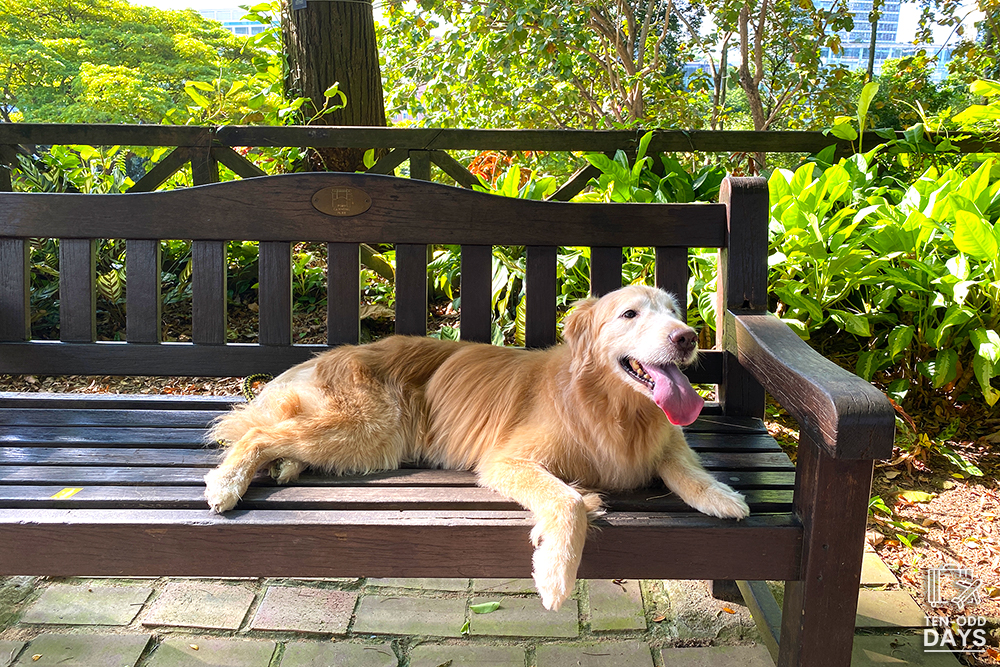
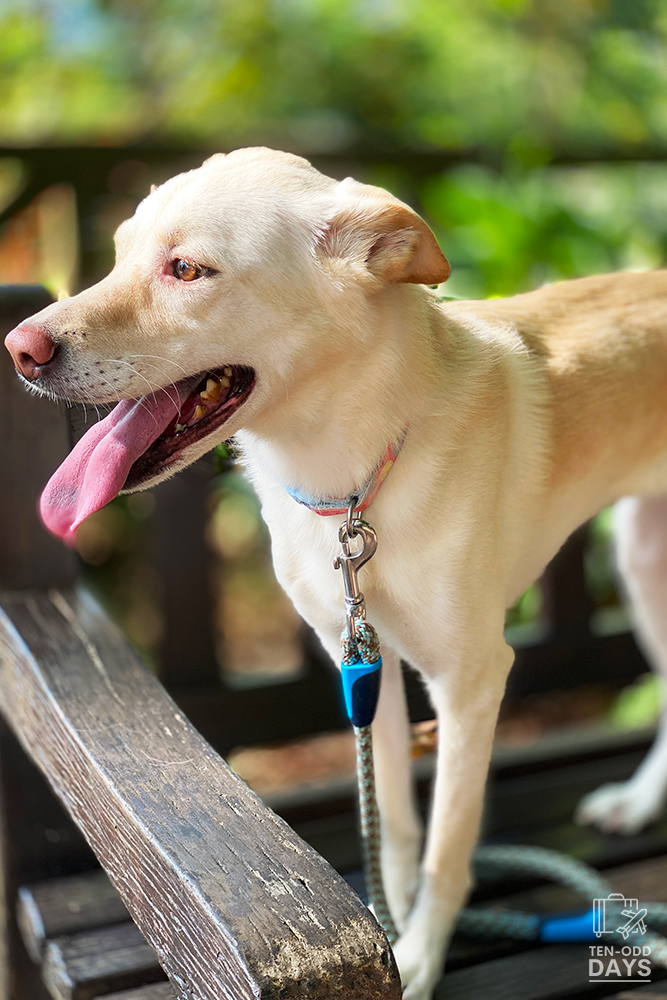
The weather has been erratic, to say the least, and we were most grateful it held up for the morning (it poured in the afternoon) while we were exploring the sprawling grounds of the garden. There was really no agenda, and so we allowed Belle and Cassie to sniff to their hearts’ content, letting them lead the way. Belle was, for the most part, trying to get acquainted with every other person she came across while Cassie was attempting to mark territory throughout the garden. One significant personality trait we confirmed during this walk: that Belle simply loves people more than she loves her own kind, and that Cassie can be rather territorial.
Having spent almost three years with Cassie, the mister and I often find ourselves comparing her to Paris, the fur-sister she never got to meet. We have drawn several stunning similarities in personality between them both that we sometimes wonder if she is Paris reincarnated. Well, she certainly embodied Paris’ distaste for posing, which makes things as challenging as ever for me, the photographer. Times like this makes me appreciate Belle the model poser all the more.
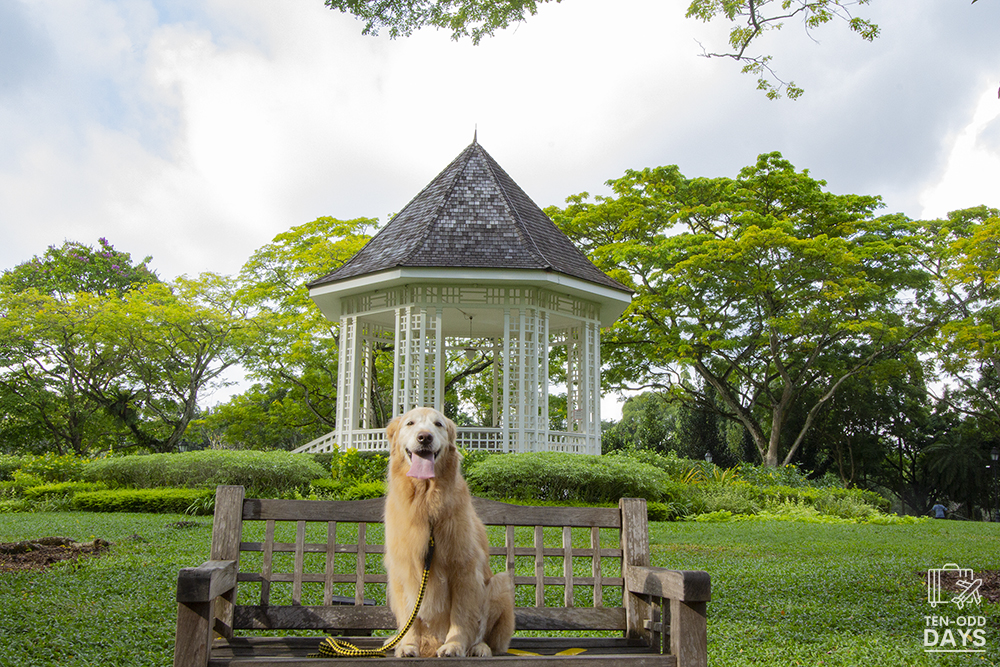
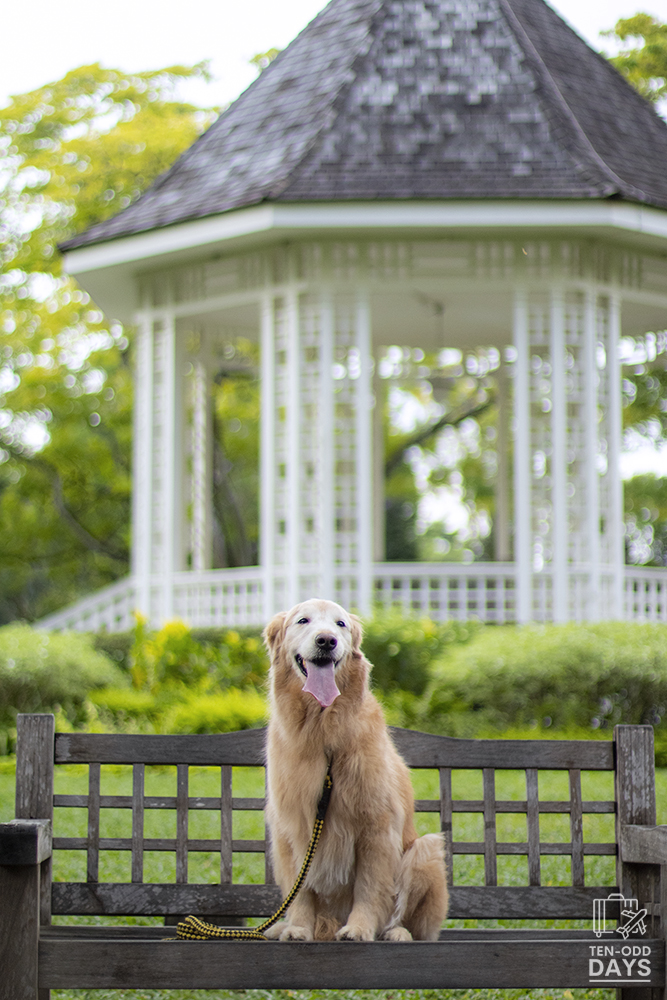
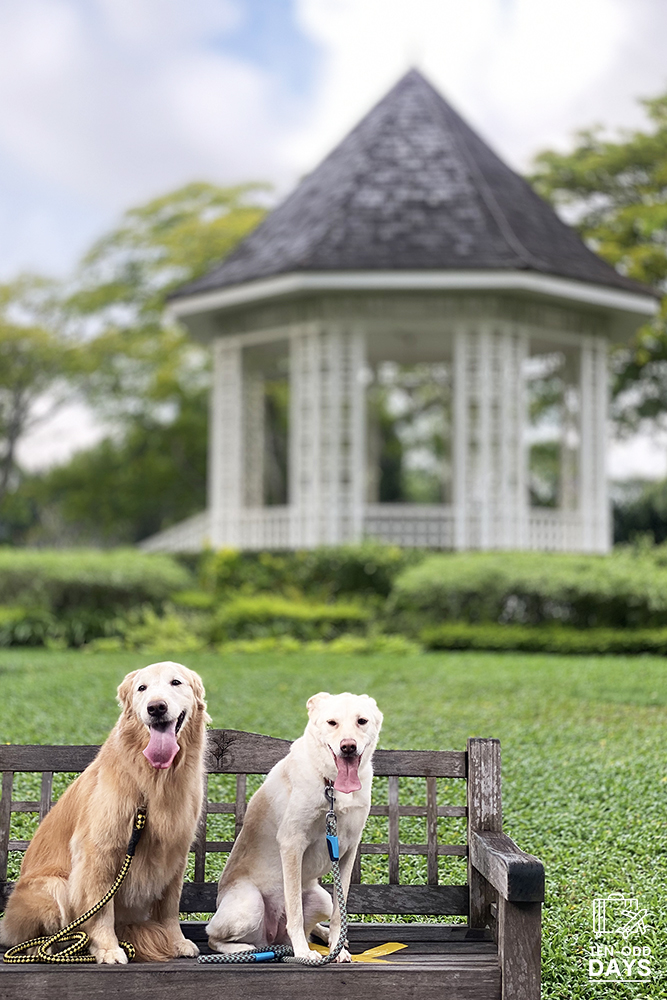
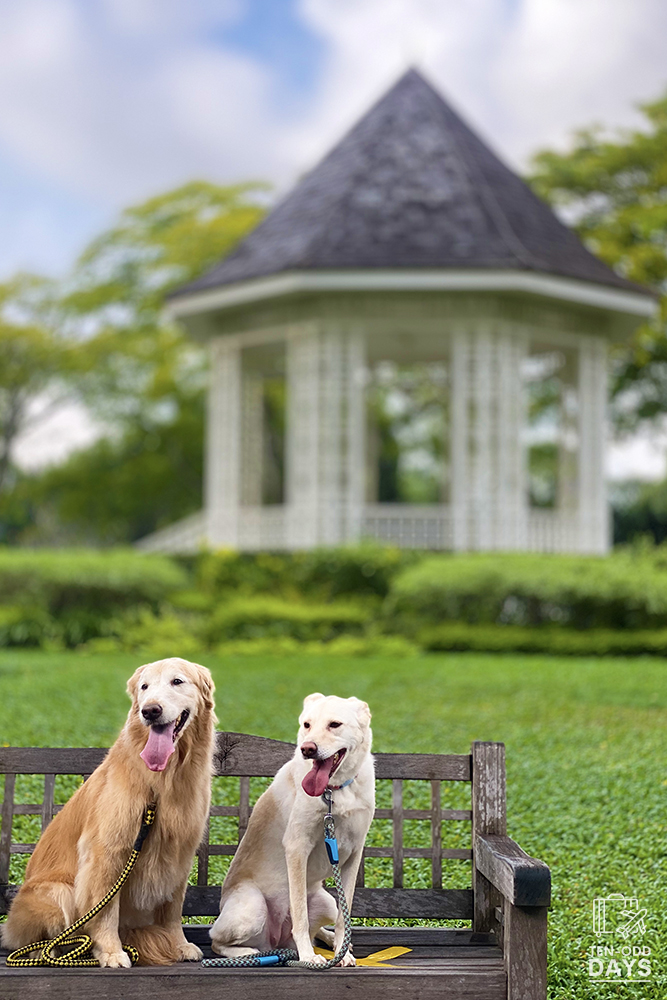
Almost two hours into the walk when the furkids were visibly tired out, we started looking for the bandstand. It took us another fifteen minutes before we finally located the iconic feature of this 161-year old Unesco World Heritage Site. It’s probably the single most recognisable landmark of the garden, but we were fortunate in that it wasn’t terribly crowded at that knoll that morning, having it almost exclusively to ourselves.
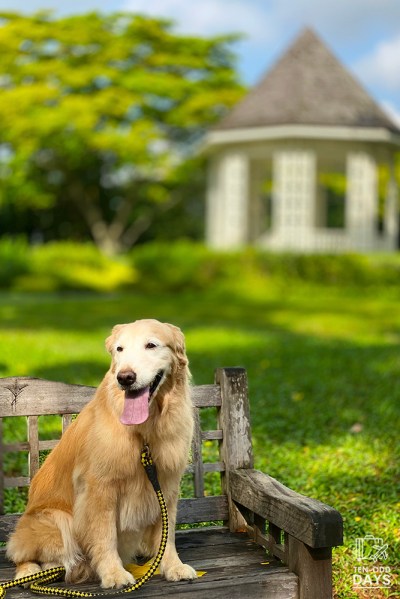
Belle and Cassie went up to the bench by the side to rest, and I managed some shots of them against the backdrop of the bandstand. These were some of the best pictures turned out for the entire outing, thanks to a toddler passing by capturing their attention. Typically we only had problems with getting Cassie to look at the camera, but Belle decided she wasn’t in the mood to be cooperative too. In this way, dogs are rather like young children – unpredictable.
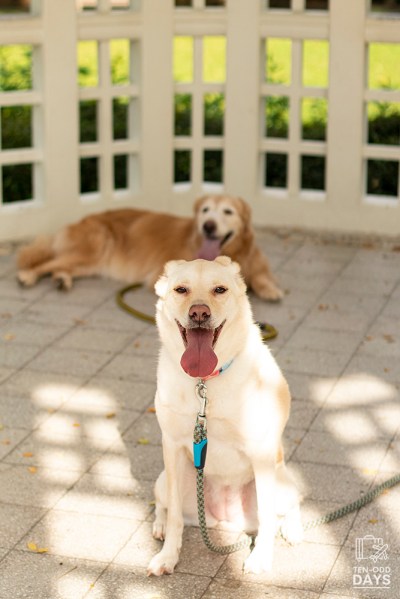
We proceeded to the bandstand where the girls lay down and got to rest some. We’ve got work to do where their stamina are concerned. In fact, I personally still haven’t gotten used to the fact that Cassie is considered a small dog (at 14kg); I often hug and pat her with force too strong for her comfort, thinking that she is a golden retriever. Three years on, and I’m still learning how much strength to exert.
Being the model poser that she is, Belle continued sitting on the bench when Cassie had long jumped off to go take in the scent of the surroundings. The Gardens had progressively gotten more crowded by that time, so we decided to call it a day.
TRIVIAL: Built in 1859 and located at the fringe of Singapore’s Orchard Road shopping district, Singapore Botanic Gardens is a sprawling 82-hectare (82,000m²) tropical garden with a predecessor initially developed to introduce the cultivation of cash crops, at Fort Canning. 153 years later in Jun 2012, Singapore entered a submission to UNESCO, indicating interest to inscribe the Gardens as a World Heritage Site. On 4 Jul 2015, Singapore Botanic Gardens successfully received inscription as a UNESCO World Heritage Site.
The expansive Gardens originally comprises three main zones known as ‘cores’ to cater to different purposes – a core to retain the old charm of the historic Gardens, a second core to cater to visitors, and the last dedicated to education. The fourth core – Tyersall Gallop – was included in 2017, adding 8-hectare to the Gardens totalling it to 82-hectare. The Gardens is a popular tourist location in Singapore, and equally popular amongst locals who like to visit for a variety of purposes from exercising, immerse in the luxurious greenery to enjoying band performances.
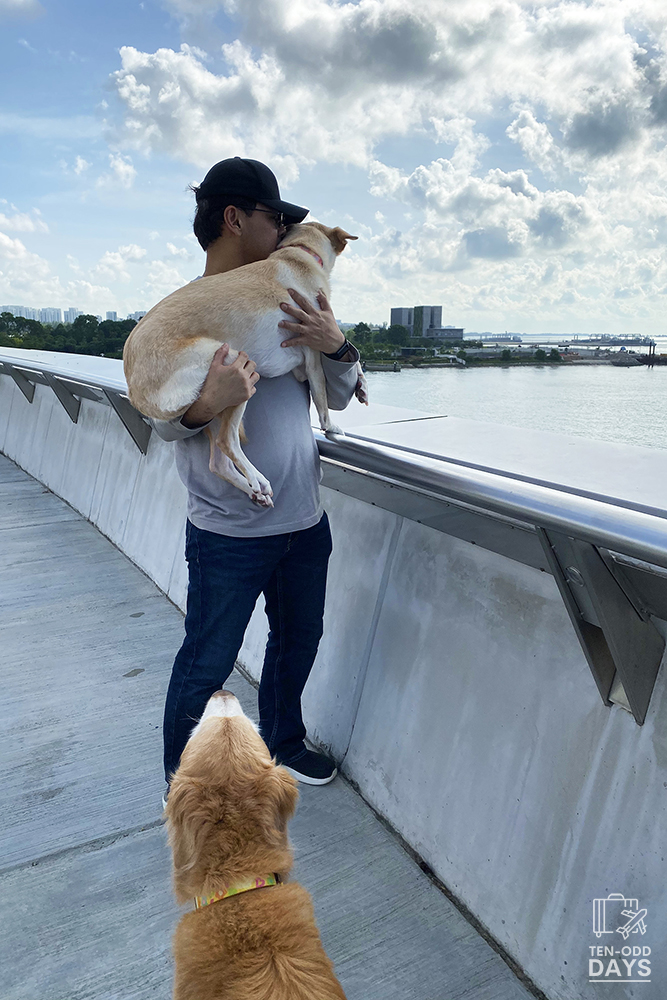
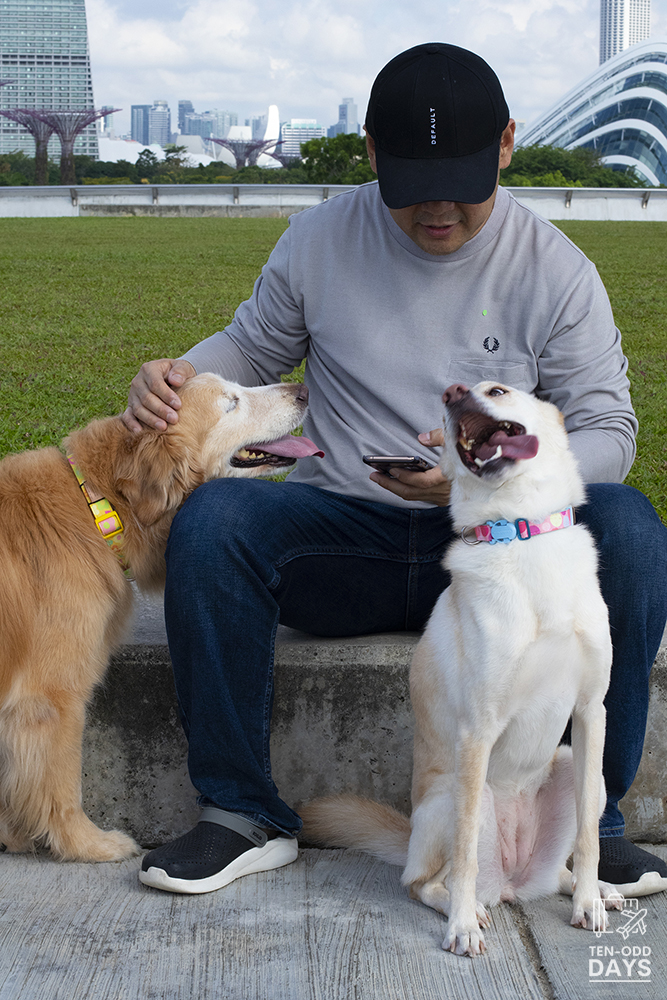
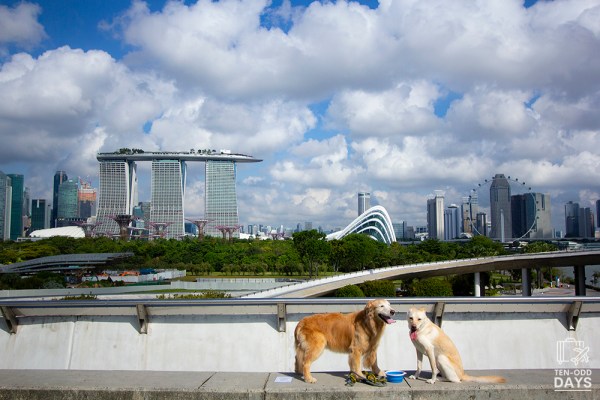
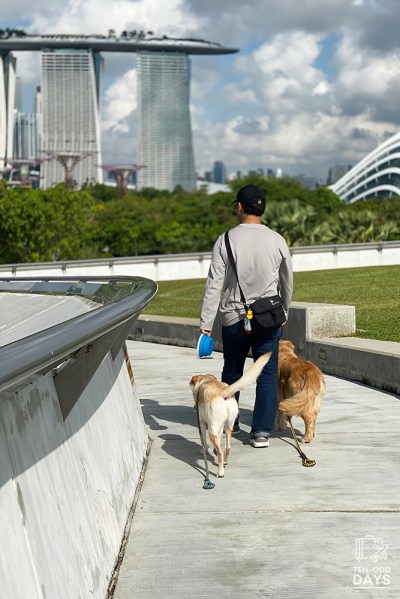
With the current global COVID-19 situation, we have been unable to travel since all Singaporeans should defer all non-essential travel. And so, bearing in mind social distancing as responsible citizens that we are, the mister and I brought our two furkids out to Marina Barrage on his birthday. A weekday no less, with almost no one in sight when we arrived, save for a mother and her child attempting to fly a kite.
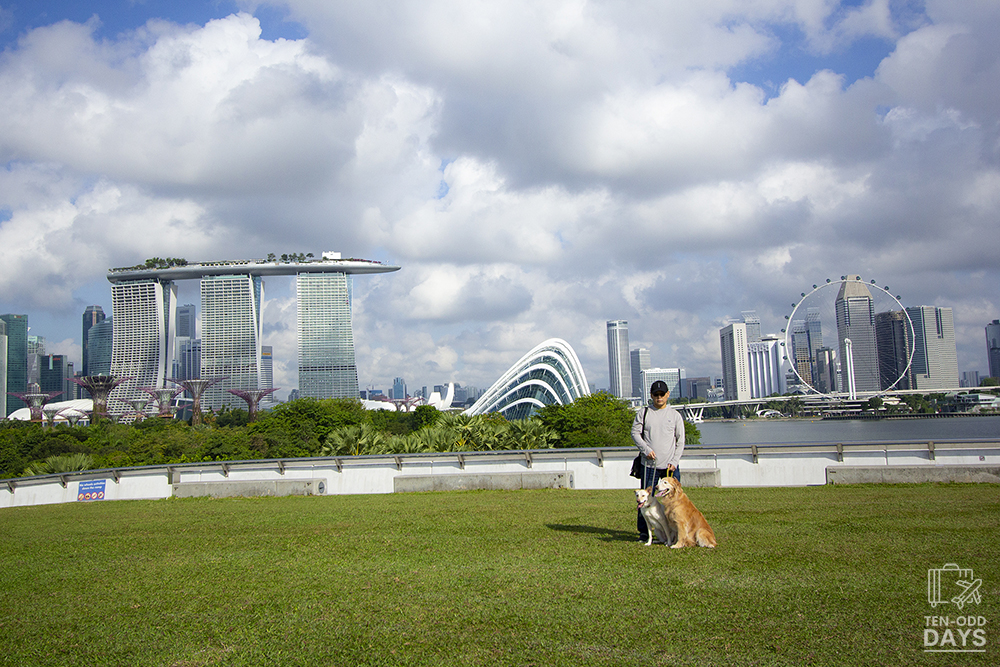
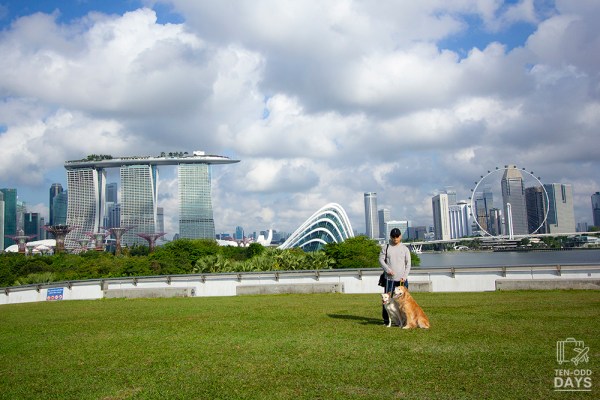
And exactly for the same reason why we chose to visit on a weekday, workers were maintaining the grass on the roof. We were requested to step off the half of the grass patch with the best view of Singapore’s skyline. Hastily, I took a snapshot of the three important figures in my life before we proceeded to the other half of the grass patch.
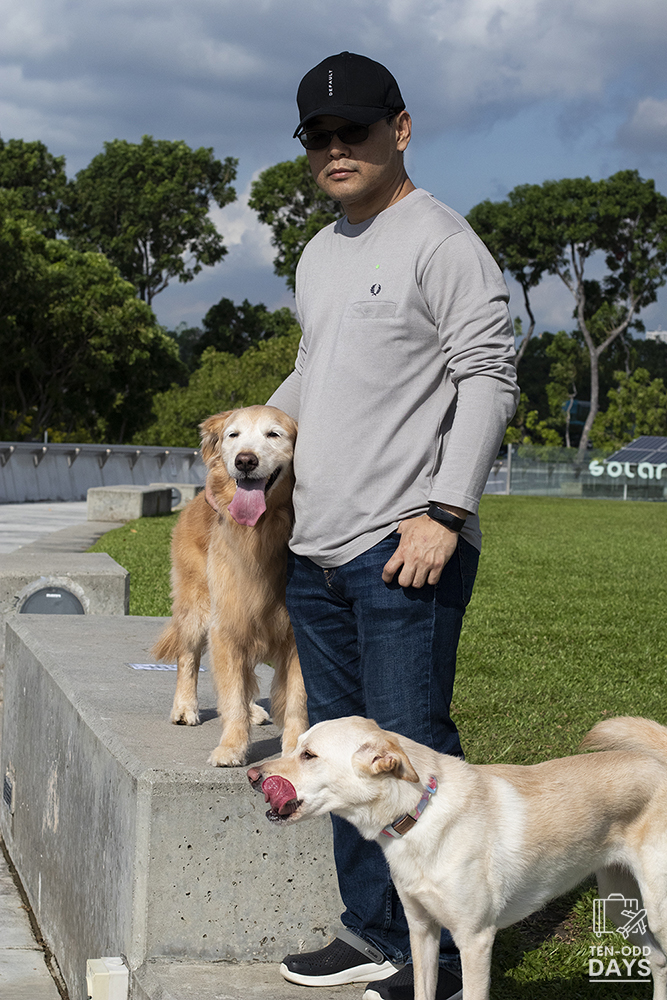
The birthday boy taking a quick picture with the two furkids.
Since we didn’t want the girls to disturb the workers trying to maintain grass on the other side, they were not given much freedom to frolic and roam about, unlike the last time we brought Paris and Belle. Not that they needed a lot of space; theses two furkids are a lot less adventurous than the other two we had and wouldn’t take many steps away from us, especially Cassie.
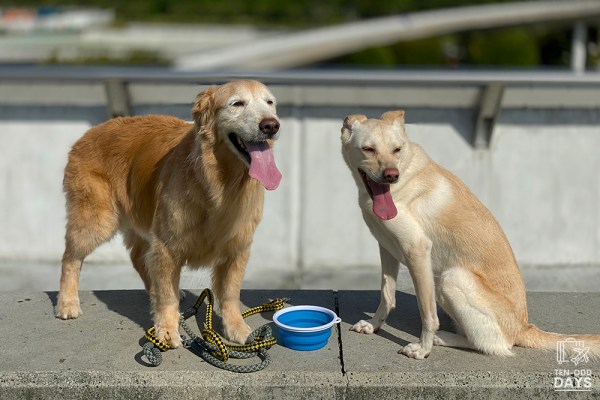
It wasn’t long before the girls stopped wanting to explore the area anyway. Without any shade in sight, Belle and Cassie went in search of their water bowl often.
The girls were panting hard from the heat and didn’t want to leave the water bowl to go play despite repeated coaxing. Indication that it was time for us to leave.
In comparison to their daddy, Belle and Cassie spend considerably more time with me since I work shorter hours these days due to a slower market. That doesn’t stop them from wanting to be around the mister more, especially on walks and occasional excursions to parks around Singapore. I reckon my slower walking pace and obsession with taking pictures didn’t quite suite their desire to dash ahead. 😕
TRIVIAL: Marina Barrage is a 350m-wide dam built across Marina Channel to keep out seawater. In essence it acts as Singapore’s 15th reservoir with a vast catchment area of 10,000ha. It was the vision of our late Senior Minister Lee Kuan Yew to build this largest freshwater reservoir located in the heart of the city in order to reduce our reliance on the import of water.
In addition to its role as a reservoir, Marina Barrage is also a flood control scheme to alleviate flooding woes in the low-lying areas in the city. Since the water level in the barrage is kept constant all the time, it is ideal for certain water activities including canoeing, kayaking and dragon-boating. And last but not the least, the grass-covered roof of the building structure called the Green Roof has become a popular place of congregation for families to have a picnic or fly kites, especially during the weekends or major festivals like National Day when fireworks can be viewed clearly from the roof. On such occasions, families can go to the Marina Barrage as early as 12 hours before the event to reserve a spot for the family.
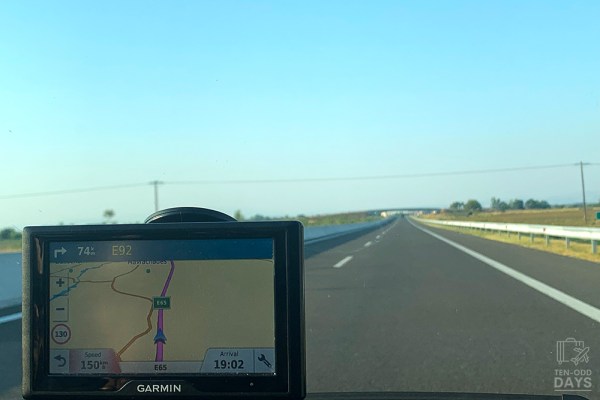
Our drive to Meteora was eventful, to say the least. In the previous post on Meteora, it was mentioned that we were stopped and booked for speeding. In my defence, it was a new expressway that had practically no vehicles for kilometres at a stretch. Nevertheless, speeding is wrong and I should have known better; nevermind the reason.
We were clocking around 150km/h when the speed limit on the expressway was 120km/h, and I was caught by a mobile traffic police van. Sheepishly, I walked back to the van after stopping the car quite a distance away (while the mister continued sitting in the car, grinning and leaving me to handle the traffic police on my own 😡 ). I was surprised to see two other young females sitting in the van, probably from the other car that was stopped nearby; they were being booked too.
The fatherly male traffic police officer was stern but fair. Perhaps much more fair that I expected. He didn’t tell me how much the fine was for, except that it won’t be too much; I was on tenterhooks the whole time he took down really detailed information. He wanted my parents’ names as well, and wanted our accommodation details (I brought along my passport, International Driving Permit, local driving licence and wallet along when I alighted) so I walked back to our rental vehicle again, to retrieve the necessary documents.
By then, the mister was getting worried (served him right for abandoning me to face the music alone!). He got out of the car to ask me why it was taking so long. I briefly explained to him before briskly walking back to the waiting officer.
After what really felt like an eternity to me, the police officer explained to me that he was letting me off with a small fine of 35€ (or thereabout), 10% of the original fine because he didn’t think I was a habitual speeder. I heaved a sigh of relief. Honestly I was expecting a fine of above 100€. He then handed me the speeding ticket and told me that we have to pay the fine at a post office, and not to him.
Having learnt a well-deserved lesson, we took our time to get to Meteora as I suppressed the strong urge to go beyond the speed limit. I’m not a speed demon per se, but I’m also certainly not a slow driver.
We were both relieved when we finally arrived at our guesthouse. It has been a long day.
Apart from the 6 monasteries in Meteora that are still occupied, we also visited other places in our slightly over 2 days there, including a visit to the viewpoint for a gorgeous sunset and a couple of hermitages. In particular, the Meteora Sunset Tour we signed up for was well-worth the time and money; we learnt so much from our guide.
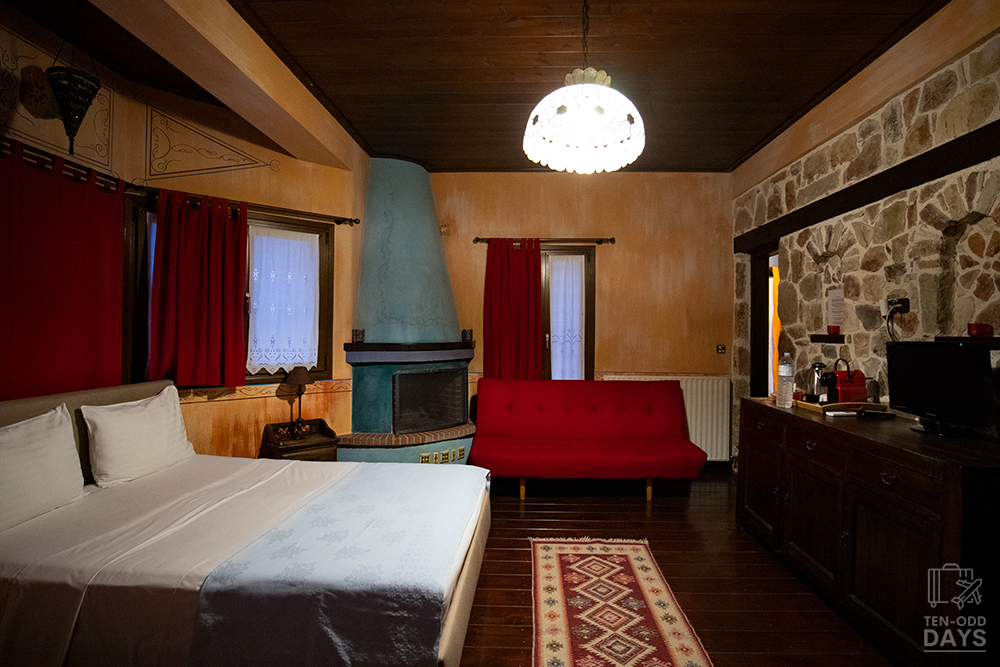
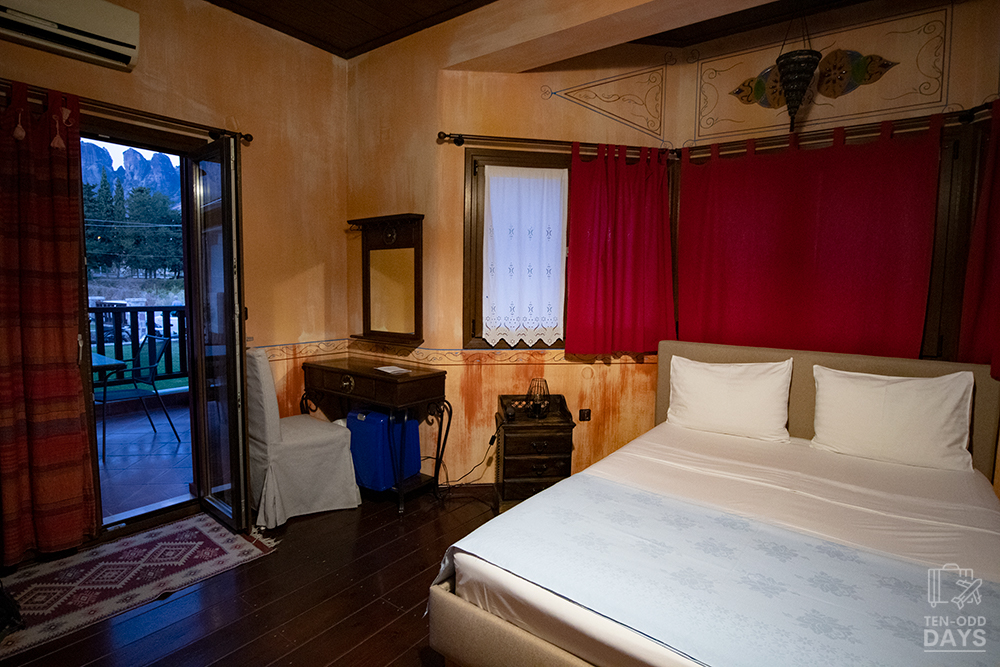
Our room at Monastiri Guesthouse in Kalampaka, one of the two towns near to Meteora.
Booked a room with a porch that led directly to the swimming pool area.
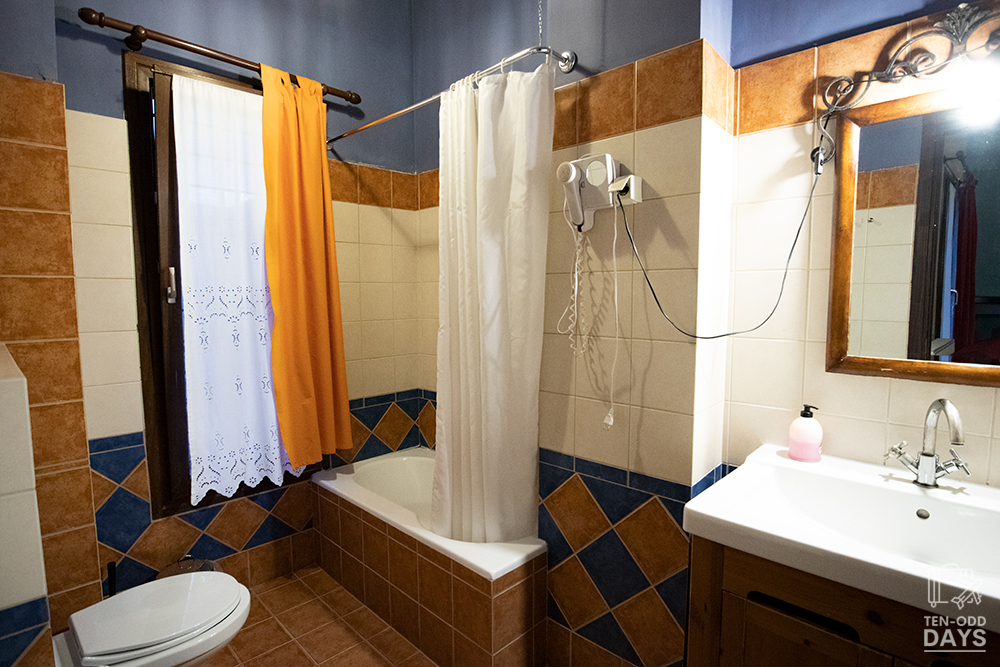
The bathroom was simple and functional.
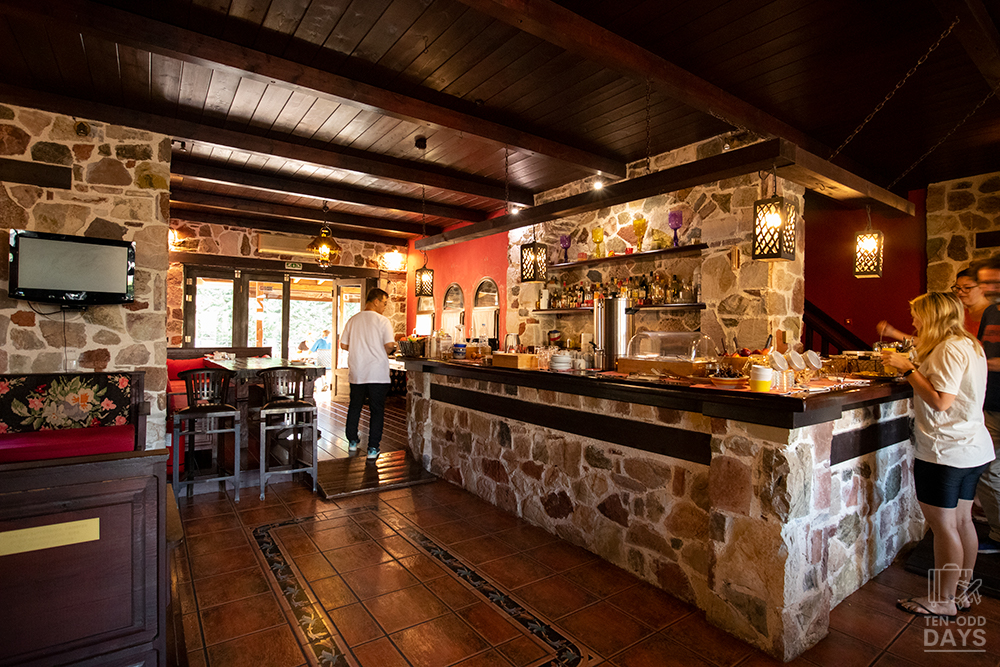
American breakfast was provided by the guesthouse, and was a sumptuous full spread to fuel up before a day of activity.
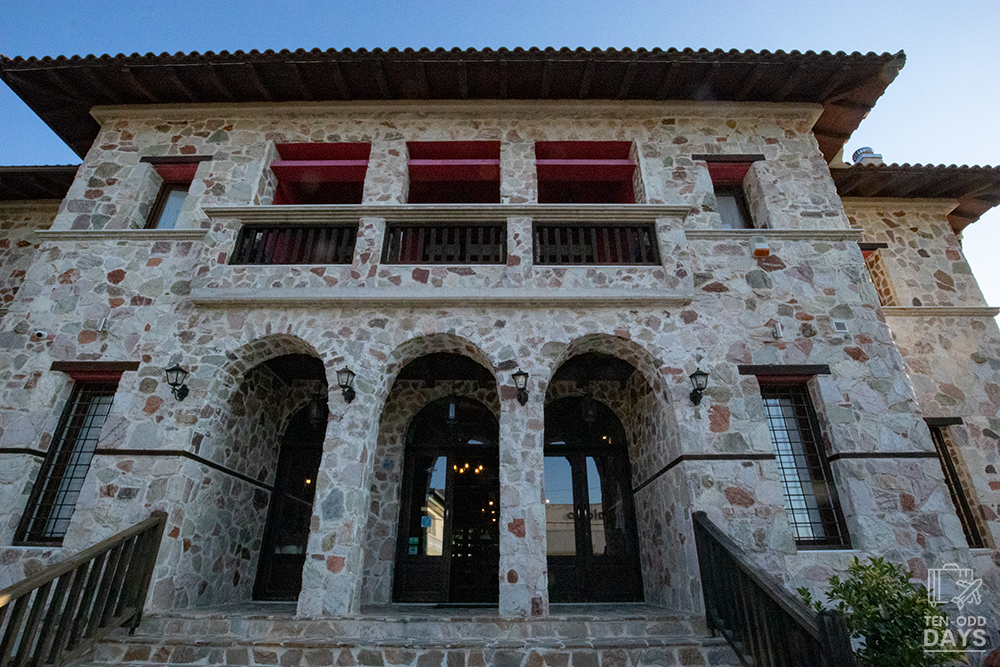
The frontal facade of Monastiri Guesthouse. Interesting construction material, made of stone I think, and likely from the area.
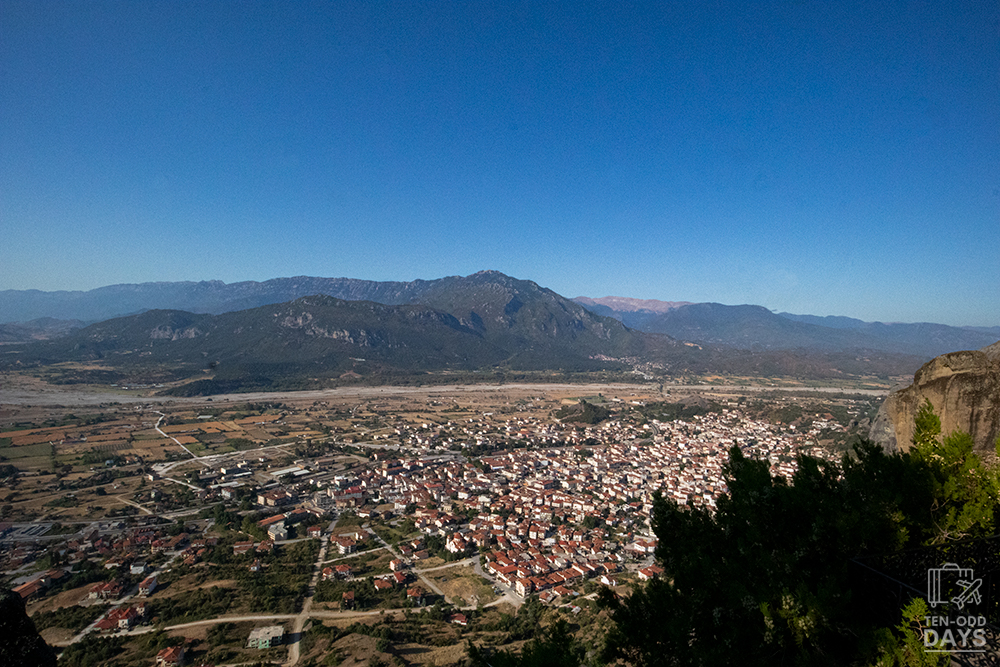
Not entirely certain if we were overlooking Kalampaka or Kastraki, but since we were at either St. Stephen’s or Holy Trinity, I’ll hazard a guess and say this is probably Kalampaka.
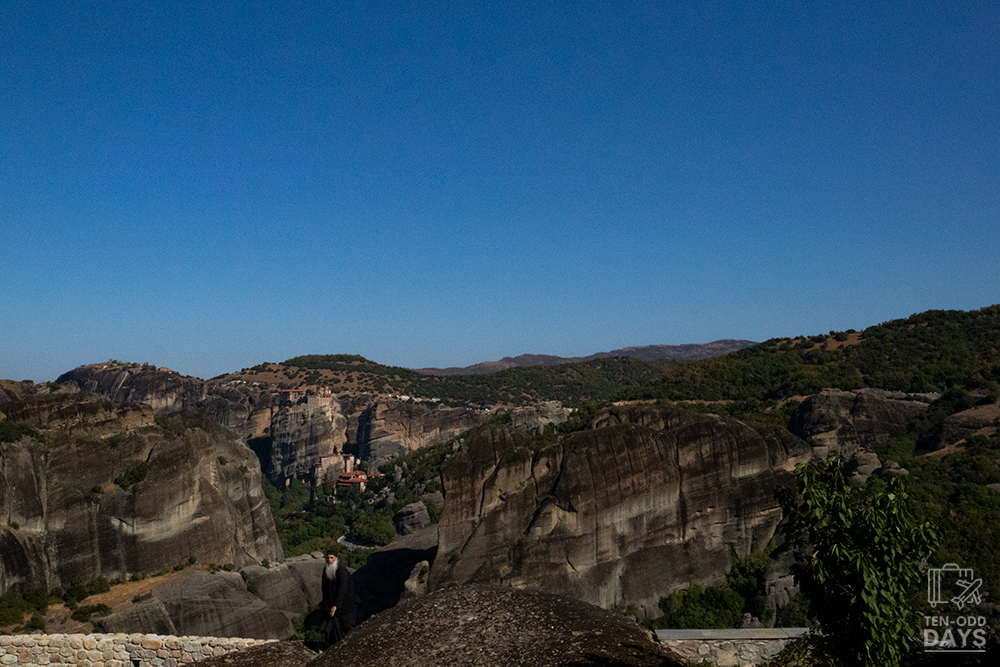
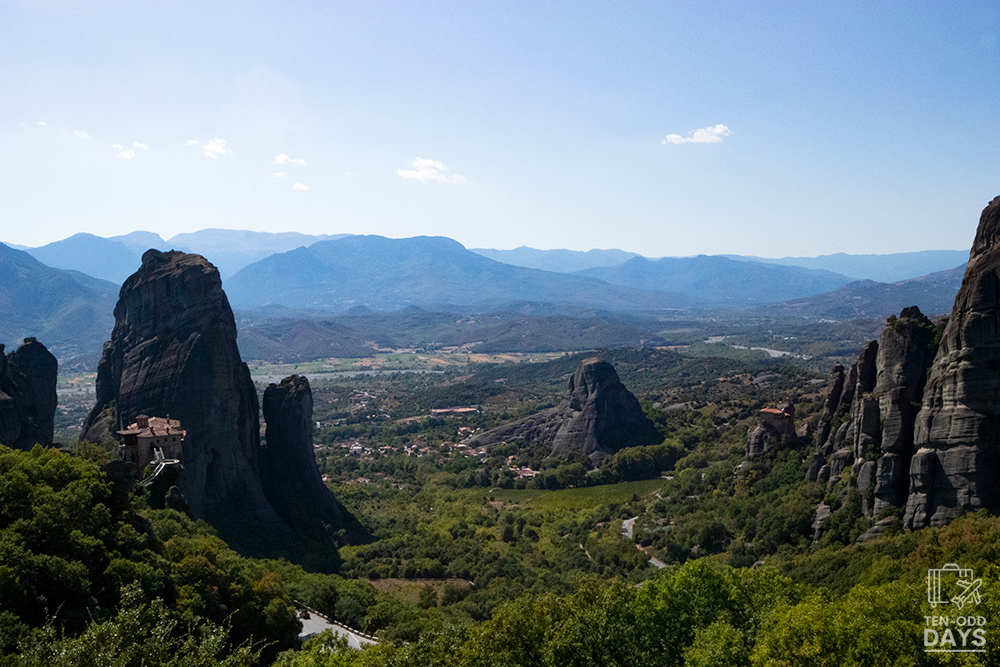
How many monasteries can you spot in this picture? If you look closely, one of the three monks living at Holy Trinity Monastery was captured in the picture as well.
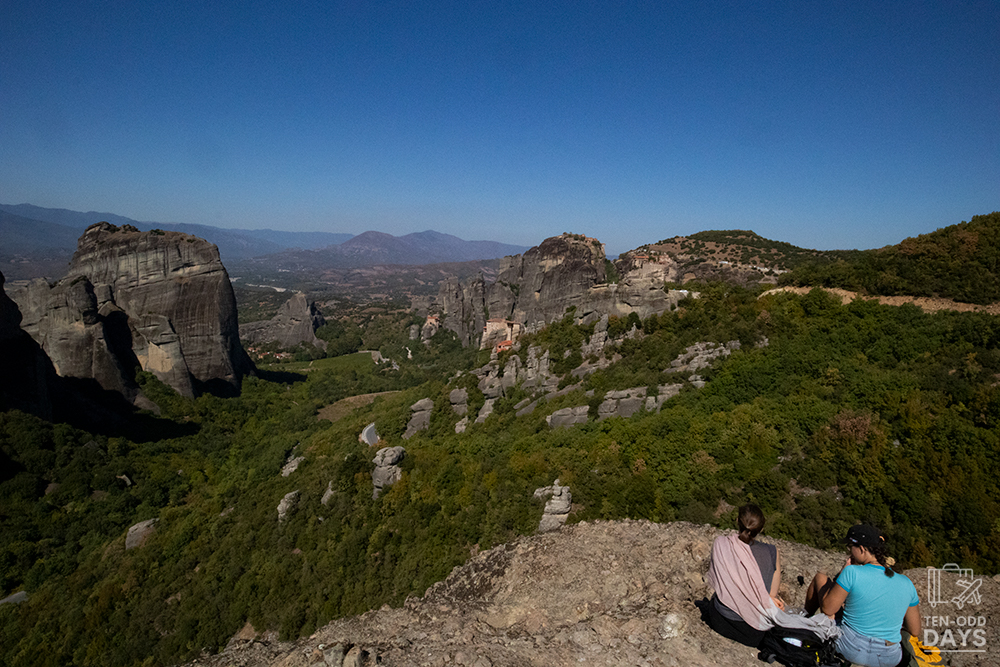
What a beautiful spot to have a picnic!
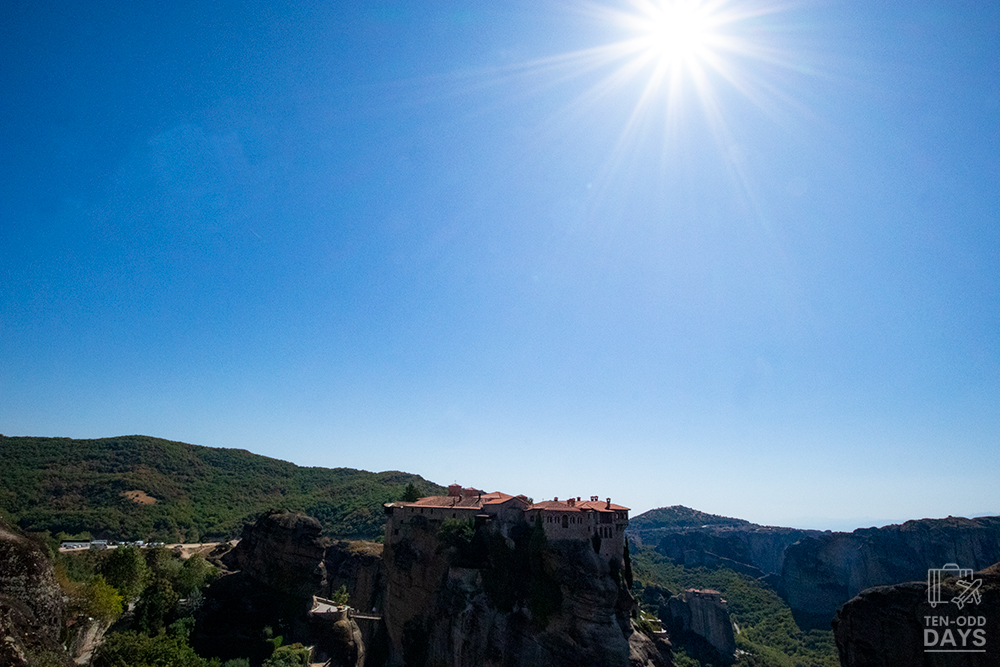
Rousanou Monastery, perched atop a narrow rock.
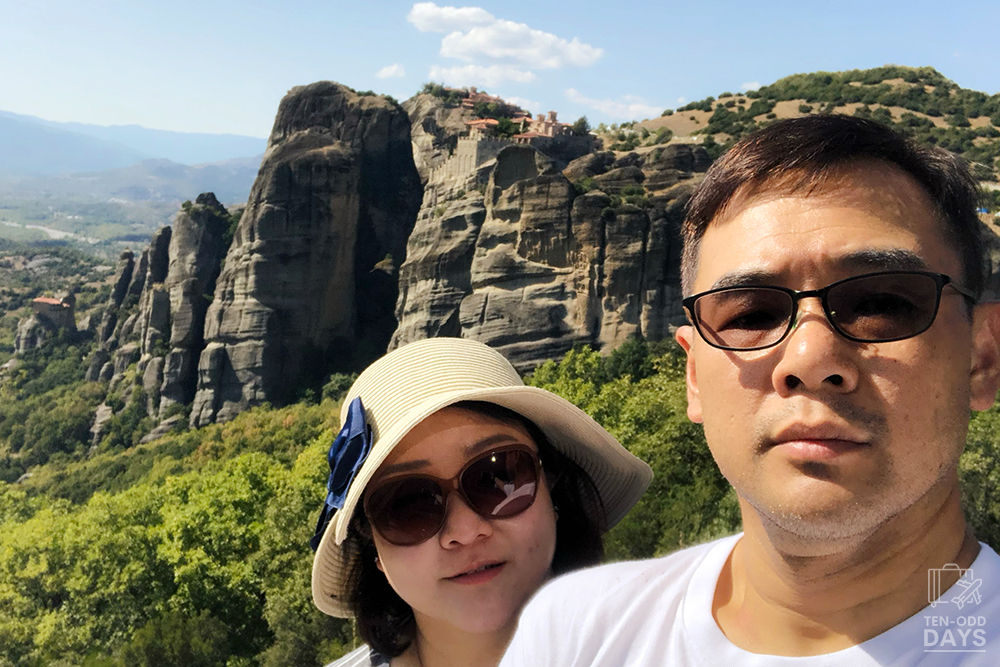
One of the few wefies we took in Meteora. The large monastery in the background would be Grand Meteoron Monastery.
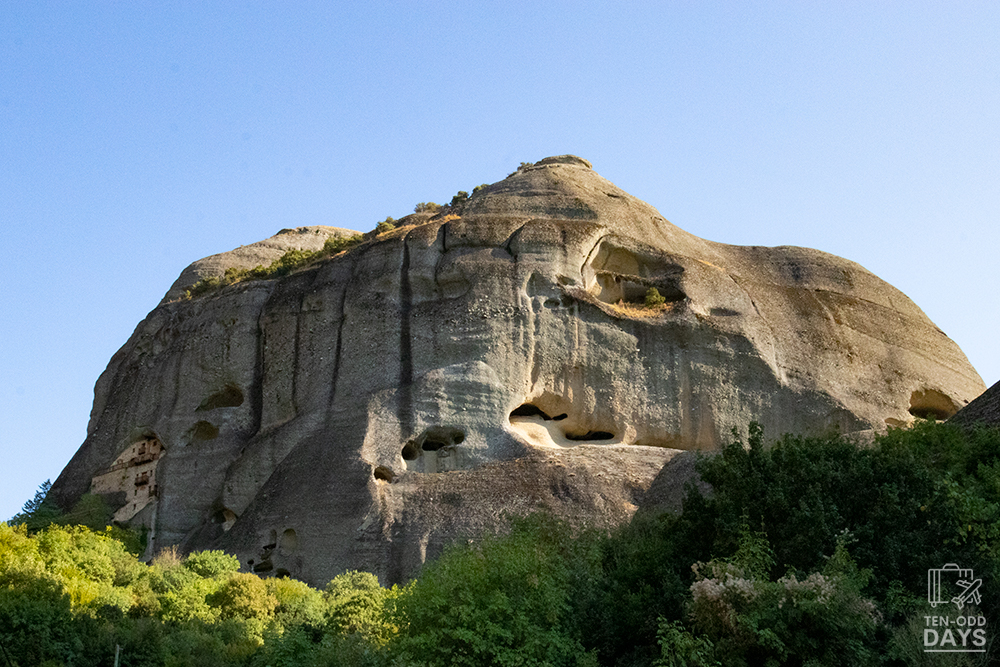
The highlight in this shot is the rock in the centre. Our guide pointed out that there was once a monastery carved into the rock but after years of disrepair and eventual decay, we can no longer make out the structure of the monastery, just cave holes.
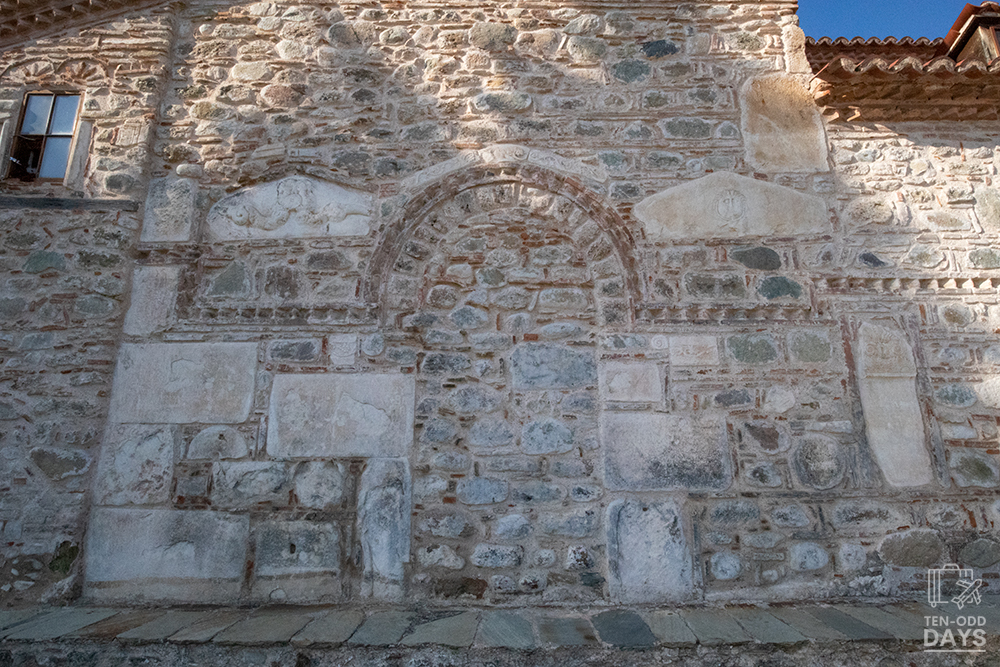
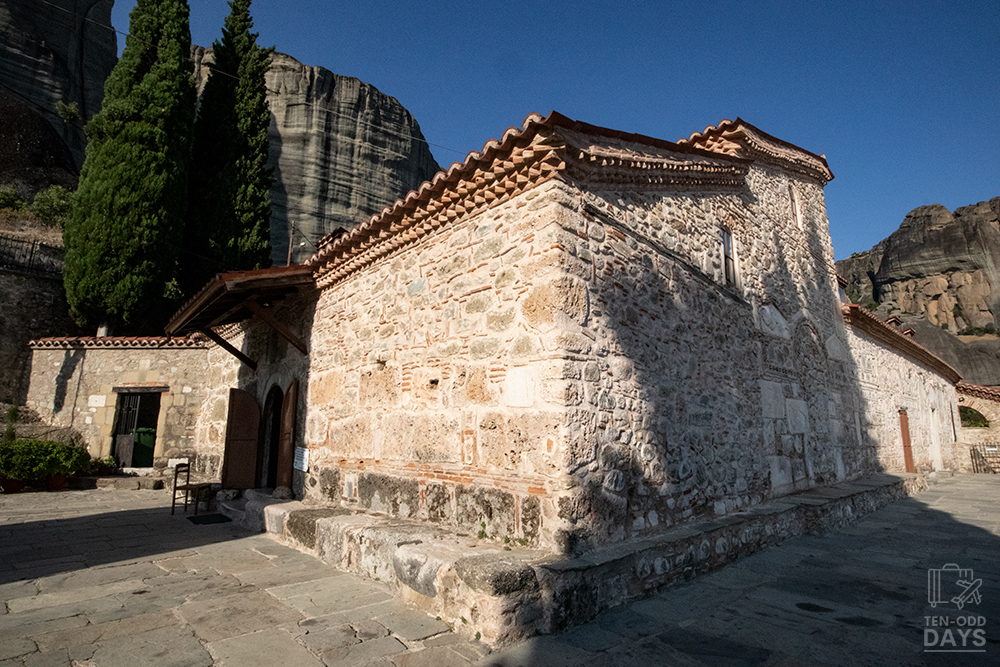
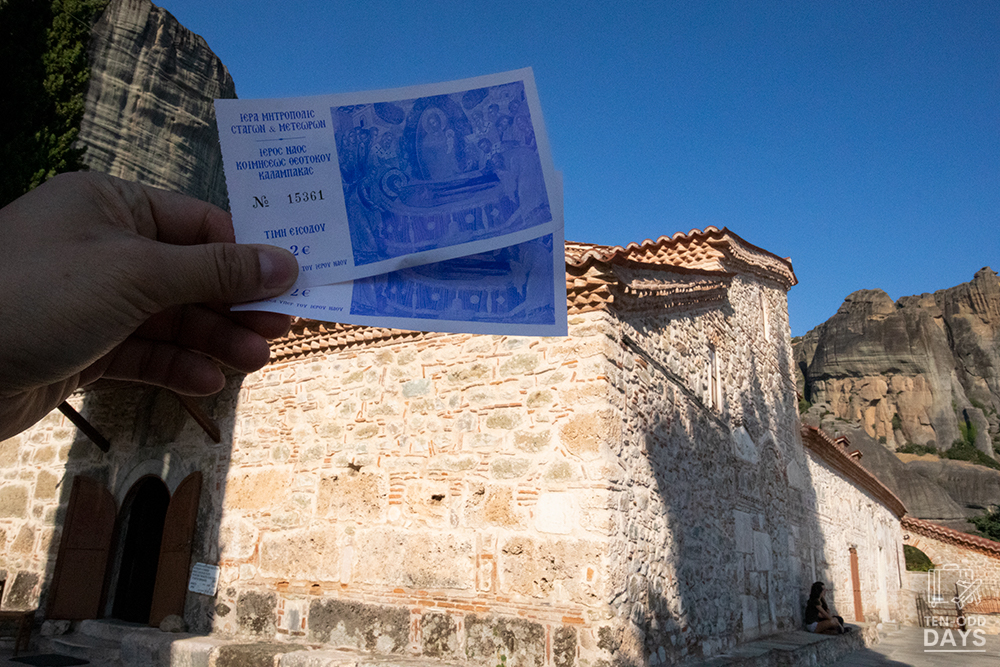
Byzantine Church of the Assumption of Virgin Mary, erected above the ruins of another church, in the 11th century.
Several cross pattée were sighted within the church, indicating that Knights Templar ever stepped foot into this ancient church.
The bell tower.
We would have completely missed this ancient church if we had not signed up for the sunset tour.
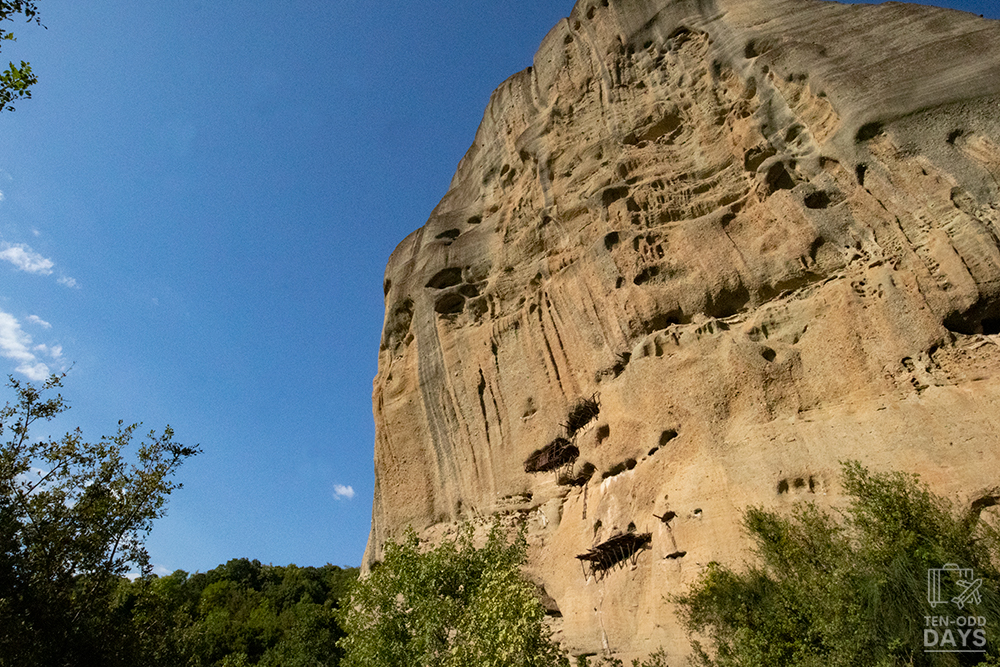
The Badova Hermit Caves are pretty well-known, mostly because they are still visible and well-preserved.
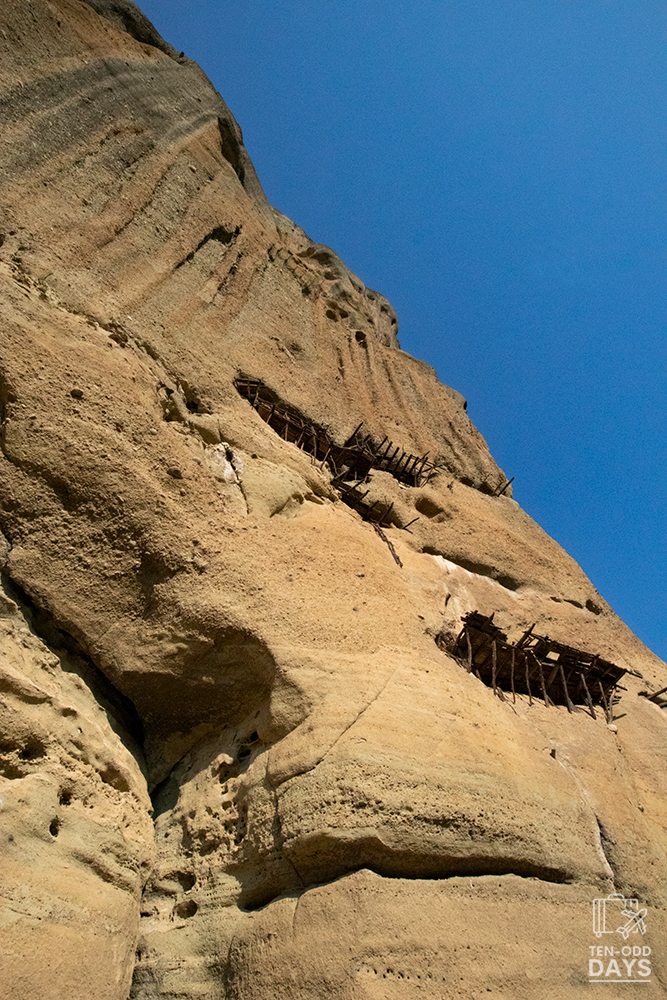
It takes a certain, almost maniacal, level of commitment and self-discipline to commit to a life of solitude in the name of religion. It happens in many religions and is still something I can’t quite fully comprehend. I have nothing but admiration for these individuals.
The ledges constructed out of wood helped the hermit monk get to a level low enough to retrieve food and supplies from volunteers who went to check on the monk periodically.
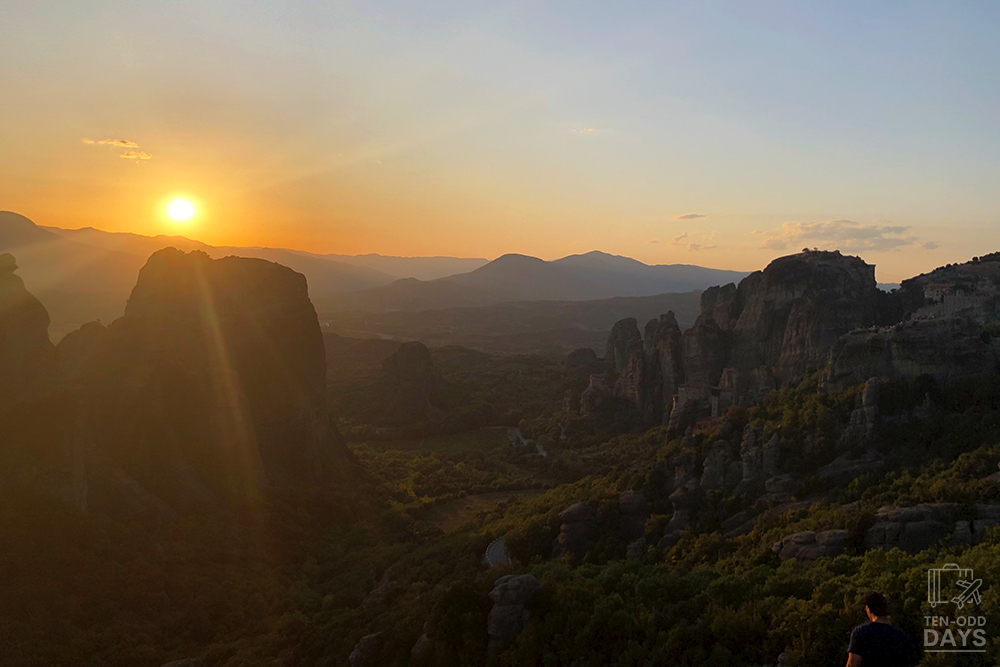
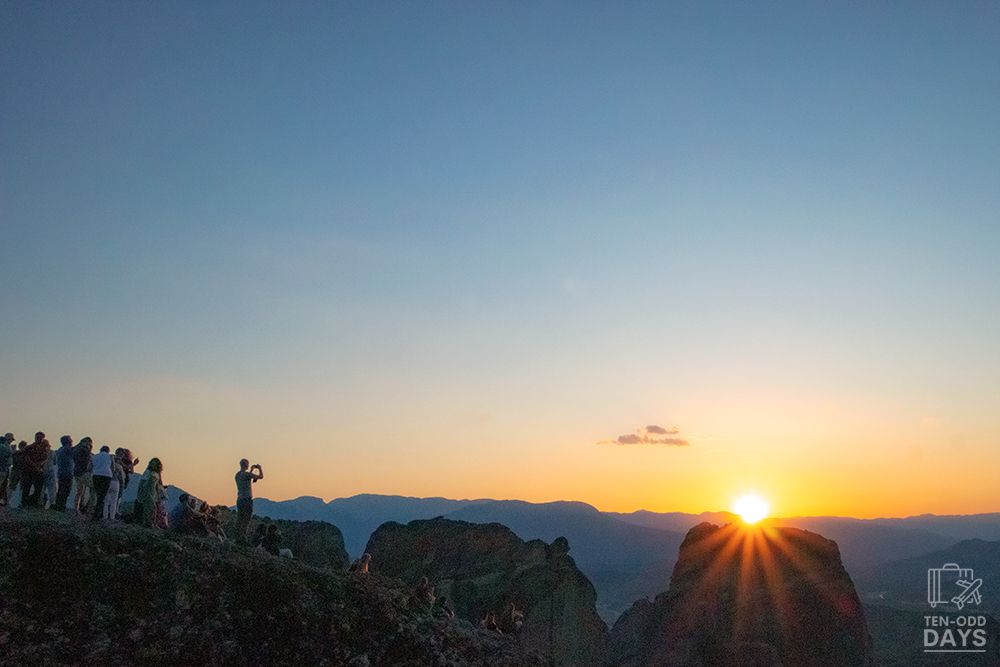
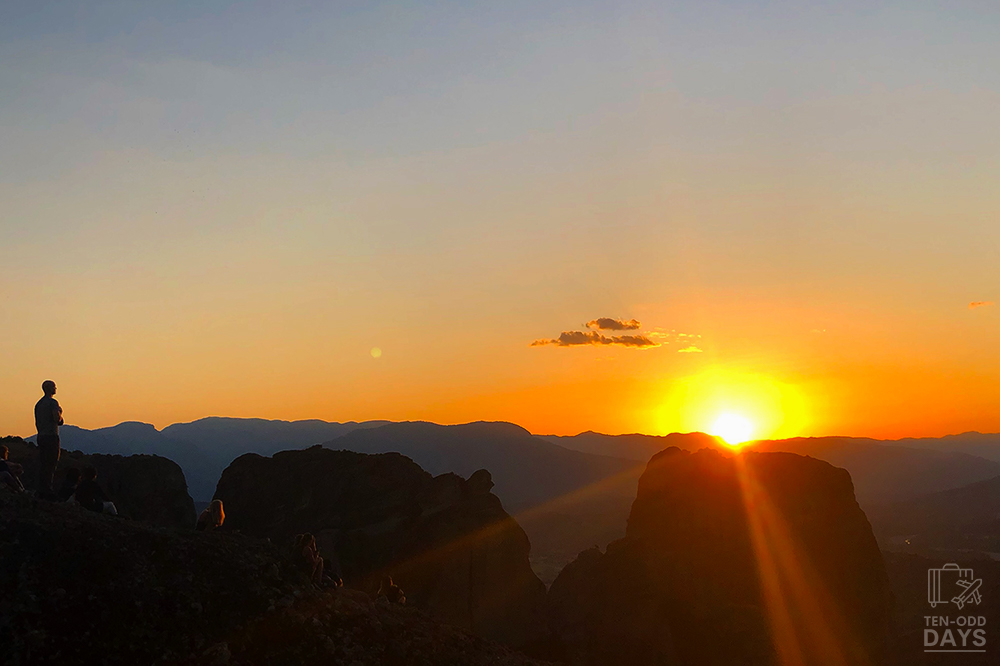
Impending sunset over the valley in Meteora. So blessed to have good weather on our first full day in Meteora because the second day was cloudy; we couldn’t see the sun setting.
According to the map provided by our guesthouse, there are two locations marked out as prime spots for sunset-viewing: one spot closer to Grand Meteoron Monastery and the other closer to St. Stephen’s Monastery. We were brought to the latter by our mini tour bus.
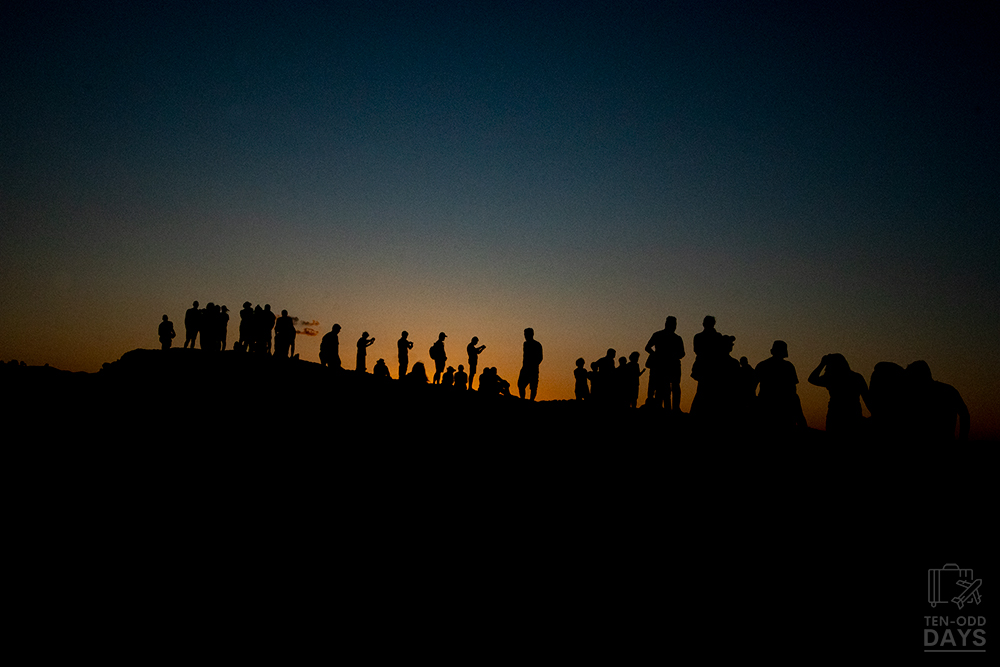
Very fiery and majestic sunset witnessed by a whole bunch of us at the viewpoint.
Once the sun set, it became dark fairly quickly. We stepped down the rocky viewpoint while we still had some light to illuminate our way.
Meteora exudes a mysterious aura; the religious fervour we felt throughout our few days in the region played no small part in this sentiment. Couple that with the wonderment of nature (of strong tectonic movements and weathering) resulting in a stunning, rugged scenery and it is crystal clear why this quietly imposing, looming rock formation is rapidly becoming a vastly popular tourist destination.
Tourists typically take a day tour from Athens to Meteora via a guided bus tour, just to have a sense of how the rock formation looked like. Far lesser choose to utilise public transport or self-drive although these two options offer more freedom to explore the area at a leisurely pace and enjoy the languid vibes of the neighbourhoods of Kalampaka or Kastraki. If you ask us, we would highly recommend spending at overnight in the area if you have the time to spare.