It felt good to be in the midst of greenery after months of not being able leave home except for essential activities. Alright, I might have exaggerated a little; parks and gardens reopened after a couple of months but erring on the side of caution, this outing only took place four months after the last.
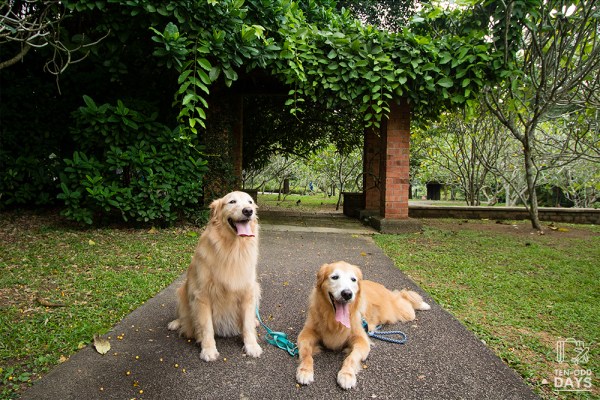
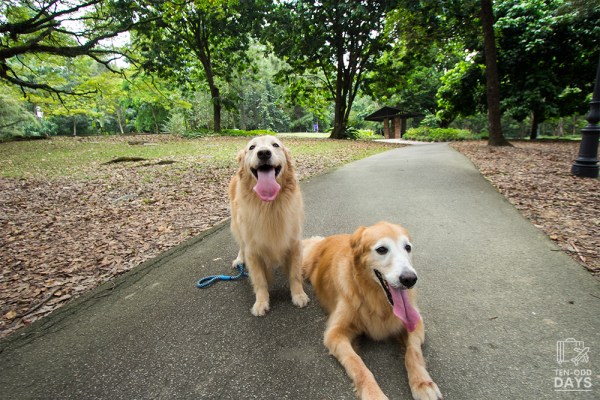
The weather has been erratic, to say the least, and we were most grateful it held up for the morning (it poured in the afternoon) while we were exploring the sprawling grounds of the garden. There was really no agenda, and so we allowed Belle and Cassie to sniff to their hearts’ content, letting them lead the way. Belle was, for the most part, trying to get acquainted with every other person she came across while Cassie was attempting to mark territory throughout the garden. One significant personality trait we confirmed during this walk: that Belle simply loves people more than she loves her own kind, and that Cassie can be rather territorial.
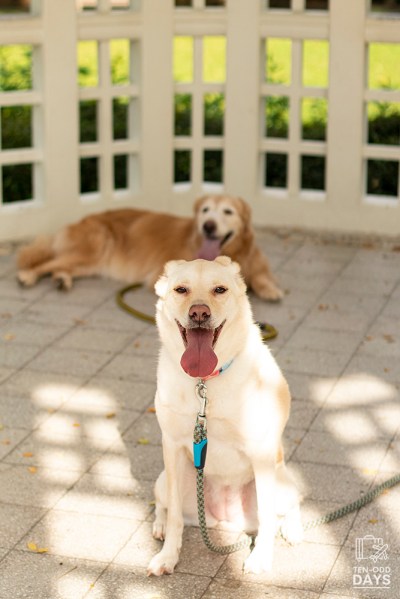
Having spent almost three years with Cassie, the mister and I often find ourselves comparing her to Paris, the fur-sister she never got to meet. We have drawn several stunning similarities in personality between them both that we sometimes wonder if she is Paris reincarnated. Well, she certainly embodied Paris’ distaste for posing, which makes things as challenging as ever for me, the photographer. Times like this makes me appreciate Belle the model poser all the more.
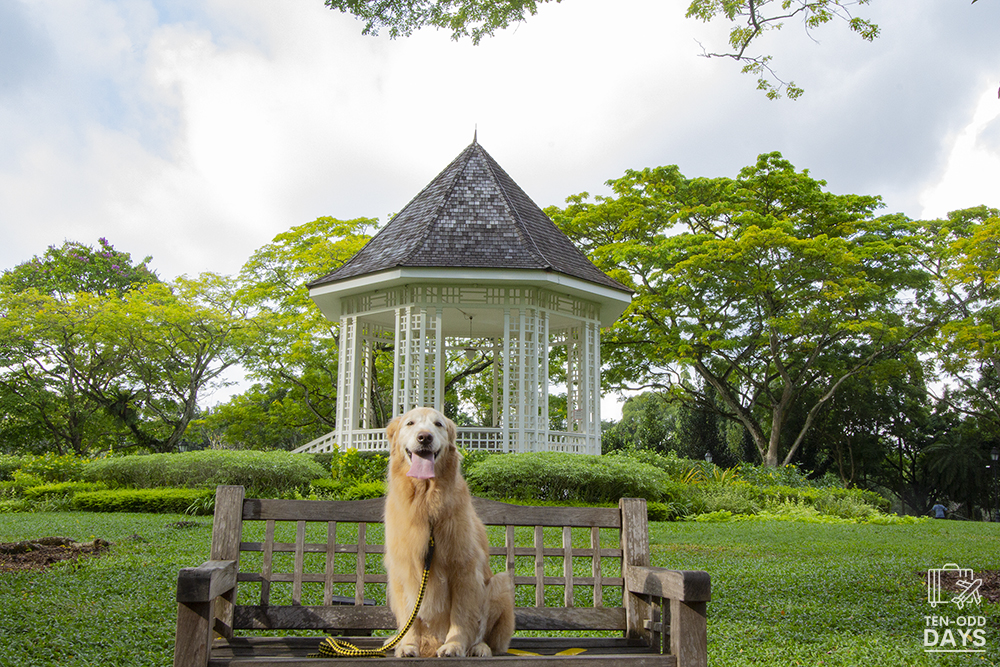
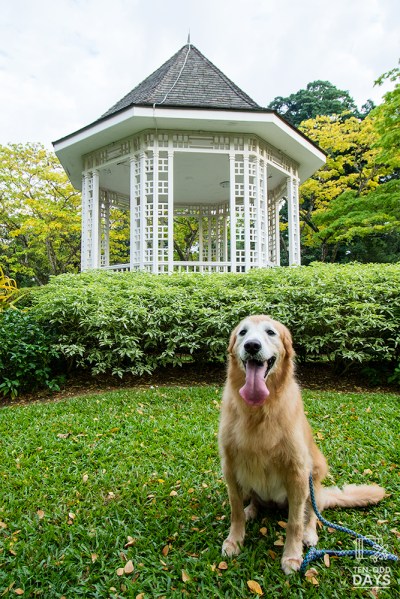
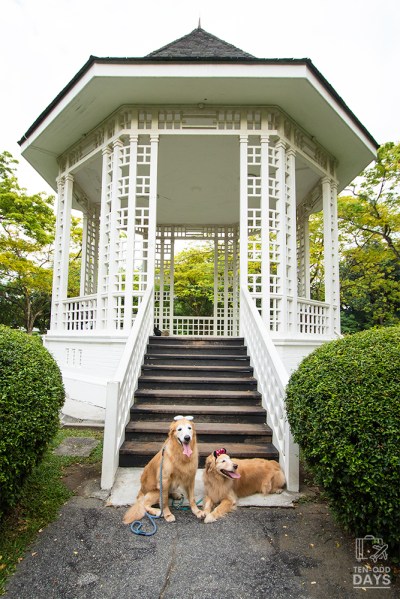
Almost two hours into the walk when the furkids were visibly tired out, we started looking for the bandstand. It took us another fifteen minutes before we finally located the iconic feature of this 161-year old Unesco World Heritage Site. It’s probably the single most recognisable landmark of the garden, but we were fortunate in that it wasn’t terribly crowded at that knoll that morning, having it almost exclusively to ourselves.
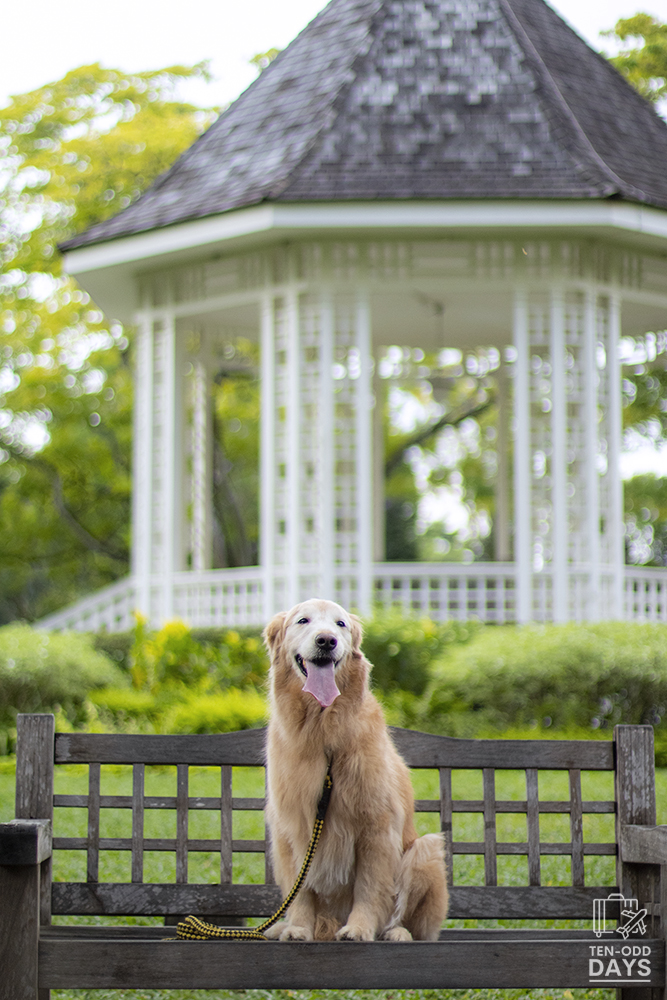
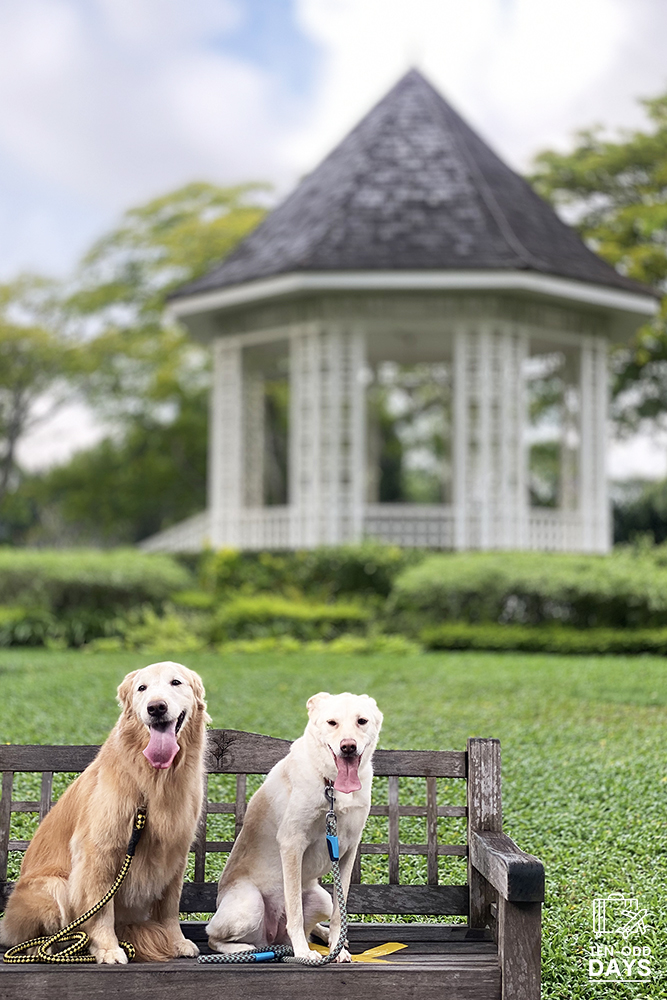
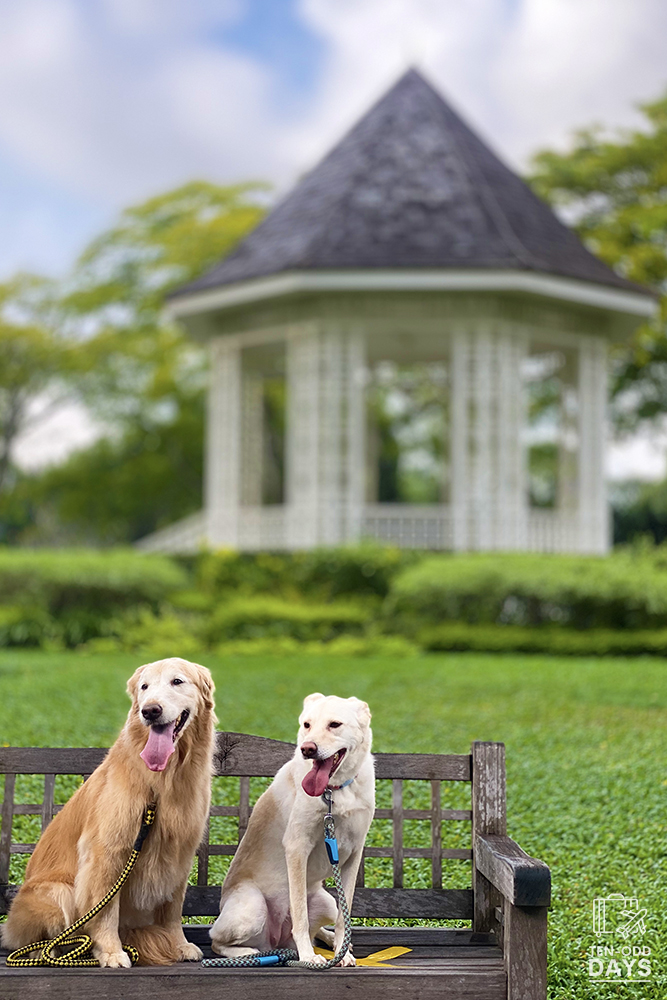
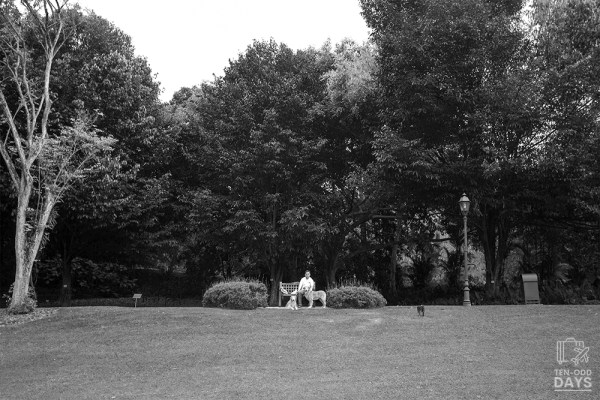
Belle and Cassie went up to the bench by the side to rest, and I managed some shots of them against the backdrop of the bandstand. These were some of the best pictures turned out for the entire outing, thanks to a toddler passing by capturing their attention. Typically we only had problems with getting Cassie to look at the camera, but Belle decided she wasn’t in the mood to be cooperative too. In this way, dogs are rather like young children – unpredictable.
We proceeded to the bandstand where the girls lay down and got to rest some. We’ve got work to do where their stamina are concerned. In fact, I personally still haven’t gotten used to the fact that Cassie is considered a small dog (at 14kg); I often hug and pat her with force too strong for her comfort, thinking that she is a golden retriever. Three years on, and I’m still learning how much strength to exert.
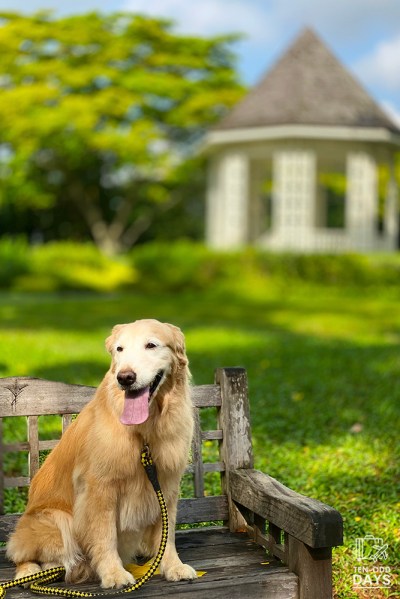
Being the model poser that she is, Belle continued sitting on the bench when Cassie had long jumped off to go take in the scent of the surroundings. The Gardens had progressively gotten more crowded by that time, so we decided to call it a day.
TRIVIAL: Built in 1859 and located at the fringe of Singapore’s Orchard Road shopping district, Singapore Botanic Gardens is a sprawling 82-hectare (82,000m²) tropical garden with a predecessor initially developed to introduce the cultivation of cash crops, at Fort Canning. 153 years later in Jun 2012, Singapore entered a submission to UNESCO, indicating interest to inscribe the Gardens as a World Heritage Site. On 4 Jul 2015, Singapore Botanic Gardens successfully received inscription as a UNESCO World Heritage Site.
The expansive Gardens originally comprises three main zones known as ‘cores’ to cater to different purposes – a core to retain the old charm of the historic Gardens, a second core to cater to visitors, and the last dedicated to education. The fourth core – Tyersall Gallop – was included in 2017, adding 8-hectare to the Gardens totalling it to 82-hectare. The Gardens is a popular tourist location in Singapore, and equally popular amongst locals who like to visit for a variety of purposes from exercising, immerse in the luxurious greenery to enjoying band performances.
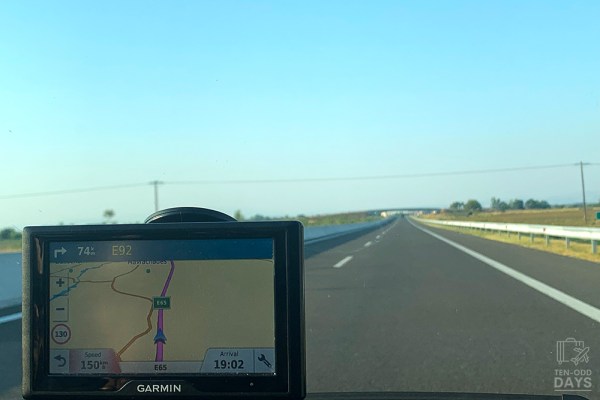
Our drive to Meteora was eventful, to say the least. In the previous post on Meteora, it was mentioned that we were stopped and booked for speeding. In my defence, it was a new expressway that had practically no vehicles for kilometres at a stretch. Nevertheless, speeding is wrong and I should have known better; nevermind the reason.
We were clocking around 150km/h when the speed limit on the expressway was 120km/h, and I was caught by a mobile traffic police van. Sheepishly, I walked back to the van after stopping the car quite a distance away (while the mister continued sitting in the car, grinning and leaving me to handle the traffic police on my own 😡 ). I was surprised to see two other young females sitting in the van, probably from the other car that was stopped nearby; they were being booked too.
The fatherly male traffic police officer was stern but fair. Perhaps much more fair that I expected. He didn’t tell me how much the fine was for, except that it won’t be too much; I was on tenterhooks the whole time he took down really detailed information. He wanted my parents’ names as well, and wanted our accommodation details (I brought along my passport, International Driving Permit, local driving licence and wallet along when I alighted) so I walked back to our rental vehicle again, to retrieve the necessary documents.
By then, the mister was getting worried (served him right for abandoning me to face the music alone!). He got out of the car to ask me why it was taking so long. I briefly explained to him before briskly walking back to the waiting officer.
After what really felt like an eternity to me, the police officer explained to me that he was letting me off with a small fine of 35€ (or thereabout), 10% of the original fine because he didn’t think I was a habitual speeder. I heaved a sigh of relief. Honestly I was expecting a fine of above 100€. He then handed me the speeding ticket and told me that we have to pay the fine at a post office, and not to him.
Having learnt a well-deserved lesson, we took our time to get to Meteora as I suppressed the strong urge to go beyond the speed limit. I’m not a speed demon per se, but I’m also certainly not a slow driver.
We were both relieved when we finally arrived at our guesthouse. It has been a long day.
Apart from the 6 monasteries in Meteora that are still occupied, we also visited other places in our slightly over 2 days there, including a visit to the viewpoint for a gorgeous sunset and a couple of hermitages. In particular, the Meteora Sunset Tour we signed up for was well-worth the time and money; we learnt so much from our guide.
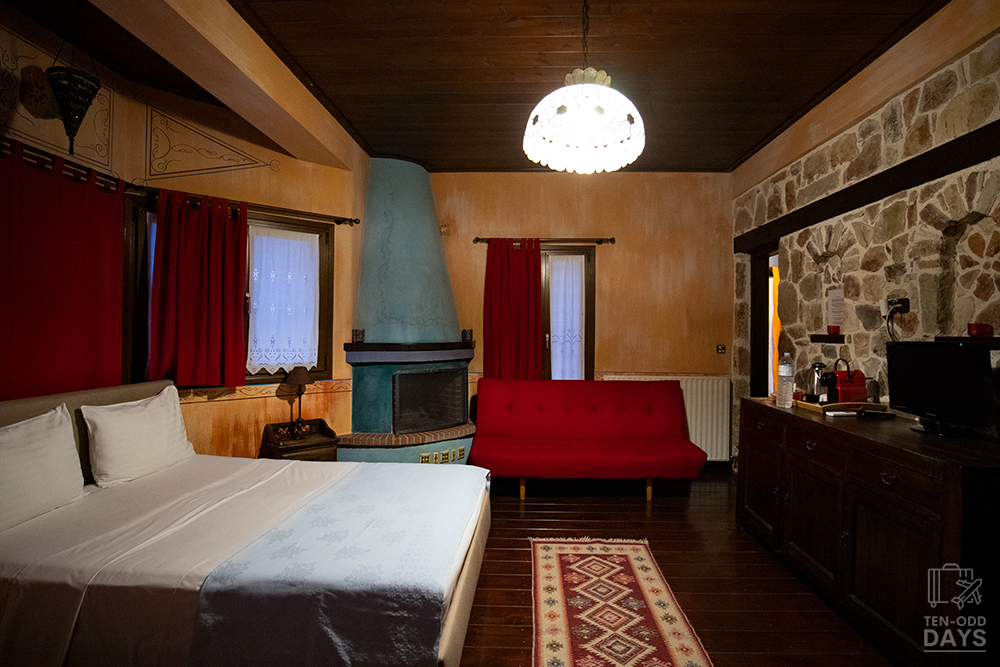
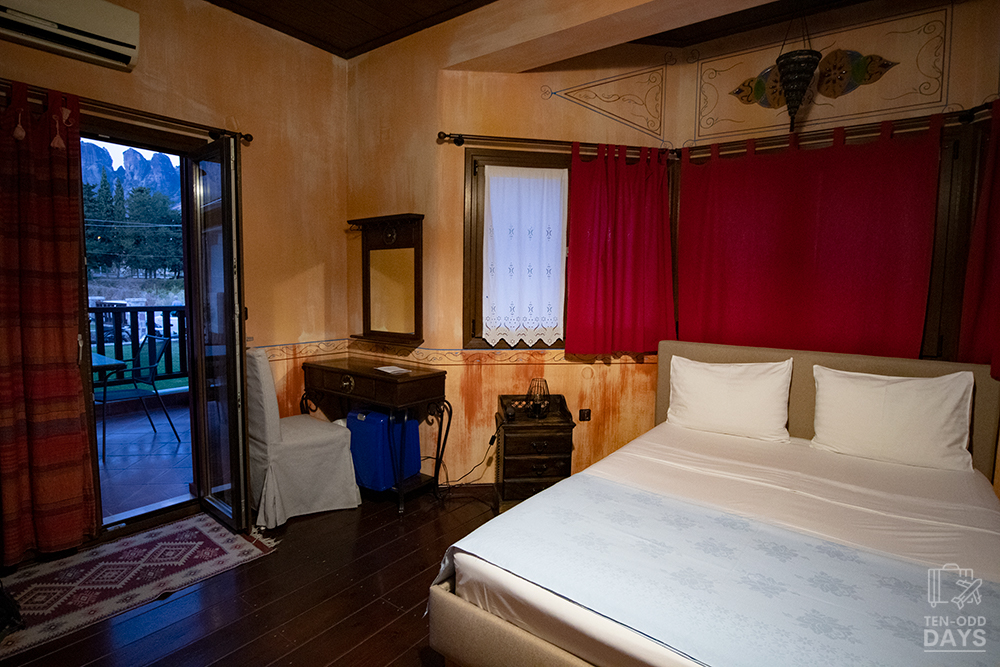
Our room at Monastiri Guesthouse in Kalampaka, one of the two towns near to Meteora.
Booked a room with a porch that led directly to the swimming pool area.
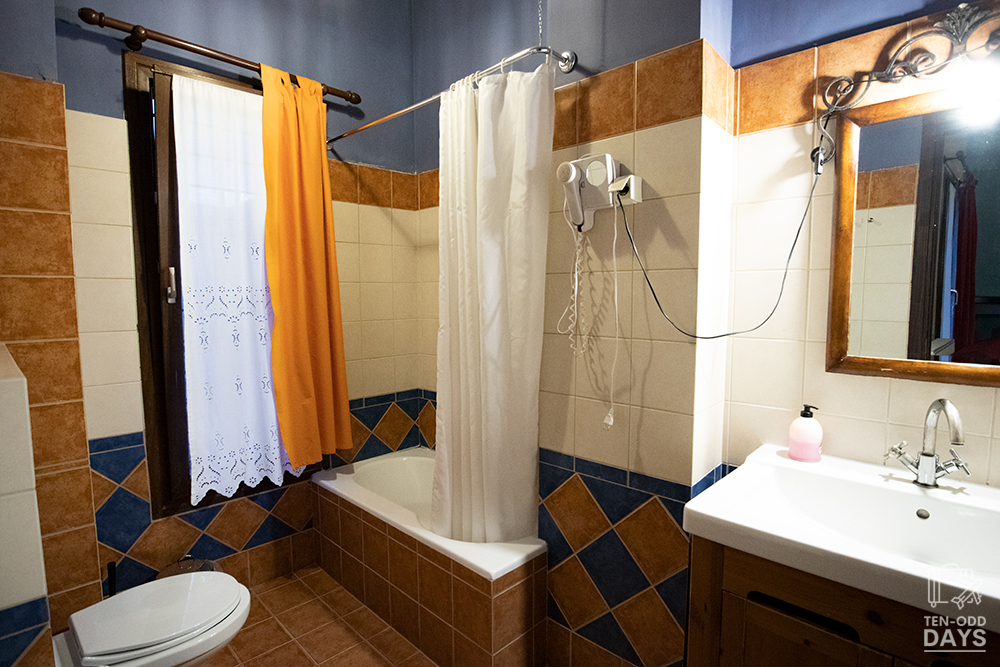
The bathroom was simple and functional.
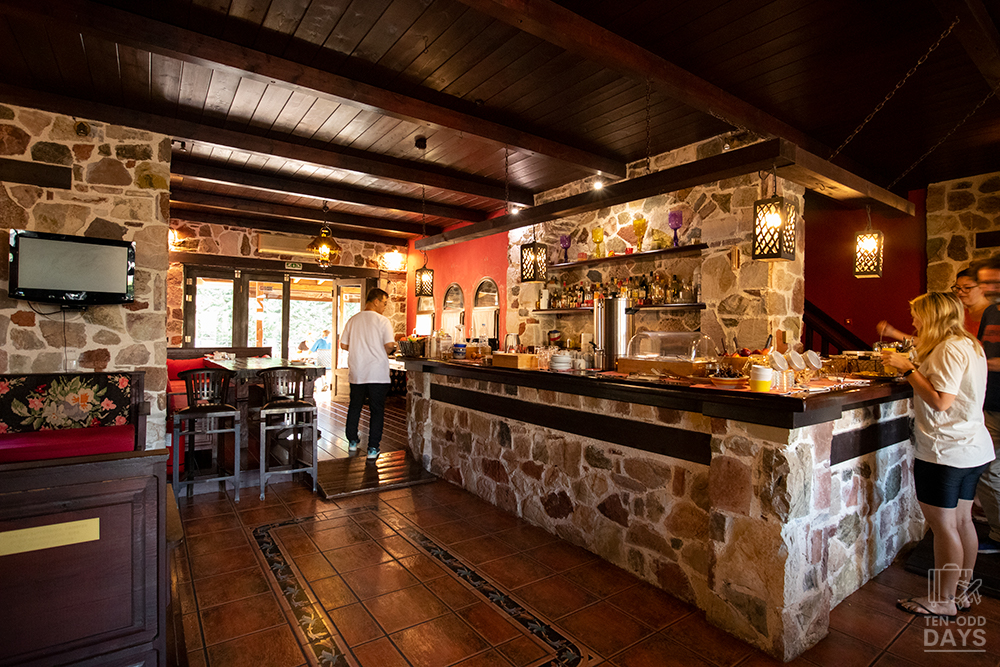
American breakfast was provided by the guesthouse, and was a sumptuous full spread to fuel up before a day of activity.
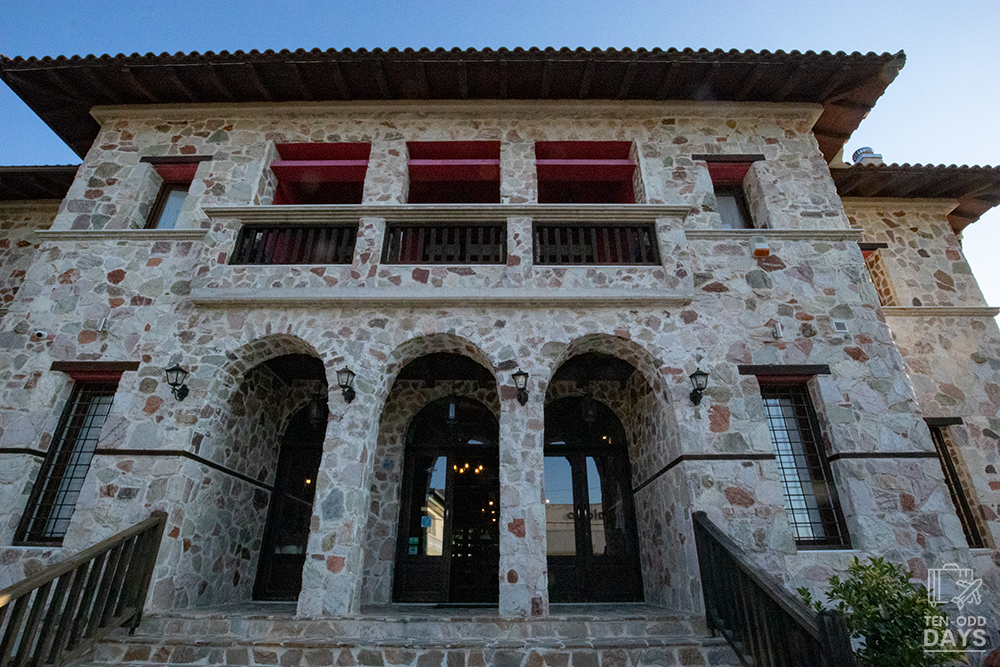
The frontal facade of Monastiri Guesthouse. Interesting construction material, made of stone I think, and likely from the area.
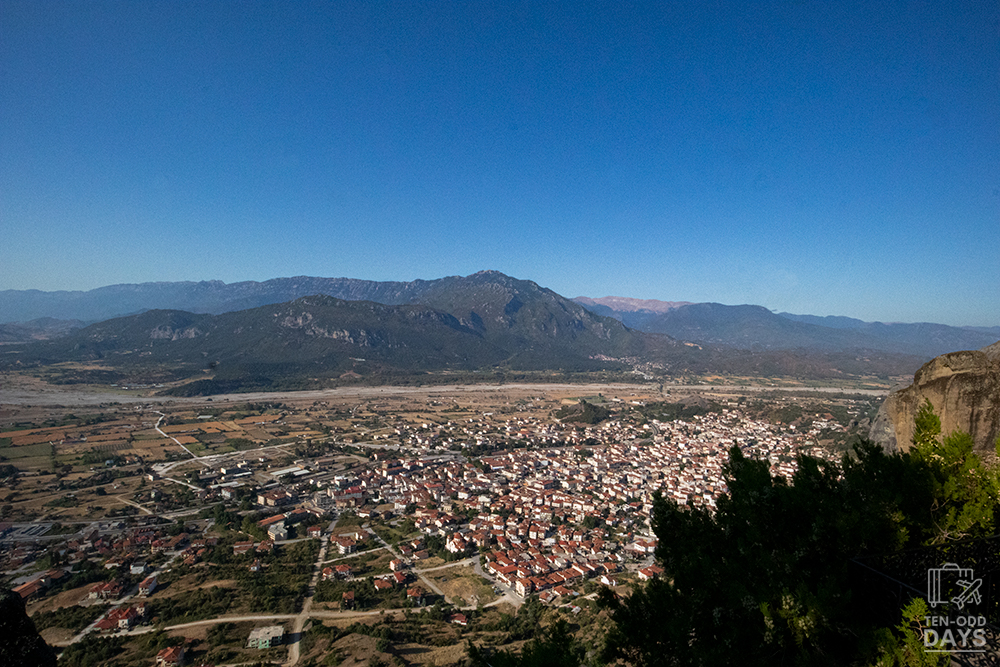
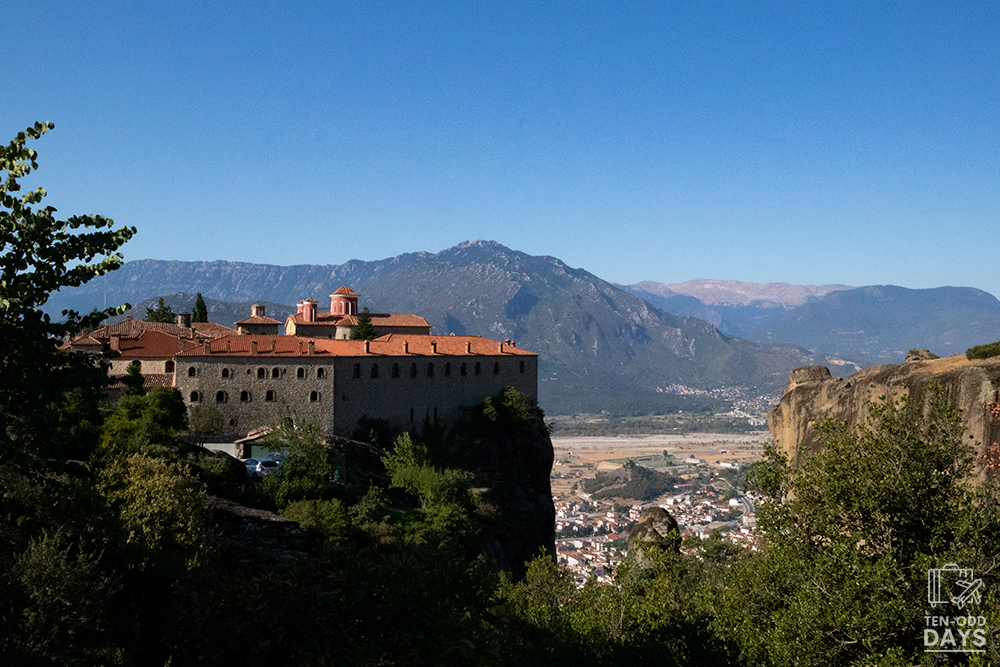
Not entirely certain if we were overlooking Kalampaka or Kastraki, but since we were at either St. Stephen’s or Holy Trinity, I’ll hazard a guess and say this is probably Kalampaka.
How many monasteries can you spot in this picture? If you look closely, one of the three monks living at Holy Trinity Monastery was captured in the picture as well.
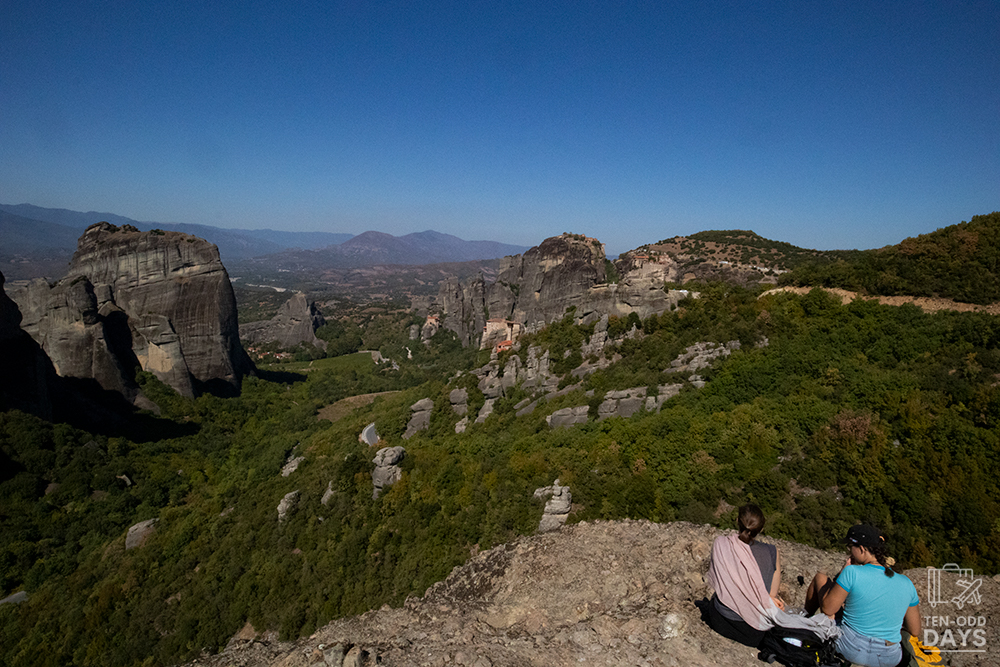
What a beautiful spot to have a picnic!
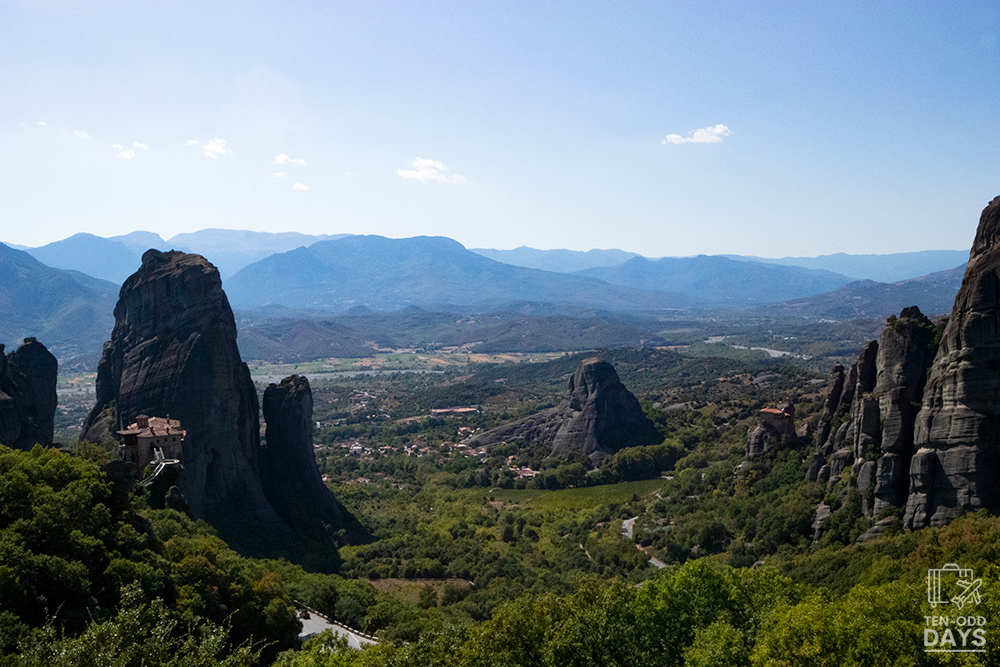
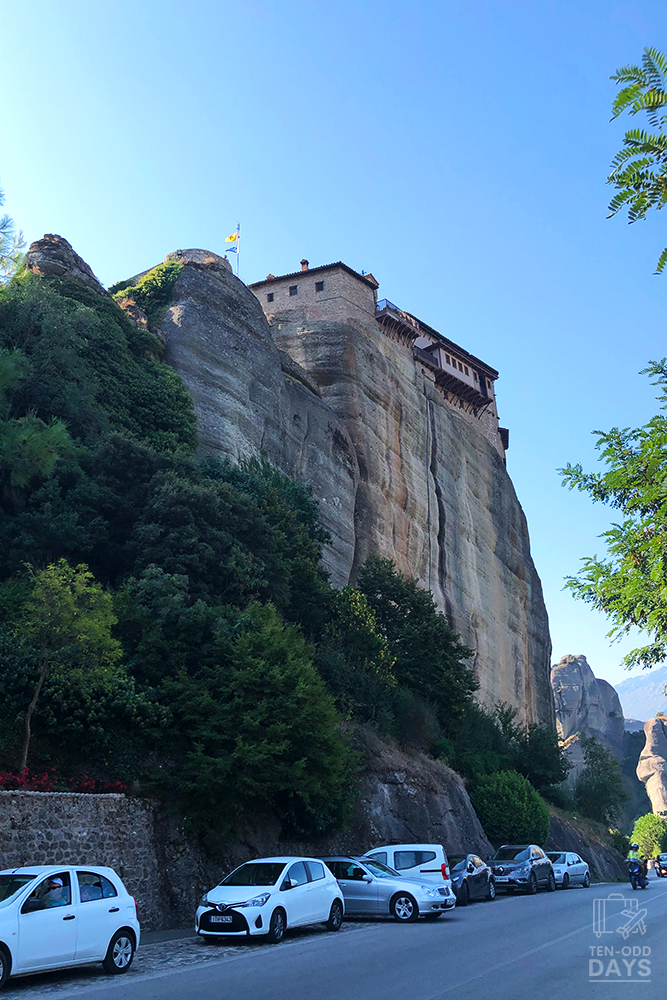
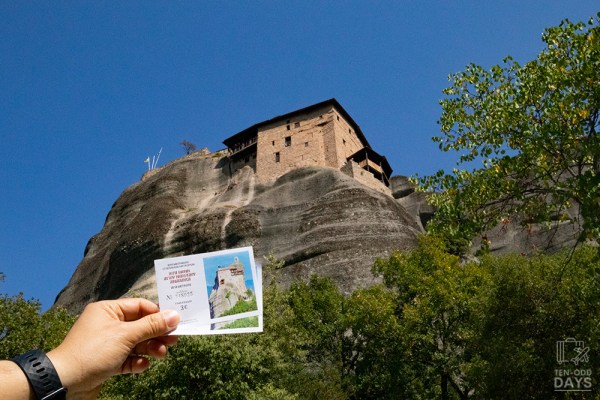
Rousanou Monastery, perched atop a narrow rock.
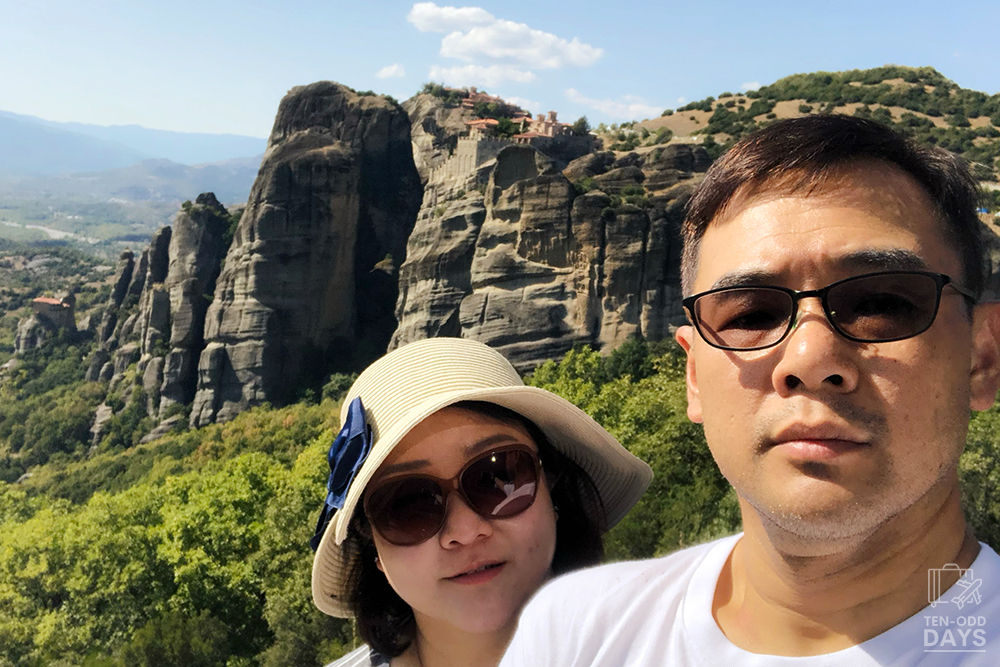
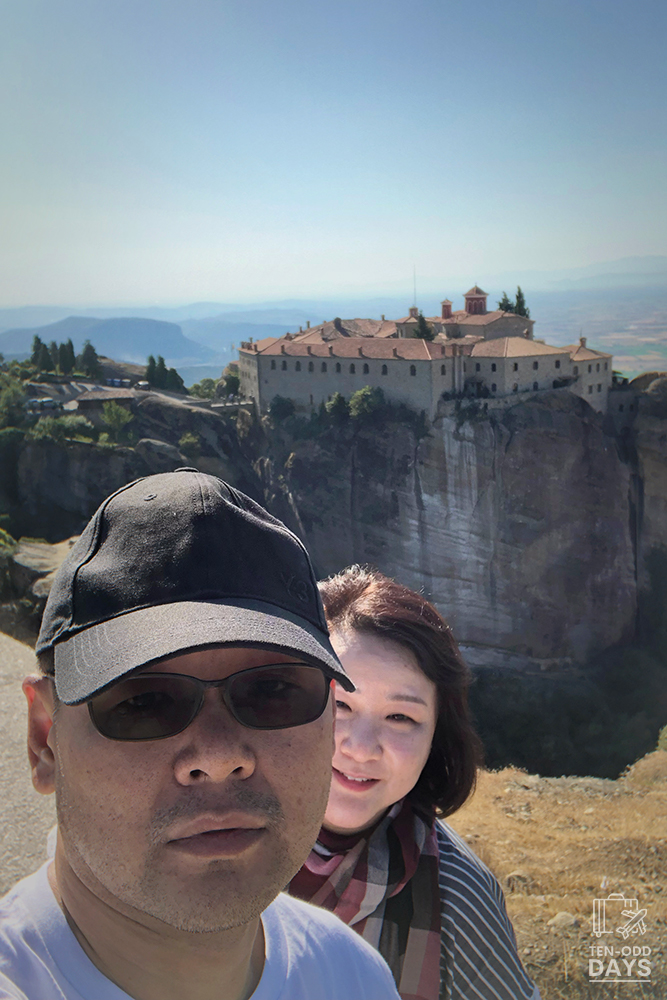
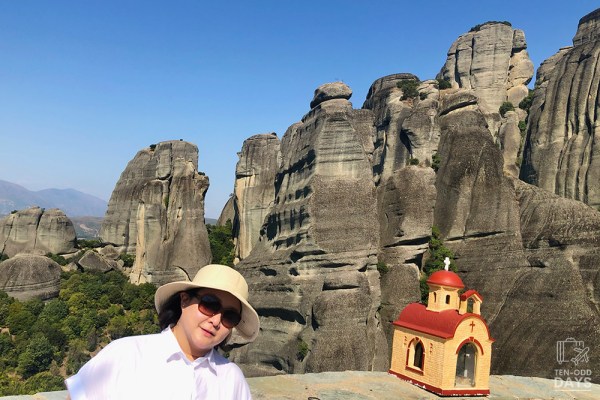
One of the few wefies we took in Meteora. The large monastery in the background would be Grand Meteoron Monastery.
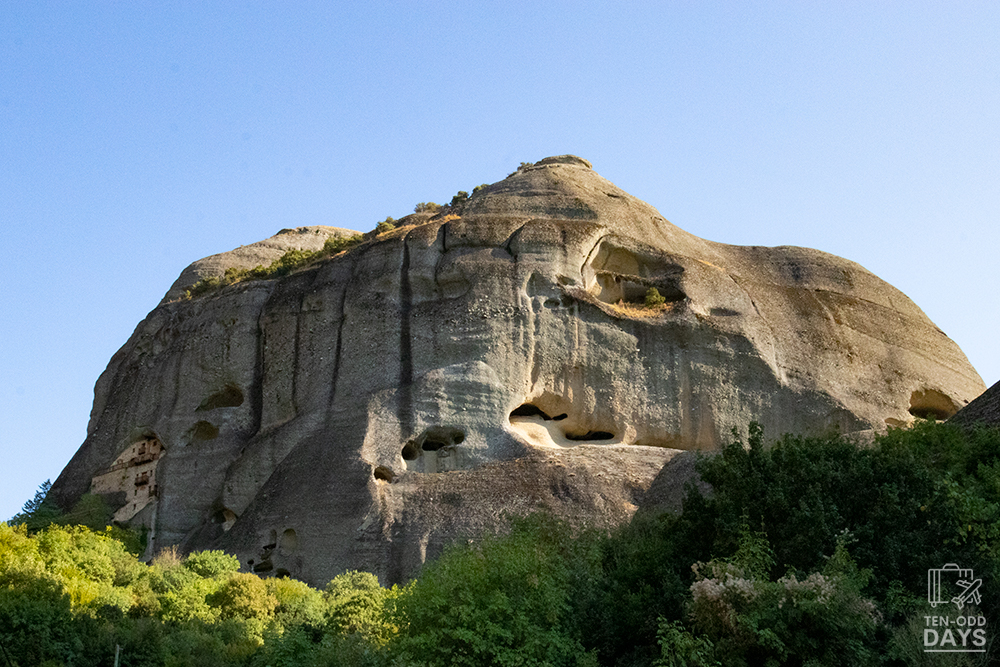
The highlight in this shot is the rock in the centre. Our guide pointed out that there was once a monastery carved into the rock but after years of disrepair and eventual decay, we can no longer make out the structure of the monastery, just cave holes.
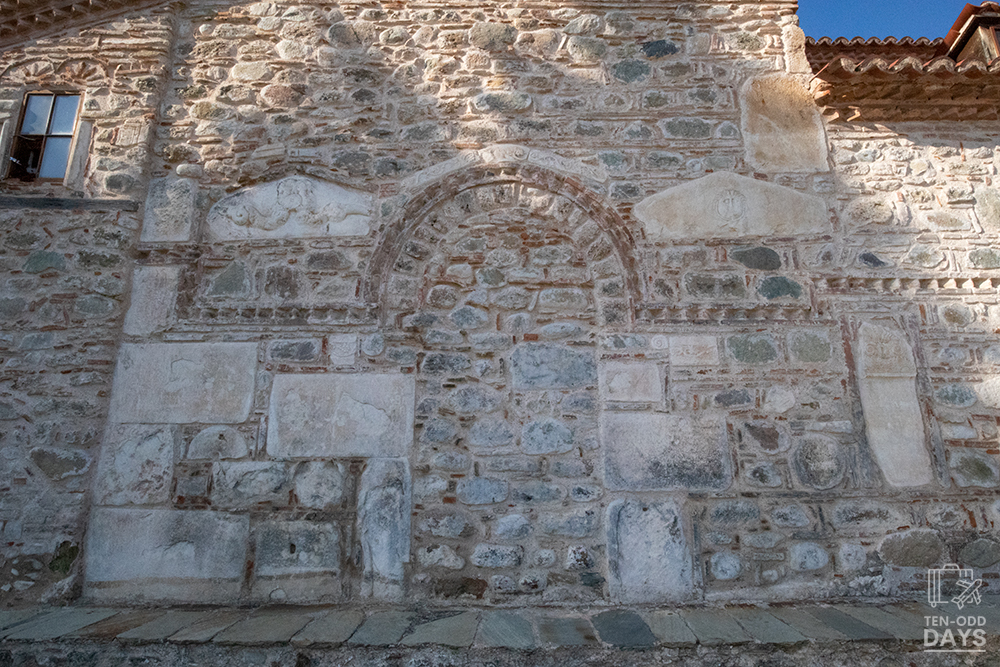
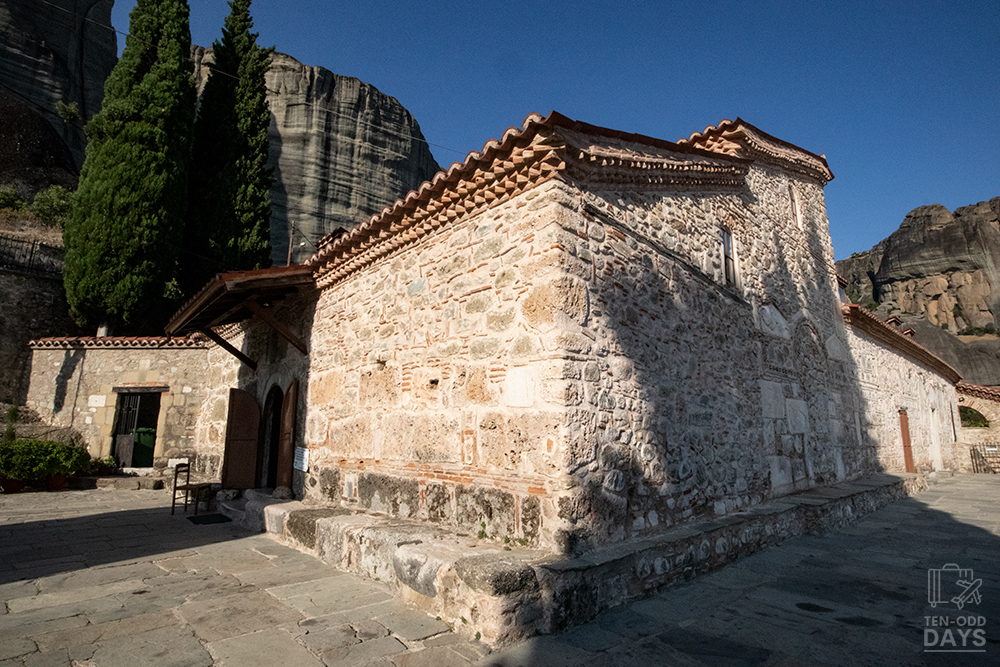
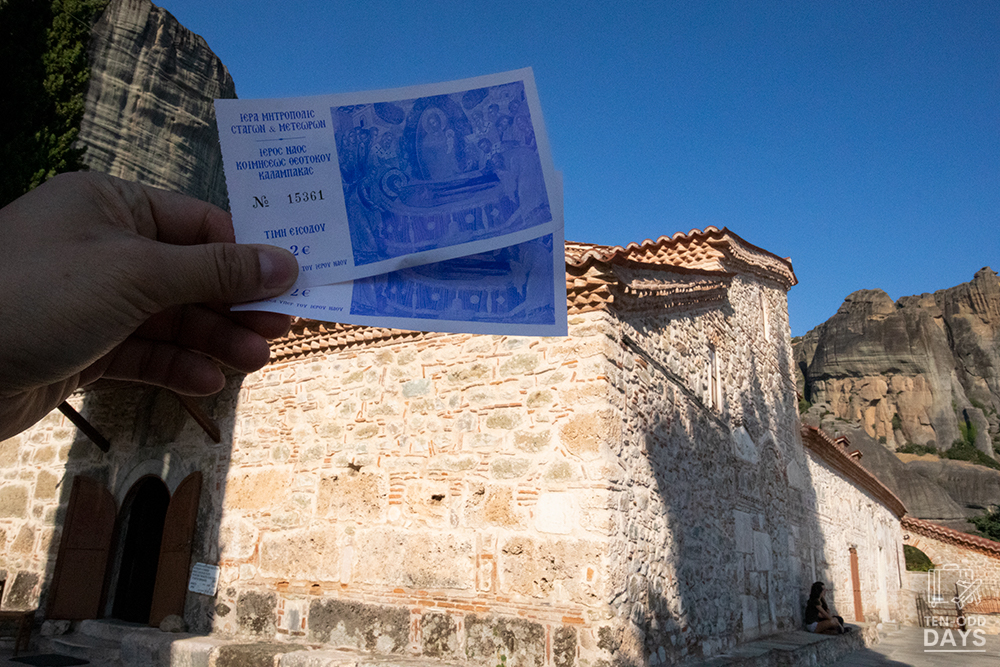
Byzantine Church of the Assumption of Virgin Mary, erected above the ruins of another church, in the 11th century.
Several cross pattée were sighted within the church, indicating that Knights Templar ever stepped foot into this ancient church.
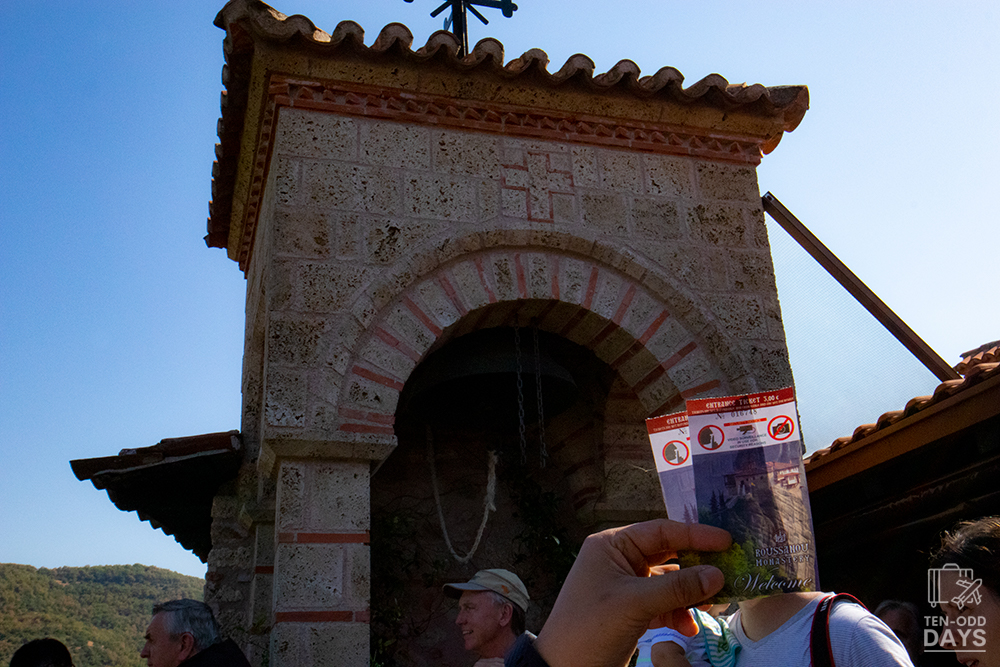
The bell tower.
We would have completely missed this ancient church if we had not signed up for the sunset tour.
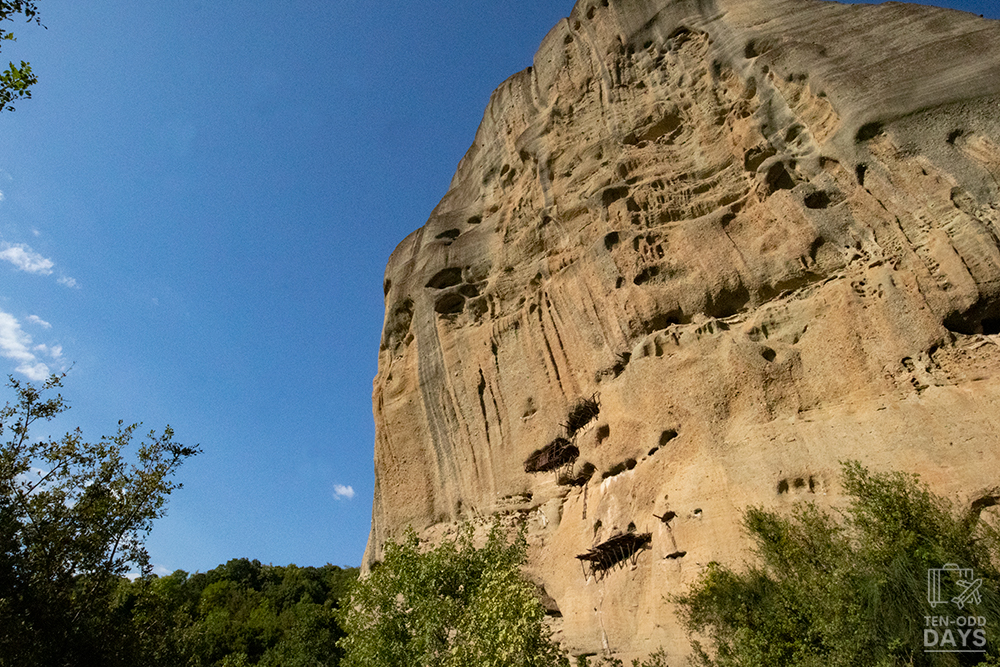
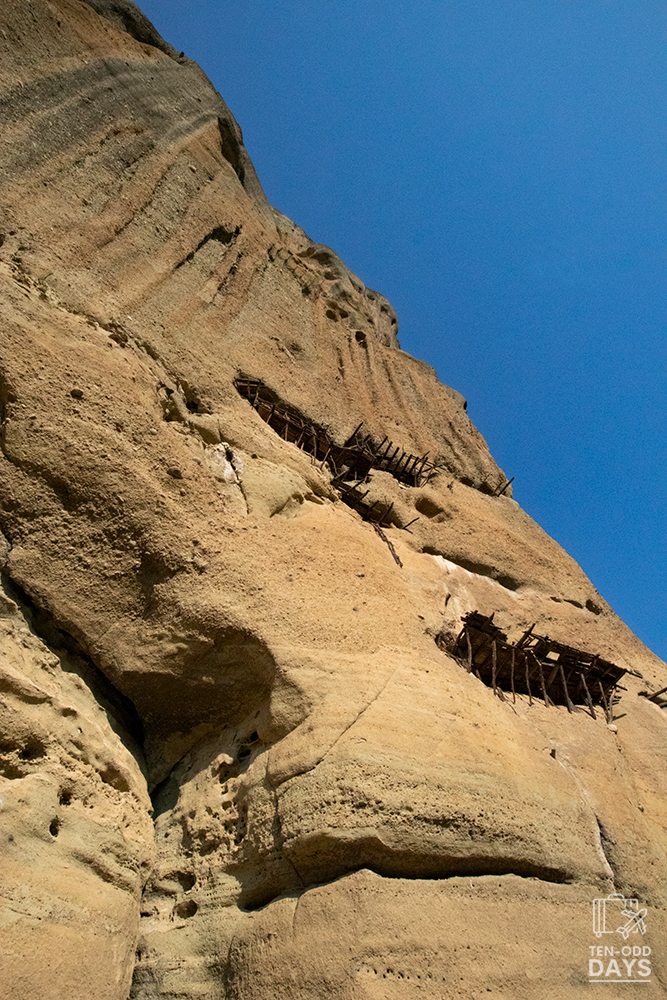
The Badova Hermit Caves are pretty well-known, mostly because they are still visible and well-preserved.
It takes a certain, almost maniacal, level of commitment and self-discipline to commit to a life of solitude in the name of religion. It happens in many religions and is still something I can’t quite fully comprehend. I have nothing but admiration for these individuals.
The ledges constructed out of wood helped the hermit monk get to a level low enough to retrieve food and supplies from volunteers who went to check on the monk periodically.
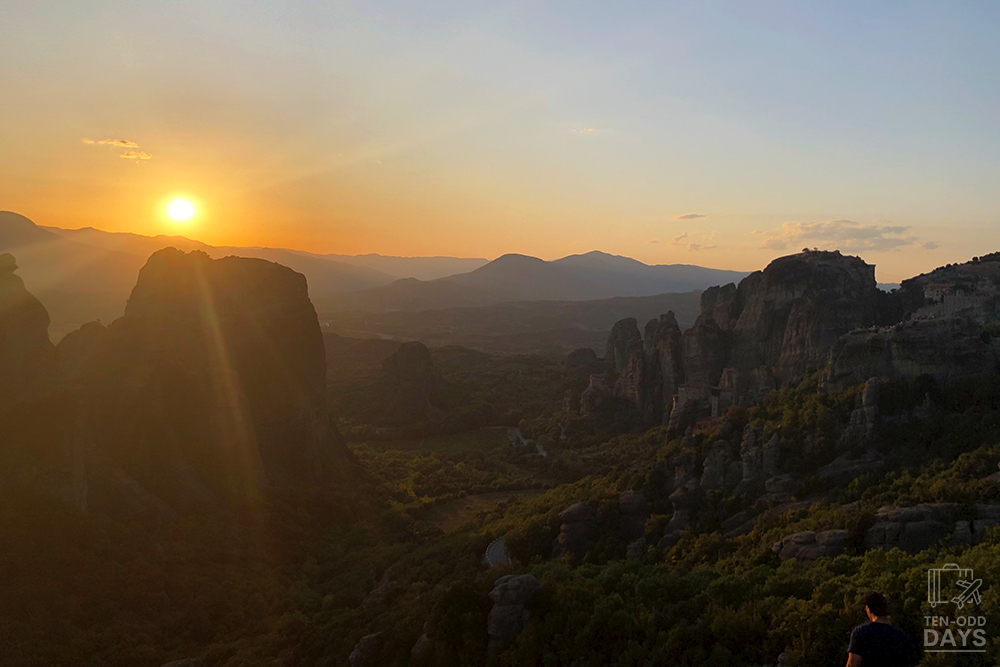
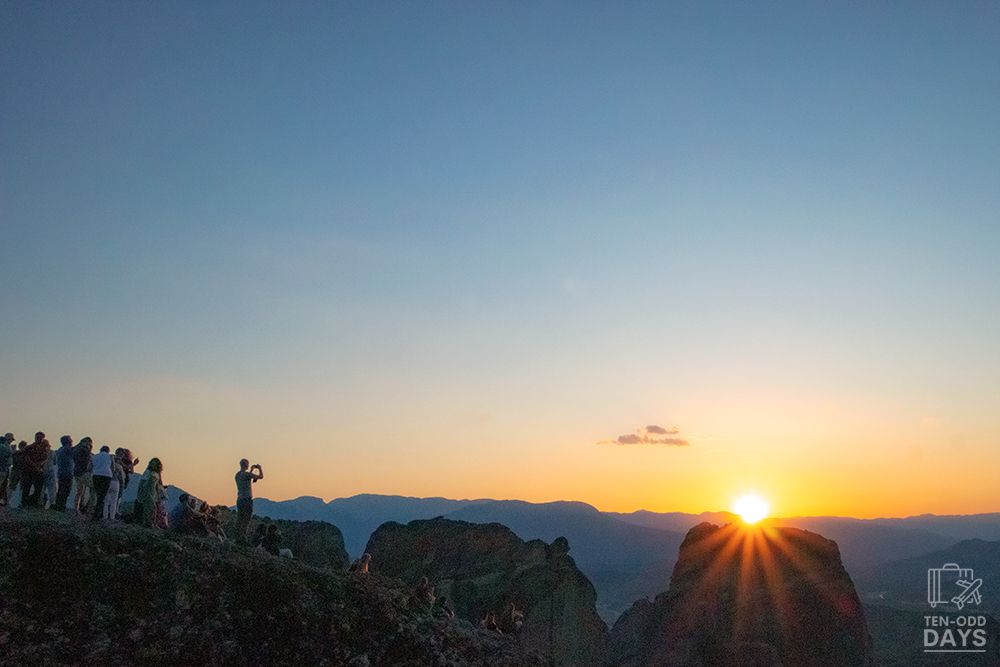
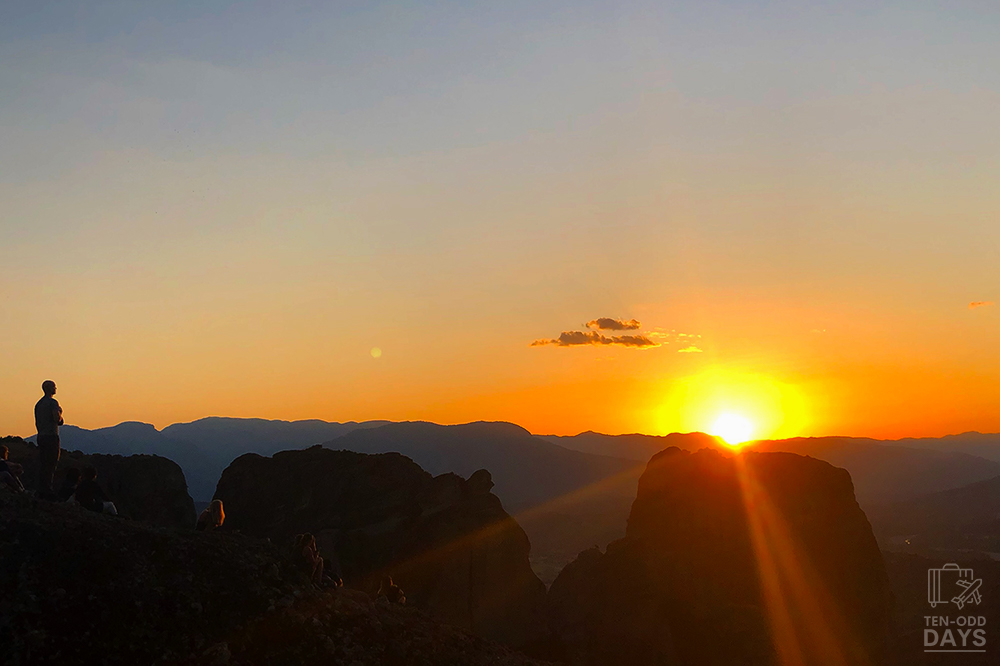
Impending sunset over the valley in Meteora. So blessed to have good weather on our first full day in Meteora because the second day was cloudy; we couldn’t see the sun setting.
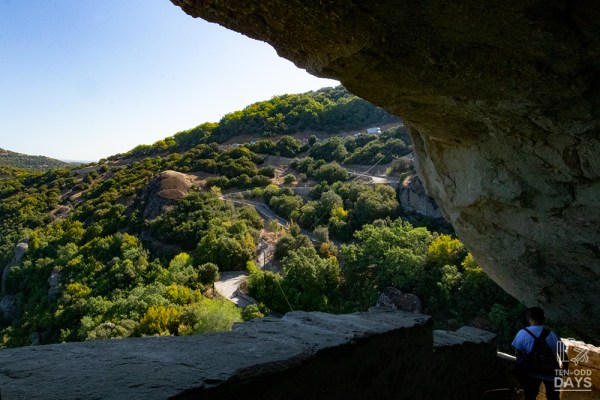
According to the map provided by our guesthouse, there are two locations marked out as prime spots for sunset-viewing: one spot closer to Grand Meteoron Monastery and the other closer to St. Stephen’s Monastery. We were brought to the latter by our mini tour bus.
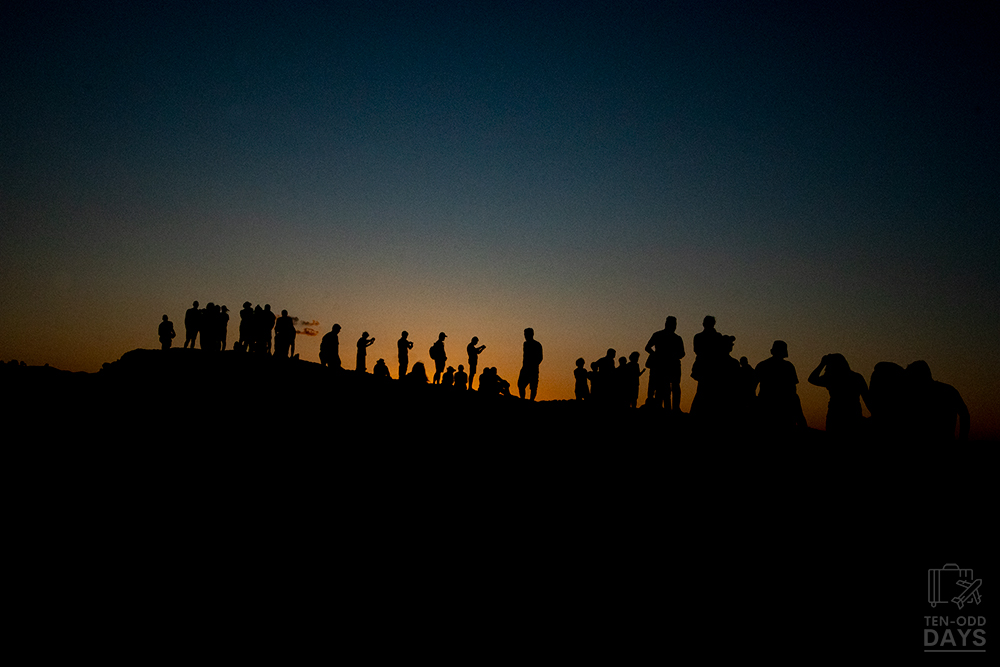
Very fiery and majestic sunset witnessed by a whole bunch of us at the viewpoint.
Once the sun set, it became dark fairly quickly. We stepped down the rocky viewpoint while we still had some light to illuminate our way.
Meteora exudes a mysterious aura; the religious fervour we felt throughout our few days in the region played no small part in this sentiment. Couple that with the wonderment of nature (of strong tectonic movements and weathering) resulting in a stunning, rugged scenery and it is crystal clear why this quietly imposing, looming rock formation is rapidly becoming a vastly popular tourist destination.
Tourists typically take a day tour from Athens to Meteora via a guided bus tour, just to have a sense of how the rock formation looked like. Far lesser choose to utilise public transport or self-drive although these two options offer more freedom to explore the area at a leisurely pace and enjoy the languid vibes of the neighbourhoods of Kalampaka or Kastraki. If you ask us, we would highly recommend spending at overnight in the area if you have the time to spare.
I’m not able to pinpoint when my fascination with Meteora began, but it would be about right to say that I’ve been wanting to see this mysterious place for myself for the longest time. Especially after two ditched plans to come to Greece.
Meteora is located in central Greece and a good 400km drive from Athens, including a pit stop in Delphi. In total, it took us almost 9 hours to finally arrive in Meteora, after a tour of Delphi ruins, being led on a merry-go-round with the provided GPS wanting us to get on E65 but kept leading us to E75 (had to use Google Maps to get it right) and getting booked for speeding while trying to catch up with time lost over the GPS boo-boo. All in all, it was an immensely eventful first day for us. In a day, we’ve experienced both an accident and a speeding ticket in a rental car, something we’ve never ever been through in more than a decade of vacation-driving.
We did get to see some bits of the Meteora rock formation from our guesthouse when we arrived at dusk but couldn’t sight any of the six monasteries we were intending to visit. The suspense made the next morning even more exciting.
It’s tricky business trying to cover all 6 monasteries in Meteora because all of them have different days of rest (once a week) so unless you plan two days to explore the area or visit during the weekend. Check their website for the latest opening hours.
St. Stephen’s Monastery
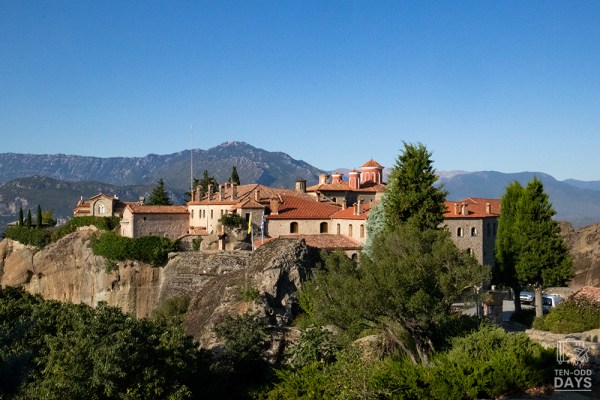
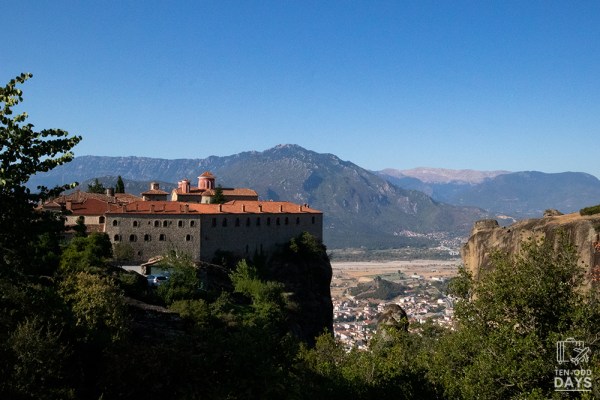
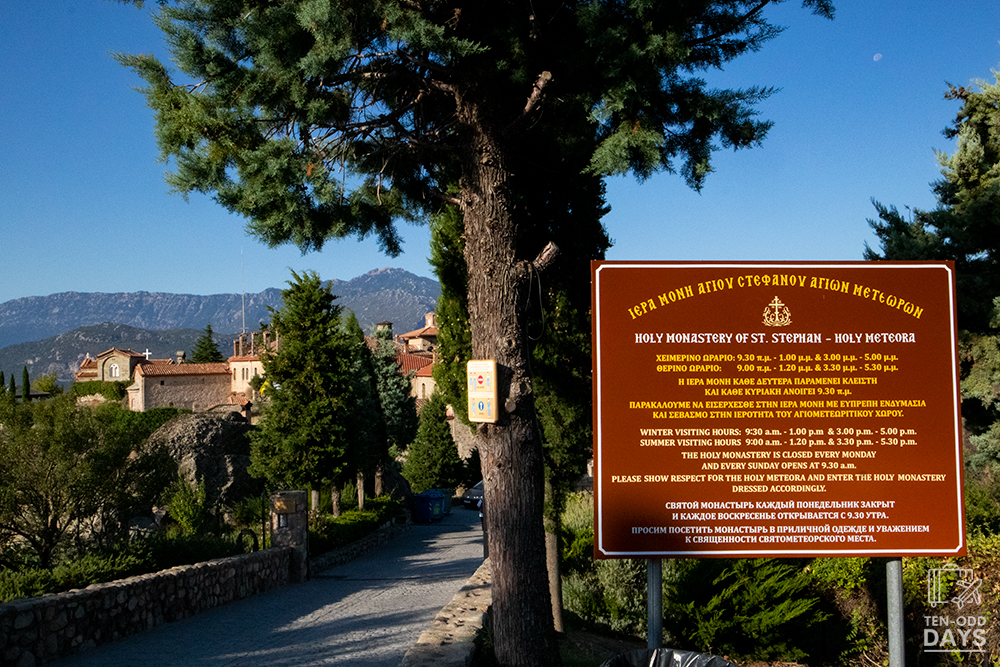
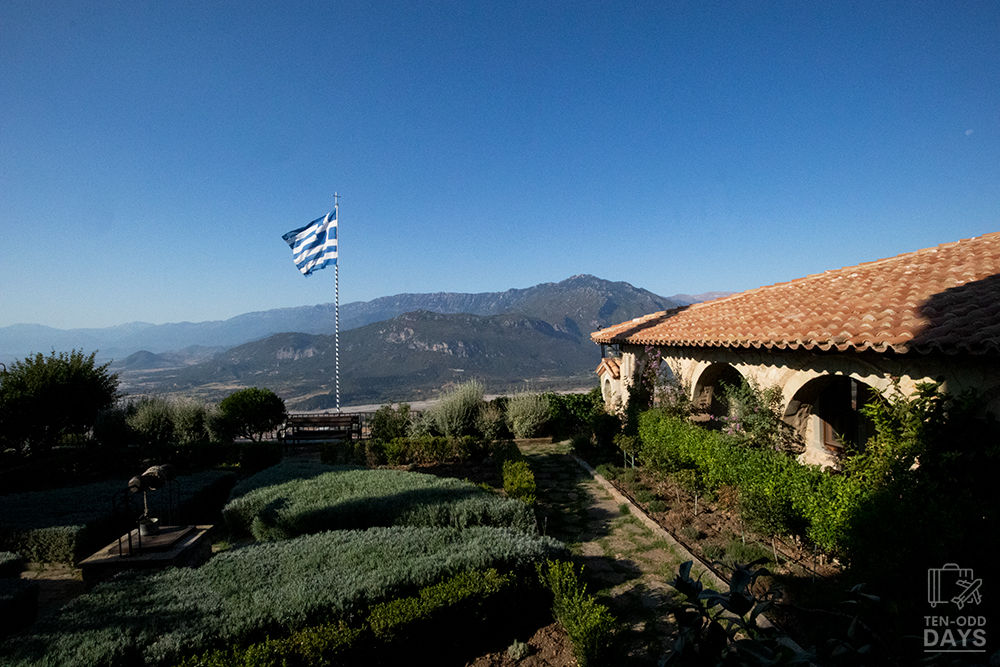
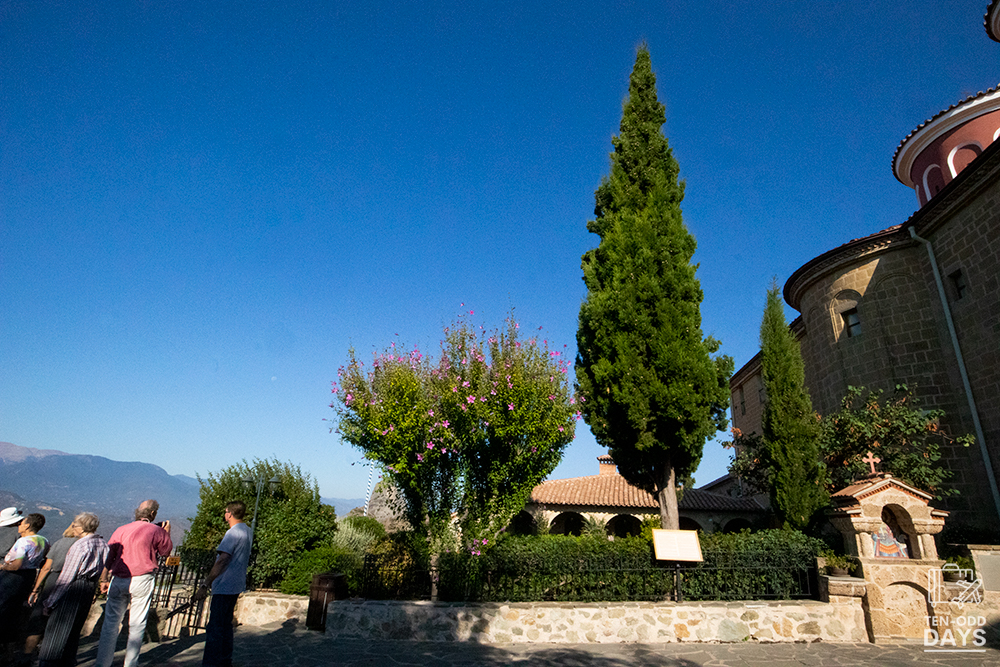
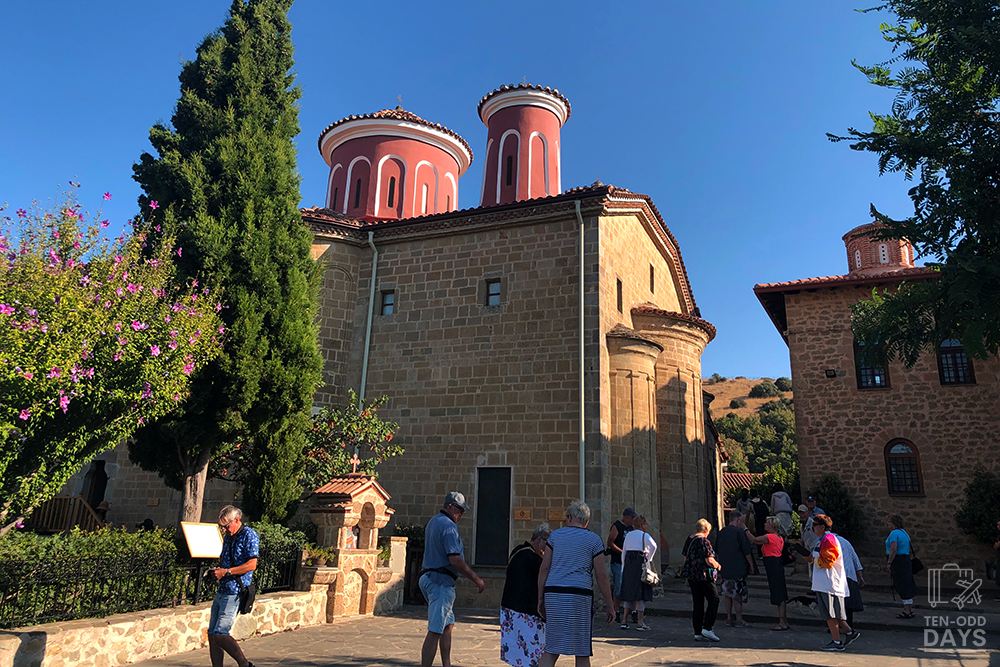
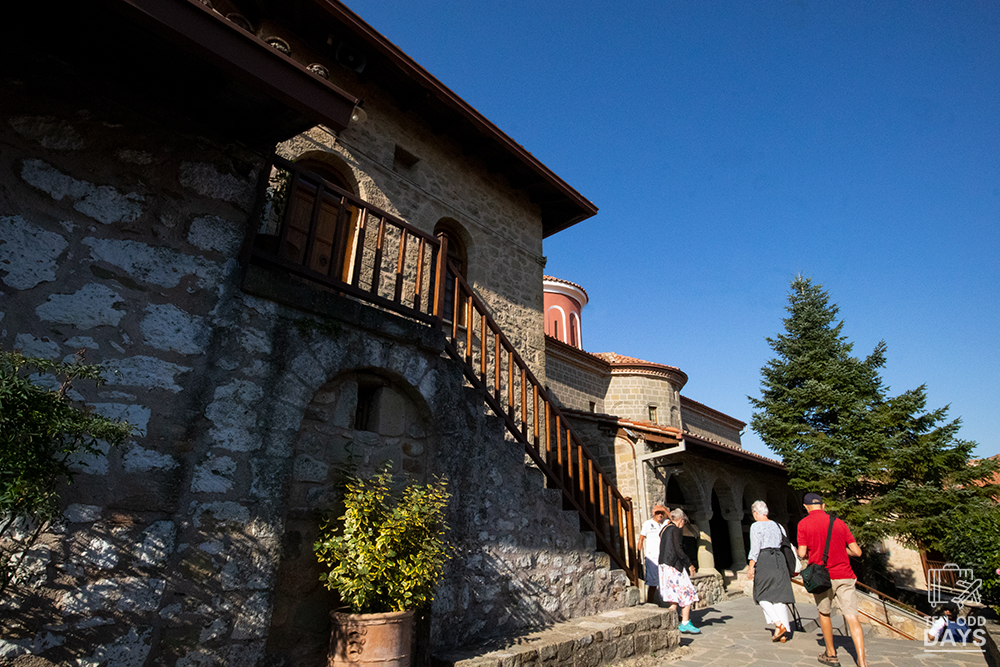
We started with the nearest one to our hotel early next morning. One of the two nunneries out of the 6 monasteries still standing today (in the 16th century there were as many as 24 monasteries but many were abandoned in the 17th & 18th centuries). St. Stephen’s was our first stop and by far the easiest one to reach after parking our car. No stairs, no slopes. Just flat ground to reach it.
There are a total of 28 nuns living in the nunnery. Everyone in our guesthouse told us they were strict so the mister was reminded repeatedly to wear long pants or he would be denied entry. I’m not sure if the black habit the nuns wore has any impact on my impression of them but I found them very stern when I was admiring the frescoes in the church. Two of them were watching the visitors closely to ensure nobody attempted to take any pictures or videos within the church interior. I have to admit that I was terrified of them.
The feminine touch was to be found everywhere within St. Stephens. The grounds was well-kept and even the frescoes were extremely well-maintained compared to the other monasteries. I’m not certain why this is so, but a guess would be that since this particular monastery was preserved by the town after it was abandoned until the nuns took over the place in 1962, the town had the means and made sure everything was well-preserved.
The interior of the church is beautiful but don’t take my word for it. Have a look yourself.
Fee: 3€ per person Closed on: Mondays & 3.30-5.30pm daily
Holy Trinity Monastery
Look closely and you can see how to path zigzagged down from the road near the top.
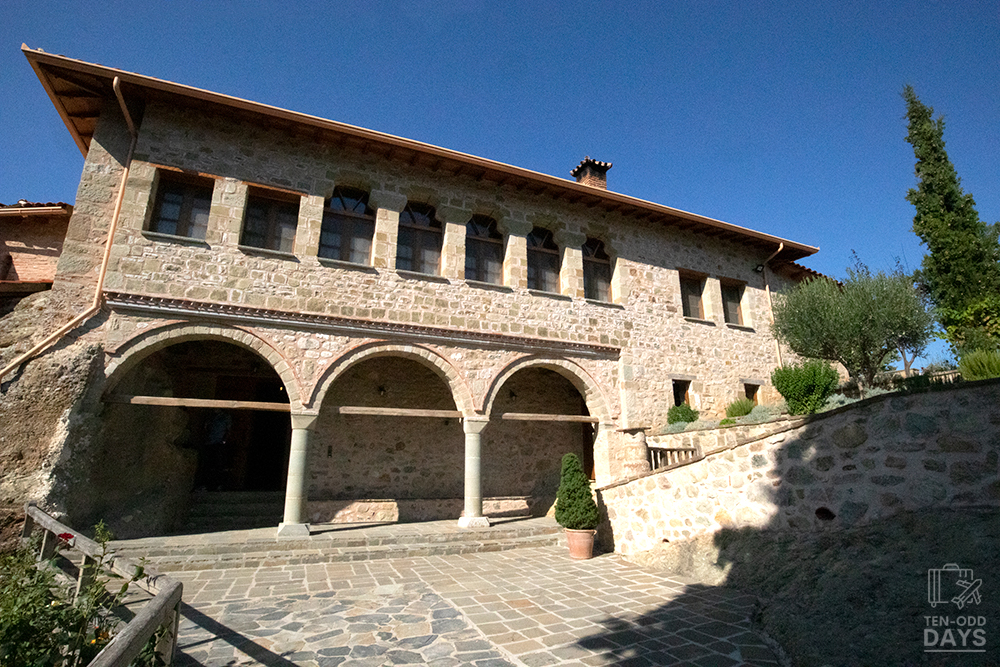
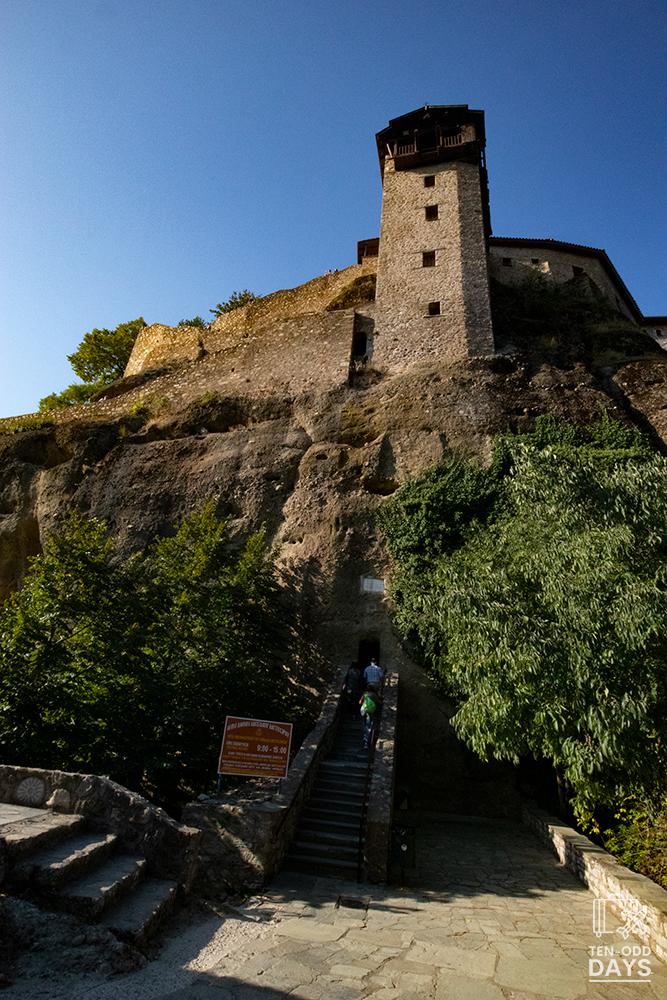
Otherwise dubbed the ‘James Bond Monastery’ because a scene in ‘For Your Eyes Only’ was shot there, Holy Trinity Monastery was much harder to reach than St. Stephen’s. After parking our car along the road side we were greeted with several stretches of steep slopes leading us down to the steps that were carved into the rock that Holy Trinity sat on. A total of 200+ steps to reach the church.
Amidst the huffs and puffs, we arrived at the church grounds. And I was requested to put on a skirt (as with every other female not in a long skirt or dress entering the monastery) they provided at the entrance even though I was very modestly dressed in a blouse and pants. I decided to use my shawl as a wraparound skirt instead.
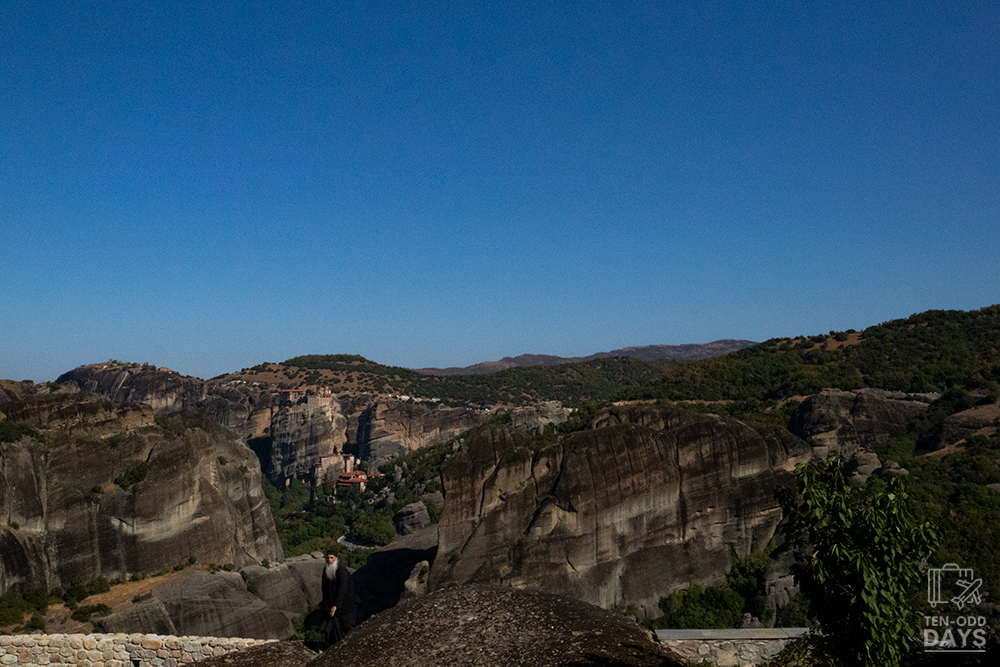
It is a much smaller church, and we learnt later that only 2 monks lived in the monastery (I was fortunate to capture one of the 2 monks living there when I was taking some pictures). The monastery was undergoing some renovation works; we saw several workers on the church grounds.
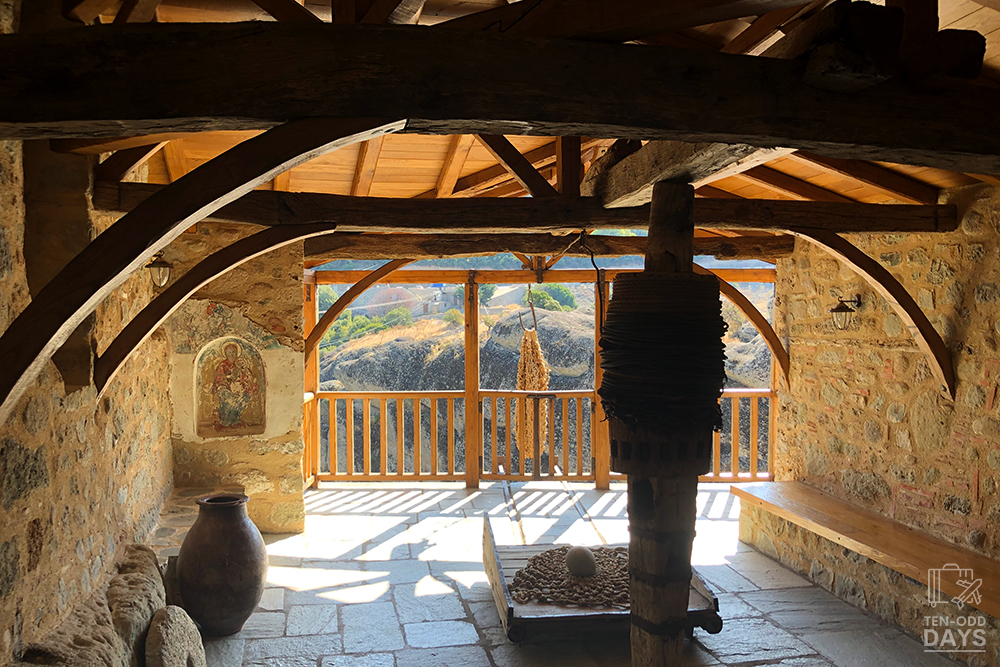
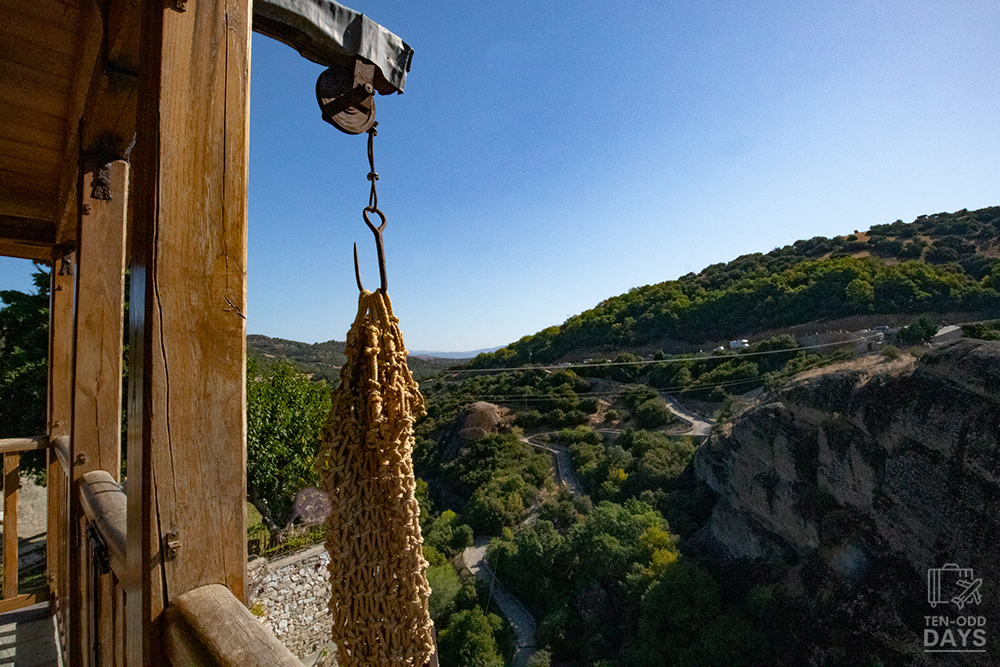
I was particularly intrigued with the ancient pulley system they used to carry supplies up the monastery earlier in the days. Although it is now being replaced by a modern system, the whole set up was still very well-maintained. I wonder if it still works.
An interesting nugget of information we learnt from our Sunset Tour guide later in the day: the monastery did not know that their grounds was going to be featured in a movie; they were told that it was for a documentary so they were rather annoyed when they learnt the truth because it brought them unwanted attention.
I didn’t know which I hated more: the steps up the the church or the steep slopes back to the car.
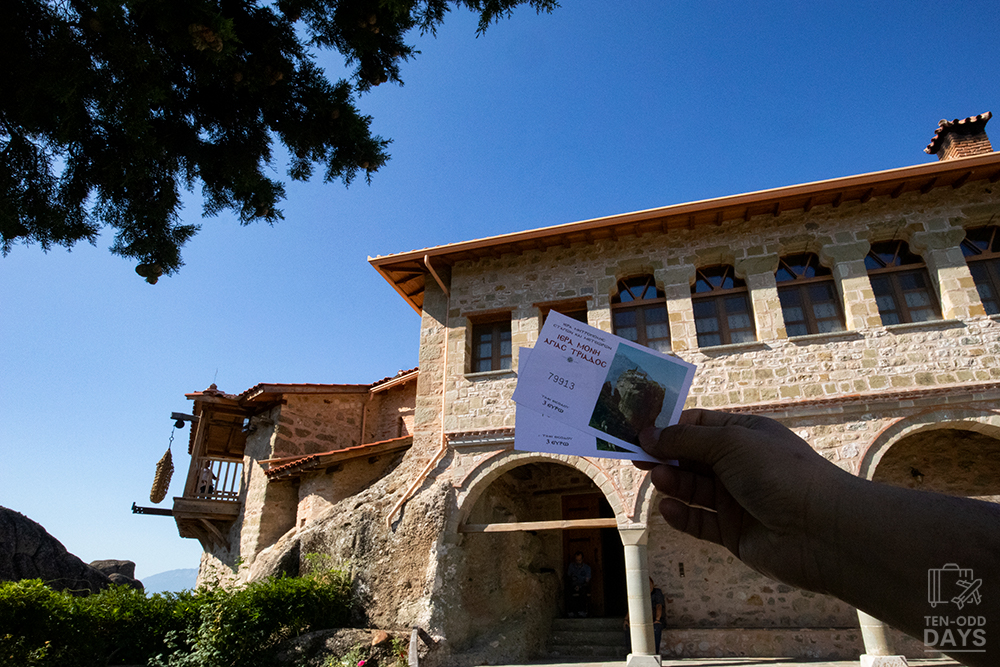
Fee: 3€ per person Closed on: Thursdays
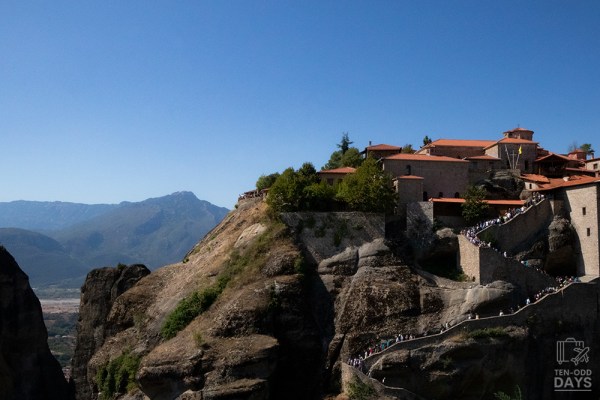
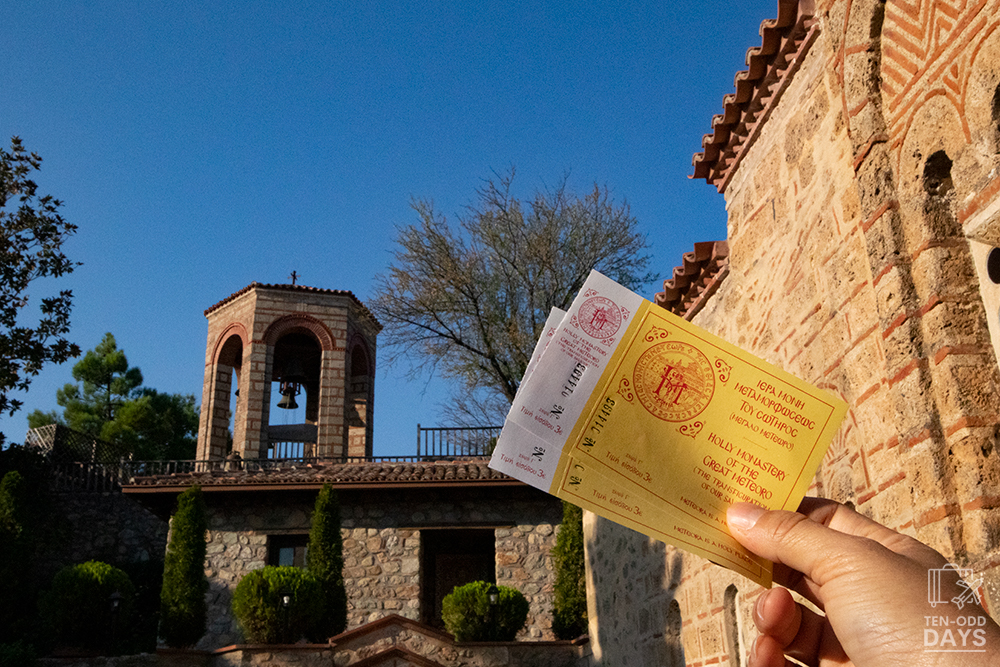
Grand Meteoron Monastery
Since we managed to make good time on our first day we thought to cover Grand Meteoron Monastery as well. That was until we drove to the monastery and saw the steady line of visitors. It was clear we weren’t going to make good time AND be in time for our sunset tour in the evening, so we ditched our ambitious plan.
As the oldest and largest monastery out of the six, only 3 monks lived there. It’s amazing how they manage to keep the vast monastery grounds so pristine and undertake the administrative role of all the monasteries in Meteora at the same time.
For the massive space this monastery occupies, it exhibits an equally impressive number of artifact in the several museums for visitors to understand the heritage and tradition of the monks who lived there as far back as the 14th century. And despite starting our day early, we couldn’t beat the day-tour crowd who came in tour buses. It seemed that the tours like to begin with Grand Meteoron Monastery, possibly because of its location and perhaps level of importance as well.
Fee: 3€ per person Closed on: Tuesdays
Varlaam Monastery
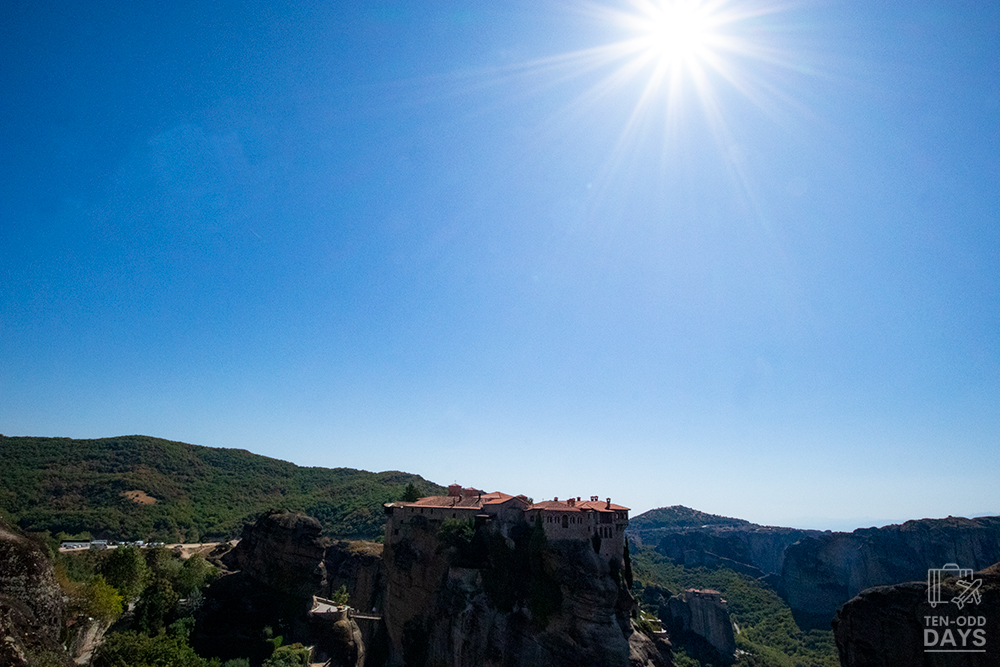
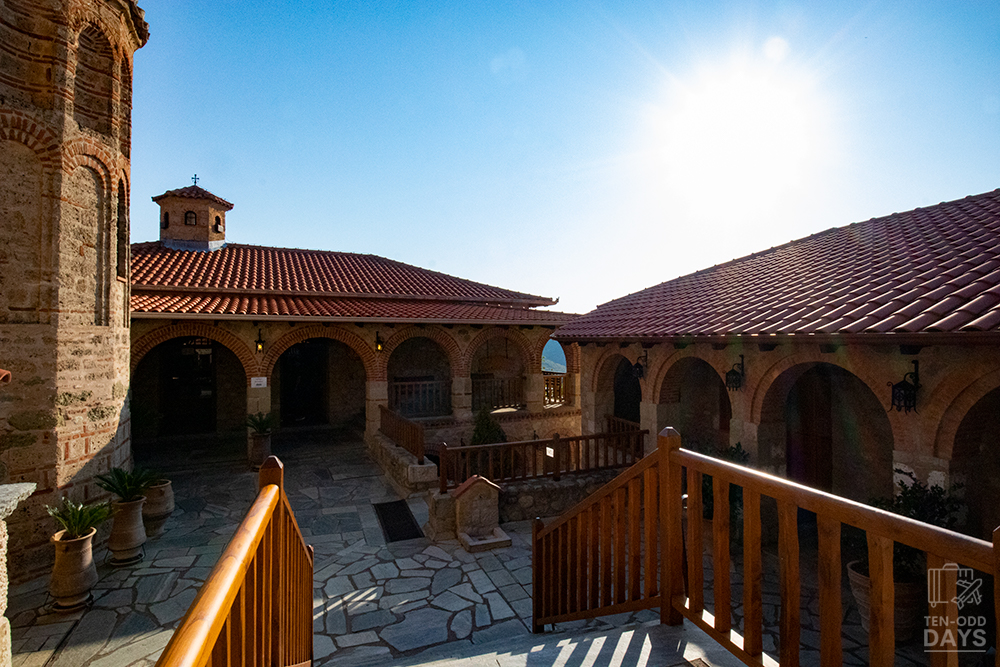
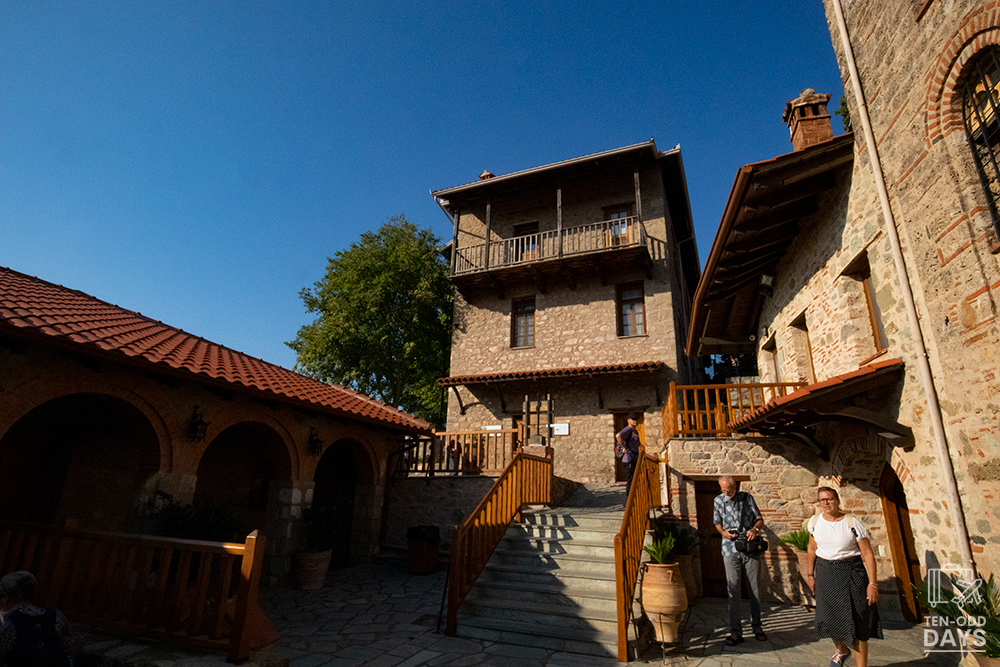
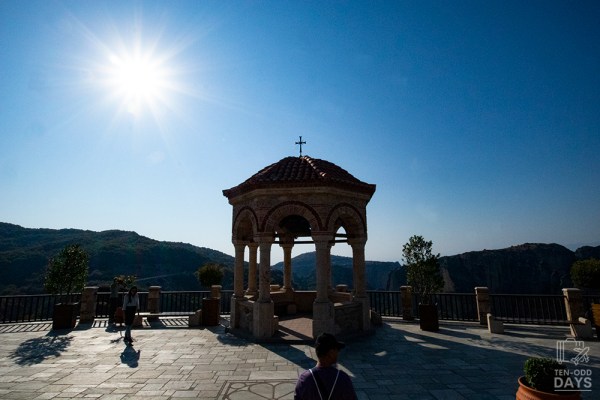
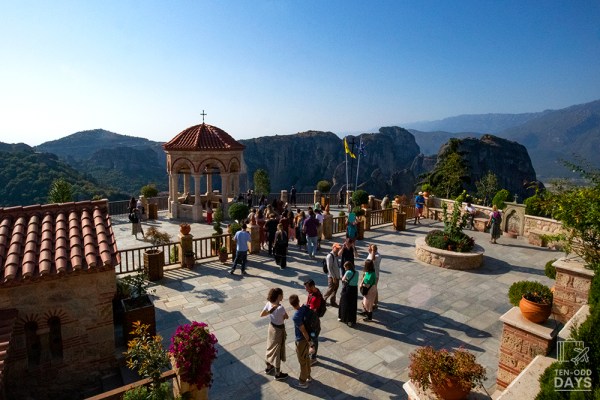
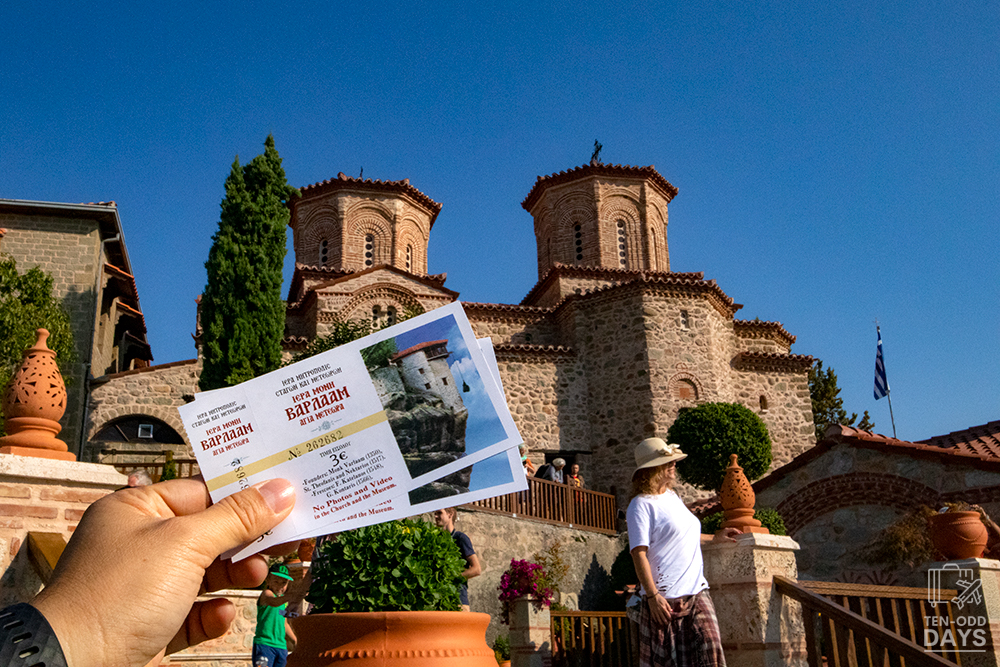
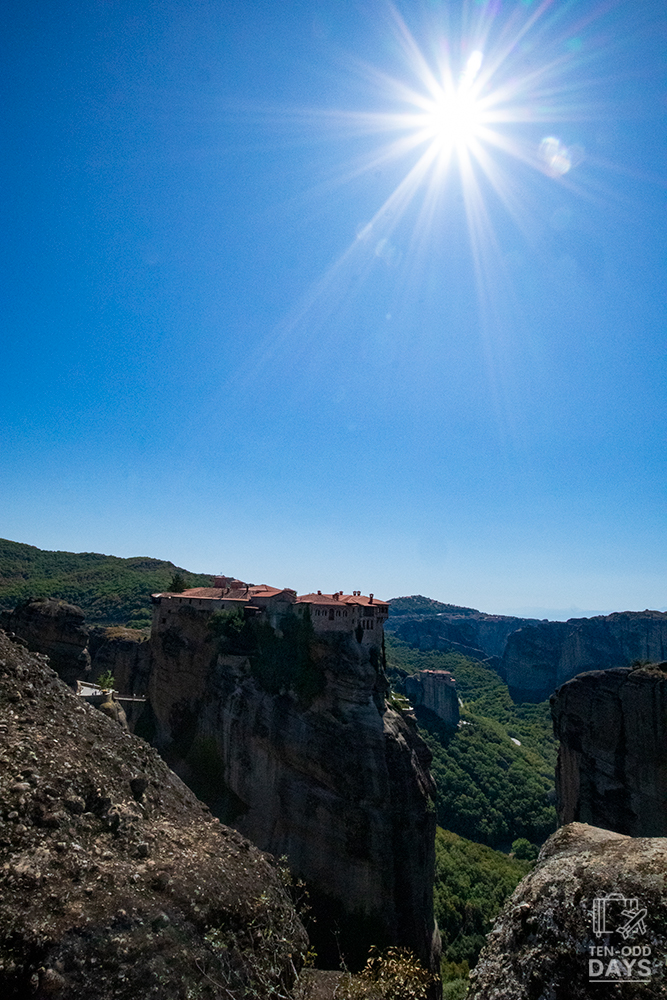
Situated between Grand Meteoron and Roussanou monasteries, Varlaam Monastery was a short drive away, and the 4th monastery we visited. Of all the monasteries, I found Varlaam Monastery to have the most picturesque courtyard, complete with a pavilion. Suffice it to say that we spent a lot more time outdoors than in the monastery itself.
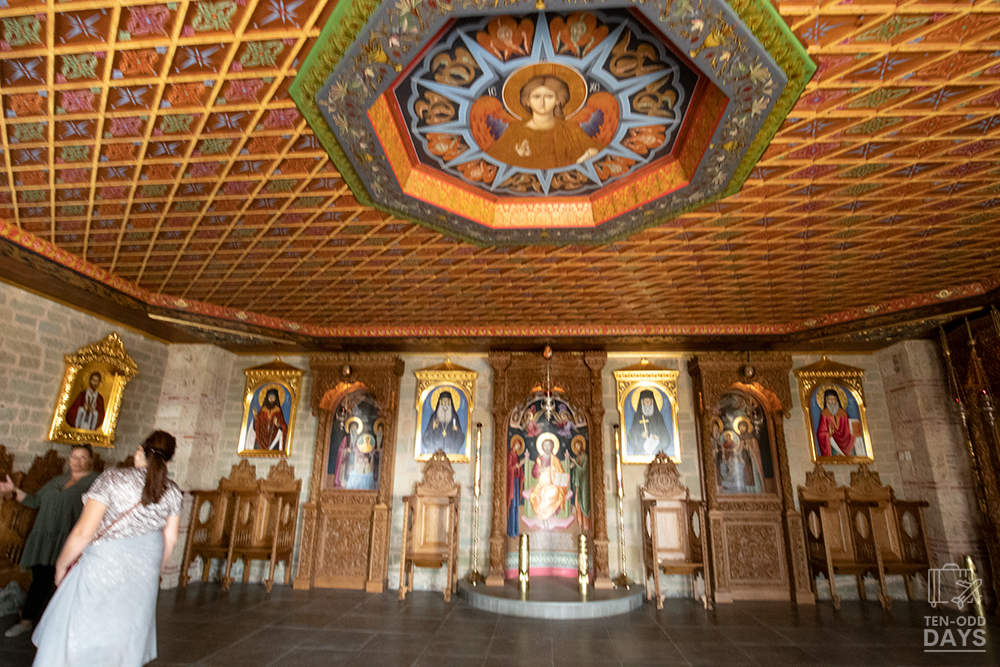
Being the second largest monastery, 7 monks live there (as opposed to 3 at Grand Meteoron Monastery) and was first occupied in the early 14th century. It also has the most well-lit interior. I’ve avoided taking pictures of the monasteries’ interior as far as I could, but I did allow myself one shot over here because it seemed to be ‘silently’ permitted. A few visitors before me took out their picture-taking contraptions and the monk on duty looked on without saying a word or showing displeasure.
This one precious picture gives an idea of how a typical monastery in Meteora is furnished – rather bare and austere – with the exception of icons adorning the interior of the church, but large free-standing statues are rarely seen, if at all. This is in general rather typical of Eastern Orthodox Churches we visited in Greece.
Fee: 3€ per person Closed on: Thursdays & Fridays
Rousanou Monastery
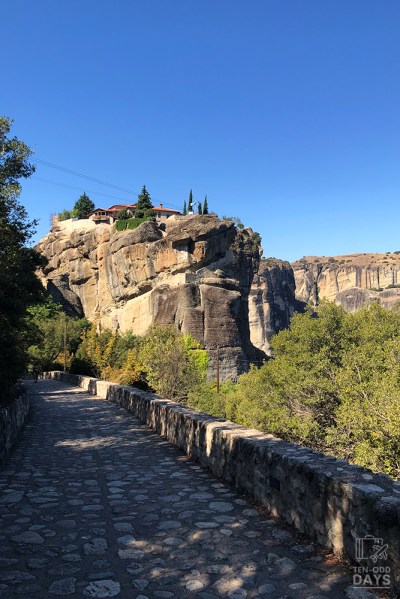
Apart from St. Stephen’s Monastery, Rousanou Monastery is the other of the 6 still-standing monasteries in Meteora to be occupied by nuns. In this case, 13 nuns. Structurally, the construction of Rousanou Monastery is an amazing feat, perched at the pinnacle of rock and occupied the whole plateau, blending perfectly into its natural surroundings.
It didn’t take long to arrive at Rousanou Monastery, given the close proximity of Grand Meteoron, Varlaam and Rousanou monasteries. Parking though, was a little challenging since we had to park along the road, together with other vehicles including several tour buses. What followed was a little trek up to the church, including slopes initially and stairs after.
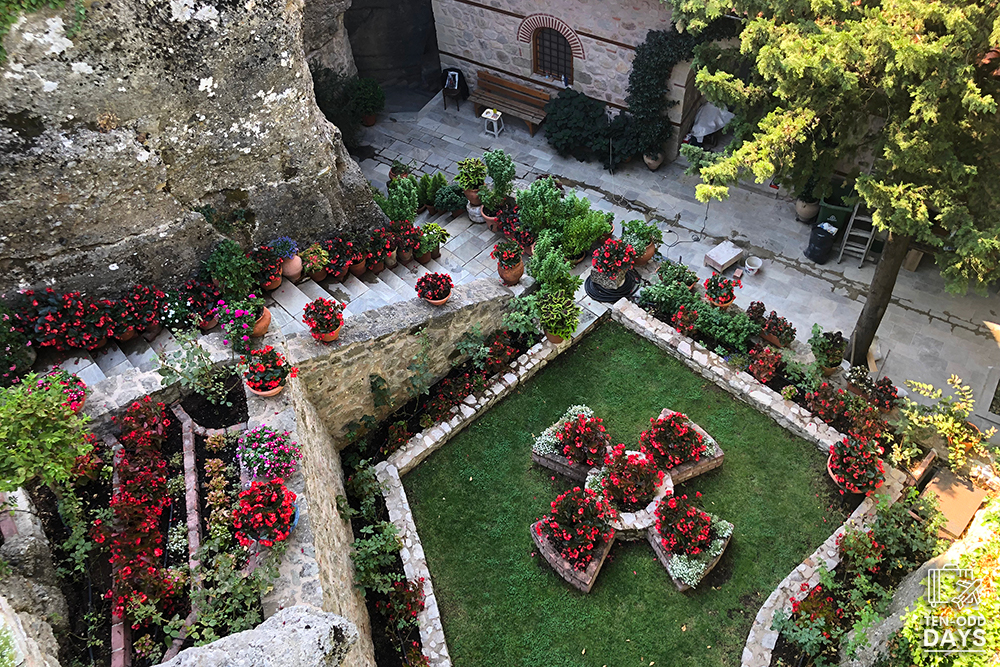
There was a bottleneck at the stairs with visitors trying to ascend and descend on the narrow path simultaneously. Progress was excruciatingly slow. As we were slowly taking the stairs to the church at the top, we looked down on our left and saw the nuns’ living quarters. Neatly pruned rose bushes on the pristine lawn greeted us; the mister and I were not the only ones amazed by the carefully grown garden.
Rousanou Monastery is amongst the smallest monasteries; we took less than 10 minutes exploring the interior before we found ourselves at the terrace again, rubbing shoulders with too many other visitors. The severely lack of breathing space made us hasten our steps to leave once we’ve admired the view from the small terrace.
Fee: 3€ per person Closed on: Wednesdays
St. Nicholas Anapafsas Monastery
A very small church with only one monk living there, St. Nicholas Anapafsas Monastery was the last of the 6 monasteries we wanted to visit. It was past noon, and the heat from the glaring sun was seriously making me sleepy.
The geological location of this monastery limited its capacity to expand in width; the only way was to build upwards. This resulted in a rather small and cramp monastery that’s a few storeys high.
I remember how I stood there, looking out at the view, marvelling and wondering how a delta, once submerged in water millions of years ago has now risen a few hundred metres above ground. These rock formation in Meteora that we see today were sediments stacked on the waterbed. In fact, Meteora’s strange geological phenomenon is not so different from Zhangjiajie National Forest Park, the place in China where the movie ‘Avatar’ was filmed.
Fee: 3€ per person Closed on: Fridays
By the time we were done with visiting all 6 monasteries, we were both hot and bothered, and terribly thirsty. Again, just like the day before. It was almost 3pm in the afternoon and way past our lunch hour. For some reason, our meal times were strangely all messed up the entire time we were in Greece; we were eating at very odd hours, much later than we usually did. Was it really caused by the hot weather?
In 2015, Singapore’s very own Botanic Gardens was inscribed as a UNESCO World Heritage Site. I remember beaming with pride as I read the news because I have such fond memories of the colossal Gardens as a child. It was always a treat when my parents brought us there occasionally. And in recent years, I too enjoy bringing the dogs out to the Gardens for walks. It’s a very large garden (by Singapore’s standard), occupying 82-hectares of land located at the fringe of Singapore’s shopping Street – Orchard Road. And due to its recent elevation in status, more tourists have been visiting the garden. We acutely felt it when we brought the girls out there this weekend. A fortunate thing that our schedule worked out somehow and good weather was forecasted so we forged ahead, leaving home as early as 7.30am hence managing to avoid the crowd that started streaming in around 9am.
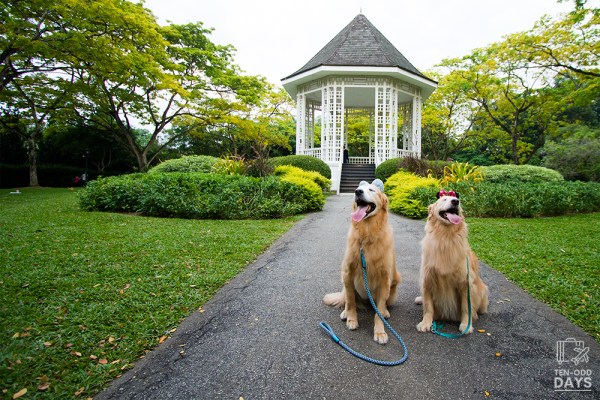
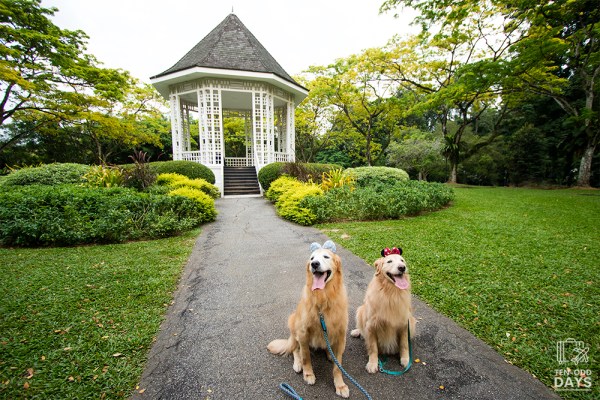
Considering Paris’ health condition at this point, we were not too ambitious about covering much ground at the Gardens. It was a simple enough strategy – to make it to the iconic landmark of the garden that is the Bandstand, and then to the Swan Lake. The bandstand is clearly a favourite spot of the locals; when we arrived at gazebo erected in 1930 there were 3 different groups of people already absorbed in their various activities. Some indie filming was going on to the right, a group of ladies were practising yoga to the left, and a group of fresh graduates wearing their convocation gowns and mortarboards were taking commemorative photographs at the back. Well, it certainly isn’t hailed to be Singapore Botanic Gardens’ iconic landmark for nothing. 🙂
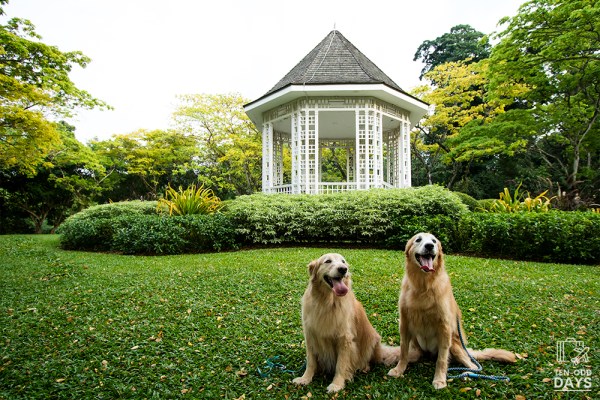
The girls didn’t seem to want to remain on the grass patch (I suspect ants were biting them since I was also bitten) so I quickly snapped some pictures with a profile of the bandstand in the background and then brought them back up to the pavement while waiting for the group at the front of the bandstand to clear the area when they were done. Paris and Belle were much happier to oblige when we got them to sit on the pavement.
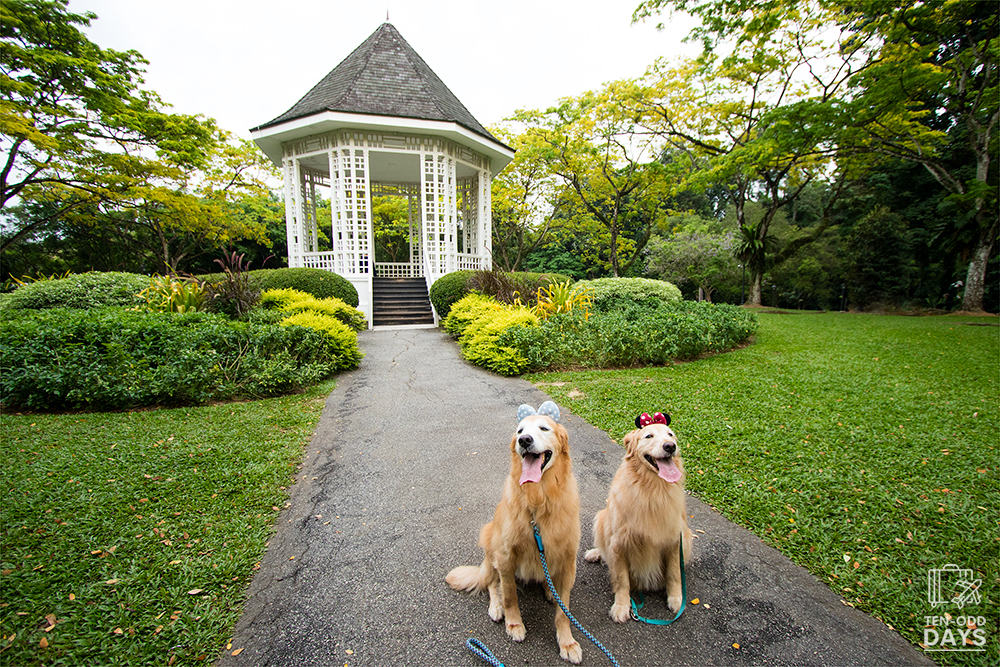
We didn’t have to wait long. By the time we had the front of the bandstand to ourselves, I have already got the girls prepped with hair bows. Most people who came across us couldn’t resist the urge to take picture of the girls because they looked so sweet! Inside, the girls were feeling anything but. They were hot, bothered and thirsty as it was exceedingly humid at the Gardens although it was still early in the day. We too, were perspiring profusely.
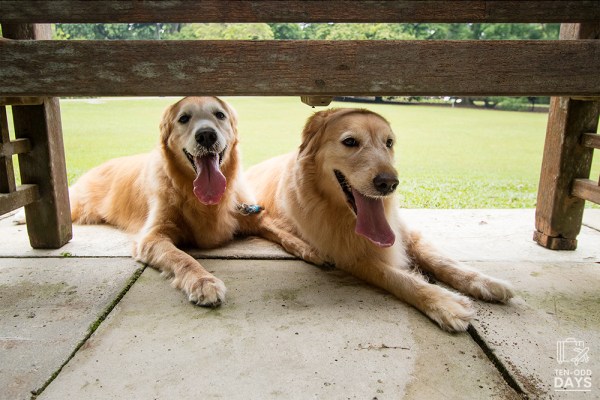
We found a bench nearby for the girls to take a rest while the mister walked back to the car to fetch their water bowl and bottled water. The girls took the opportunity to indulge in their favourite past-time – people watching. Since they were too tired to stray off, I wasn’t watching them too closely, allowing them to explore around the bench freely. Both decided that it was a good idea to nestle under the bench together. These girls… sometimes I simply cannot fathom what go through their minds. 😆
The mister loves the girls to the moon and back. And his love is reciprocated by both Paris and Belle, without a doubt. They see him as the Alpha of the pack and most of the time, only listen to his instructions. As I was making my way down to the centre of the grass patch (to allow the girls to do a sport of sprinting towards me), I turned back and saw a picture-perfect moment – all three of them were looking at me from the bench. I’m thinking of printing this into a large poster to hang on one of our walls at home.
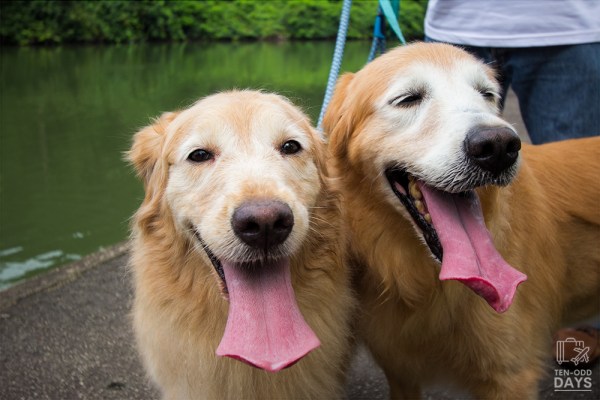
After ample rest and water, we proceeded to the Swan Lake. Kind of an anticlimax because it wasn’t very picturesque. Perhaps the cloudy sky did a great disservice to its beauty. In any case, the girls were exhausted and we decided to call it a day there and then. Didn’t even get to meet up with our friends who wanted to see Paris since they were only coming much later.
As we were leaving, I commented to the mister about how nice it is that entering and visiting Singapore Botanic Gardens doesn’t require any fee. We have visited parks and gardens overseas that collect an entrance fee. I hope it remains this way; the Gardens has become such an integral part of our lives.
After the visit to Ephesus, we were whisked off to a leather apparel factory, which unfortunately took up too much of our time that we arrived at Pamukkale, our next destination, much later than planned.
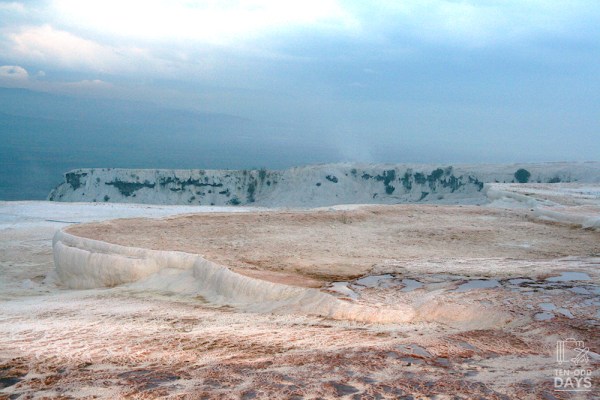
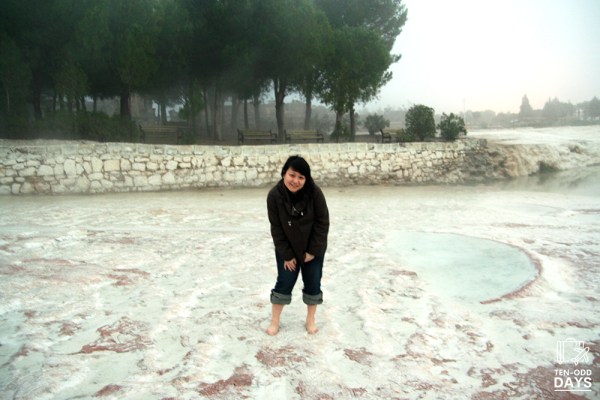
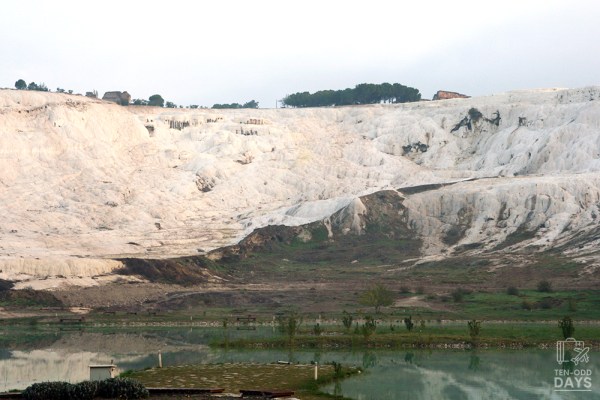
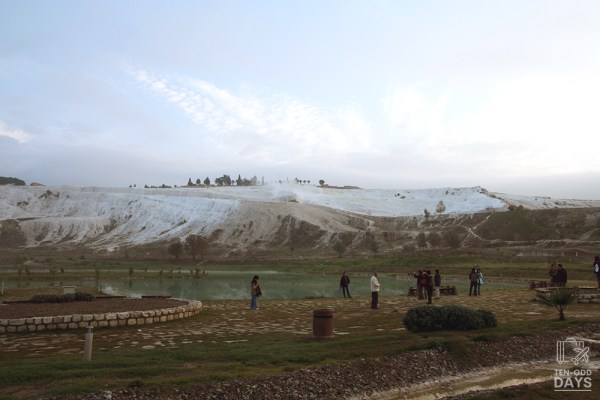
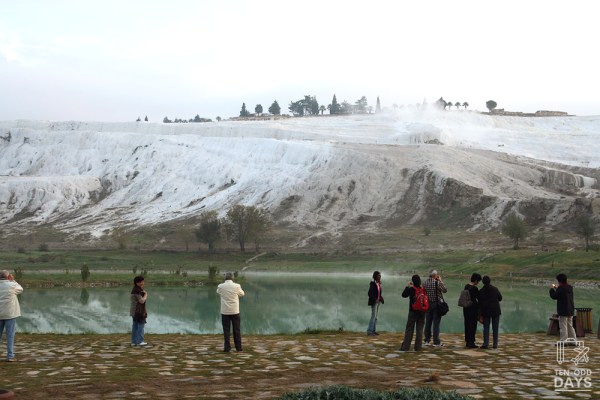
Pamukkale, meaning ‘cotton castle’ in Turkish, is a town in southwestern Turkey most well-known for its mineral rich thermal waters that slowly trickle down cotton-white travertine terraces. The most pervasive image of Pamukkale most people would have has to be white terraces with numerous mini craters filled with sky blue water. This was unfortunately nothing close to what we saw when we arrived close to sundown.
At the entrance to Pamukkale.
The white travertine terraces were, to our dismay, not white at all. Not even remotely close to white, to be honest. It looked like too many visitors to this site have trampled on and dirtied the once pristine white formations.
The picture above was heavily edited. Don’t be fooled by how bright it looked; it was almost pitch dark by then. Encouraged by our tour guide, we gingerly took off our shoes and walked around in the thermal waters to have a feel of it. Given how dark it was, we didn’t venture far from the designated pathway.
Since we didn’t get to see much of the site, we were promised that we would be brought back here again next morning for a quick look before continuing on to our next destination. Reluctantly but cautiously, we made our way back to the coach that brought us to our accommodation for the night.
And that was when trouble ensued. I started having the runs the entire night, together with stomach cramps. It wouldn’t be exaggerated to say that I’ve gone to the bathroom close to 20 times before we realised that something was very wrong. The mister sought help from our tour leader, who in turn got in touch with a local doctor to come look in on me. I went to the bathroom another ten times before he arrived, and gave me an injection to alleviate the symptoms. That injection cost us 100USD. 😮 At least it worked; the bathroom visits reduced sharply after the doctor left.
From there on, the trip went downhill for the both of us. For the next couple of days, I almost never got off the coach for sightseeing, sleeping my way through while nursing the bout of stomachache (which very much later my local GP told me it was for certain a bout of food poisoning) unless it wasn’t possible for me to stay in the coach. Many a times I had to coax the mister to go sightsee without me. He would hastily go down, take some pictures, and rush back to the coach to accompany me without lingering. I felt bad and wanted to get well quickly, but it took several days for my stomach to settle again.
I think the group was rather disappointed that we only got to stop at the foot to take pictures of the terraced travertine instead of entering the attraction again. But there was a schedule to keep to, and it was the best our tour leader could bargain for. Kinda wished we didn’t have to go to the leather apparel factory.
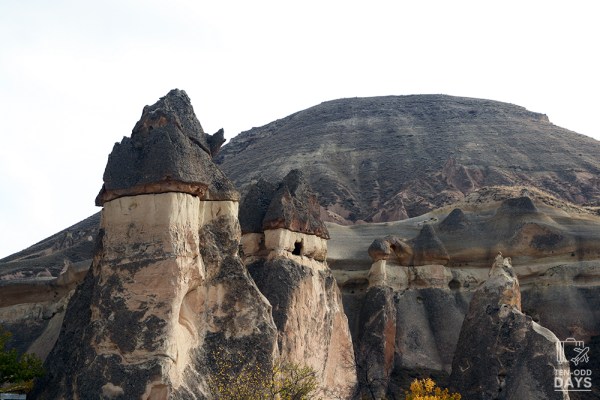
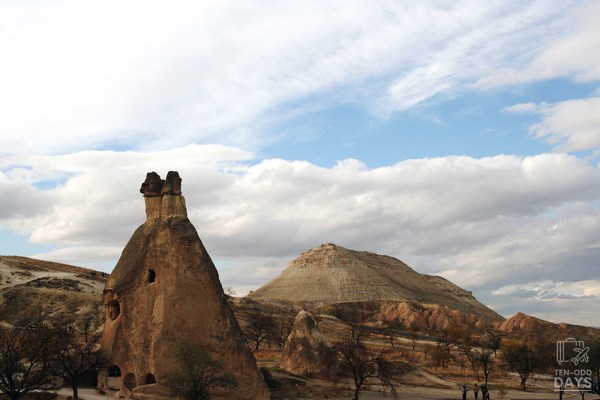
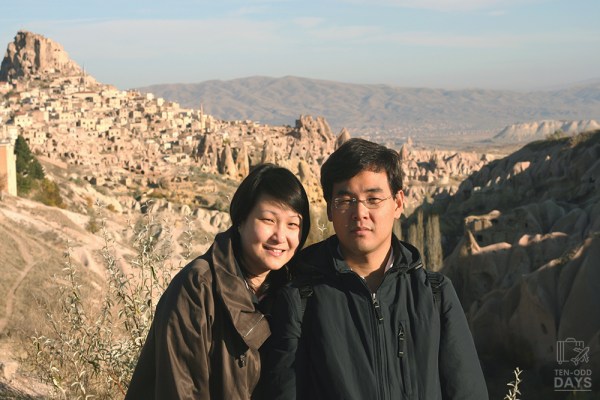
After lunch, we headed for Göreme, a town in the Cappadocia region known for the strange naturally-formed rock formations called ‘fairy chimneys’ and hot air balloon rides over the region.
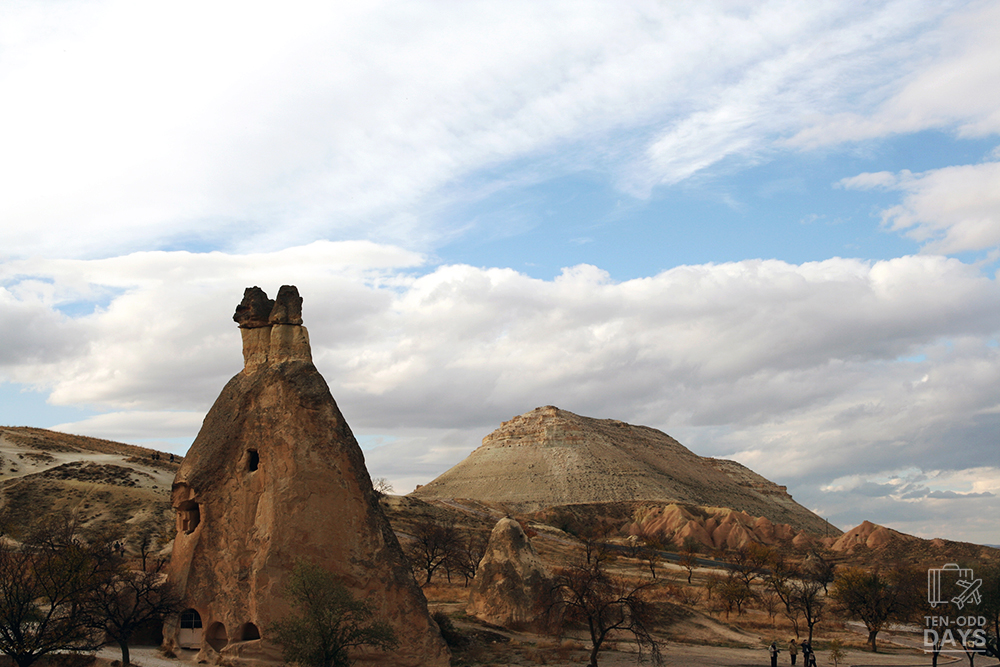
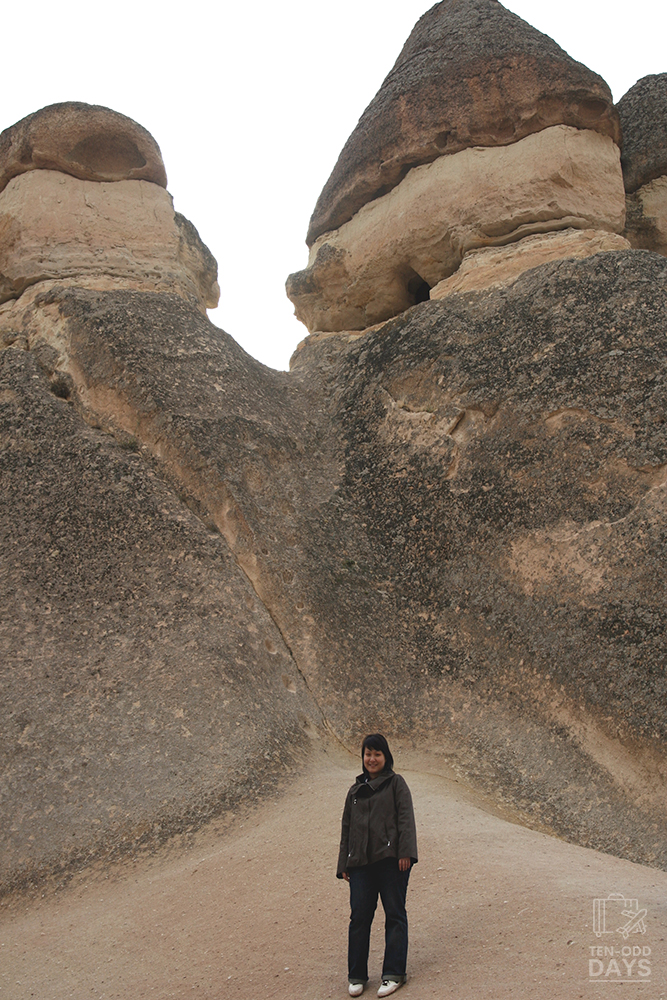
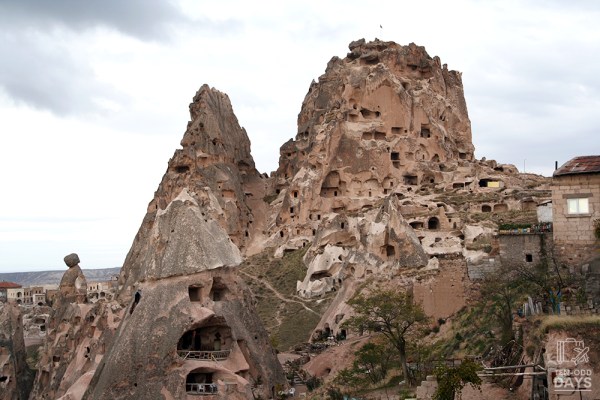
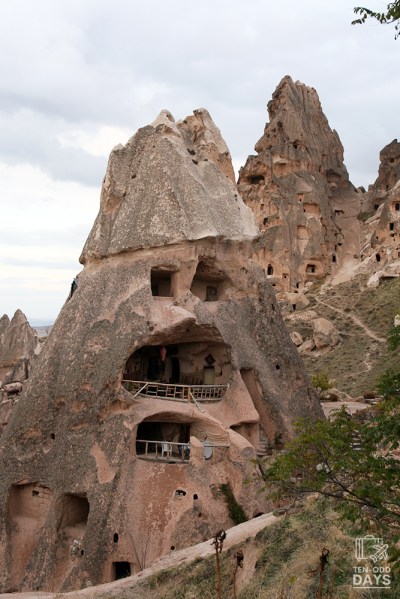
At first glance, the striking fairy chimneys looked really strange to us. Being the good student that I once was, I listened intently as our tour guide started explaining how the geologic processes that commenced millions of years ago first created this unique landscape. Then volcanic eruptions brought ash to this region, which settled and hardened into tuff. Tuff is relatively soft and porous, resulting in rather ingenious ways of using the interesting terrain, chief among which, homes. But this wouldn’t have been possible with simply tuff alone. Along with tuff, basaltic igneous rocks resulted from the violent volcanic eruptions also cooled and settled. Since tuff and basalt erode at different rates, million years of weathering resulted in the mushroom-headed tall columns that we see today. And it’s all natural, not unlike what we see in Meteora, Greece or Zhangjiajie, China.
Cappadocia sat along the historic Silk Road trading route. Prior to that, it was also centrally located, bringing to its region centuries of conflict between warring empires. For that very reason, the town was raided, plundered and invaded several times over the course of time. Natives had retreated into the area, and chiselled into the rock to escape political turmoil. Later, it also became an area of refuge for fleeing Christians escaping from persecution of the Romans, then the Muslims.
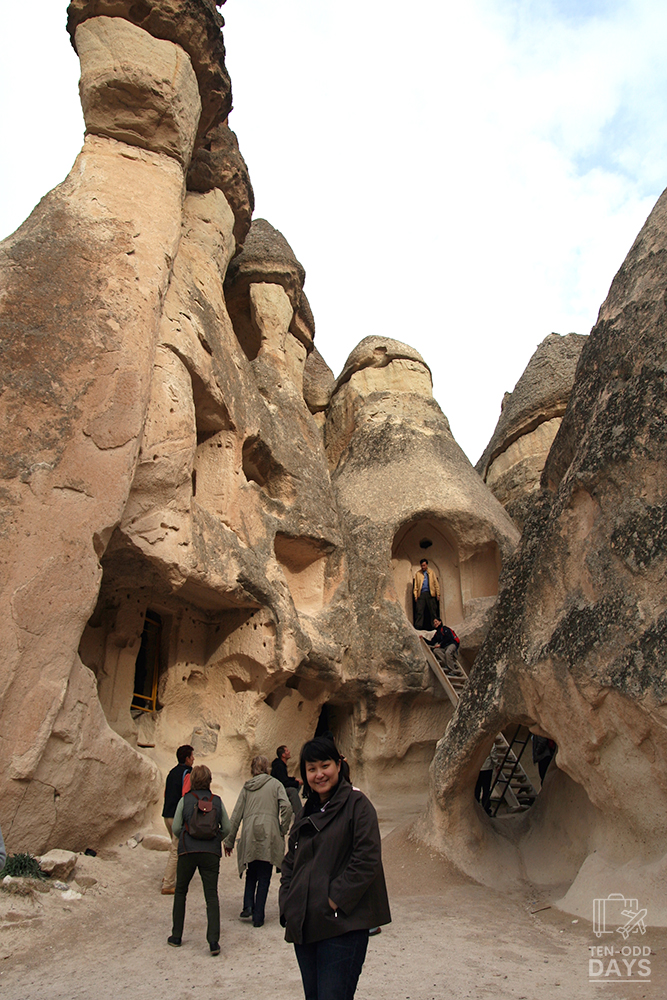
The niches chiselled into the fairy chimneys are such amazing work of art! They may not look much from outside, but these columns formed a network of living quarters, churches, stables, stores etc. like a small town would have. And if you look closely at the columns that have been preserved in this open-air museum, one can clearly see how the each room of each dwelling was being utilised.
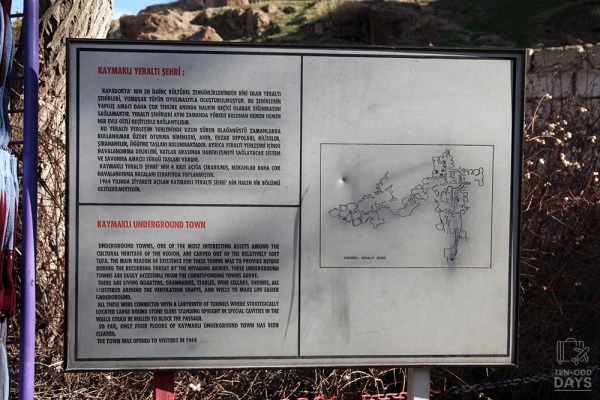
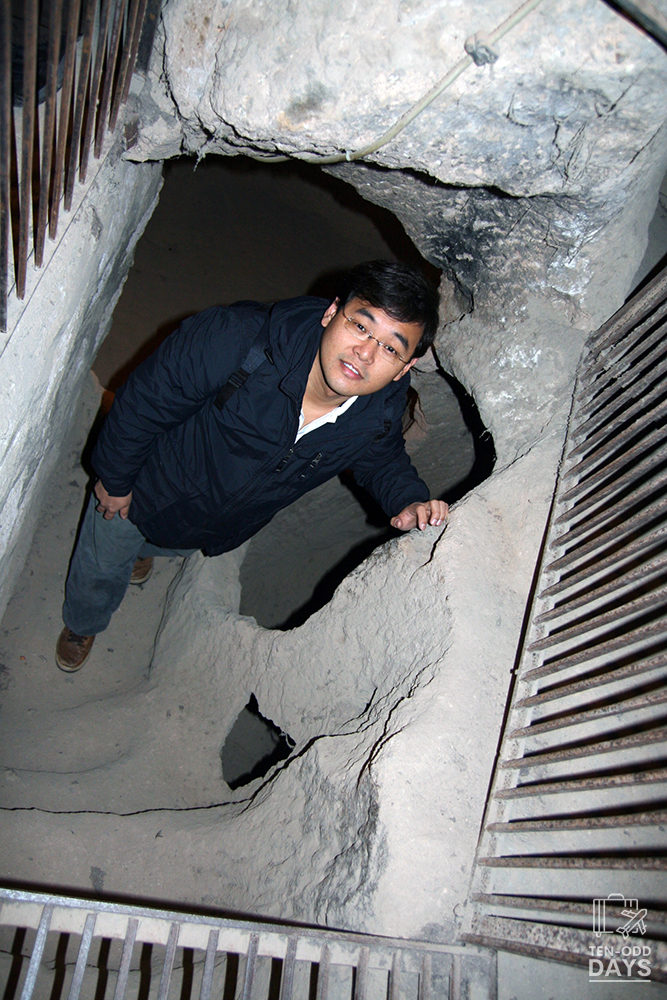
Of course, these houses were not sufficient to help the refugee Christians escape from their persecutors. Oftentimes, they also had to retreat into their subterranean hideout cities when they heard/saw hostile forces approaching. We visited one of several in the region – Kaymakli Underground Town.
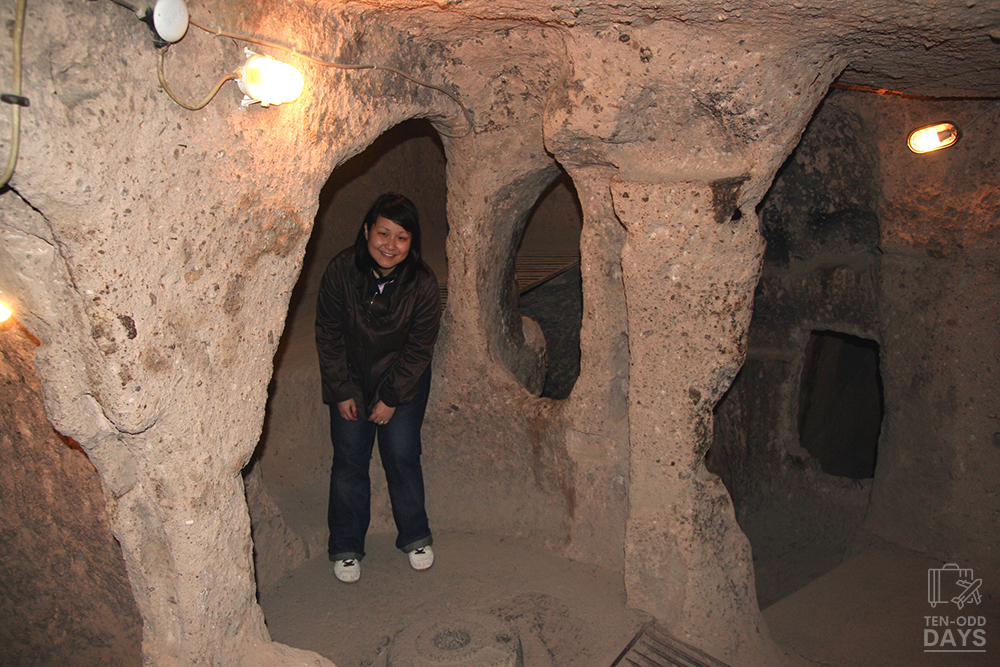
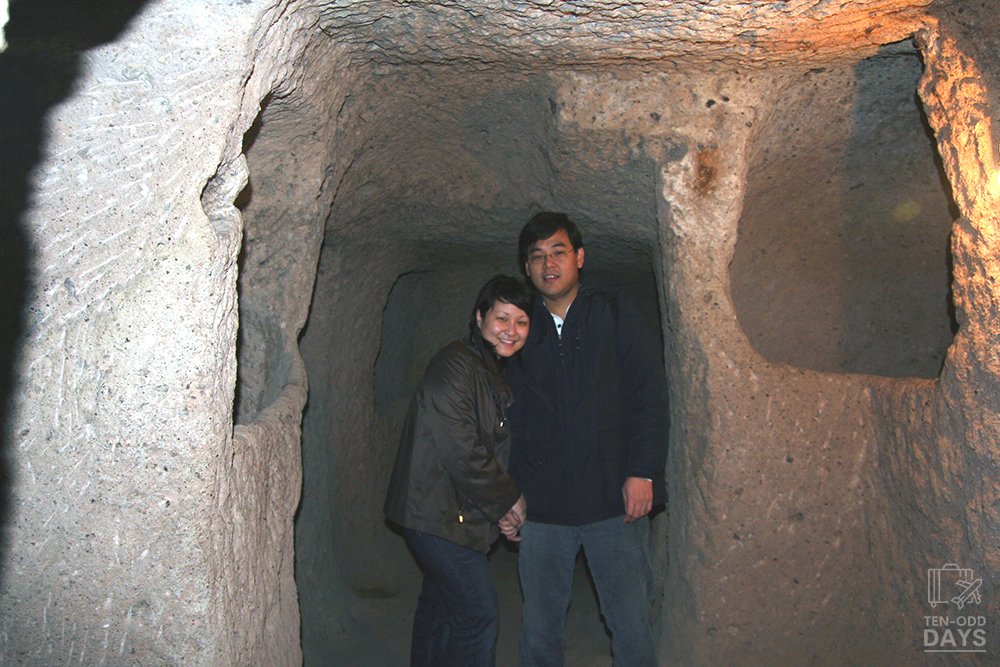
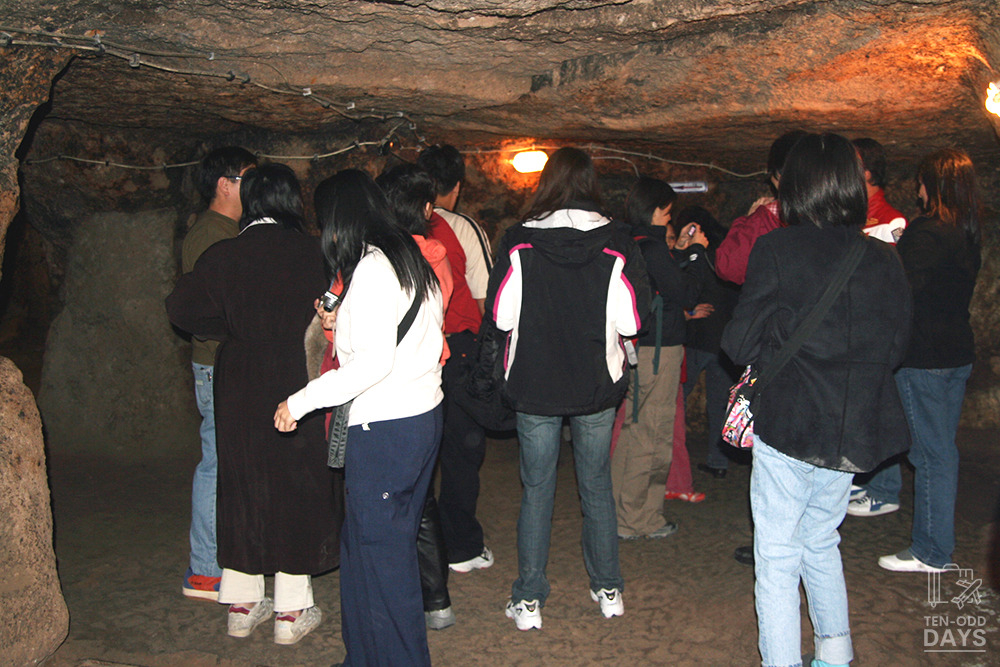
If Kaymakli was anything to go by, these underground towns were really not built for the clastrophobic or the giants that walk amongst us. Some areas were so small we could barely get through. It also reflected something that is universally true – grit and resilience in human beings should never be underestimated. In spite of the extremely harsh living conditions, life went on for the refugees. And in the face of adversity, they even built such remarkable underground towns! Nothing but admiration for them.
The last site we visited in Cappadocia before we left was to the Pigeon Valley. As the name suggests, it’s a valley where a vast number of man-made pigeon holes have been carved into the tuff. We have learnt throughout history, seldom did our ancestors do things out of boredom: the pigeons that lived in the valley in the past used to be trained as message carriers. In modern times though, this practice has gradually become archaic. Very few pigeons now still live in the valley although this stretch has become a rather popular hiking trail.
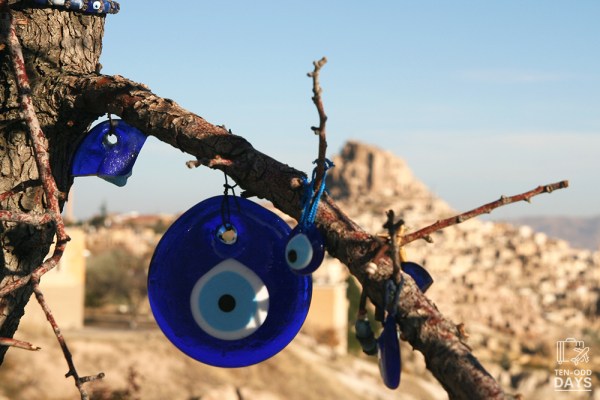
Throughout our tour of Turkey, we kept coming across this blue eye emblem. They come in the form of glass pendants, earrings etc. It is called the Nazar Boncuk, the evil blue eye. It’s supposedly an ancient talisman in the Middle East, that protects the owner/wearer from the bad energies caused by jealousy or envy toward the person. I truly wanted to purchase a small souvenir with the blue eye, but the mister insisted he wanted nothing of that sort anywhere in the house at all. He’s cautious (and perhaps superstitious) like that. And so, we left Turkey with none.
Ephesus (near Selçuk in modern day Turkey) was an important ancient landmark. Especially with respect to Christianity, since it was mentioned several times in the Bible. Even the tenth book of the New Testament was a letter from Paul dedicated to Ephesian Christians.
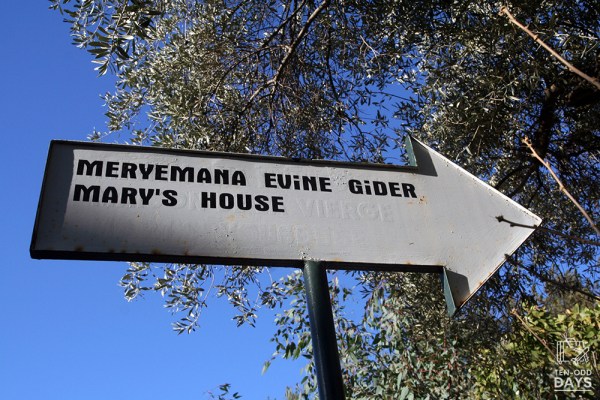
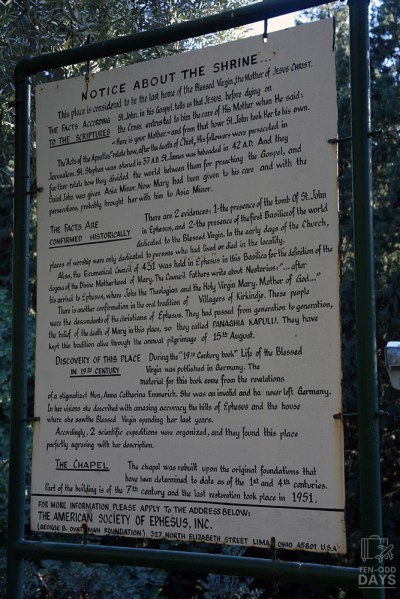
Given its significance, it was fortuitous then, that after traversing from the Istanbul Airport to the western coast of Turkey adjacent to the Aegean Sea, our first stop was to the House of the Virgin Mary. It was said that Mother Mary travelled to Ephesus together with St. John the Evangelist, whom Jesus Christ entrusted his mother to as his newly adoptive mother during his crucifixion, and it was here that they lived.
While the Catholic Church neither confirmed nor denied the authenticity of this house in which Mother Mary has lived and died, three Popes have visited this site namely: Pope VI, Pope John Paul II and Pope Benedict XVI. I would think the gesture alone speaks volume, to say the least, nevermind the official stance.
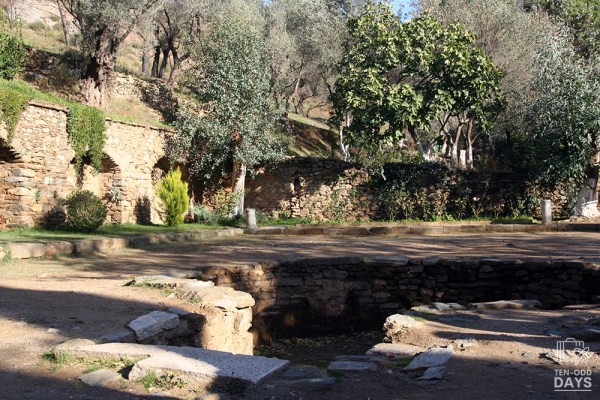
The ancient Baptismal font located near the entrance of the site.
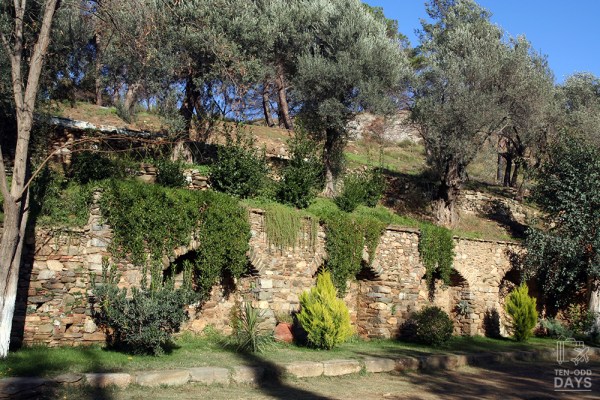
The House of the Virgin Mary was located a mere 9km away from the ancient site of Ephesus, and what greeted us in the early afternoon when we visited was a picture of serenity. Greenery surrounded the site, and we were rather surprised to find ourselves the only visitors to this rather significant religious site. And as with most ancient Christian shrines, the dried up baptismal font was located near the entrance and was the first sombre reminder that we have entered a religious site.
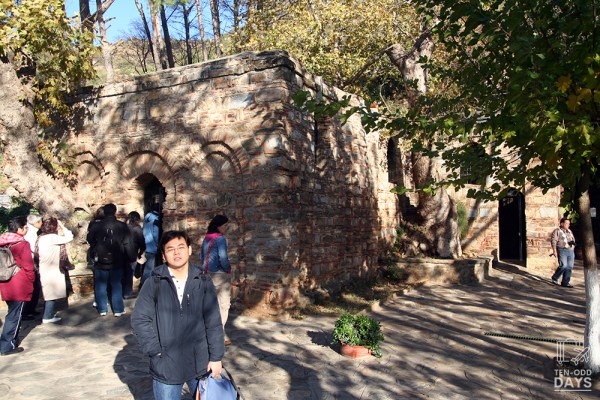
We walked a little way ahead to catch up with the group (we dawdled and lagged behind while taking pictures) and came to a halt as we patiently waited for our tour group mates to make their way into the nondescript stone house via a tiny doorway. It gave me a great opportunity to stray away from the group once again, to the chagrin of the mister.
None of the original furniture remained in the house, if my memory serves me well. The interior has been converted into a chapel, wherein by the time we entered, was almost void of visitors. I lit a candle, said a little prayer, and we made our way out.
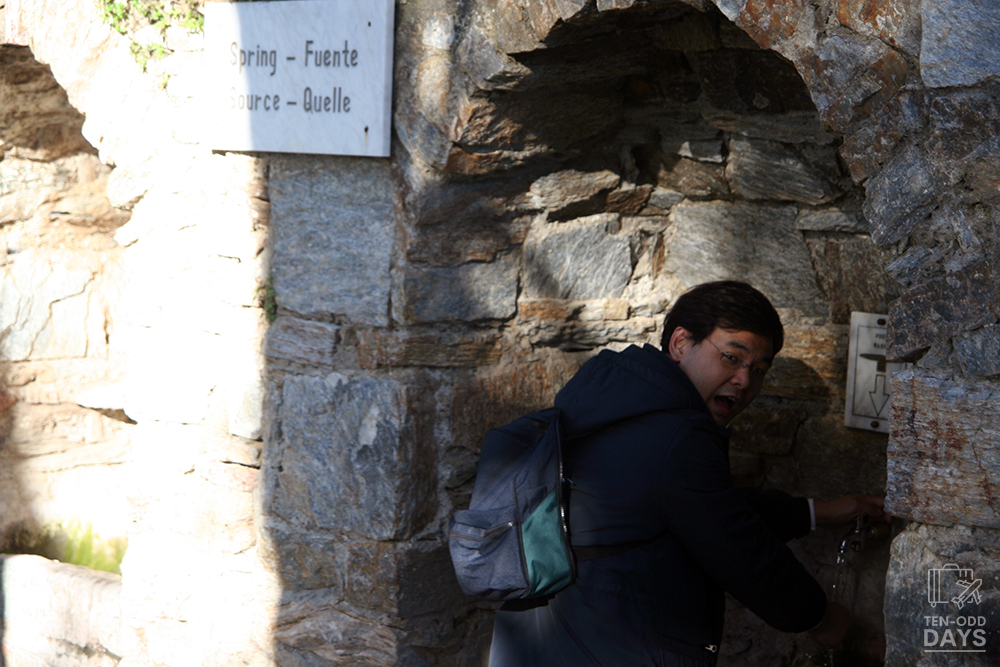
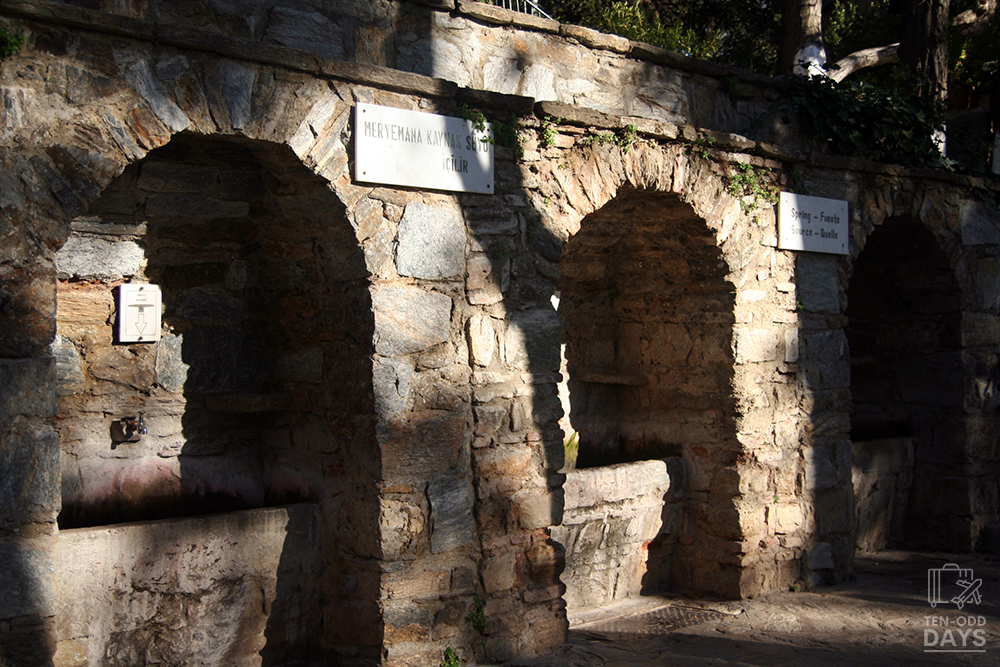
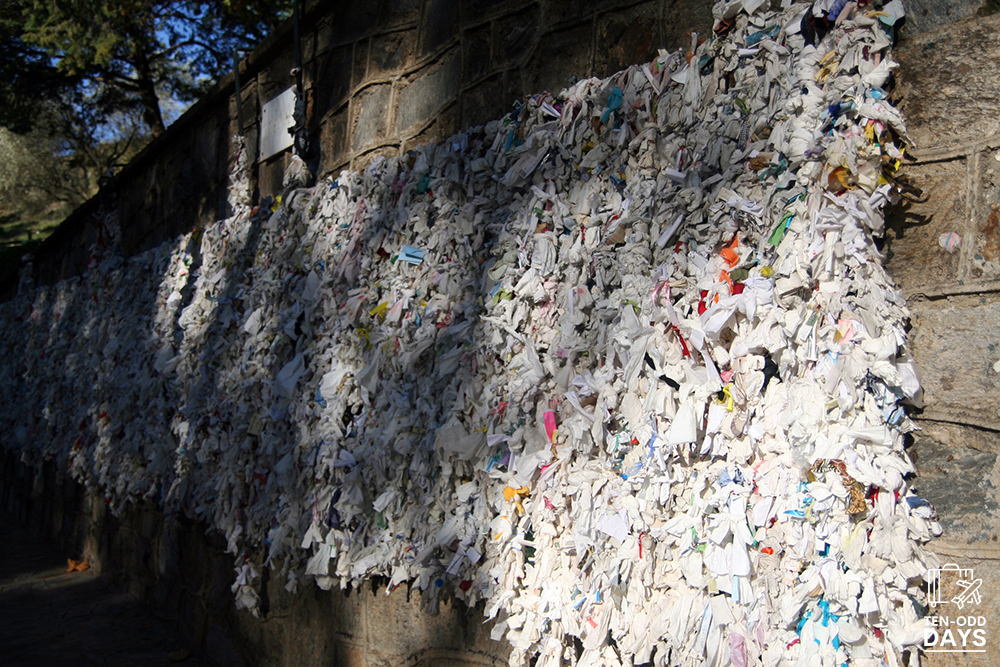
We explored the rest of the site, and came by the holy water taps and a wishing wall! There were three taps in total that released holy water. We didn’t know the difference between the three taps and randomly chose one like everyone else did. Water was cool and provided some respite from the afternoon sun, although in general the whole site was shady from the carefully pruned greenery that surrounded us.
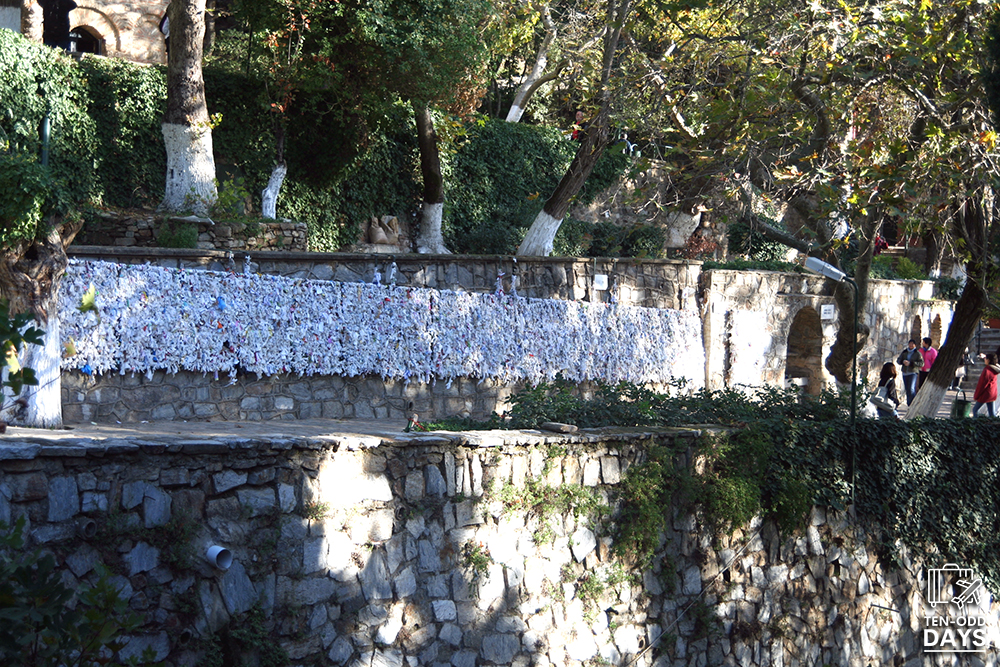
The wishing wall though, was impressive and a rather curious sight to us! We’d come across bridges and walls filled with love locks, or in Japan, Shinto shrines with trees tied with paper ‘bad fortune lots’. But this, a wall filled with personal possessions of wishes, was a first.
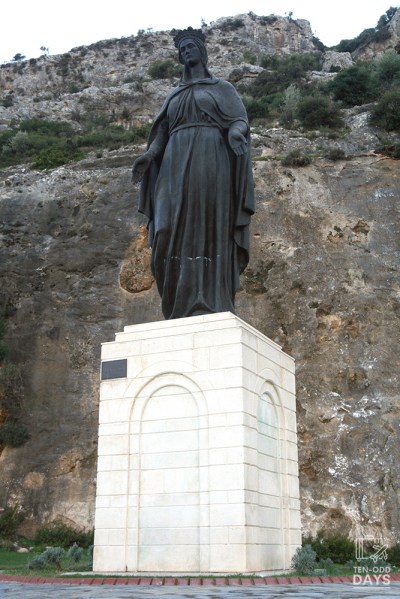
On our way back to our accommodation, we passed by this bronze statue of Mother Mary. To us, it really seemed like it was erected by the roadside, in the middle of nowhere. Yet I believe its location was not a coincidence, given its proximity to the House. We alighted from our coach, crossed the road to take some pictures of the statue of Madonna and Ephesus in the distance before embarking again, calling it a day.
In comparison to the tranquility we experienced at the House of the Virgin Mary, Ephesus was bustling with activity when we visited the following morning, despite the drizzle. It came across as rather strange that the former was skipped despite its proximity to Ephesus. We were glad we took up an organised tour that didn’t opt to skip it.
Ephesus was an ancient port city, and at a time, was populated with close to a quarter million of people, coming in a close second to most populous Rome. Excavations revealed that there was already an ancient human settlement in the area since the Neolithic Age. It went through numerous changes over the centuries that reflected a long human history and cultural traditions, from Hellenistic to Roman Imperial and early Christian periods.
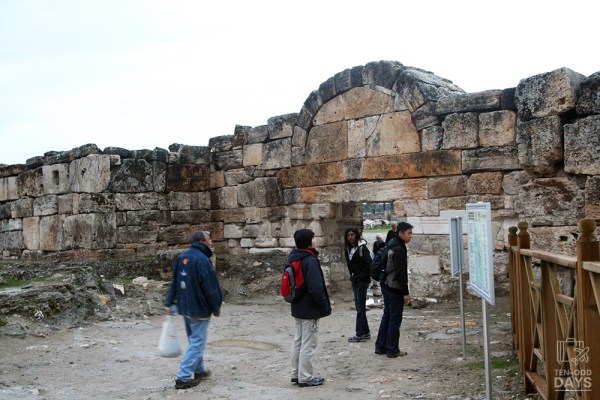
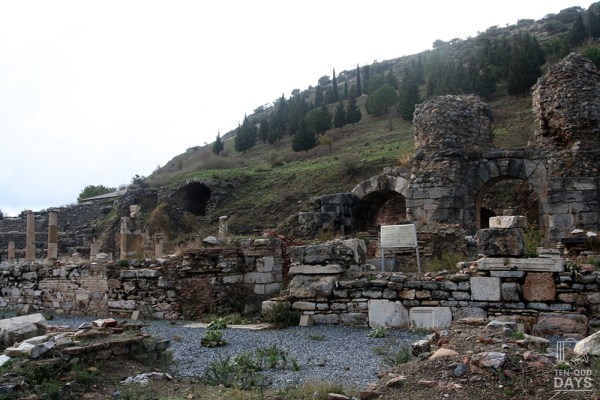
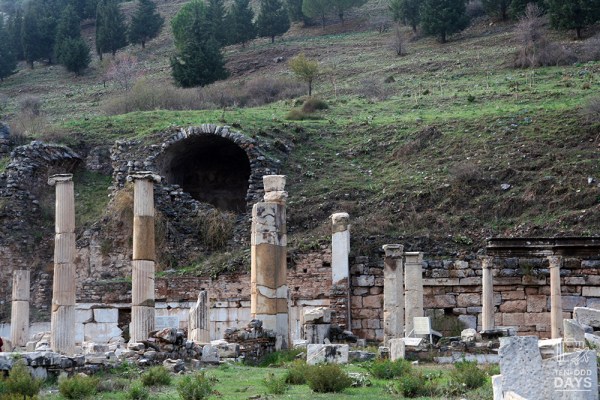
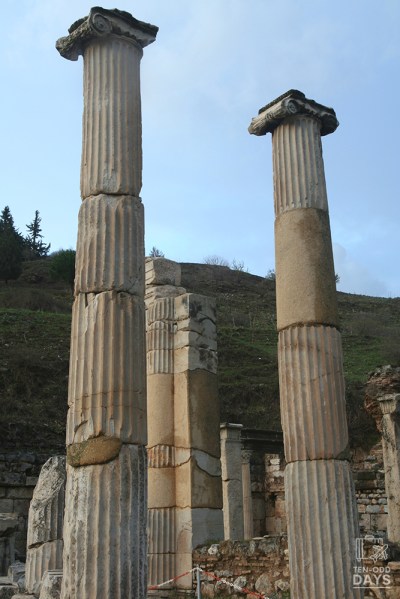
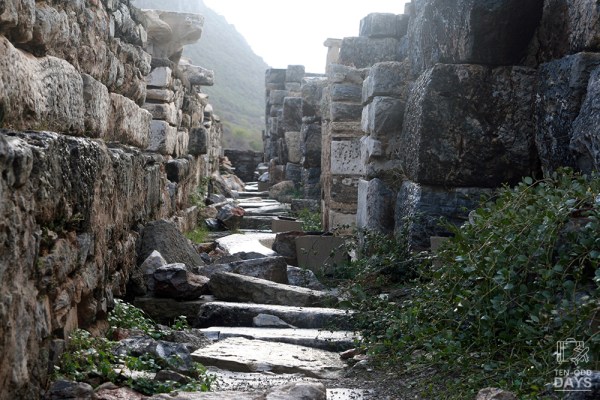
Piles and piles of rocks greeted us as we walked through the ancient archaeological site, and they would have been totally unintelligible to us if not for our local guide. To be honest, even with his explanation, we couldn’t quite visualise the past grandeur of this ancient site that was once deemed to be the most important Greek city.
The mister was impatiently waiting for me to be done with picture-taking. Incidentally this picture turned out to be one of the most iconic pictures I’ve taken on this trip.
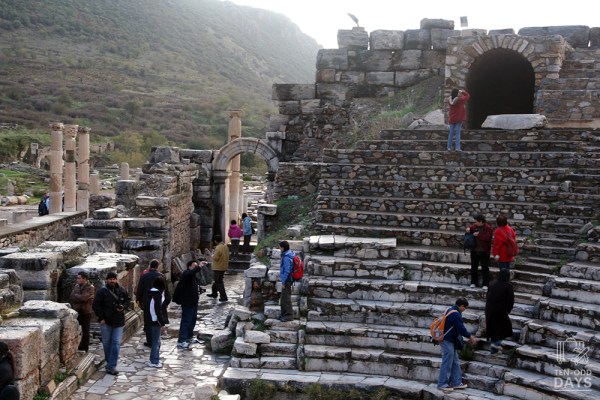
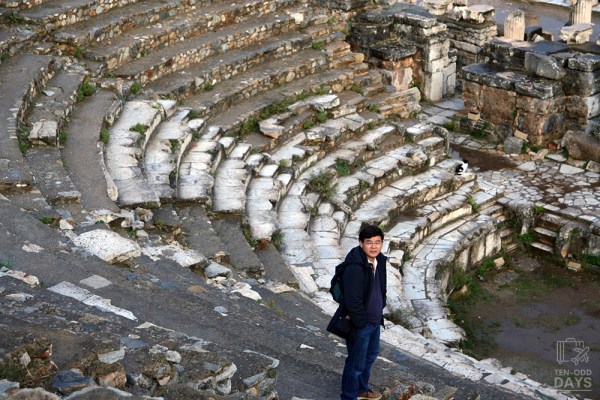
It was drizzling and we had to tread slowly over the slippery rocks, careful not to slip and fall. And finally, we came to a site that didn’t require too much of our imagination. All of us could tell that it was an amphitheatre of sorts, and true enough, that was the Odeon, a small theatre with a capacity of 1,500 spectators.
Back in 2007 when we visited (I’m really only writing this post in 2021, 14 years later), we were stepping all over the ancient theatre. It wasn’t disallowed. I wonder if things have changed now, in order to preserve the site. Degradation of archaeological sites due to natural causes through the course of time is a harsh reality all archaeologists fear and deal with on a daily basis. They really don’t need further destruction due to human negligence.
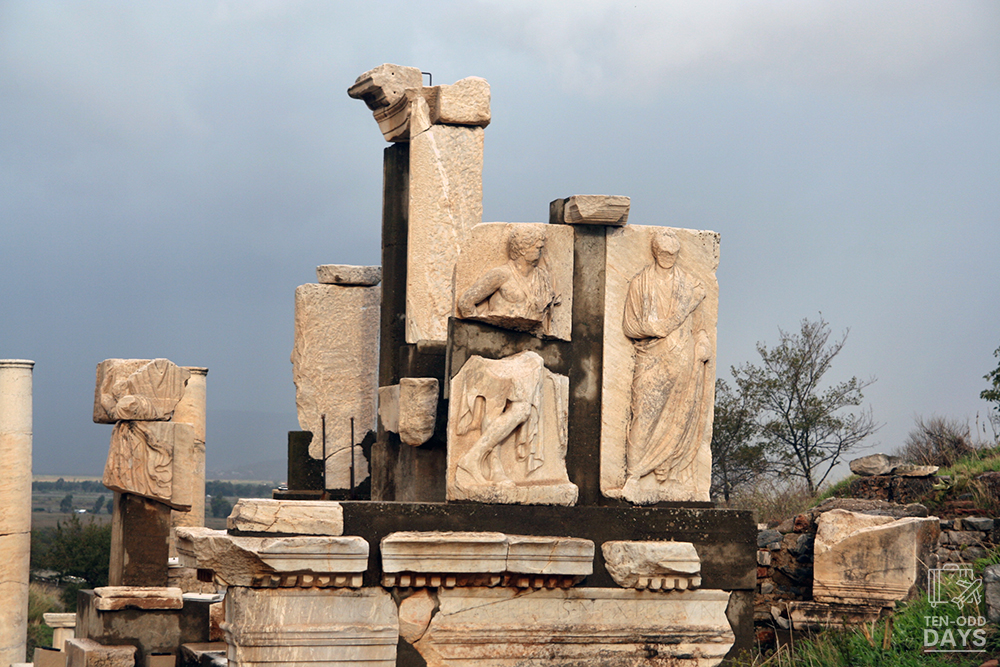
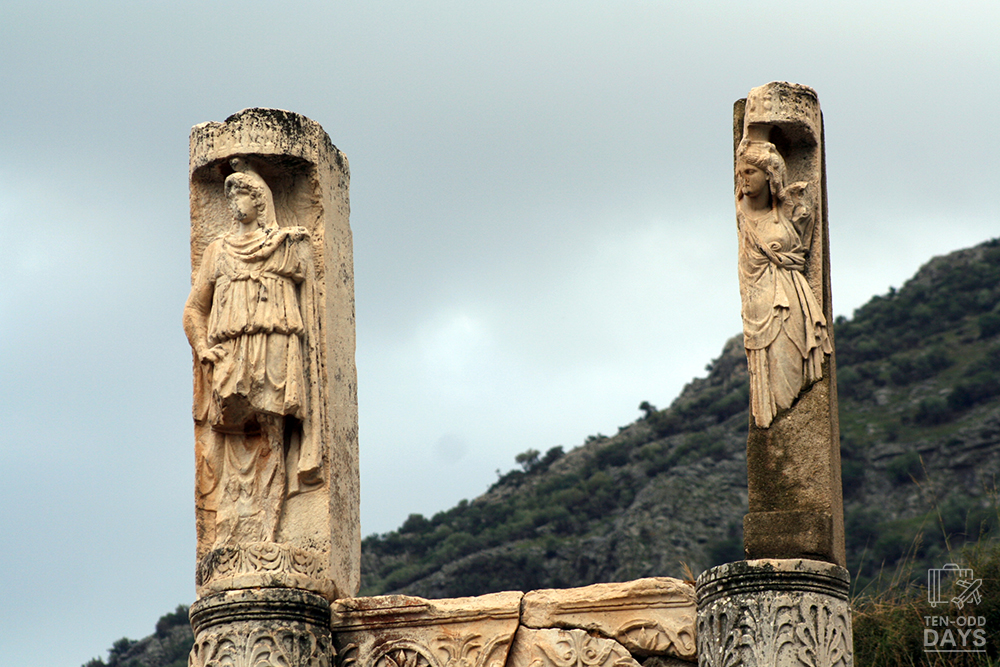
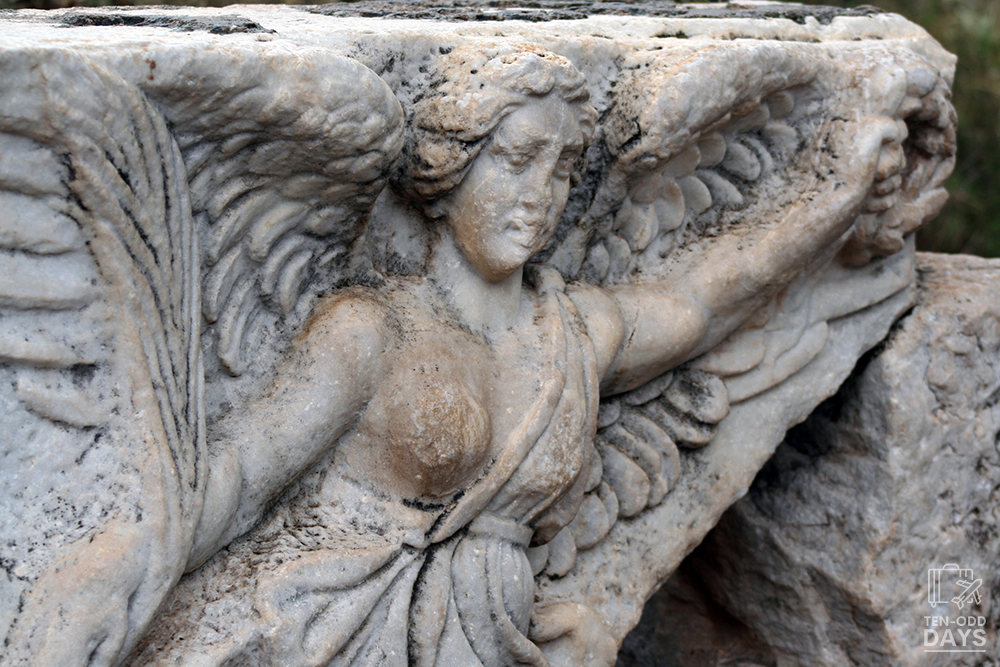
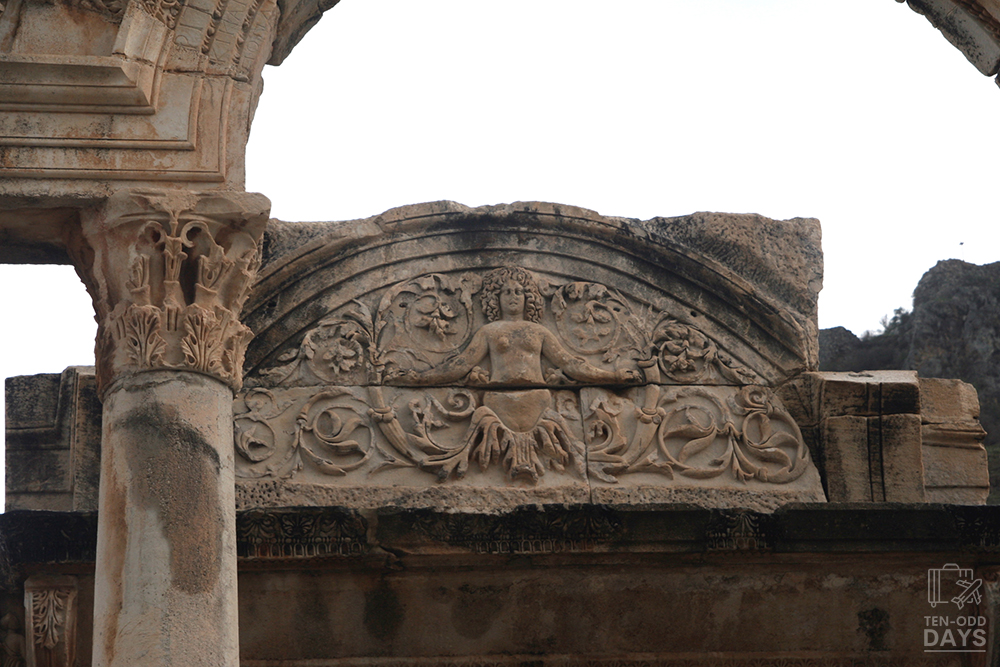
More ruins along the way as we meandered through the site. This round, more carvings and ornamental stones than random stones stacked on top of each other. In fact the white stone carving is one of the Greek goddess Nike who personified victory. Call me ignorant – I didn’t know there was a Greek goddess named Nike! 😮
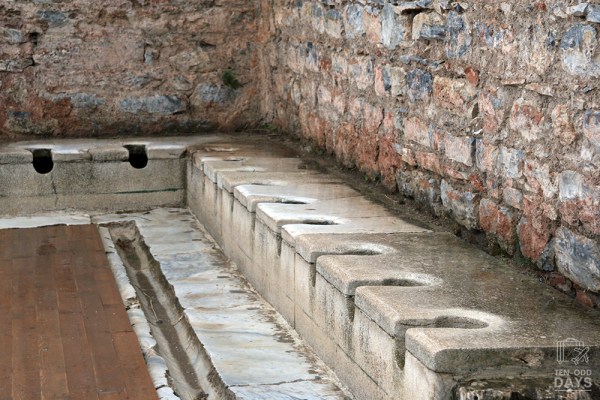
And if you think you know what this is, you are probably right. It was the public latrine and everyone recognised it at first glance. 😆 We discussed at length on whether we would use it. To be honest, I’m really not so sure… given a choice, I would rather go home.
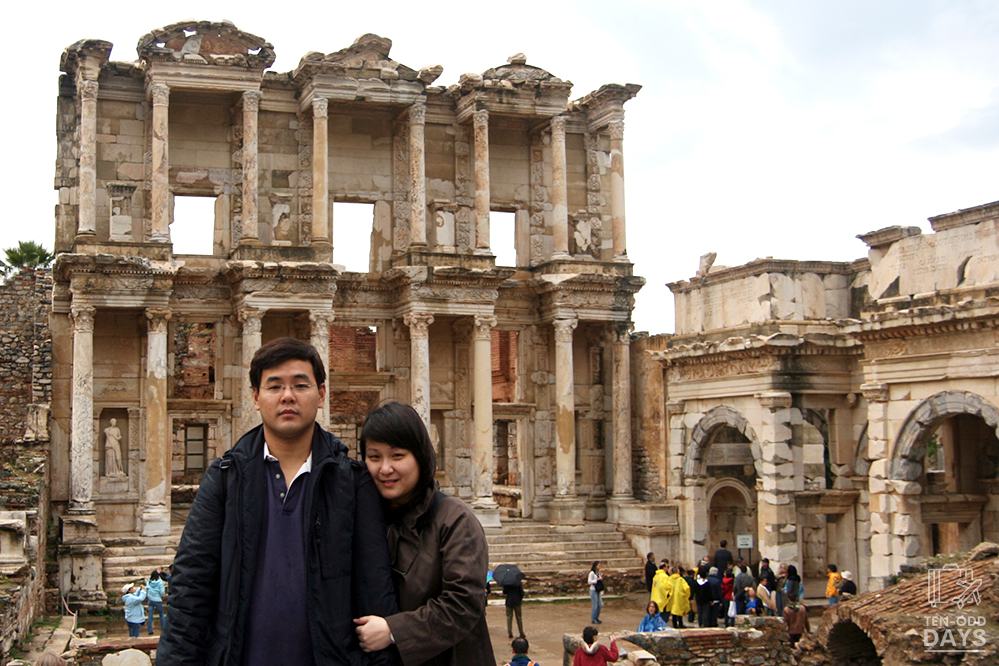
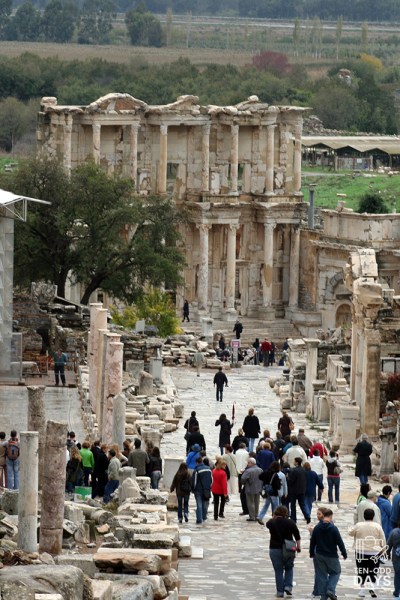
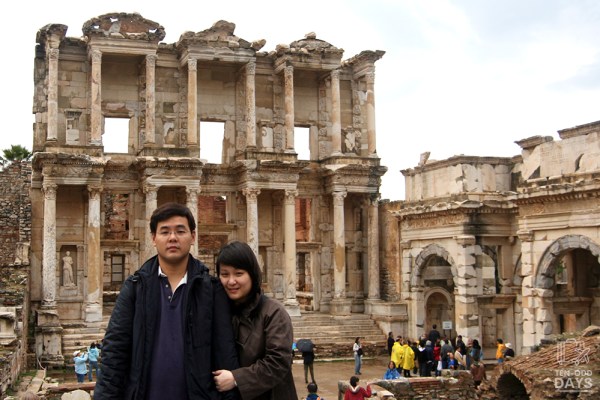
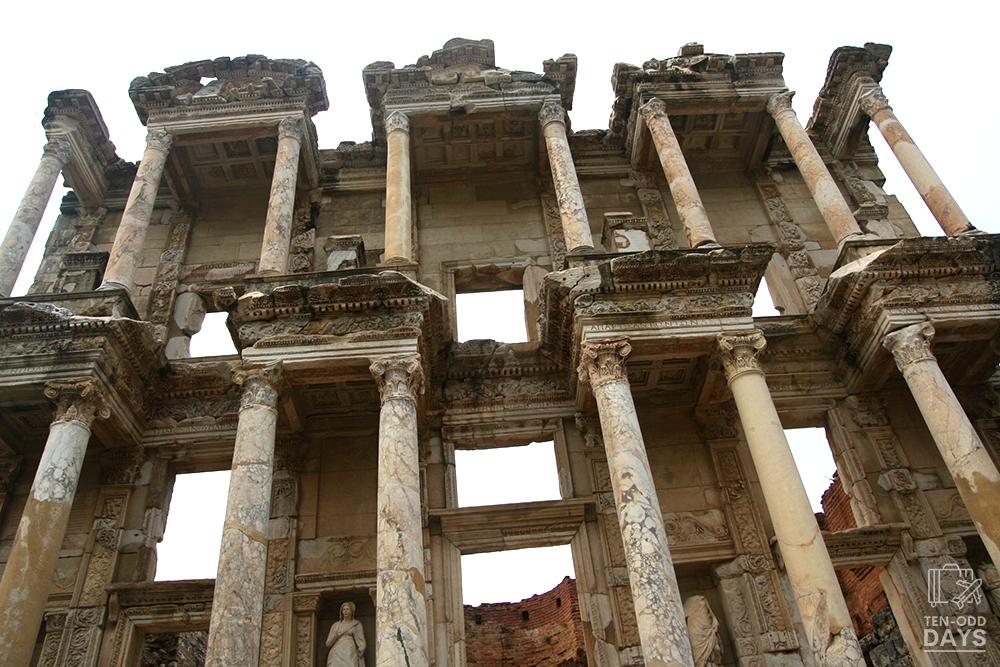
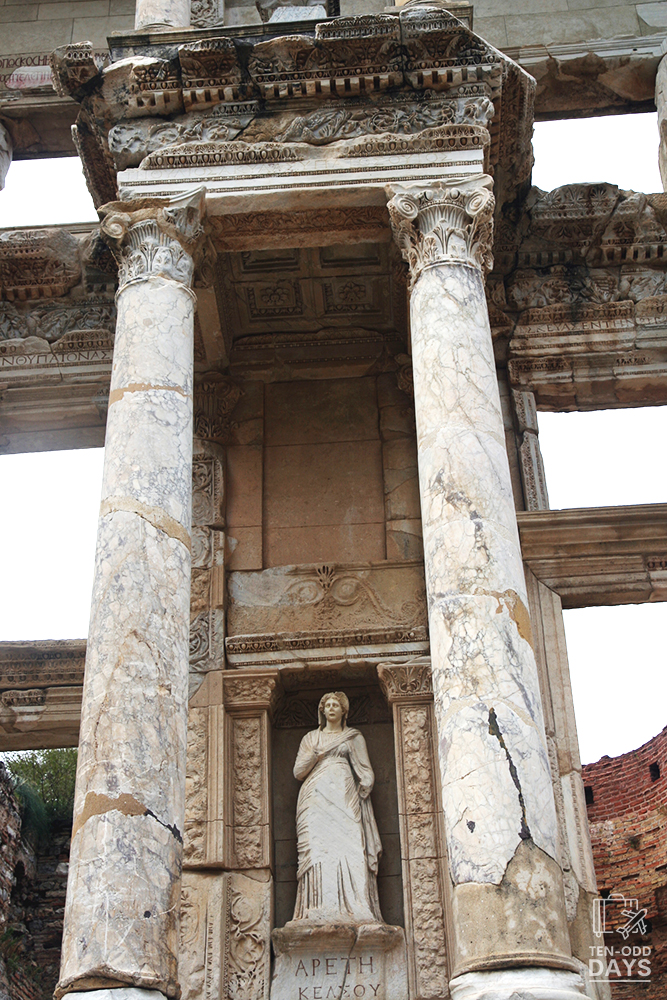
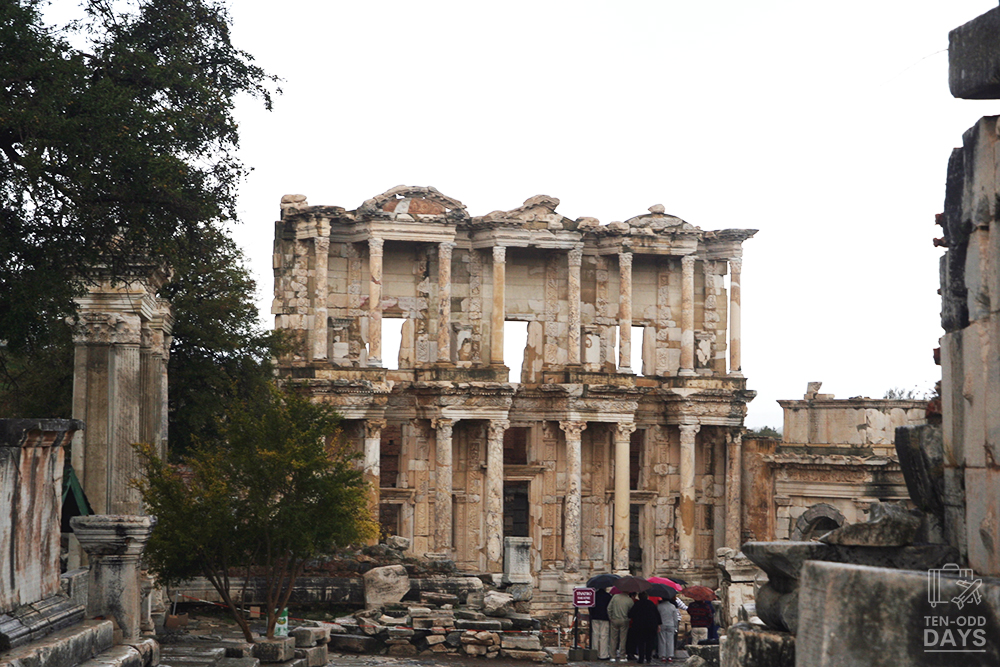
And at long last, we arrived at the Library of Celsus. This library was built at the behest of Gaius Julius Aquila, a consul in imperial Rome, in honour of his father. At its height, the library was believed to have contained a repository of as many as 12,000 scrolls and was said to be the third largest library in the Roman empire, behind Alexandria and Pergamum.
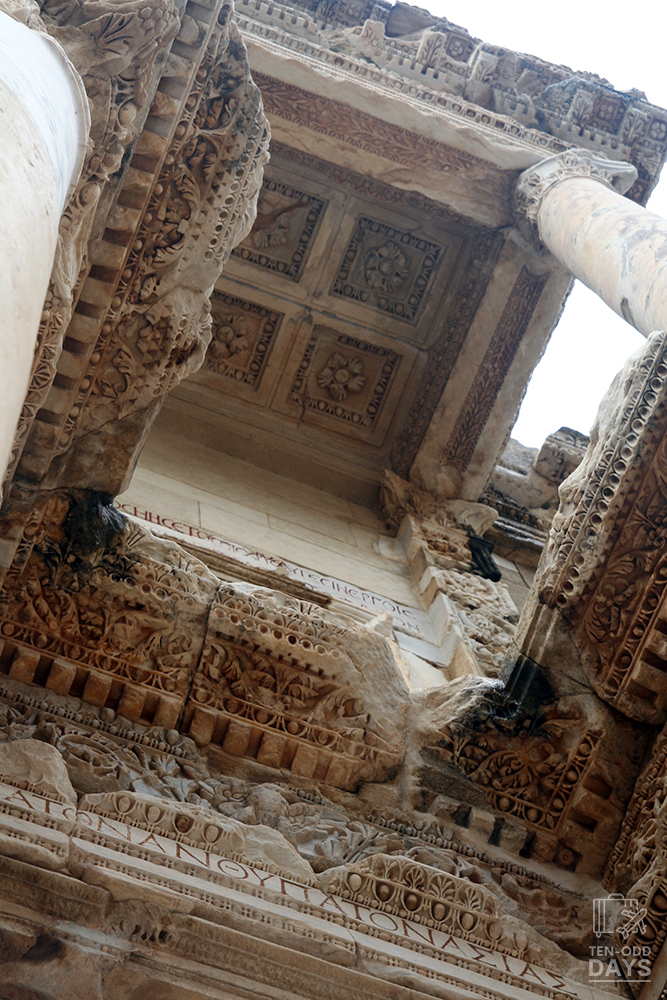
A fire or earthquake was believed to have destroyed the interior of the library and its contents in the 3rd century. The facade withstood the destruction, only to be destroyed during an earthquake a few centuries later. It laid in ruins quietly over the centuries until 1970 when a team led by a German archaeologist commenced a reconstruction campaign. Between 1970 and 1978, the facade of the ancient library was carefully reconstructed either from the pieces found at site or copies made from some pieces that were already acquired by museums. It was by and large a vastly successful reconstruction project, if you ask a layman like me.
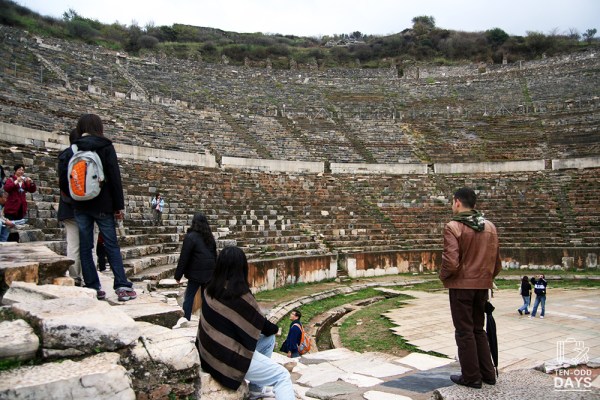
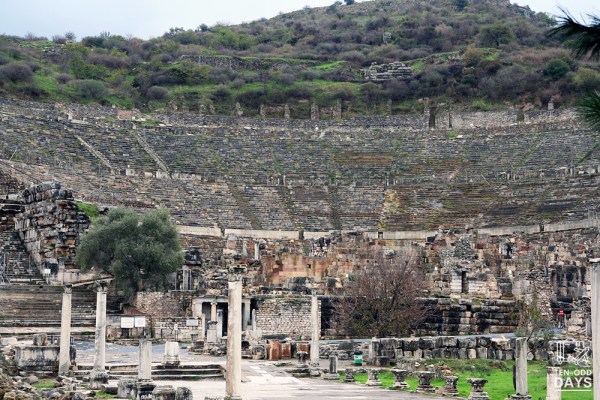
And the last monument we arrived at before leaving the archaeological site was the well-preserved Grand Theatre of Ephesus, first constructed during the Hellenistic period and later, to be modified several times during Roman times. When it was fully functional, this theatre could hold up to some 24,000 seated spectators. With the Grand Theatre as our end point, we had some time to explore the area. By then, crowd at the archaeological site had visibly thinned. We were quite possibly the last group of people to clear the site for the day.
Leaving you with a picture of how impressive the Grand Theatre looked from afar as we departed.
We spent the night away in a very large room. There were a total of 4 doubler-decker bunk beds for the both of us, and the huge space really unsettled me. I most likely didn’t sleep the whole night because it just felt… strange. The mister felt the same way but we both unilaterally but unanimously decided to keep it to ourselves until we left the hotel the next morning. Suffice it to say that we were both mighty glad when we got to leave the room for good.
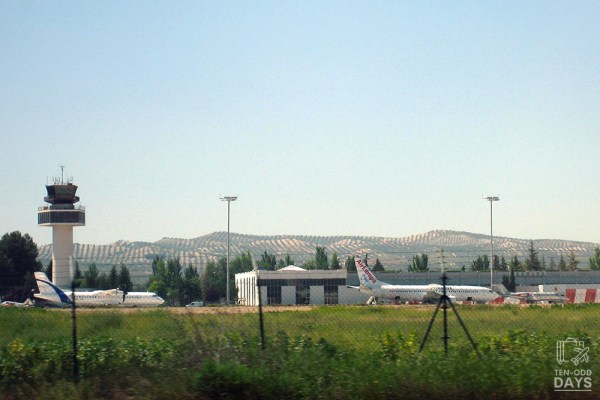
After breakfast, we were hanging around outside waiting to board the coach and that was when we were rather surprised to learn that hotel in the outskirts of Granada is located just across from where Granada National Airport is! Not very certain here, but I’m guessing that this airport serves only domestic flights and probably doesn’t operate at night since we were not bothered by landing or departing aircraft the night before.
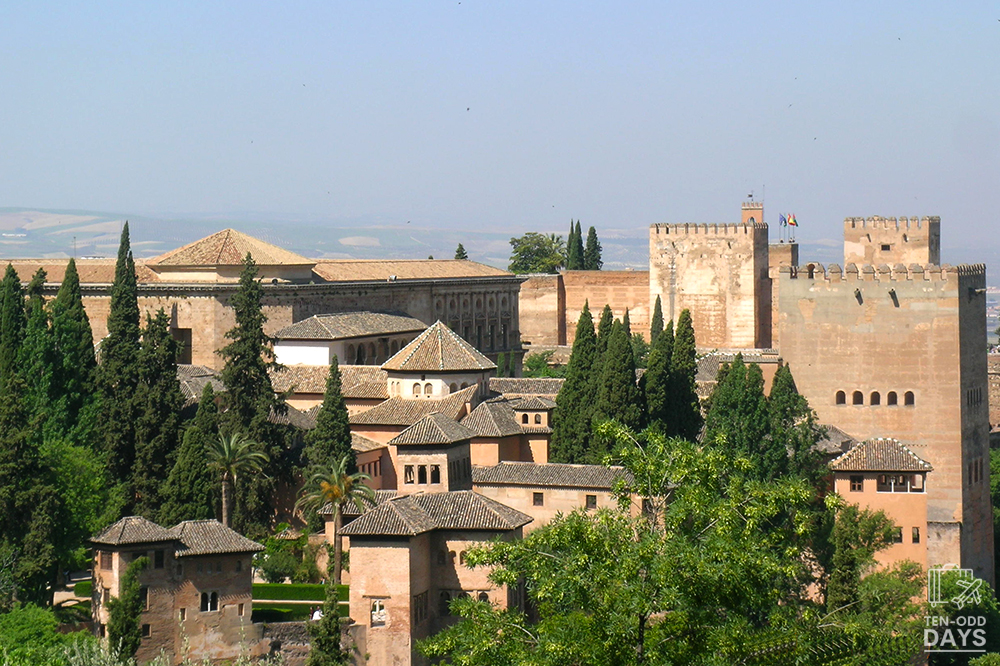
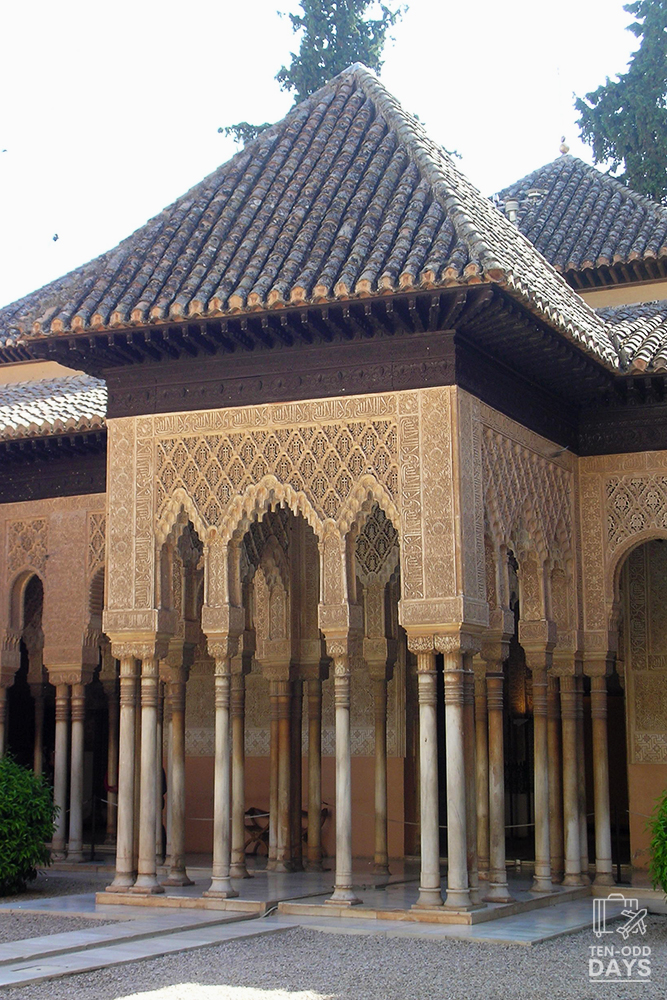
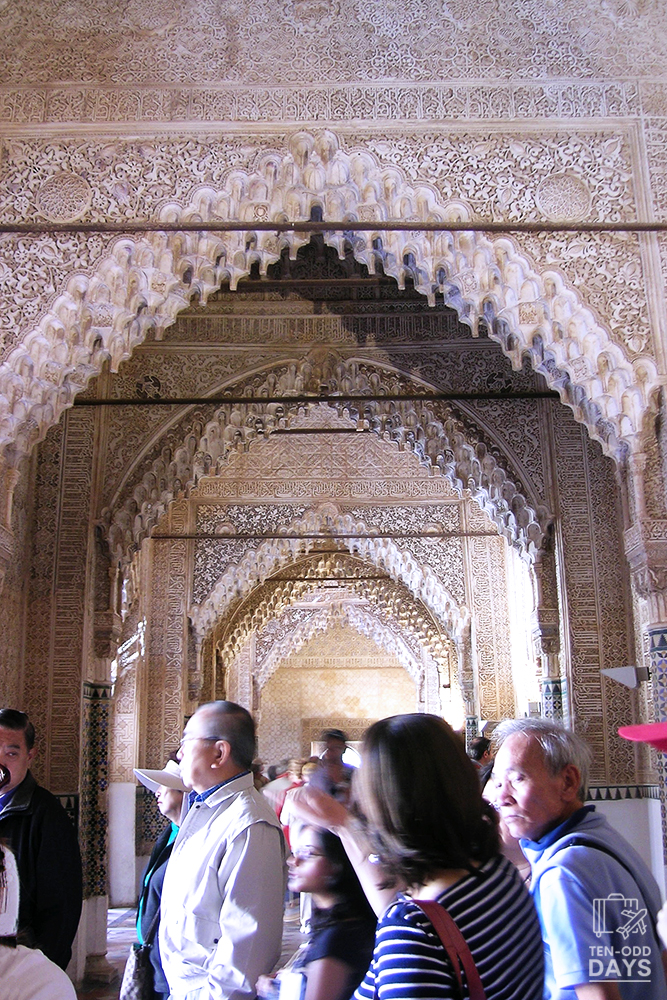
And the day has finally arrived! We are finally visiting La Alhambra, the location I consider to be my personal highlight of this trip. While this palace and fortress complex is perhaps not as well-known as Sagrada Familia the iconic landmark of Spain, it can most certainly hold its own with its colourful history, evident from being the second most visited tourist attraction of the country.
A cursory check on Alhambra’s official ticketing website gives one an idea of how massive the palace grounds are. Apart from the palace itself, there are massive gardens and museums for both day and evening admissions. And since queues for both ticket-buying and entering are equally long, an intended visit must be planned in advance. This is really something I want to put out there for everyone including ourselves (we do want to explore Andalusia on our own again, one day) to consider since it’s easy to think that this seemingly lesser known attraction will be less crowded.
Another bright and sunny day.
Yup. Crowded. I think it wasn’t that difficult to conclude. And this was just at the entrance. We were hoping that the crowd dispersed in the sparse palace grounds. We were fortunate that it really did.
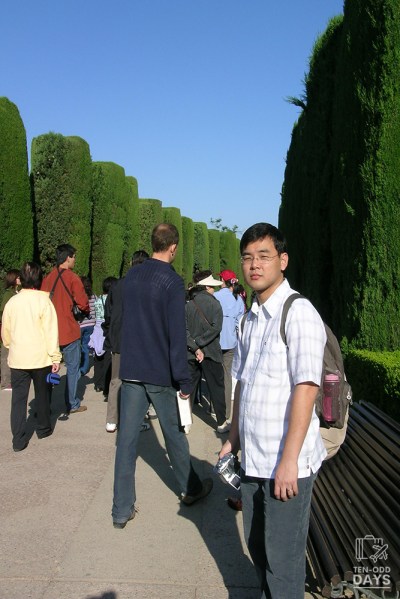
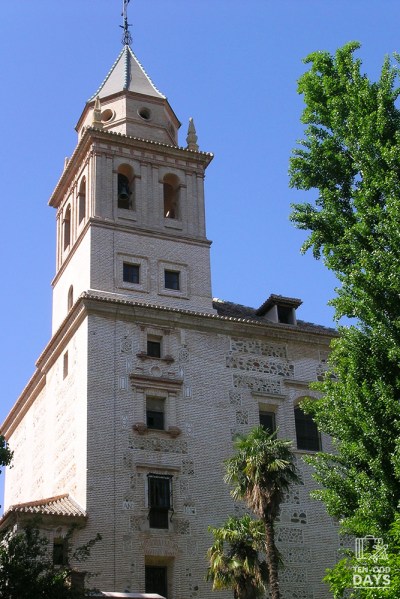
We walked quickly through the gardens to keep in pace with our guide through the grounds, to get to Charles V Palace. Came by beautiful buildings along the way but we were running on a schedule trying to beat the crowd so…
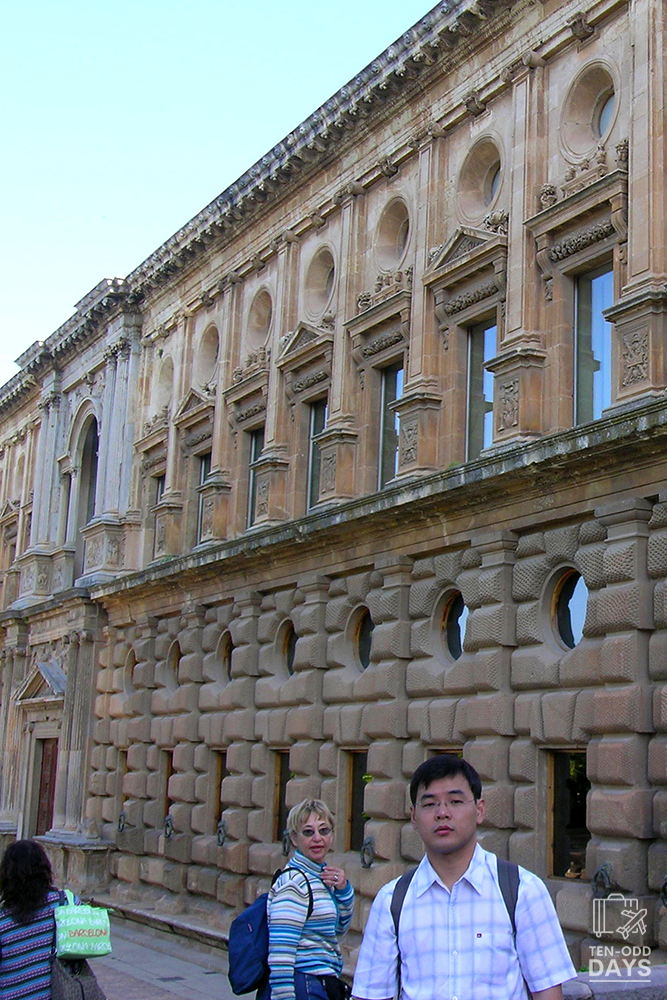
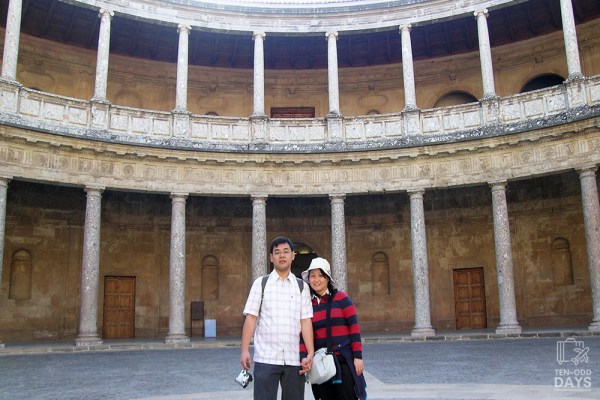
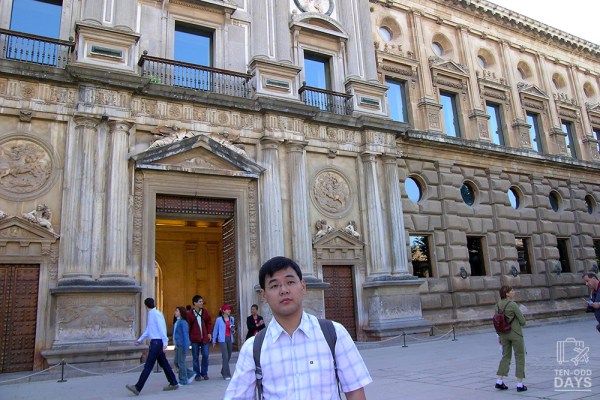
Charles V Palace (Spanish: Palacio de Carlos V), possibly one of the most unique structures within the compound of La Alhambra, was ordered to be constructed by Charles V, the Holy Roman Emperor from 1500-1558. While some of the rooms within the palace had been converted by Catholic Monarchs after the conquest of Granada in 1492, Charles V wished to have a permanent residence befitting his status to be built near the Alhambra palaces.
Taking a picture within Charles V Palace.
This building is of relative importance in Spain due to the Renaissance style although it met with multiple difficulties and construction was only completed in 1952, more than four centuries after works commenced in 1527. Standing within the unique circular two-storey patio almost made me feel like I was in a bullring. Totally unrelated to the structure itself but considering that I was in Spain after all, I didn’t feel too bad about this gross misunderstanding.
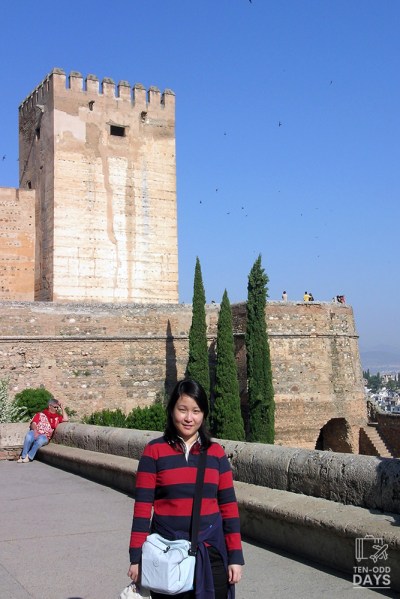
From Charles V Palace, we proceeded to the fortress of Alcazaba, one of the oldest part of Alhambra. Built in the 13th century, the Alcazaba had had a colourful history: when the palaces were completed, the Moors used this fortress for military purposes. Later on when the Christians took over, they transformed it into the state prison. Like many other parts of Alhambra, it was neglected, fell into disrepair and was forgotten until the late 19th century when restorative works commenced.
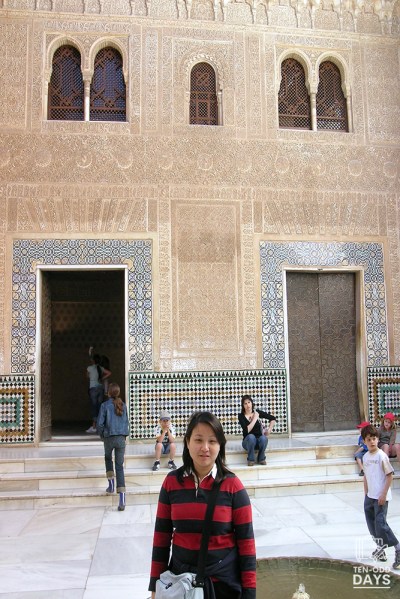
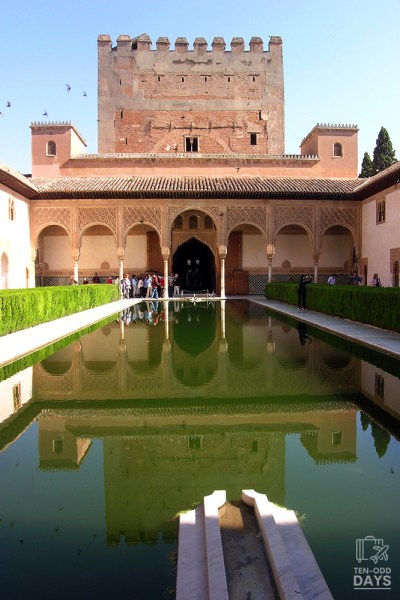
Patio of the Gilded Room, between the Mexuar and the Gilded Room, became a meeting place for everyone.Court of the Myrtles.A closer view.
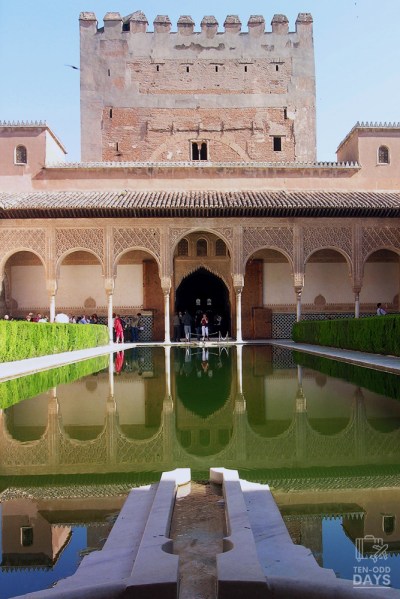
Throughout history, Court of the Myrtles (Spanish: Patio de los Arrayanes) was given various names but the current name came about because of the myrtle bushes surrounding the central pool. At 31 metres long and slightly over 7 metres wide, this pond has somewhat become an iconic spot whereby every visitor to Alhambra tries to photograph (the queue to get into the vantage spot was long). It’s easy to see why – the green pool acted as a mirror, reflecting the surrounding buildings and structures.
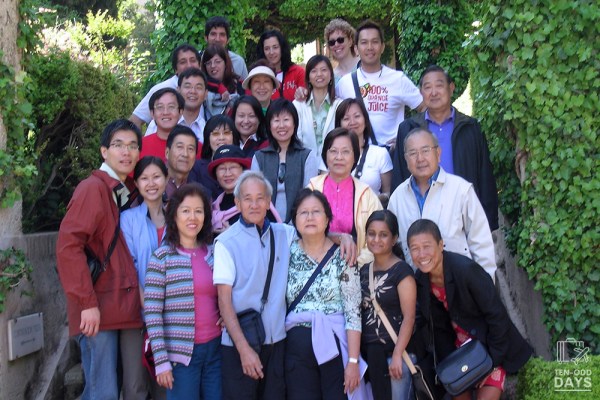
A precious group photo of the group of people we travelled with.Generalife, the most beautiful part of the grounds, in my opinion.
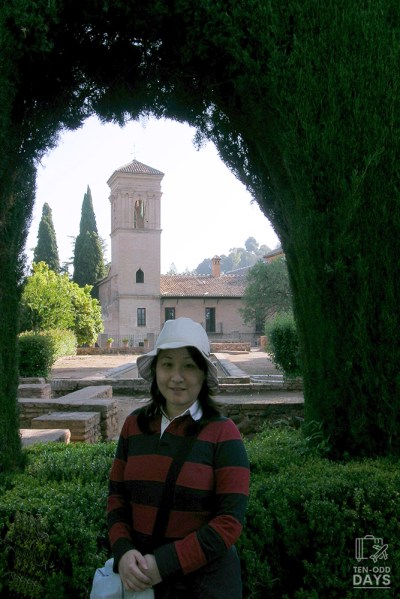
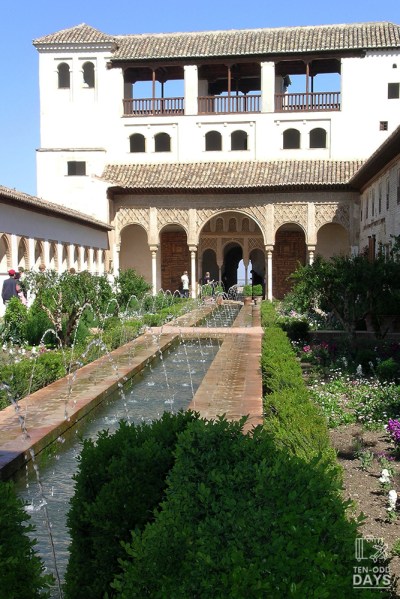
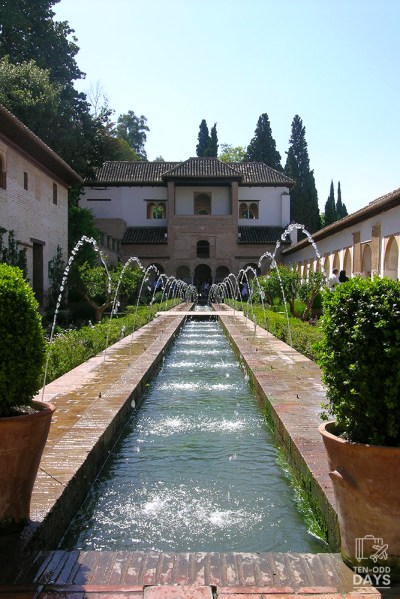
You could say that our guide saved the best for last. The Generalife (Spanish: Palacio de Generalife) we see today is nothing like what it looked like before, since it was altered and rebuilt multiples times throughout history since the 13th century. Composed of several beautiful, large gardens, the quarters became a retreat for Kings of Granada who wanted to get away from the mundane-ness of their duties. In contrast to the more opulent architecture of other buildings in the area, buildings of Generalife are plain and simple. Here, the floral and water take centrestage.
While walking in Generalife, I get it why this place was chosen as the place to get away from it all. With the greenery and sounds of water trickling, I felt calm and at peace despite the heat. Kinda makes me wonder how this place looks like at night. From pictures online, La Alhambra is breathtaking at night.


 Wayfaring: Still